ULI103U Introduction to International Relations 2018-2019 Yaz Okulu Soruları
20 soru · Yaz okulu · 2018-2019
ULI103U Introduction to International Relations dersinin 2018-2019 yaz okulu sınavı 20 sorudan oluşur; ders AÖF Siyaset Bilimi ve Kamu Yönetimi (İngilizce) bölümünde okutulur. Sorular aşağıda sırasıyla yer alır. Doğru cevaplar ve sonucun, testi çözdüğünde görünür.
Önizleme · 20 soru. Cevaplamak ve sonucunu görmek için sınavı başlat.
Sorular
20 soru
Soru 1
Soru 2
Soru 3
Soru 4
Soru 5
Soru 6
Soru 7
Soru 8
Soru 9
Soru 10
Soru 11
Soru 12
Soru 13
Soru 14
Soru 15
Soru 16
Soru 17
Soru 18
Soru 19
Soru 20
Sınav modunda süre tutulur, doğru cevaplar ve sonucun sınav bitince görünür.
Dersin üniteleri
Ünite özetleri ve konu anlatımları
- 1. Ünite: The Study Of International Relations
- 2. Ünite: The Historical Evolution Of The International System
- 3. Ünite: Theories Of International Relations
- 4. Ünite: International Security
- 5. Ünite: International Law
- 6. Ünite: International Organizations
- 7. Ünite: Global Political Economy
- 8. Ünite: Globalization And Global Society
ULI103U Introduction to International Relations ders sayfası: bütün sınavlar ve üniteler
Soruların metni (otomatik okuma)
Görsellerden otomatik okunmuştur; hata içerebilir. Sorular, görsellerdeki hâliyle geçerlidir.
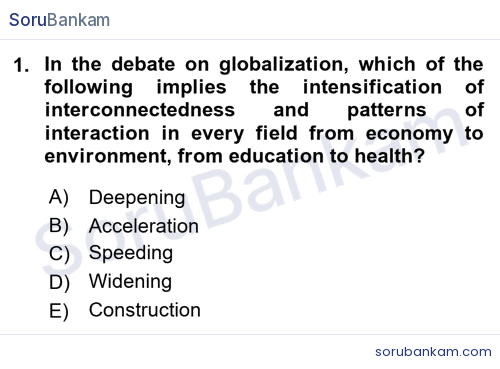
In the debate on globalization, which of the following implies the intensification of interconnectedness and patterns interaction in every field from economy to environment, from education to health? A) Deepening B) Acceleration C) Speeding D) Widening E) Construction
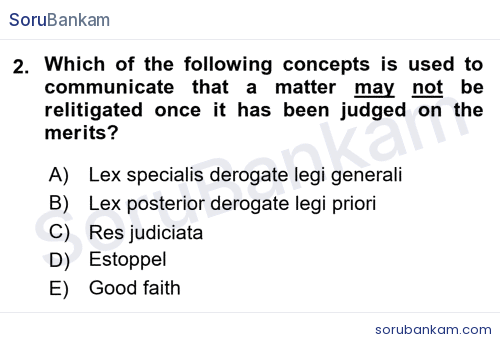
Which of the following concepts is used to communicate that a matter may not be relitigated once it has been judged on the merits? A) Lex specialis derogate legi generali B) Lex posterior derogate legi priori C) Res judiciata D) Estoppel E) Good faith
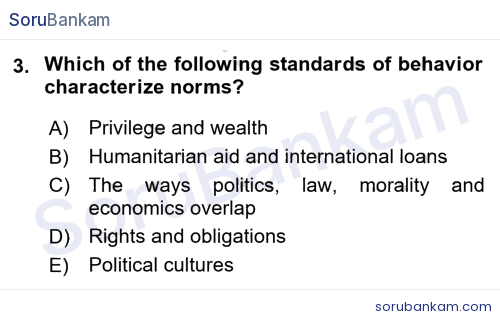
Which of the following standards of behavior. characterize norms? A) Privilege and wealth B) Humanitarian aid and international loans C) The ways politics, law, morality -and economics overlap D) Rights and obligations E) Political cultures
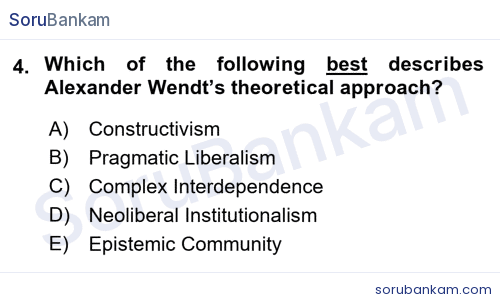
Which of the following best describes Alexander Wendt's theoretical approach? A) Constructivism B) Pragmatic Liberalism C) Complex Interdependence D) Neoliberal Institutionalism E) Epistemic Community
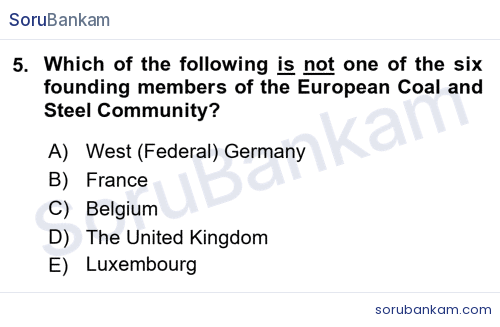
Which of the following is not one of the six founding members of the European Coal and Steel Community? A) West (Federal) Germany B) France C) Belgium D) The United Kingdom E) Luxembourg
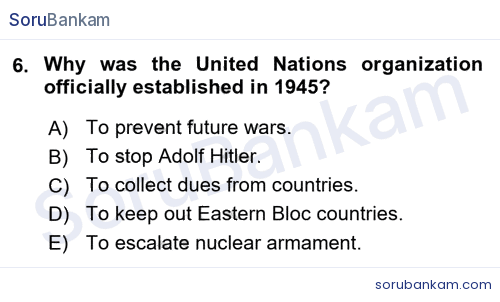
Why was the United Nations organization officially established in 1945? A) To prevent future wars'• B) Te'stop Adolf Hitlerd C) To collect dues from countries. D) To keep out Eastern Bloc countries. E) To escalate nuclear armament.
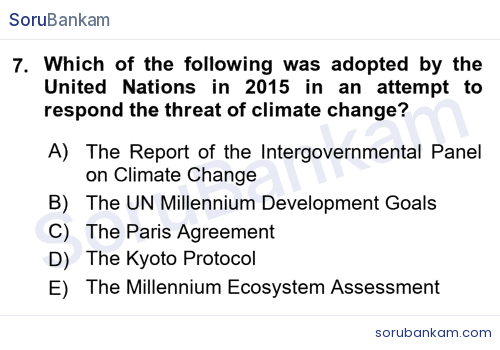
Which of the following was adopted by the United Natlons in 2015 in an attempt to respond the threat of climate change? A) The: Report of the Intergovernmental Panel A on Climate Change B) The UN Millennium Development Goals C) The Paris Agreement D) The Kyoto Protocol E) The Millennium Ecosystem Assessment
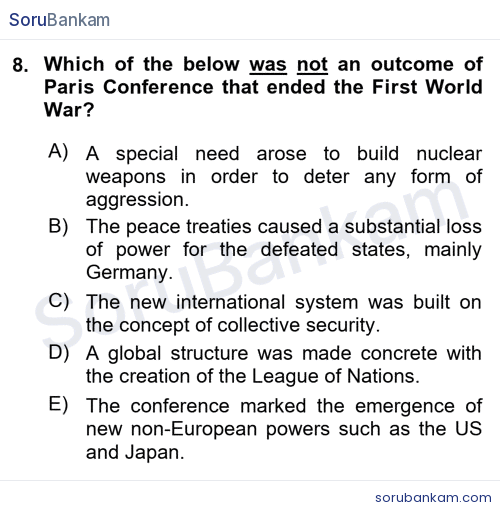
Which of the below was not an outcome of Paris Conference that ended the First World War? A) A special need arose to build nuclear weapons in order to deter any form of aggression. B) The peace treaties caused a substantial loss of power for the defeated states, mainly Germany. C) The new international system was built on the concept of collective security. D) A global structure was made concrete with the creation of the League of Nations. E) The conference marked the emergence of new non-European powers such as the US and Japan.
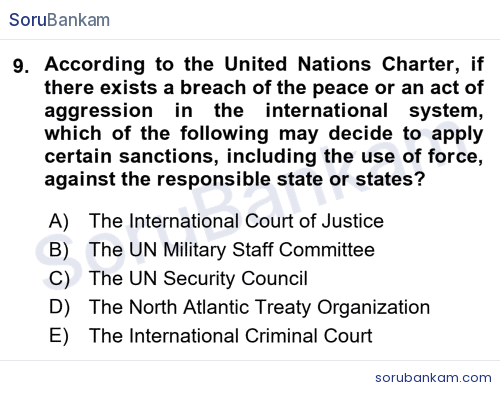
According to the United Nations Charter, if there exists a breach of the peace or an act of aggression in the international system, which of the following may decide to apply certain sanctions, including the use of force, against the responsible state or states? A) The International Court of Justice B) The UN Military Staff Committee C) The UN Security Council D) The North Atlantic Treaty Organization E) The International Criminal Court
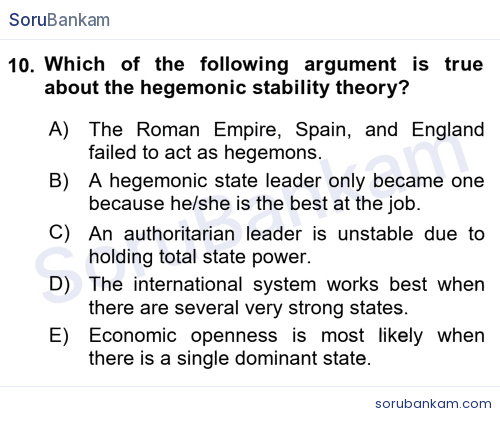
Which of the following argument is true about the hegemonic stabllity theory? A) The Roman Empire, Spain, and England failed to act as hegemons. B) A hegemonic state leader only became one because he/she is the best at the job. C) An authoritarlan leader is unstable due to holding total state power. D) The international system works best wan there are several very strong states E) Economic openness is most. tikely when there is a single dominant state.
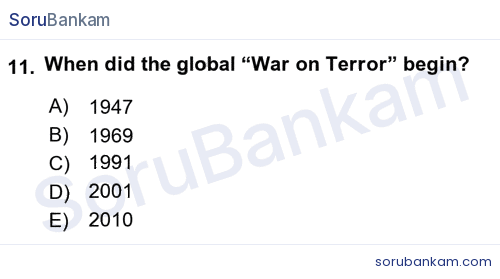
11. When did the global "War on Terror" begin? 1947 1969 € C) $991 D) 2001 E) 2010
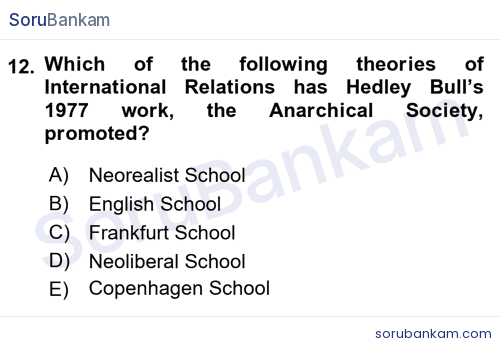
Which of the following theories International Relations has Hedley. Bull's 1977 work, the Anarchical Society, promoted? A) Neorealist School B) English School C) Frankfurt School D) Neoliberal School E) Copenhagen School
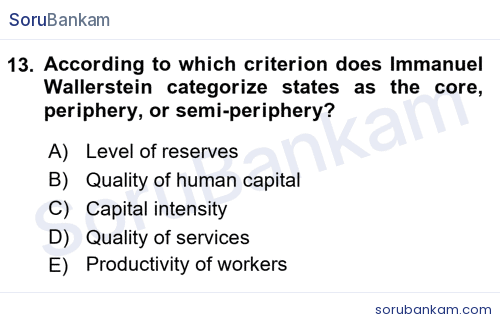
According to which criterion does Immanuel Wallerstein categorize states as the core, periphery, or semi-periphery? A) Level of reserves B) Quality of human capital C) Capital intensity D) Quality of services E) Productivity of workers
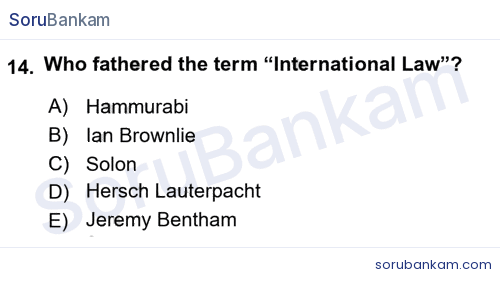
Who fathered the term "International Law"? A) . Hammurabi B) lan Brownlie C) "Solon D) Hersch Lauterpacht E) Jeremy Bentham
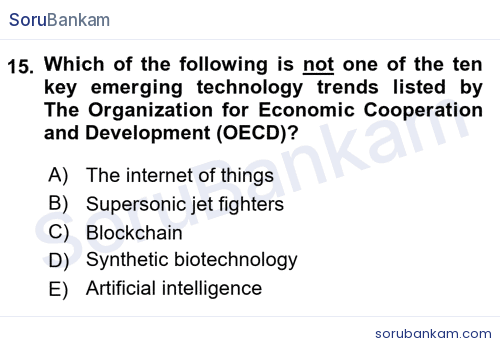
Which of the following is not one of the ten key emerging technology trends listed by The Organization for Economic Cooperation and Development (OECD)? A) The internet of things B) Supersonic jet fighters C) Blockchain D) Synthetic biotechnology E) Artificial intelligence
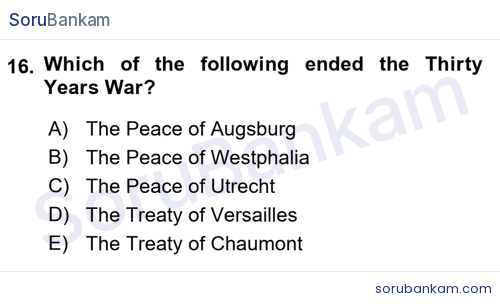
Which of the following ended the Thirty Years War? A) The Peace of Augsburg B) The Peace of Westphalia C) The Peace of Utrecht D) The Treaty of Versailles E) The Treaty of Chaumont
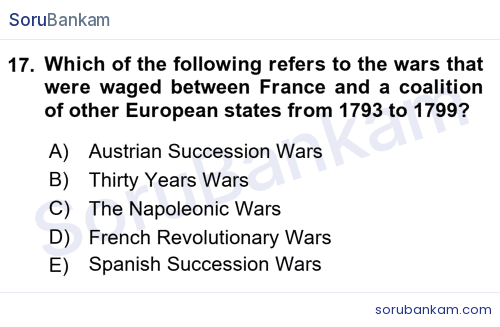
Which of the following refers to the wars that were waged between France and a coalition of other European states from 1793 to 1799? A) Austrian Succession Wars B) Thirty Years Wars C) The Napoleonic Wars D) French Revolutionary Wars E) Spanish Succession Wars
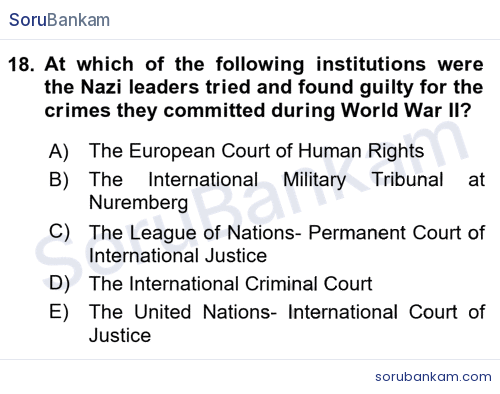
At which of the following institutions were,. the Nazi leaders tried and found guilty for the crimes they committed during World War I!? A) The European Court of Human Rights B) The International Military Tribunal • at Nuremberg C) The League of Nations- Peymanent Court of International Justice D) The International Criminal Court E) The United Nations: International @buit of Justice
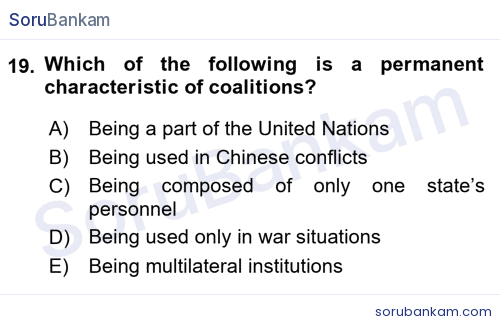
Which of the following is a permanent characteristic of coalitions? A) Being a part of the United Nations B) Being used in Chinese conflicts C) Being composed of only one state's personnel D) Being used only in war situations E) Being multilateral institutions
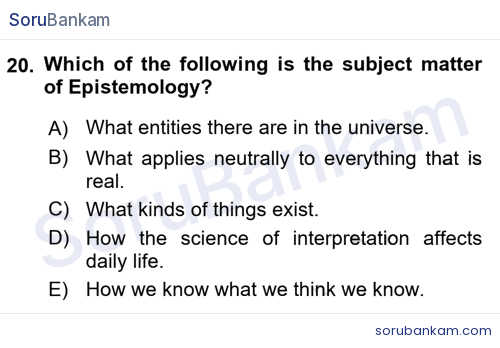
Which of the following is the subject matter of Epistemology? A) What entities there are in the universe. B) What applies neutrally to everything that is real. C) What kinds of things exist. D) How the science of interpretation: affects daily iffe. E) How we know what we think we know.