ULI103U Introduction to International Relations 2019-2020 Vize Soruları
20 soru · Vize · 2019-2020
ULI103U Introduction to International Relations dersinin 2019-2020 vize sınavı 20 sorudan oluşur; ders AÖF Siyaset Bilimi ve Kamu Yönetimi (İngilizce) bölümünde okutulur. Sorular aşağıda sırasıyla yer alır. Doğru cevaplar ve sonucun, testi çözdüğünde görünür.
Önizleme · 20 soru. Cevaplamak ve sonucunu görmek için sınavı başlat.
Sorular
20 soru
Soru 1
Soru 2
Soru 3
Soru 4
Soru 5
Soru 6
Soru 7
Soru 8
Soru 9
Soru 10
Soru 11
Soru 12
Soru 13
Soru 14
Soru 15
Soru 16
Soru 17
Soru 18
Soru 19
Soru 20
Sınav modunda süre tutulur, doğru cevaplar ve sonucun sınav bitince görünür.
Dersin üniteleri
Ünite özetleri ve konu anlatımları
- 1. Ünite: The Study Of International Relations
- 2. Ünite: The Historical Evolution Of The International System
- 3. Ünite: Theories Of International Relations
- 4. Ünite: International Security
- 5. Ünite: International Law
- 6. Ünite: International Organizations
- 7. Ünite: Global Political Economy
- 8. Ünite: Globalization And Global Society
ULI103U Introduction to International Relations ders sayfası: bütün sınavlar ve üniteler
Soruların metni (otomatik okuma)
Görsellerden otomatik okunmuştur; hata içerebilir. Sorular, görsellerdeki hâliyle geçerlidir.
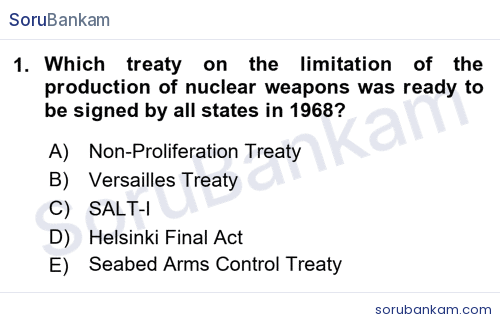
Which treaty on the limitation of the production of nuclear weapons was ready to be signed by all states in 1968? A) Non-Proliferation Treaty B) Versailles Treaty C) SALT-I D) Helsinki Final Act E) Seabed Arms Control Treaty
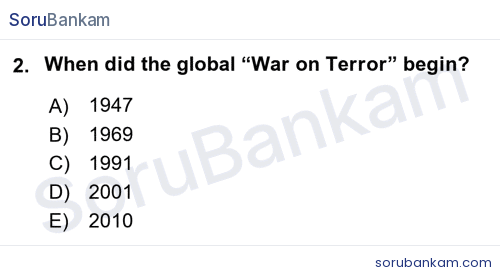
When did the global "War on Terror" begin? A) 1947 B) 1969 C) 1991 D) 2001 E) 2010
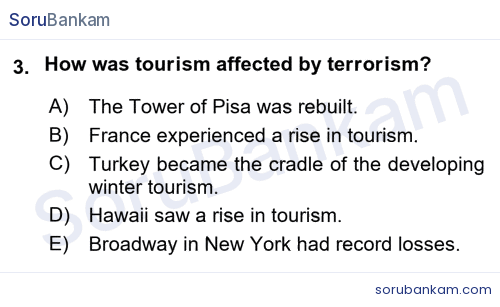
How was tourism affected by terrorism? .. " A) The Tower of Pisa was rebuilt. B) France experienced a ree in tourism. C) Turkey became the cradle of the developing winter tourism. D) Hawaii saw a rise in tourism. +* E) Broadway in New York.bad record losses.
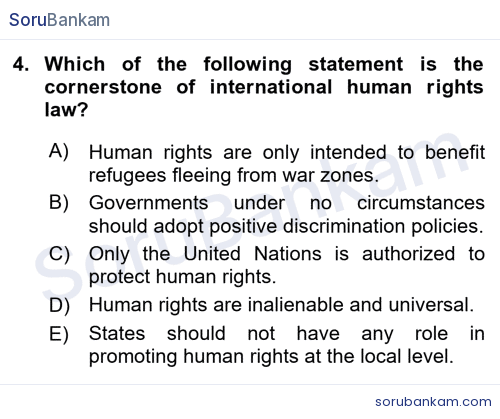
Which of the following statement is the cornerstone of international human rights law? A) Human rights are only intended to benefit refugees fleeing from war zones. B) Governments under no circumstances should adopt positive discrimination policies. C) Only the United Nations is authorized to protect human rights. D) Human rights are inalienable and universal. E) States should not have any role in promoting human rights at the local level.
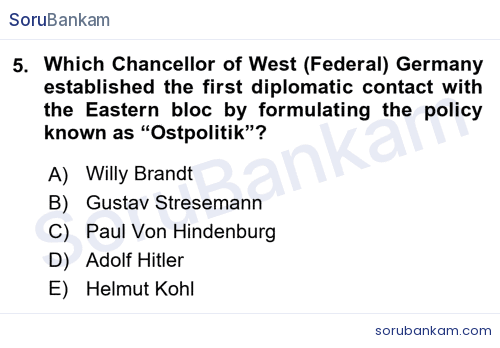
Which Chancellor of West (Federal) Germany established the first diplomatic contact with the Eastern bloc by formulating the policy known as "Ostpolitik"? A) Willy Brandt r. B) Gustav Stresemann »'1,l C) Paul Von Hindenburg D) Adolf Hitler E) Helmut Kohl
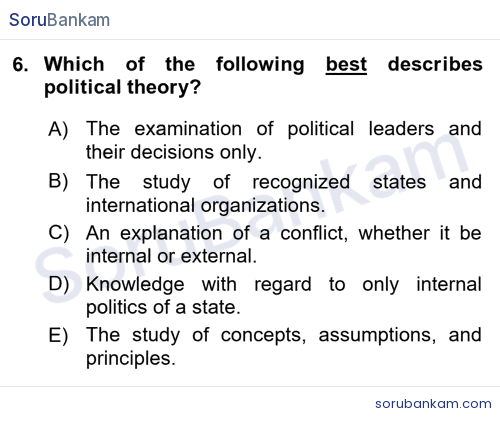
Which of the following best describes political theory? A) The exemination of political leaders and their decisions only. B) The study of recognized states and international organizations. C) An explanation of a conflict, whether it be internal or extemal. D) Kňowledge with regard to only internal politics of a state. E) The study of concepts, assumptions, and principles.
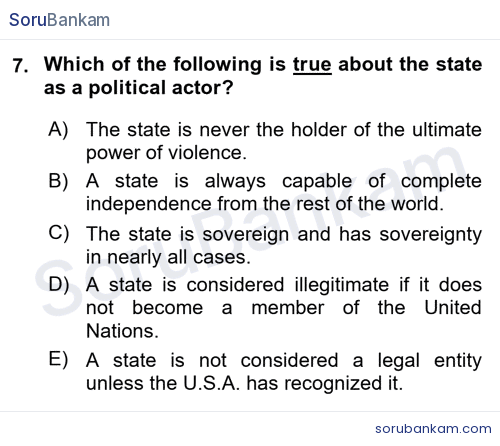
Which of the following is true about the state as a polltical actor? A) The state is never the holder of the ultimate power of violence. B) A state is always capable of complete independence from the rest of the world. C) The state is sovereign and has sovereignty in nearly all cases. D) A state is considered illegitimate if it does not become a member of the United Nations. E) A state is not considered a legal entity unless the U.S.A. has recognized it.
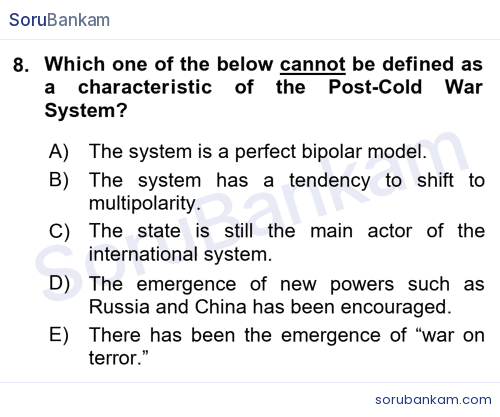
Which one of the below cannot be defined as a characteristic of the Post-Cold War System? A) The system is a perfect bipolar model. B) The system has a tendency to shift to multipolarity. C) The state is still the main actor of the international system. D) The emergence of new powers such as Russia and China has been encouraged. E) There has been the emergence of "war on terror."
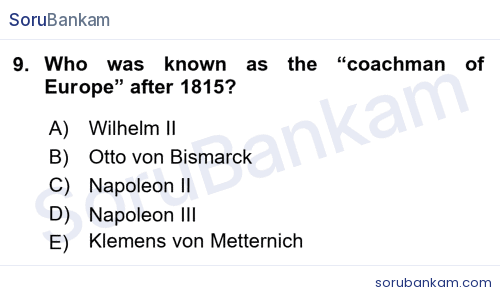
Who was known the "coachman of Europe" after 1815? A) Wilhelm B) Otto von Bismarck: C) Napoleon I/ D) Napoleon III E) Klemens von Metternich
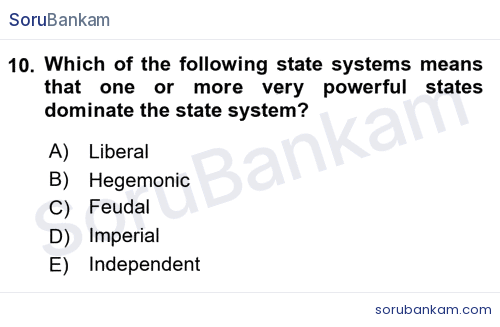
Which of the following state systems means that one or more very powerful states dominate the staid system? 3. A) Liberal B) Hegemonic C) Feudal D) Imperial E) Independent
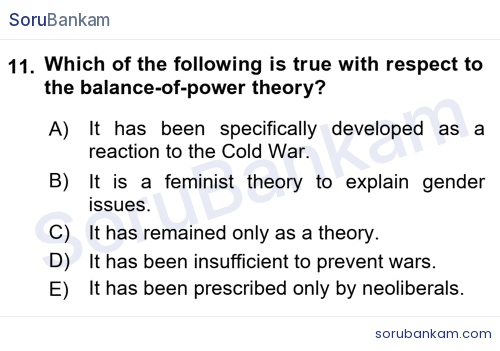
Which of the following is true with respect to the balance-of-power theory? A) It has been specifically developed as a reaction to the Cold War. B) It is a feminist theory to explain gender issues. C) It has remained only as a theory. D) It has been insufficient to prevent wars. E) It has been prescribed only by neoliberals.
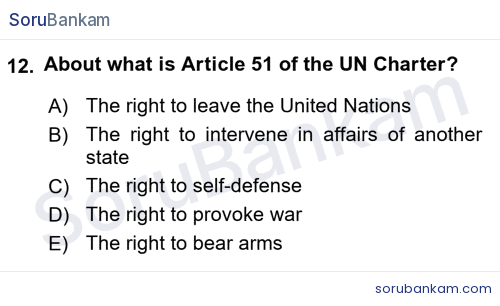
About what is Article 51 of the UN Charter? A) The right to leave the United Nations B) The right to intervene in affairs of another state C) The right to self-defense 1. D) The right to provoke war 153. E) The right to bear arms
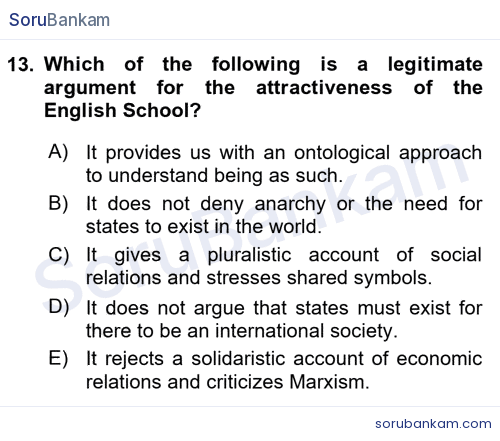
Which of the following is a legitimate argument for the attractiveness of the English Schogl?^ A) It provides us with an ontological approach to understand being as such. B) It does not deny anarchy or the need for states to exișt in the world. C) It gives " a pluralistic account of social relations and stresses shared symbois. D) It does not argue that states must exist for there to be an international society. E) It rejects a solidaristic account of economic relations and criticizes Marxism.
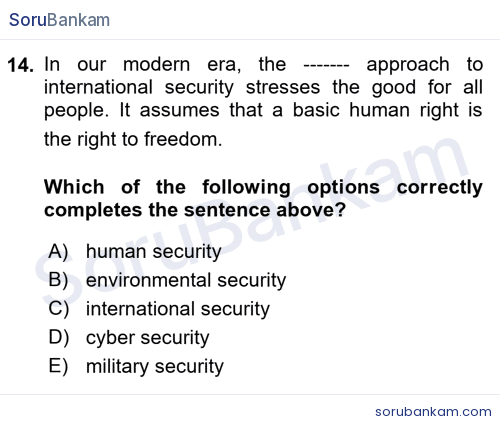
In our moder era, the - approach to international security stresses the good for all people. It assumes that a basic human right is the right to freedom. Which of the following options correctly completes the sentence above? A) human security B) environmental security C) international security D) cyber security E) military security
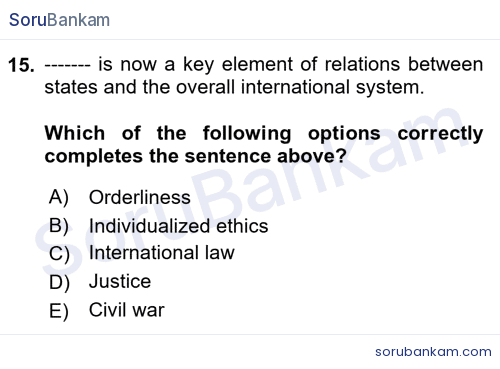
- is now a key element of relations between states and the overall international system. Which of the following options correctly completes the sentence above? A) Orderliness B) Individualized ethics C) International law D) Justice E) Civil war
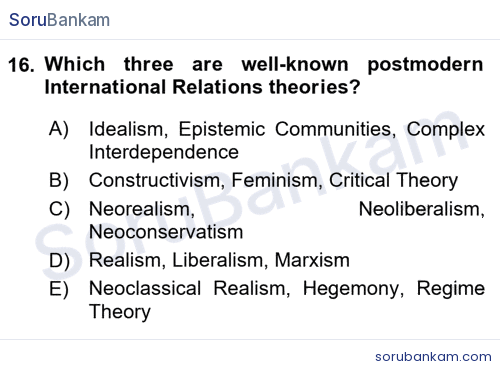
Which three are well-known postmodern. International Relations theories? A) Idealism, Epistemic Communities, Complex Interdependence B) Constructivism, Feminism, Critical Theory C) Neorealism, Negliberalism, Neoconservatism D) Realism, Liberalism, Marxism E) Neoclassical Realism, Hegemony, Regime' Theory
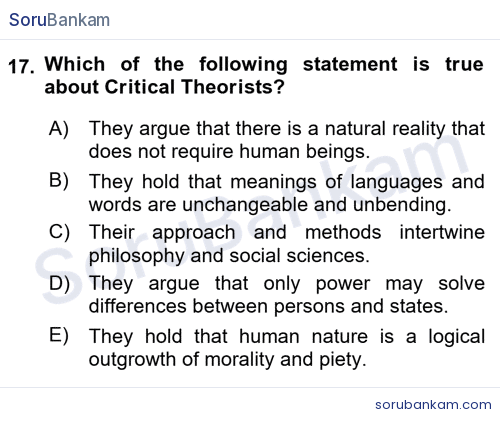
Which of the following statement is true about Critical Theorists? A) They argue that there is a natural reality that does not require human beings. B) They hold that meanings of languages and words are unchangeable and unbending. C) Their approach and methods intertwine philosophy and social sciences. D) They argue that only power may solve differences between persons and states. E) They hold that human nature is a logical outgrowth of morality and piety.
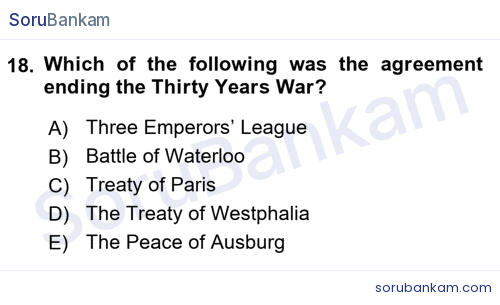
Which of the following was the agreement ending the Thirty Years War? A) Three Emperors' League B) Battle of Waterloo C) Treaty of Paris D) The Treaty of Westphalia 1**. E) The Peace of Ausburg
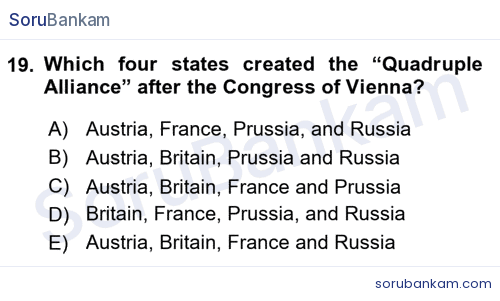
Which four states created the "Quadruple Alliance" after the Congress of Vienna? A) Austria, France, Prussia, and Russia B) Austria, Britain, Prussia and Russia C) Austria, Britain, France and Prussia D) Britain, France, Prussia, and Russia E) Austria, Britain, France and Russia
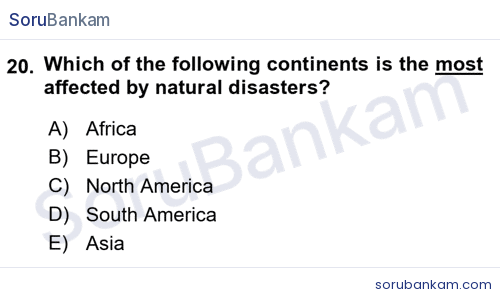
Which of the following continents is the most affected by natural disasters? A) Africa B) Europe C) North America D) South America E) Asia