ULI103U Introduction to International Relations 2021-2022 Final Soruları
20 soru · Final · 2021-2022
ULI103U Introduction to International Relations dersinin 2021-2022 final sınavı 20 sorudan oluşur; ders AÖF Siyaset Bilimi ve Kamu Yönetimi (İngilizce) bölümünde okutulur. Sorular aşağıda sırasıyla yer alır. Doğru cevaplar ve sonucun, testi çözdüğünde görünür.
Önizleme · 20 soru. Cevaplamak ve sonucunu görmek için sınavı başlat.
Sorular
20 soru
Soru 1
Soru 2
Soru 3
Soru 4
Soru 5
Soru 6
Soru 7
Soru 8
Soru 9
Soru 10
Soru 11
Soru 12
Soru 13
Soru 14
Soru 15
Soru 16
Soru 17
Soru 18
Soru 19
Soru 20
Sınav modunda süre tutulur, doğru cevaplar ve sonucun sınav bitince görünür.
Dersin üniteleri
Ünite özetleri ve konu anlatımları
- 1. Ünite: The Study Of International Relations
- 2. Ünite: The Historical Evolution Of The International System
- 3. Ünite: Theories Of International Relations
- 4. Ünite: International Security
- 5. Ünite: International Law
- 6. Ünite: International Organizations
- 7. Ünite: Global Political Economy
- 8. Ünite: Globalization And Global Society
ULI103U Introduction to International Relations ders sayfası: bütün sınavlar ve üniteler
Soruların metni (otomatik okuma)
Görsellerden otomatik okunmuştur; hata içerebilir. Sorular, görsellerdeki hâliyle geçerlidir.
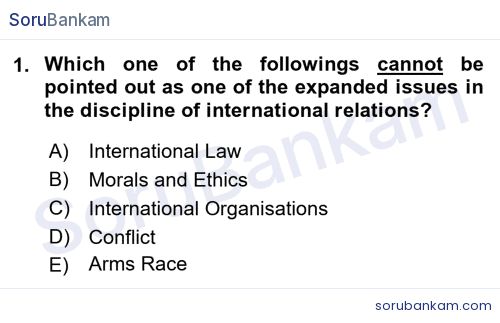
Which one of the followings cannot be pointed out as one of the expanded issues in the discipline of international relations? A) International Law B) Morals and Ethics C) International Organisations D) Conflict E) Arms Race
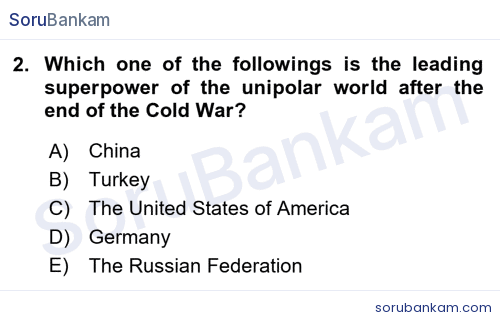
Which one of the followings is the leading superpower of the unipolar world after the end of the Cold War? A) China B) Turkey C) The United States of America D) Germany E) The Russian Federation
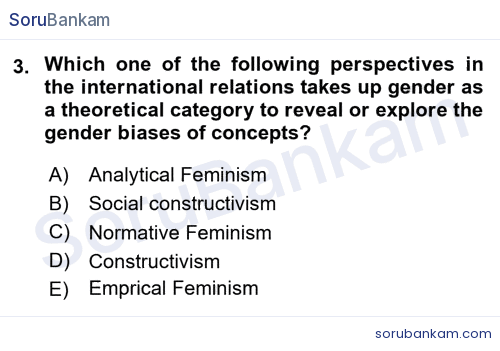
Which one of the following perspectives in the international relations takes up gender as a theoretical category to reveal or explore the gender biases of concepts? A) Analytical Feminism B) Social constructivism C) Normative Feminism D) Constructivism E) Emprical Feminism
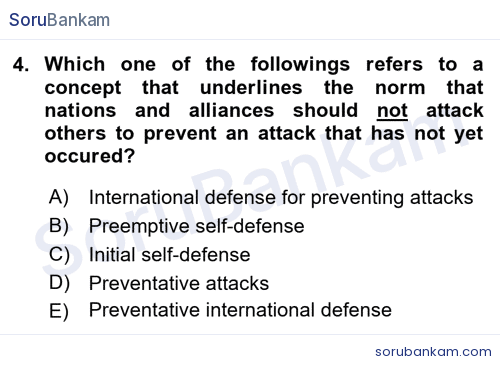
Which one of the followings refers to a concept that underlines the norm that nations and alliances should not attack others to prevent an attack that has not yet occured? A) International defense for preventing attacks B) Preemptive self-defense C) Initial self-defense D) Preventative attacks E) Preventative international defense
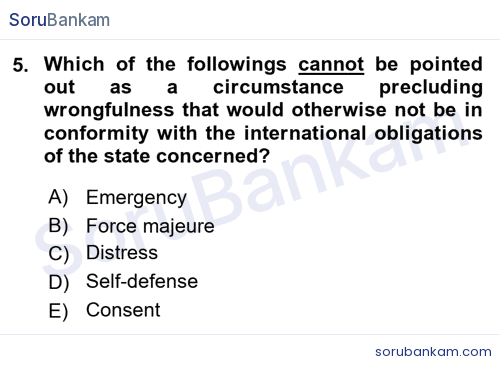
Which of the followings cannot be pointed out circumstance precluding wrongfulness that would otherwise not be in conformity with the international obligations of the state concerned? A) Emergency B) Force majeure C) Distress D) Self-defense E) Consent
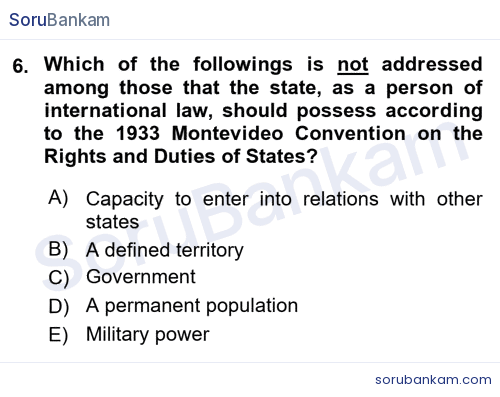
6. Which of the followings is not addressed among those that the state, as a person of International law, should possess according to the 1933 Montevideo Convention on the Rights and Duties of States? • A) Capacity to enter into relations with other states B) A defined territory Government D) A permanent population E) Military power
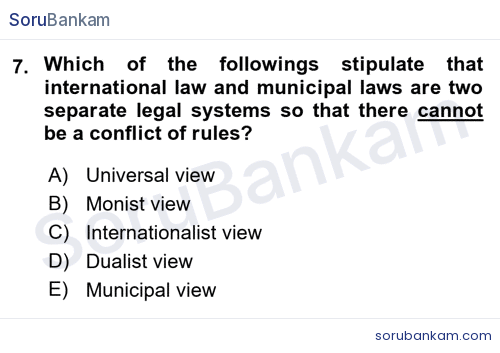
Which of the followings stipulate that international law and municipal laws are two separate legal systems so that there cannot be a conflict of rules? A) Universal view B) Monist view C) Internationalist view D) Dualist view E) e) Municipal view
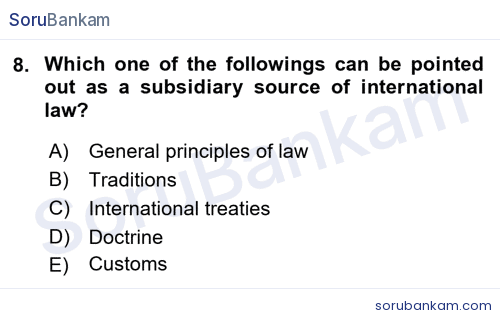
Which one of the followings can be pointed out as a subsidiary source of international law? A) General principles of law B) Traditions C) International treaties D) Doctrine E) Customs
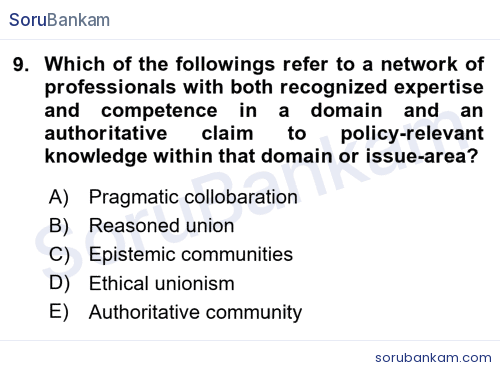
Which of the followings refer to a network of. professionals with both recognized expertise and competence ina domain and an authoritative claim to policy-relevant knowledge within that domain or issue-area? A) Pragmatic collobaration B) Reasoned union C) Epistemic communities D) Ethical unionism E) Authoritative community
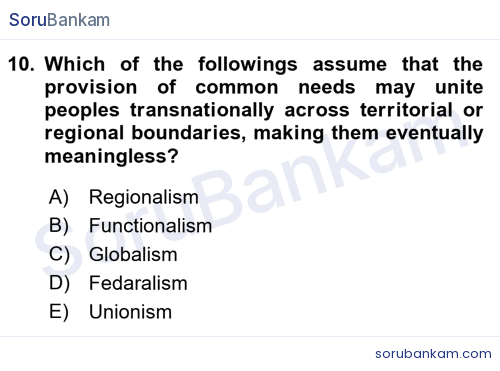
Which of the followings assume that the provision of common needs may unite peoples transnationally across territorial or regional boundaries, making them eventually meaningless? A) Regionalism B) Functionalism C) Globalism D) Fedaralism E) Unionism
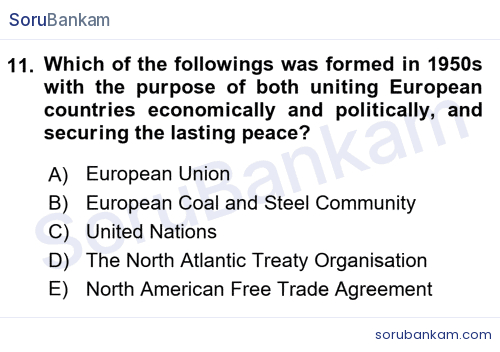
Which of the followings was formed in 1950s with the purpose of both uniting European countries economically and politically, and securing the lasting peace? A) European Union B) European Coal and Steel Community C) United Nations D) The North Atlantic Treaty Organisation E) North American Free Trade Agreement
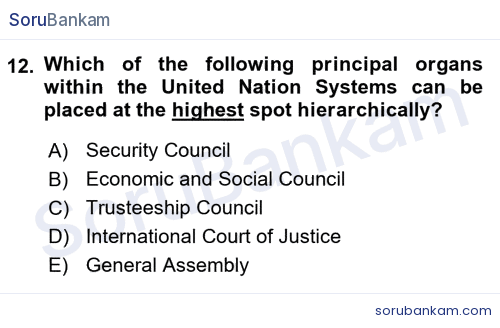
Which of the following principal organs within the United Nation Systems can be placed at the higheśt spot hierarchically? A) Security Council B) , "B) Economic and Social Council C) Trusteeship Coupcil D) International Court of Justice E) General Assembly
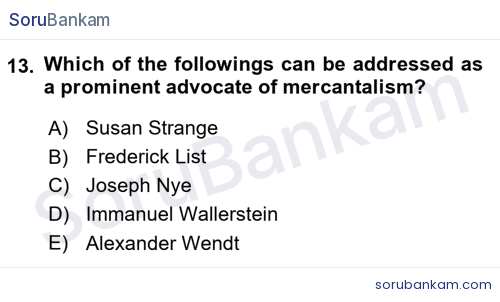
Which of the followings can be addressed as a prominent advocate of mercantalism? A) Susan Strange B) Frederick List C) Joseph Nye D) Immanuel Wallerstein E) Alexander Wendt
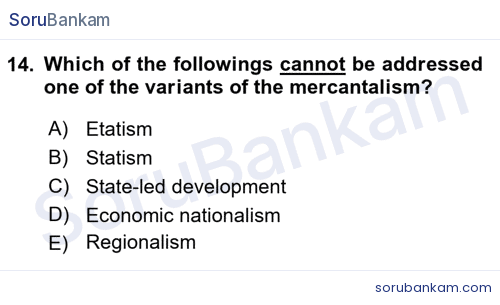
Which of the followings cannot be addressed one of the variants of the mercantalism? A) Etatism B) Statism C) State-led development D) Economic nationalism E) Regionalism
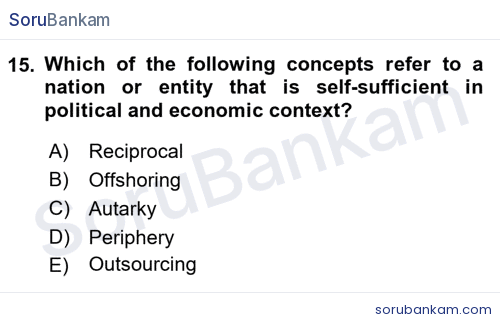
Which of the following concepts refer to a nation or entity that is self-sufficient in political and economic context? A) Reciprocal B) Offshoring C) Autarky D) Periphery. E) Outsourcing
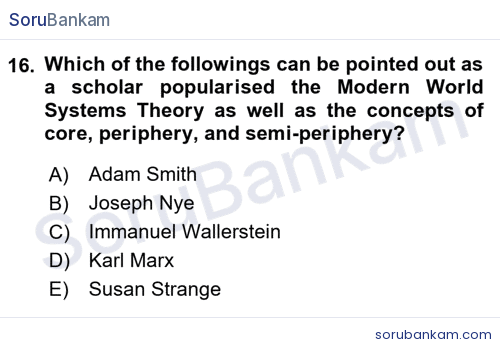
Which of the followings can be pointed out as a scholar popularised the Modern. World Systems Theory as well as the concepts of core, periphery, and semi-periphery? A) Adam Smith B) Joseph Nye C) Immanuel Wallerstein ni' D) Karl Marx E) Susan Strange
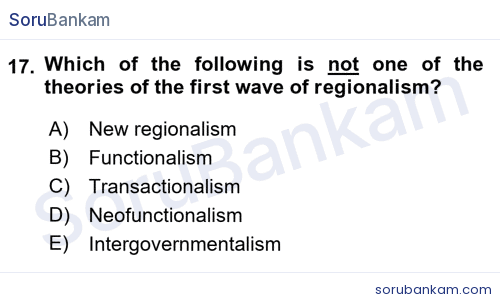
Which of the following is not one of the theories of the first wave of regionalișm? A) New regionalism B) Functionalism C) Transactionalism D) Neofunctionalișm E) Intergovemmentalism
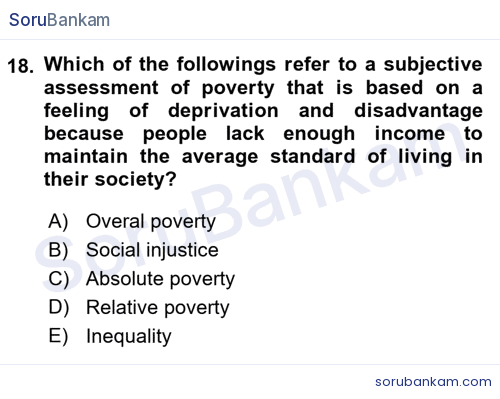
Which of the followings refer to a subjective assessment of poverty that is based on a feeling of deprivation and disadvantage because people lack enough income to maintain the average standard of living in their society? 7. A) Overal poverty B) Social injustice C) Absolute poverty D) Relative poverty E) Inequality
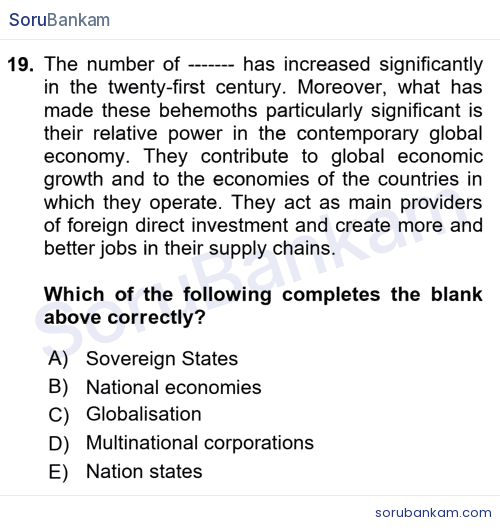
The number of - has increased significantly in the twenty-first century. Moreover, what has made these behemoths particularly significant is their relative power in the contemporary global economy. They contribute to global economic • frowit and to the economies of the countries in which they operate. They act as main providers of toreign direct investment and create more and better jobs in their supply chains. Which of the following completes the blank above correctly? A) Sovereign States B) National economies C) Globalisation D) Multinational corporations E) Nation states
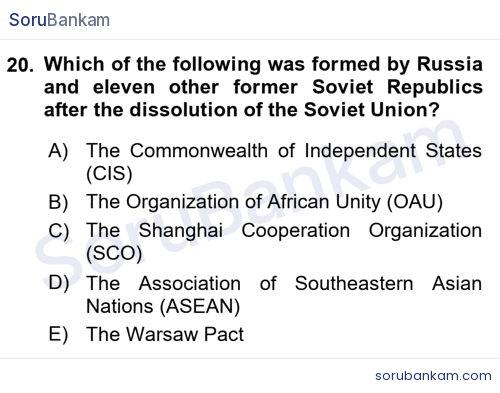
Which of the following was formed by Russia and eleven other former Soviet Republics after the dissolution of the Soviet Union? A) The Commonwealth of Independent States (CIS) B) The Organization of African Unity (OAU) C) The Shanghai Cooperation Organization (SCO) D) The Association of Southeastern Asian Nations (ASEAN) E) The Warsaw Pact