ULI103U Introduction to International Relations 2023-2024 Yaz Okulu Soruları
20 soru · Yaz okulu · 2023-2024
ULI103U Introduction to International Relations dersinin 2023-2024 yaz okulu sınavı 20 sorudan oluşur; ders AÖF Siyaset Bilimi ve Kamu Yönetimi (İngilizce) bölümünde okutulur. Sorular aşağıda sırasıyla yer alır. Doğru cevaplar ve sonucun, testi çözdüğünde görünür.
Önizleme · 20 soru. Cevaplamak ve sonucunu görmek için sınavı başlat.
Sorular
20 soru
Soru 1
Soru 2
Soru 3
Soru 4
Soru 5
Soru 6
Soru 7
Soru 8
Soru 9
Soru 10
Soru 11
Soru 12
Soru 13
Soru 14
Soru 15
Soru 16
Soru 17
Soru 18
Soru 19
Soru 20
Sınav modunda süre tutulur, doğru cevaplar ve sonucun sınav bitince görünür.
Dersin üniteleri
Ünite özetleri ve konu anlatımları
- 1. Ünite: The Study Of International Relations
- 2. Ünite: The Historical Evolution Of The International System
- 3. Ünite: Theories Of International Relations
- 4. Ünite: International Security
- 5. Ünite: International Law
- 6. Ünite: International Organizations
- 7. Ünite: Global Political Economy
- 8. Ünite: Globalization And Global Society
ULI103U Introduction to International Relations ders sayfası: bütün sınavlar ve üniteler
Soruların metni (otomatik okuma)
Görsellerden otomatik okunmuştur; hata içerebilir. Sorular, görsellerdeki hâliyle geçerlidir.
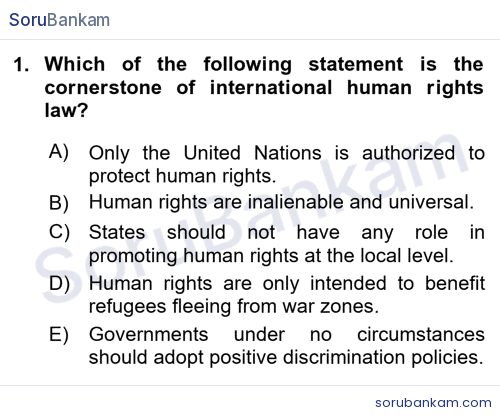
Which of the following statement is the cornerstone of International human rights law? A) Only the United Nations is authorized to protect human rights. B) Human rights are inalienable and universal. C) States should not have any role in promoting human rights at the local level. D) Human rights are only intended to benefit refugees fleeing from war zones. E) Governments under no circumstances should adopt positive discrimination policies.
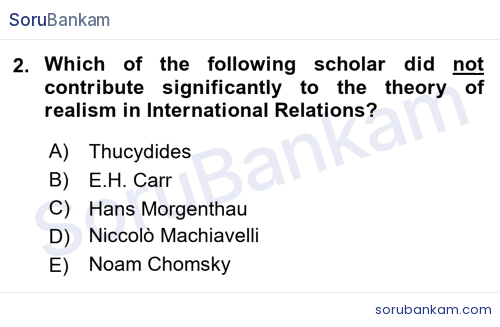
Which of the following scholar did not contribute significantly to the theory of realism in International Relations? A) Thucydides B) E.H. Carr C) Hans Morgenthau D) Niccolò Machiavelli E) Noam Chomsky
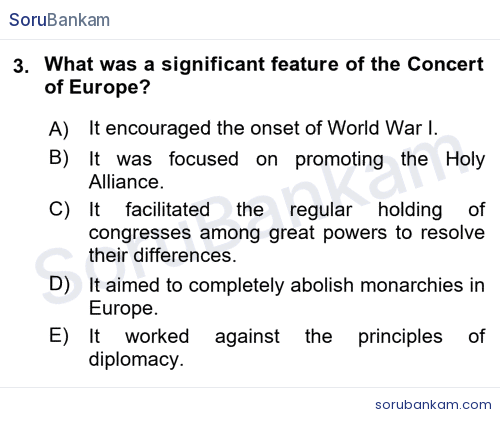
3. What was a significant feature of the Concert of Europe? , "' A) It encauraged the onset of World War I. B) It was focused on promoting the hol. Alliance. C) It facilitated the regular halding congresses among great powers to resolve their differences. D) H'aimed to completely abolish monarchies in Europe. worked against the principles of diplomacy.
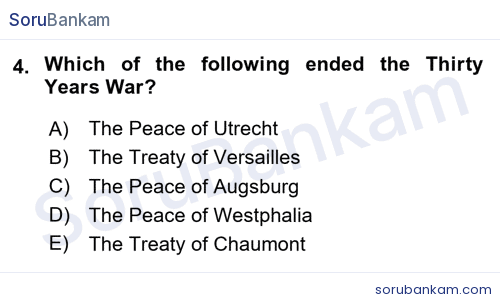
Which of the following ended the Thirty Years War? A) The Peace of Utrecht B) The Treaty of Versailles C) The Peace of Augsburg D) The Peace of Westphalia E) The Treaty of Chaumont
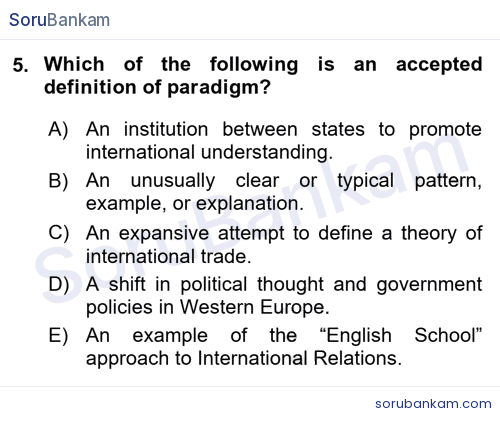
Which of the following is an accepted definition of paradigm? A) An institution between states to promote international understanding. B) An unusually clear or typical patter, example, or explanation. C) An expansive attempt to define a theory of international trade. D) A shift in political thought and government policies in Western Europe. E) An example of the "English School" approach to InternationakRelations.
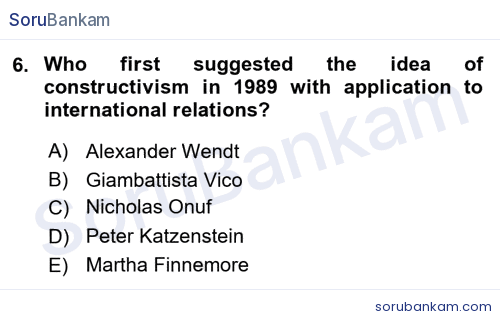
Who first suggested the idea constructivism in 1989 with application to international relatións? A) Alexander Wendt B) wi B) Giambattista Vico C) Nicholas Onuf D) Peter Katzenstein E) Martha Finnemore
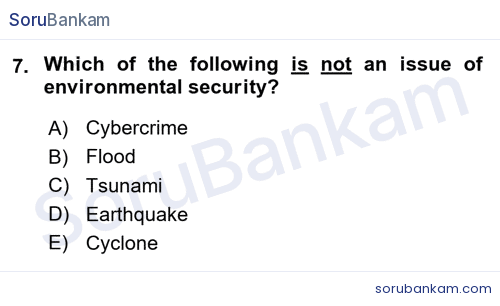
Which of the following is not an issue of environmental security? A) Cybercrime B) Flood C) Tsunami D) Earthquake E) Cyclone
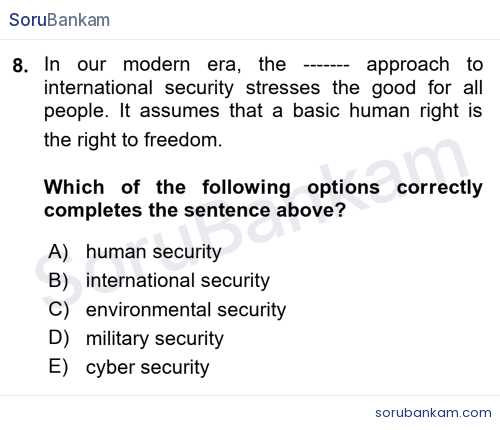
In our modem era, the —- approach to international security stresses the good for all people. It assumes that a basic human right is the right to freedom. Which of the following options correctly completes the sentence above? A) human security B) international security C) environmental security D) military security E) cyber security
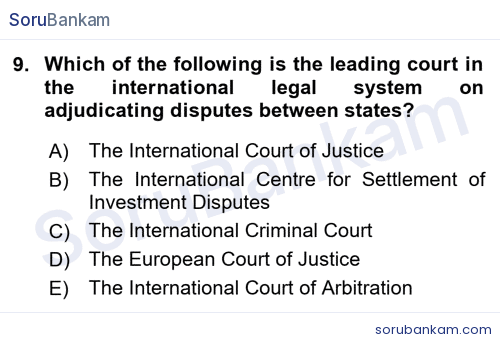
9. Which of the following is the leading court in the International legal system adjudicating disputes between states? A) The International Court of Justice The International Centre for Settlement of Investment Disputes C) The International Criminal Court D) The European Court of Justice E) The International Court of Arbitration
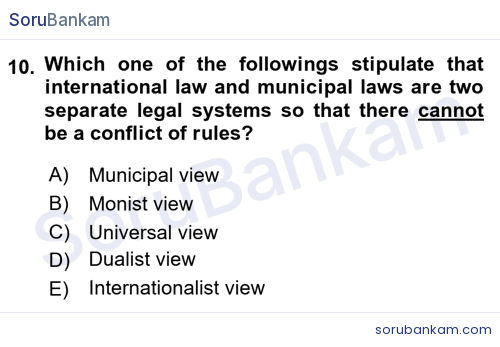
Which one of the followings stipulate that international law and municipal laws are two separate legal systems so that there cannot be a conflict of rules? A) Municipal view B) Monist view C) Universal view D) Dualist view E) Internationalist view
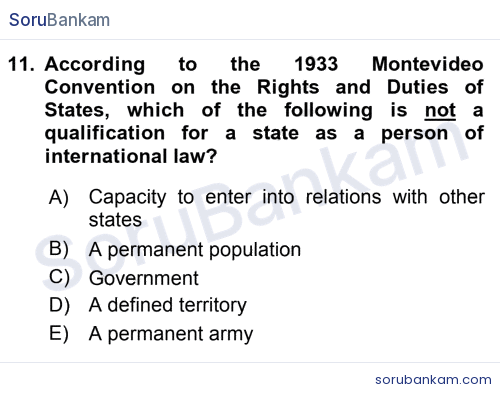
According to the 1933 Montevideo Convention on the Rights and Duties of States, which of the following is not a qualification for a stațe as a person of international law? A) Capacity to enter into relations with other states B) A perganent populatiop v" C) . Government D) « D) A defined territory E) A permanent army
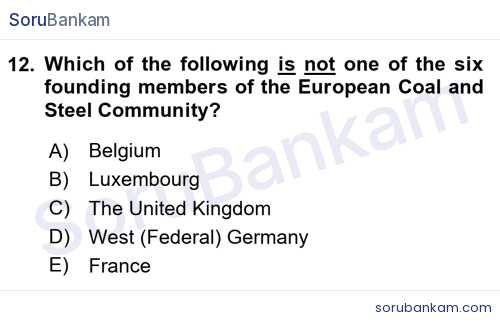
Which of the following is not one of the six founding members of the European Coal and Steel Community? A) Belgium B) Luxembourg C) The United Kingdom D) West (Federal) Germany E) France
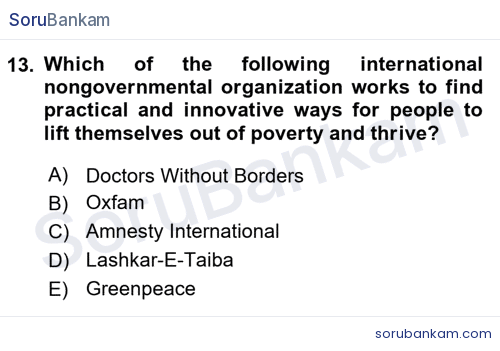
Which of the following international. nongovernmental organization works to find practical and innovative ways for people to lift themselves out of poverty and thrive? A) Doctors Without Borders B) Oxíam C) Amnesty Intemational D) Lashkar-E-Taiba E) Greenpeace
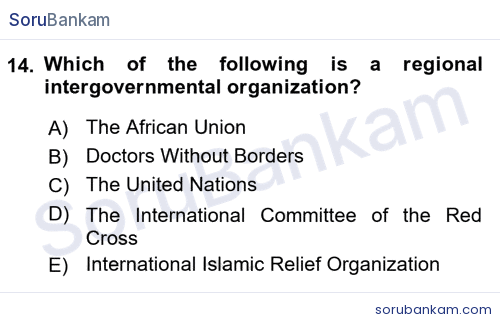
Which of the following is a regional. intergovernmental organization? A) The African Union B) Doctors Without Borders C) The United Nations D) The International Committee of the Red Cross E) International Islamic Relief Organization
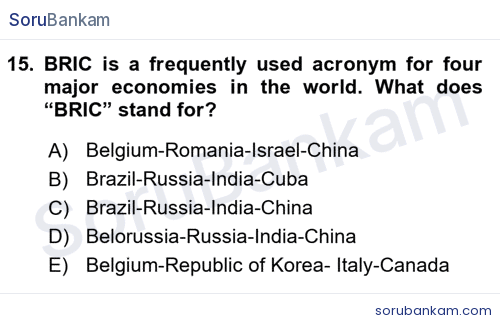
BRIC is a frequently used acronym for four major economies in the world. What does "BRIC" stand for? A) Belgium-Romania-Israel-China B) Brazil-Russia-India-Cuba C) Brazil-Russia-India-China D) Belorussia-Russia-India-China E) Belgium-Republic of Korea- Italy-Canada
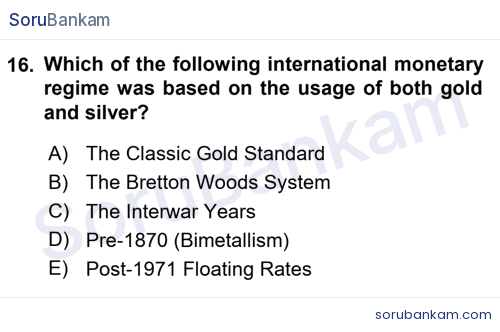
Which of the following international monetary regime was based on the usage of both gold and silver? A) The Classic Gold Standard B) The Bretton Woods System C) The Interwar Years D) Pre-1870 (Bimetallism) E) Post-1971 Floating Rates
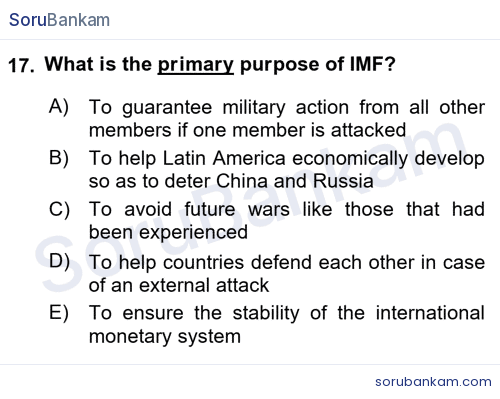
17. What is the primary purpose of IMF? A) To guarantee military action from all other members if one member is attacked To help Latin America economically develop so as to deter China and Russia C) To avoid future wars like those that had been experienced D) To help countries defend each other in case of an external attack E) To ensure the stability of the international monetary system
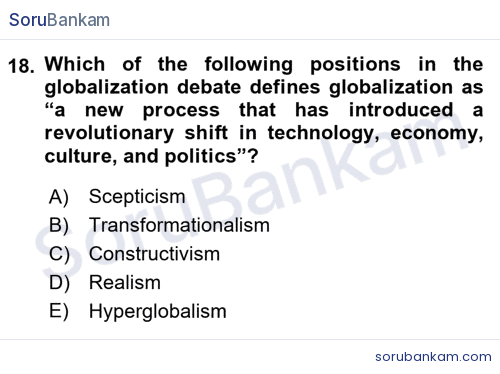
Which of the following positions in the globalization debate defines globalization 'as "a new process that has introduced a revolutionary shift in technology, economy, culture, and politics"? A) Scepticism B) Transformationalism C) Constructivism D) Realism E) Hyperglobalism
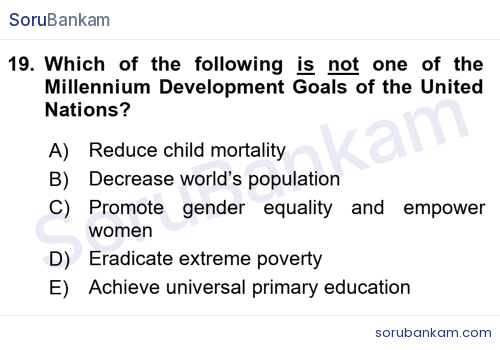
Which of the following is not one of the Millennium Development Goals of the United Nations? A) Reduce child mortality B) Decrease world's population C) Promote gender equality and empower women D) Eradicate extreme poverty E) Achieve universal primary education
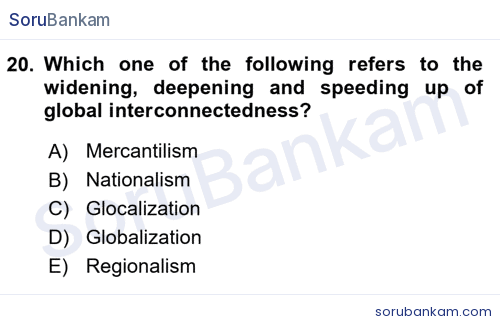
Which one of the following refers to the widening, deepening and speeding up of global interconnectedness? A) Mercantilism B) Nationalism C) Glocalization D) Globalization E) Regionalism