ULI103U Introduction to International Relations 2022-2023 Vize Soruları
20 soru · Vize · 2022-2023
ULI103U Introduction to International Relations dersinin 2022-2023 vize sınavı 20 sorudan oluşur; ders AÖF Siyaset Bilimi ve Kamu Yönetimi (İngilizce) bölümünde okutulur. Sorular aşağıda sırasıyla yer alır. Doğru cevaplar ve sonucun, testi çözdüğünde görünür.
Önizleme · 20 soru. Cevaplamak ve sonucunu görmek için sınavı başlat.
Sorular
20 soru
Soru 1
Soru 2
Soru 3
Soru 4
Soru 5
Soru 6
Soru 7
Soru 8
Soru 9
Soru 10
Soru 11
Soru 12
Soru 13
Soru 14
Soru 15
Soru 16
Soru 17
Soru 18
Soru 19
Soru 20
Sınav modunda süre tutulur, doğru cevaplar ve sonucun sınav bitince görünür.
Dersin üniteleri
Ünite özetleri ve konu anlatımları
- 1. Ünite: The Study Of International Relations
- 2. Ünite: The Historical Evolution Of The International System
- 3. Ünite: Theories Of International Relations
- 4. Ünite: International Security
- 5. Ünite: International Law
- 6. Ünite: International Organizations
- 7. Ünite: Global Political Economy
- 8. Ünite: Globalization And Global Society
ULI103U Introduction to International Relations ders sayfası: bütün sınavlar ve üniteler
Soruların metni (otomatik okuma)
Görsellerden otomatik okunmuştur; hata içerebilir. Sorular, görsellerdeki hâliyle geçerlidir.
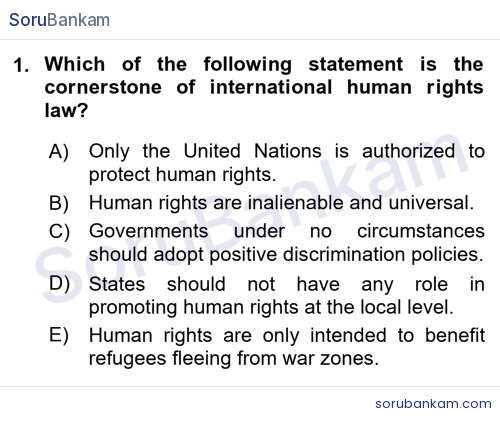
Which of the following statement is the cornerstone of international human rights law? A) Only the United Nations is authorized to protect human rights. B) Human rights are inalienable and universal. C) Governments under no circumstances should adopt positive discrimination policies. D) States should not have any role in promoting human rights at the local level. E) Human rights are only intended to benefit refugees fleeing from war zones.
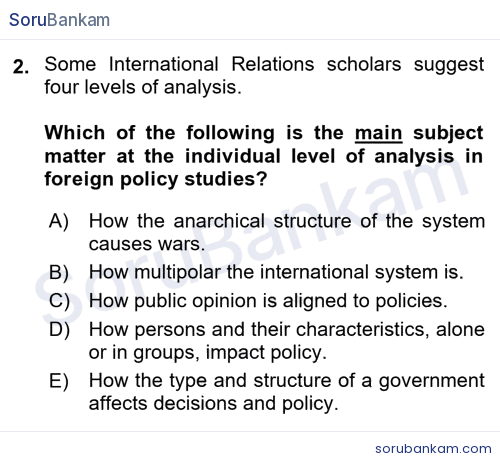
Some International Relations scholars suggest four levels of analysis. Which of the following is the main subject matter at the individual level of analysis in foreign policy studies? A) How the anarchical structure, of the system causes wars. B) How multipolar the international system is.. C) How public opinion is aligned to policieș.' D) How persons and their characteristics, alone or in groups,-impact policy. - E) How the type and structure of a government 1 affects decisions and policy.
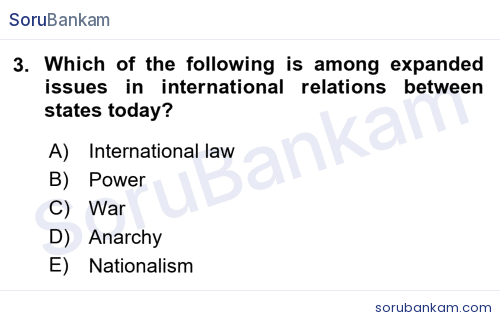
Which of the following is among expanded issues in international relations between states today? A) International law B) Power C) War D) Anarchy E) Nationalism
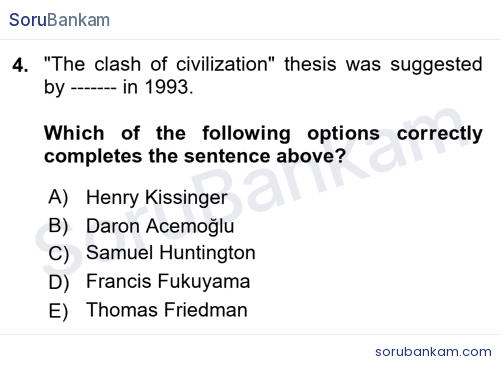
"The clash of civilization" thesis was suggested by - in 1993. Which of the following options correctly completes the sentence above? A) Henry Kissinger .. B) Daron Acemoğlu C) Samuel Huntington D) Francis Fukuyama E) Thomas Friedman
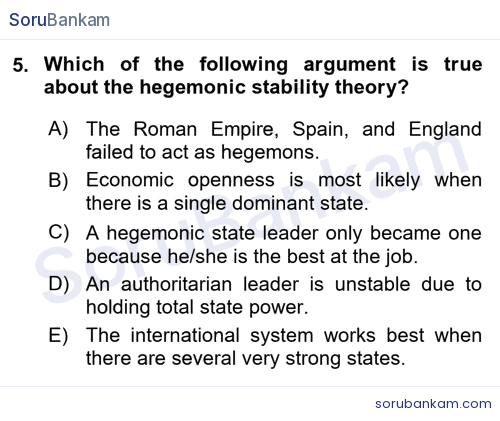
5. Which of the following argument is true about the hegemonic stability theory? A) The Roman Empire, Spain, and England failed to act as hegemons. Economic openness is most likely when there is a single dominant state. C) A hegemonic state leader only became one because fie/she is the best at the job. D) An authoritarian leader is unstable due to holding total state power. E The internațional system works best when there are several very strong states.
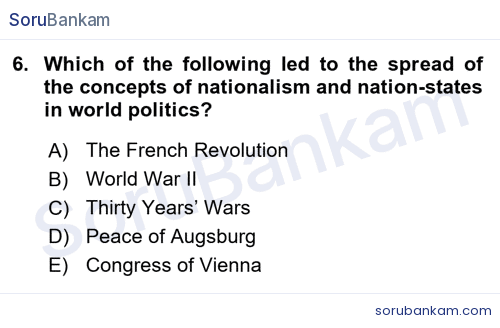
Which of the following led to the spread of the concepts of nationalism and nation-states in world politics? A) The French Revolution B) World War i/ C) Thirty Years' Wars D) Peace of Augsburg E) Congress of Vienna
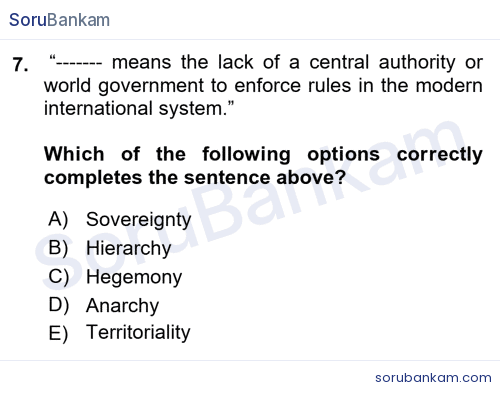
- means the lack of a central authority or world government to enforce rules in the modern international system." Which of the following options correctly completes the sentence above? A) Sovereignty B) Hierarchy C) Hegemony D) Anarchy E) Territoriality
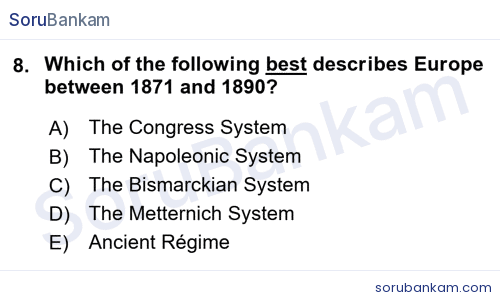
Which of the following best describes Europe between 187t and 1890? A) The Congress System B) The Napoleonic System C) The Bismarckian System D) The Metternich System E) Ancient Régime
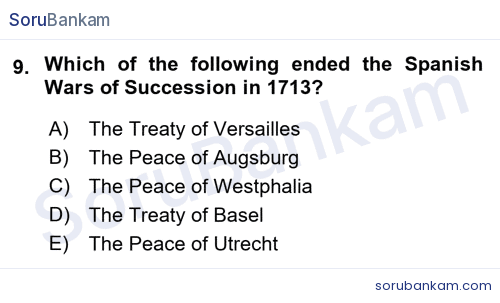
Which of the following ended the Spanish Wars of Succession In 17137 A) The Treaty of Versailles B) The Peace of Augsburg C) The Peace of Westphalia D) The Treaty of Basel E) The Peace of Utrecht
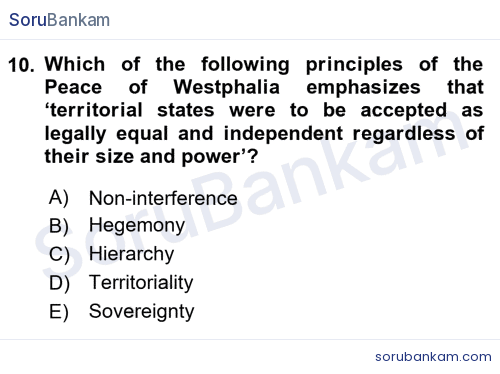
Which of the following principles of the Peace of Westphalia emphasizes that territorial states were to be accepted as legally equal and independant regardless of their size and power'? A) Non-interference B) Hegemony C) Hierarchy D) Territoriality E) Sovereignty
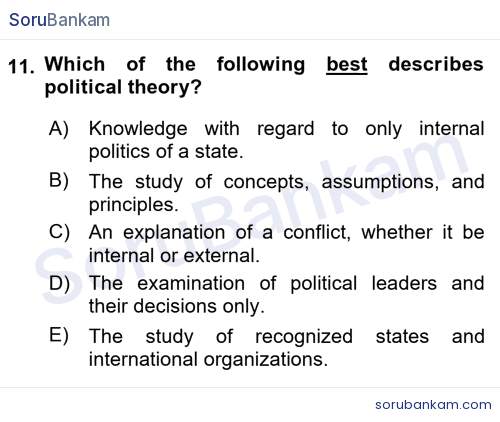
Which of the following best describes political theory? A) Knowledge with regard to only internal politics of a state. B) The study of concepts, assumptions, and principles. C) An explanation of a conflict, whether it be internal or external. D) The examination of political leaders and their decisions only. E) The study of recognized states and international organizations.
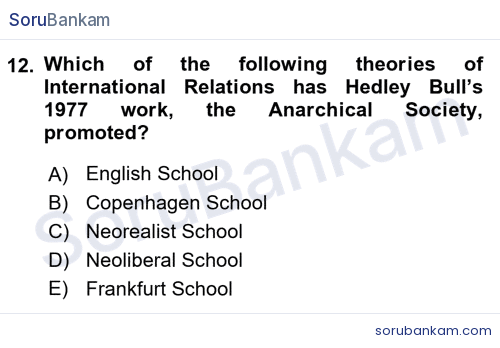
Which of the following theories International Relations has • Hedley Bull's 1977 work, the Anarchical Society, promoted? A) English School ."." B) Copenhagen School C) Neorealist School D) Neoliberal School E) Frankfurt School
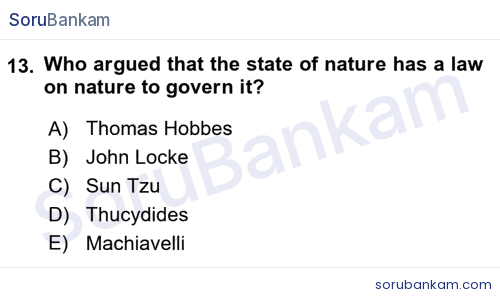
13. Who argued that the state of nature has a law on nature to govern it? A) Thomas Hobbes B) Jahn Locke . "C) Sun Tzu D) Thucydides e) Machiavelli
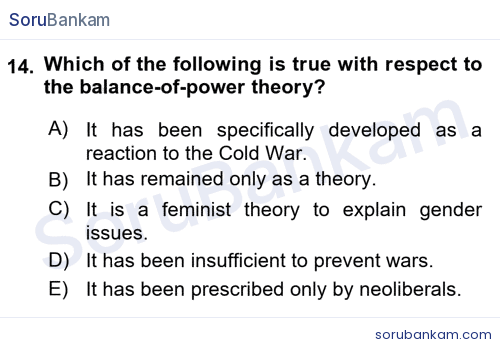
Which of the following is true with respect to the balance-of-power theory? A) It has been specifically developed as a reaction to the Cold War. B) w' B) It has remained only as a theory. C) It is a feminist theory to explain gender issues. D) It has been insufficient to prevent wars. E) It has been prescribed only by neoliberals.
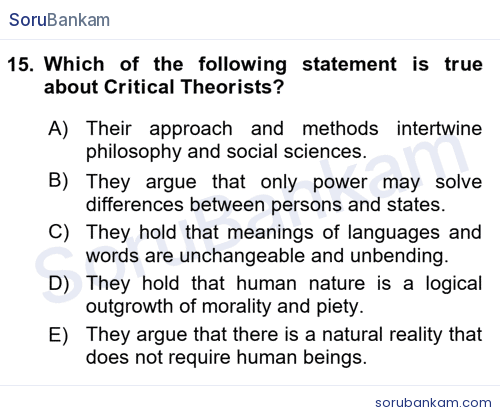
Which of the following statement is true about Critical Theorists? A) Their approach and methods intertwine philosophy and social sciences. B) They argue that only power may solve differences between persons and states. C) They hold that meanings of languages and words are unchangeable and unbending. D) They hold that human nature is a logical outgrowth of morality and piety. E) They argue that there is a natural reality that does not require human beings.
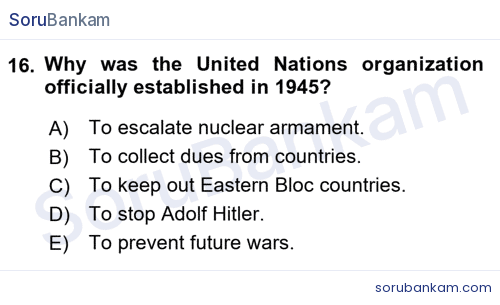
Why was the United Nations organization officially established in 1945? A) To escalate nuclear armament. B) To collect dues from countries. C) To keep out Eastern Bloc countries. D) To stop Adolf Hitler. E) To prevent future wars.
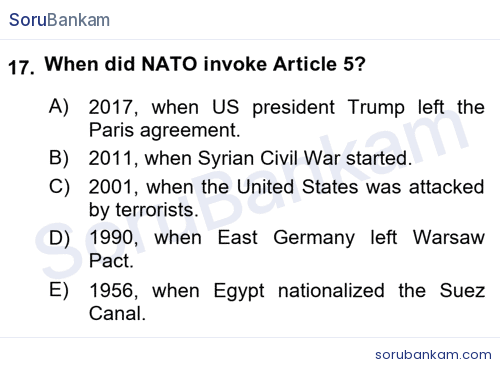
17. When did NATO invoke Article 5? A) 2017, when US president Trump left the Paris agreement. 2011, when Syrian Civil War started. C) 2001, when the United States was attacked by terrorists. D) 1990, when East Germany left Warsaw Pact. E) 1956, when Egypt nationalized the Suez Canal.
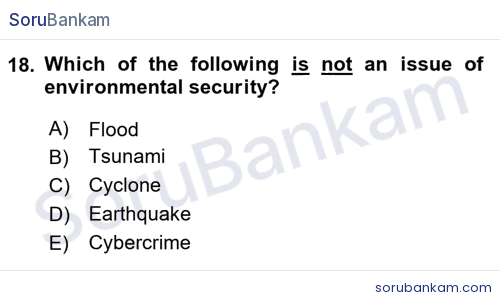
Which of the following is not an issue of A) environmental security? Flood B) Tsunami C) Cyclone D) Earthquake r. E) Cybercrime
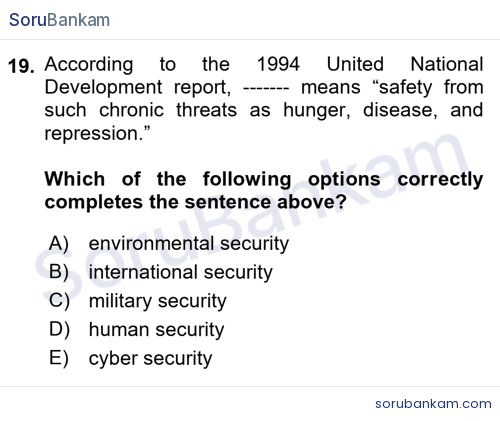
According to the 1994 United National Development report, -- means "safety from such chronic threats as hunger, disease, and repression." Which of the following options correctly completes the sentence above? A) environmental security B) international security C) military security D) human security E) cyber security
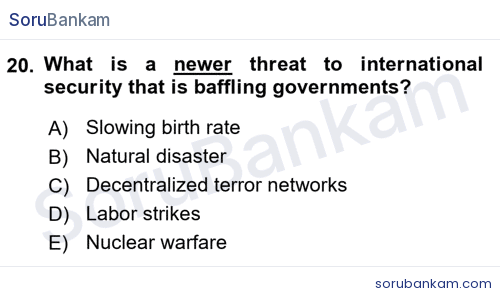
What is a newer threat to international security that is baffling governments? A) Slowing birth rate B) Natural disaster C) Decentralized terror networks D) Labor strikes 23. E) Nuclear warfare