ULI103U Introduction to International Relations 2023-2024 Vize Soruları
20 soru · Vize · 2023-2024
ULI103U Introduction to International Relations dersinin 2023-2024 vize sınavı 20 sorudan oluşur; ders AÖF Siyaset Bilimi ve Kamu Yönetimi (İngilizce) bölümünde okutulur. Sorular aşağıda sırasıyla yer alır. Doğru cevaplar ve sonucun, testi çözdüğünde görünür.
Önizleme · 20 soru. Cevaplamak ve sonucunu görmek için sınavı başlat.
Sorular
20 soru
Soru 1
Soru 2
Soru 3
Soru 4
Soru 5
Soru 6
Soru 7
Soru 8
Soru 9
Soru 10
Soru 11
Soru 12
Soru 13
Soru 14
Soru 15
Soru 16
Soru 17
Soru 18
Soru 19
Soru 20
Sınav modunda süre tutulur, doğru cevaplar ve sonucun sınav bitince görünür.
Dersin üniteleri
Ünite özetleri ve konu anlatımları
- 1. Ünite: The Study Of International Relations
- 2. Ünite: The Historical Evolution Of The International System
- 3. Ünite: Theories Of International Relations
- 4. Ünite: International Security
- 5. Ünite: International Law
- 6. Ünite: International Organizations
- 7. Ünite: Global Political Economy
- 8. Ünite: Globalization And Global Society
ULI103U Introduction to International Relations ders sayfası: bütün sınavlar ve üniteler
Soruların metni (otomatik okuma)
Görsellerden otomatik okunmuştur; hata içerebilir. Sorular, görsellerdeki hâliyle geçerlidir.
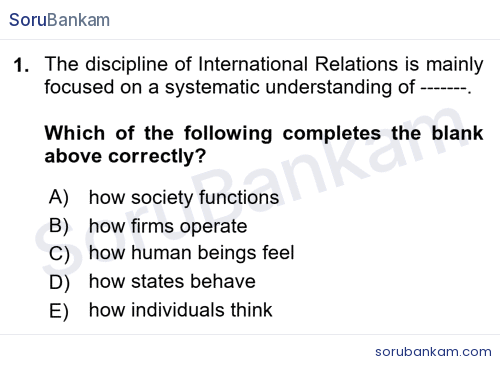
The discipline of International Relations is mainly focused on a systematic understanding of--.. Which of the following completes the blank above correctly? A) how society functions B) how firms operate C) how human beings feel D) how states behave E) how individuals think
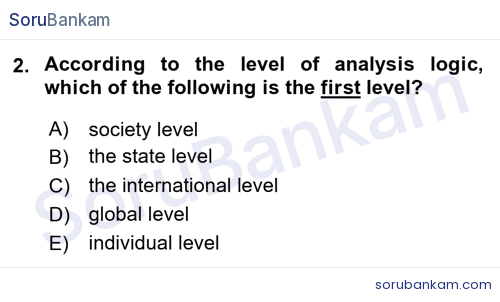
According to the level of analysis logic, which of the following is the first level? A) society tevel B) the state level C) the international level D) global level E) individual level
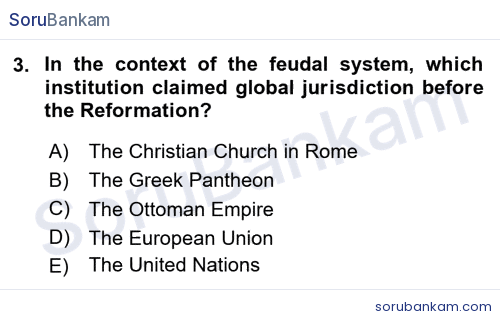
In the context of the feudal system, which Institutlon claimed global jurisdiction before the Reformation? ' A) The Christian Church in Rome B) The Greek Pantheon C) The Ottoman Empire D) The European Union E) Thé United Nations ' »
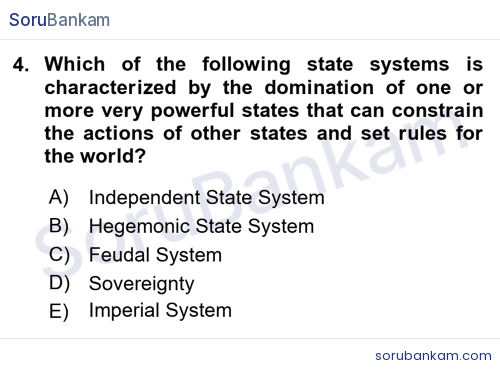
Which of the following state systems is characterized by the domination of one or more very powerful states that can constrain the actions of other states and set rules for the world? A) Independent State System B) Hegemonic State System C) Feudal System D) Sovereignty E) Imperial System
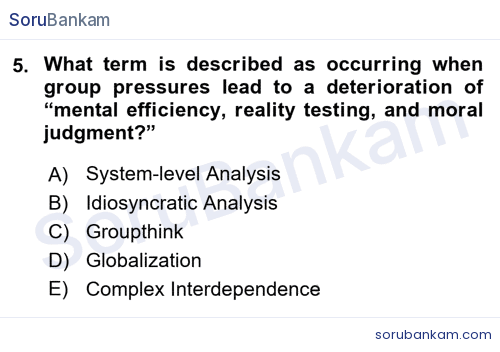
What term is described as occurring when group pressures lead to a deterioration of "mental efficiency, reality testing, and moral judgment?" A) System-level Analysis B) Idiosyncratic Analysis .. C) Groupthink D) Globalization E) Complex Interdependence
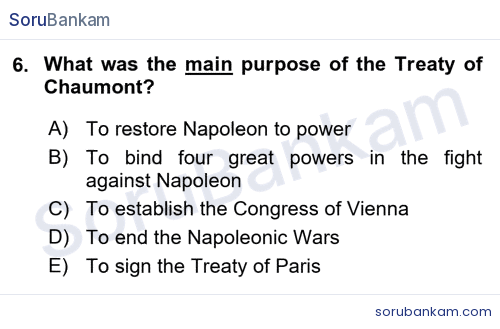
6. What was the main purpose of the Treaty of Chaumont? To restore Napoleon to power B), To bind four great powers in the fight against Napoleon To establish the Congress of Vienna D) To end the Napoleonic Wars E) Tosign the Treaty of Paris
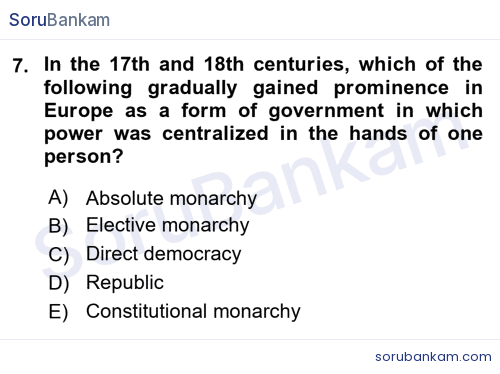
In the 17th and 18th centuries, which of the following gradually galned prominence In Europe as a form of government in which power was centralized in the hands of one person? A) Absolute monarchy B) Elective monarchy C) Direet democracy D) Republic E) Constitutional monarchy
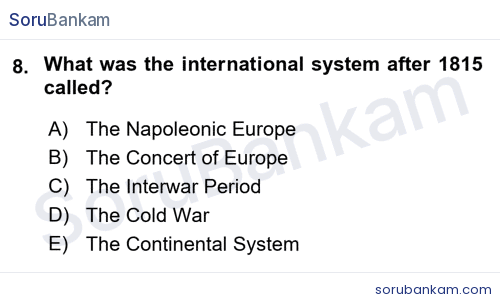
What was the international system after 1815 called? A) The Napoleonic Europe B) The Concert of Europe C) The Interwar Period D) The Cold War E) The Continental System
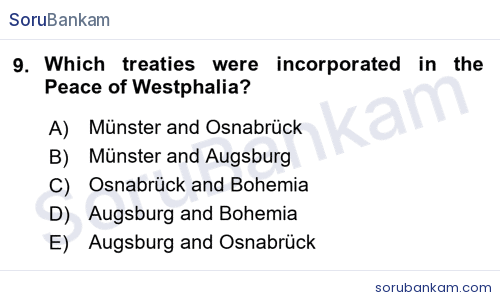
Which treaties were incorporated in the Peace of Westphalia? A) Münster and Osnabrück B) Münster and Augsburg C) Osnabrück and Bohemia D) Augsburg and Bohemia E) Augsburg ańd Osnabrück
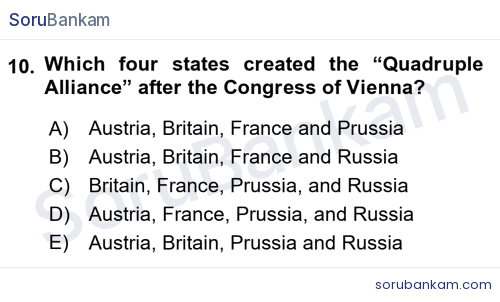
Which four states created the "Quadruple Alliance" after the Congress of Vienna? A) Austria, Britain, France and Prussia B) Austria, Britain, France and Russia C) Britain, France, Prussia, and Russia D) Austria, France, Prussia, and Russia E) Austria, Britain, Prussia and Russia
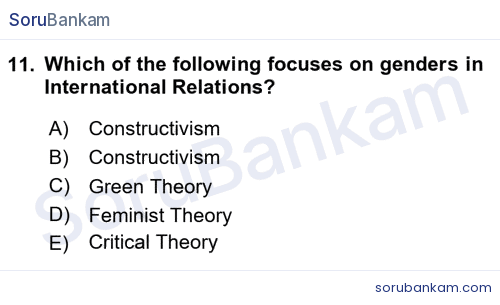
Which of the following focuses on genders in International Relations? A) Constructivism B) Constructivism C) Green Theory D) Feminist Theory, E) Critical Theory
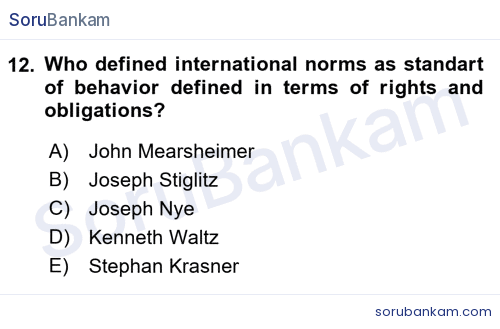
Who defined international norms as standart of behavior defined in terms of rights and obligations? A) John Mearsheimer B) Joseph Stiglitz C) Joseph Nye D) Kenneth Waltz E) Stephan Krasner
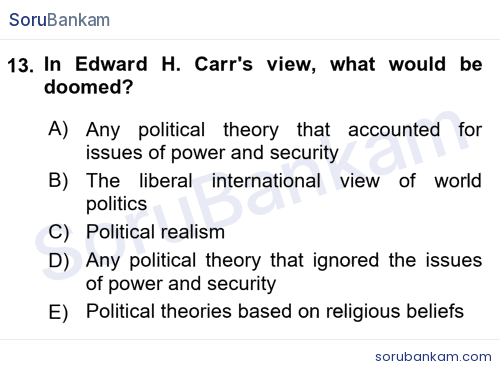
In Edward H. Carr's view, what would be doomed? A) Any political theory that accounted for issues of power and security B) The liberal international view Wond politics C) Political realism D) Any political theory that ignored the issues of power and security E) Political theories based on religious bellets
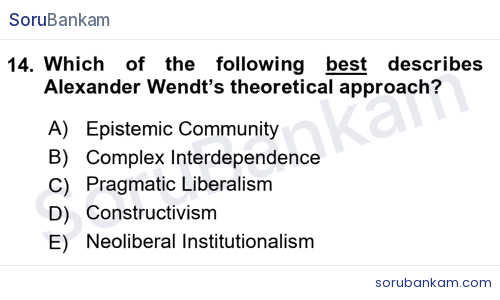
Which of the following best describes Alexander Wendt's theoretical approach? A) Epistemic Community B) Cômplex Interdependence C) Pragmatic Liberalism D) Constructivism E) Neoliberal Institutionalism
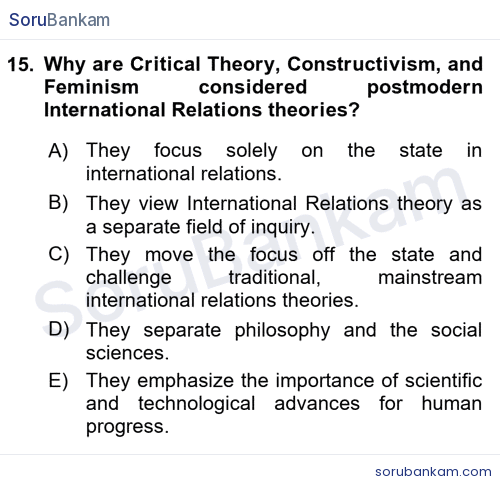
Why are Critical Theory, Constructivism, and Feminism considered postmodern International Relations theories? A) They focus solely on the state in international relations. B) They view International Relations theory as a separate field of inquiry. C) They move the focus off the state and challenge traditional, mainstream international relations theories. D) They separate philosophy and the social sciences. E) They emphasize the importance of scientific and technological advances for human progress.
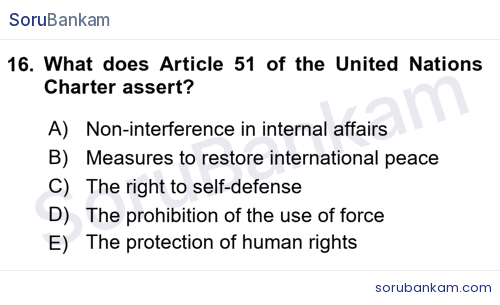
What does Article 51 of the United Nations Charter assert? A) Non-interference in internal affairs B) Measures to restore international peace C) The right to self-defense D) The prohibition of the use of force E) The protection of human rights
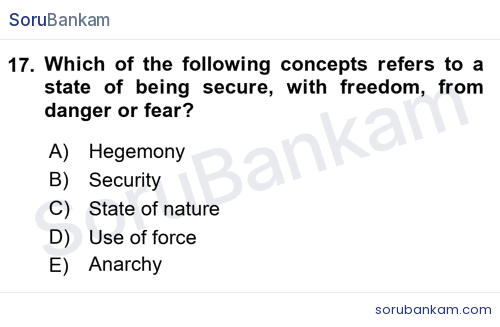
Which of the following concepts refers to a state of being secure, with freedom, from danger or fear? A) Hegemony B) Security C) State of nature D) Use of force E) Anarchy
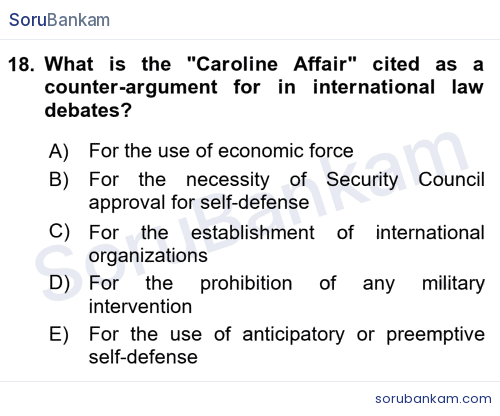
18. What is the "Caroline Affair" cited as a counter-argument for in international law debates? A) For the use of economic force For the necessity of Security Council approval for self-defense C) For the establishment international organizations D) For the prohibition of any miltary intervention E) For the use of anticipatory or preemptive self-defense
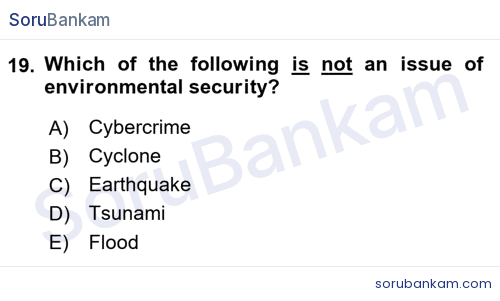
Which of the following is not an issue of environmental security? A) Cybercrime B) Cyclone C) Earthquake D) Tsunami E) Flood
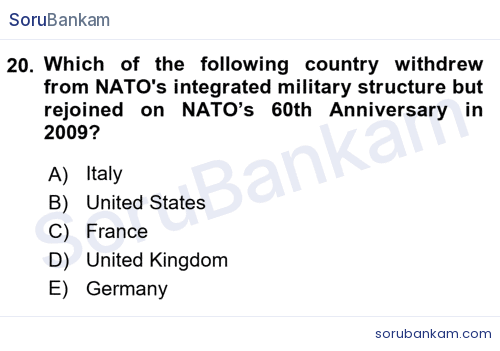
Which of the following country withdrew from NATO's integrated military structure but rejoined on NATO's 60th Anniversary in 2009? A) Italy B) United States .. C) France D) United Kingdom E) Germany