ULI103U Introduction to International Relations 2018-2019 Final Soruları
20 soru · Final · 2018-2019
ULI103U Introduction to International Relations dersinin 2018-2019 final sınavı 20 sorudan oluşur; ders AÖF Siyaset Bilimi ve Kamu Yönetimi (İngilizce) bölümünde okutulur. Sorular aşağıda sırasıyla yer alır. Doğru cevaplar ve sonucun, testi çözdüğünde görünür.
Önizleme · 20 soru. Cevaplamak ve sonucunu görmek için sınavı başlat.
Sorular
20 soru
Soru 1
Soru 2
Soru 3
Soru 4
Soru 5
Soru 6
Soru 7
Soru 8
Soru 9
Soru 10
Soru 11
Soru 12
Soru 13
Soru 14
Soru 15
Soru 16
Soru 17
Soru 18
Soru 19
Soru 20
Sınav modunda süre tutulur, doğru cevaplar ve sonucun sınav bitince görünür.
Dersin üniteleri
Ünite özetleri ve konu anlatımları
- 1. Ünite: The Study Of International Relations
- 2. Ünite: The Historical Evolution Of The International System
- 3. Ünite: Theories Of International Relations
- 4. Ünite: International Security
- 5. Ünite: International Law
- 6. Ünite: International Organizations
- 7. Ünite: Global Political Economy
- 8. Ünite: Globalization And Global Society
ULI103U Introduction to International Relations ders sayfası: bütün sınavlar ve üniteler
Soruların metni (otomatik okuma)
Görsellerden otomatik okunmuştur; hata içerebilir. Sorular, görsellerdeki hâliyle geçerlidir.
Which of the following is the primary emphasis of classical liberalism as a political philosophy and an ideology? A) Limited, individual gains and a society without any government at all. B) _ The formation of cooperative coalitions and trade unions to benefit the poor. C) Ridding the world of war completely and securing perpetual peace. D) Securing the freedoms of the individual by limiting government power. E) Helping the elites and the rich to gradually accumulate power and economic wealth.
Which of the following led to the spread of the concepts of nationalism and nation-states in world politics? A) Industrial Revolution B) The French Revolution C) Thirty Years' Wars D) Peace of Augsburg E) Congress of Vienna
3. Which of the following is true about Neoliberalism's approach economic issues? A) Supports the privatization of public enterprises Supports imposing non-tariff barriers to international trade. C) Holds that the state must pay the entire cost of'citizens education. D) Argues that high taits should be enforced on exports and imports. Argues that all individual assets should be confiscated
4. International security is so complex in the 21st century because of which of the following? A) Increasing interconnectivity. Less money allocated to research. C) NATO operations around the world. D) Proliferation of nuclear weapons. Criminal behavior becoming harder to detect.
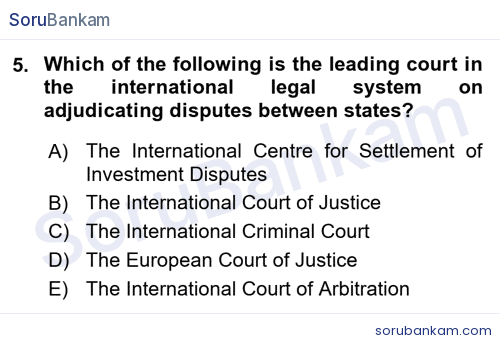
Which of the following is the leading court in the international legal system adjudicating disputes between states? A) The International Centre for Settlement of Investment Disputes B) The International Court of Justice C) The International Criminal Court D) The European Court of Justice E) The International Court of Arbitration
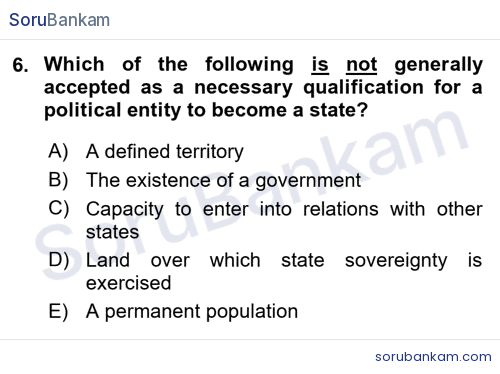
Which of the following is not generally accepted as a necessary qualification for a polítical entity to become a state? A) A defined territory B) , "B) The existence of a government C) Capacity to enter into relations with other states D) Land bver which, state sovereignty is .. + exercised E) A permanent population
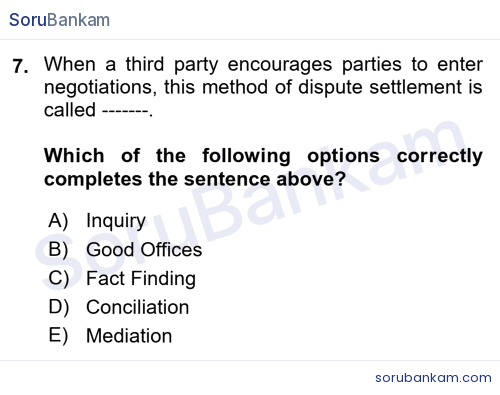
When a third party encourages parties to enter negotiations, this method of dispute settlement is called -—. Which of the following optlons correctly completes the sentence above? A) Inquiry B) Good Offices C) Fact Finding D) Conciliation E) Mediation
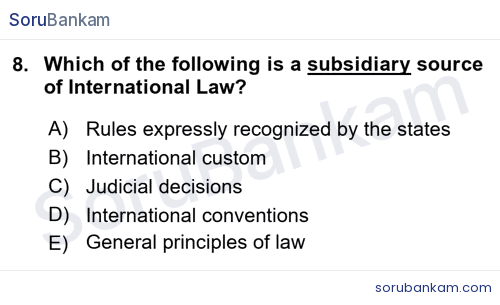
Which of the following is a subsidiary source of International Law? A) Rules expressly recognized by the states B) l International custom C) Judicial decisions D) International conventions E) General principles of law
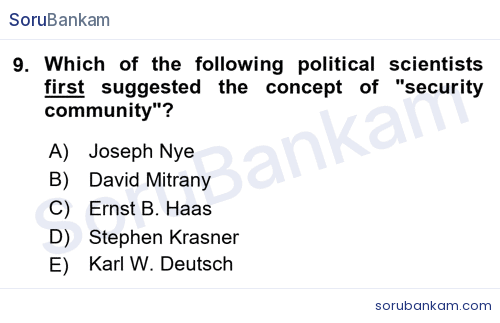
Which of the following political scientists first suggested the concept of "security community"? A) Joseph Nye B) David Mitrany C) Ernst B. Haas D) Stephen Krasner E) Karl W. Deutsch
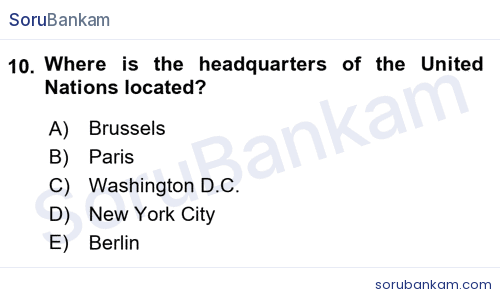
Where is the headquarters of the United Nations located? A) Brussels B) Paris C) Washington D.C. D) New York City E) Berlin
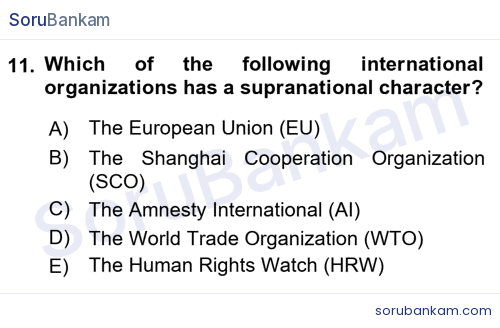
Which of the following internationa organizations has a supranational character? A) The European Union (EU) B) The Shanghai Cooperation Organization (SCO) C) The Amnesty International (Al). D) The World Trade Organization (WTO) E) The Human Rights Watch (HRW)
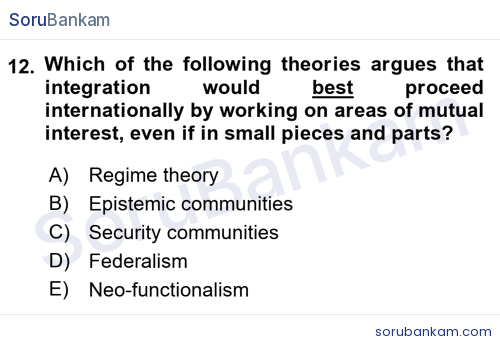
Which of the following theories argues that Integration would best proceed internationally by working on areas of mutual interest, even if in small pieces and parts? A) Regime theory B) Epistemic communities C) Security communities D) Federalism E) Neo-functionalism
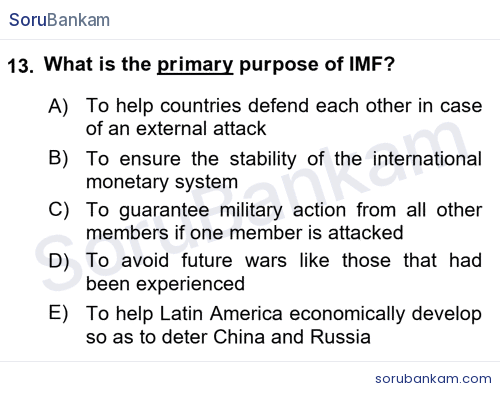
What is the primary purpose of IMF? A) To help countries defend each other in case of an external attack B) To ensure the stability of the international monetary system C) To guarantee military action from all other members if one member is attacked D) To avoid future wars like those that had been experienced E) To help Latin America economically develop so as to deter China and Russia
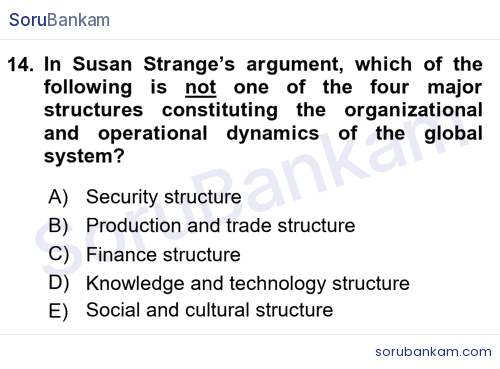
In Susan Strange's argument, which of the following is not one of the four major structures constituting the organizational and operational dynamics of the global system? A) Security structure B) Production and trade structure C) Finance structure D) Q) Knowledge and technology structure E) Social and cultural structure
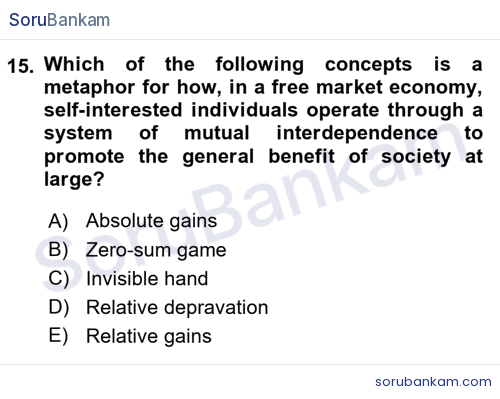
Which of the following concepts is a metaphor for how, in a free market economy, self-interested individuals operate through a system of mutual interdependence promote the general benefit of society at large? A) Absolute gains B) Zero-sum game C) Invisible hand D) Relative depravation E) Relative gains
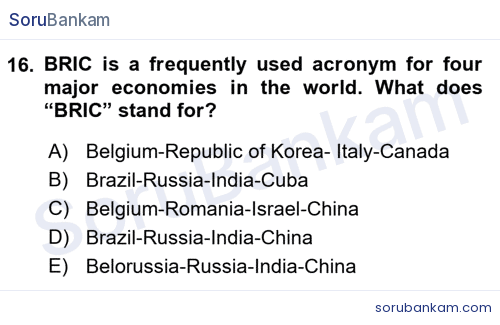
BRIC is a frequently used acronym for four major economles in the world. What does "BRIC" stand for? A) Belgium-Republic of Korea- Italy-Canada B) Brazil-Russia-India-Cuba C) Belgium-Romania-Israel-China D) Brazil-Russia-India-China E) Belorussia-Russia-india-China
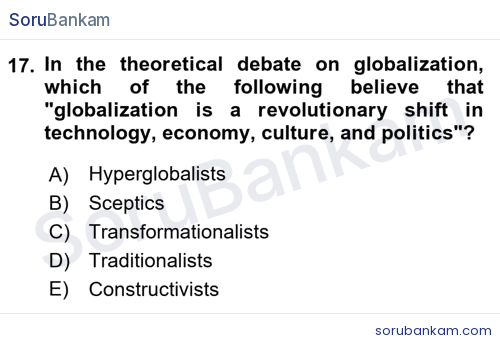
In the theoretical debate on globalization, which of the following believe that "globalization is a revolutionary shift in technology, economy, culture, and politics"? A) Hyperglobalists B) Sceptics C) Transformationalists D) Traditionalists E) Constructivists
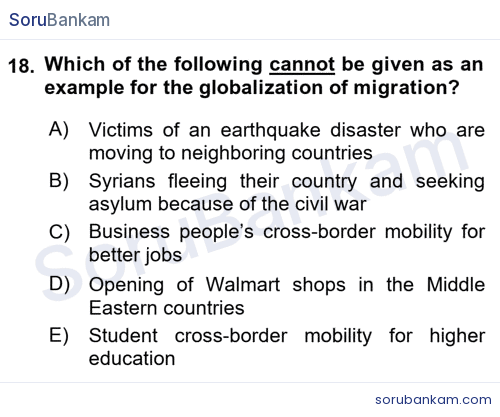
Which of the following cannot be given as an example for the globalization of migration? A) Victims of an earthquake disaster who are moving to neighboring countries B) Syrians fleeing their country and seeking asylum because of the civil war C) Business people's cross-border mobility for better jobs D) Opening of Walmart shops in the Middle. Eastern countries E) Student cross-border mobility for higher education
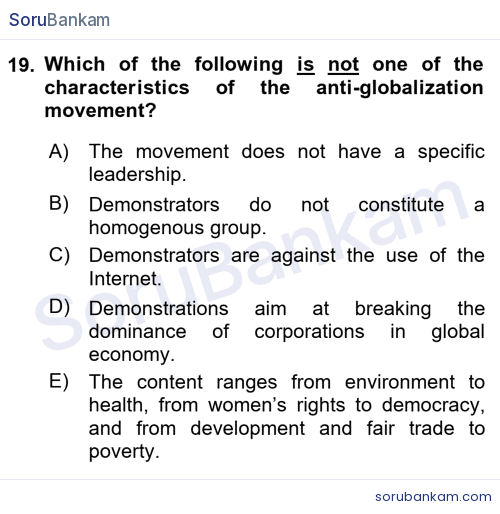
Which of the following is not one of the characteristics of the anti-globalization movement? A) The movement does not have a specific leadership. B) Demonstrators do not constitute a homogenous group. C) Demonstrators are against the use of the Internet. D) Demonstrations aim at breaking the dominance of corporations in global economy. E) The content ranges from environment to health, from women's rights to democracy, and from development and fair trade to poverty.
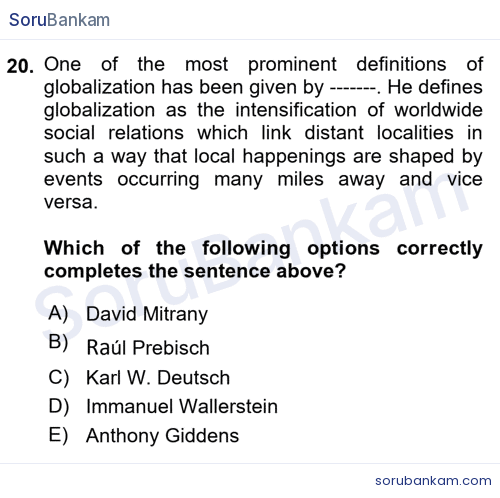
One of the most prominent definitions of globalization has been given by --_. He defines globalization as the intensification of worldwide social relations which link distant localities in such a way that local happenings are shaped by events occuring many miles away and. vice versa. Which of the following options correctly completes the sentence above? A) David Mitrany B) Raúl Prebisch C) Karl W. Deutsch D) Immanuel Wallerstein E) Anthony Giddens