ULI103U Introduction to International Relations 2021-2022 Vize Soruları
20 soru · Vize · 2021-2022
ULI103U Introduction to International Relations dersinin 2021-2022 vize sınavı 20 sorudan oluşur; ders AÖF Siyaset Bilimi ve Kamu Yönetimi (İngilizce) bölümünde okutulur. Sorular aşağıda sırasıyla yer alır. Doğru cevaplar ve sonucun, testi çözdüğünde görünür.
Önizleme · 20 soru. Cevaplamak ve sonucunu görmek için sınavı başlat.
Sorular
20 soru
Soru 1
Soru 2
Soru 3
Soru 4
Soru 5
Soru 6
Soru 7
Soru 8
Soru 9
Soru 10
Soru 11
Soru 12
Soru 13
Soru 14
Soru 15
Soru 16
Soru 17
Soru 18
Soru 19
Soru 20
Sınav modunda süre tutulur, doğru cevaplar ve sonucun sınav bitince görünür.
Dersin üniteleri
Ünite özetleri ve konu anlatımları
- 1. Ünite: The Study Of International Relations
- 2. Ünite: The Historical Evolution Of The International System
- 3. Ünite: Theories Of International Relations
- 4. Ünite: International Security
- 5. Ünite: International Law
- 6. Ünite: International Organizations
- 7. Ünite: Global Political Economy
- 8. Ünite: Globalization And Global Society
ULI103U Introduction to International Relations ders sayfası: bütün sınavlar ve üniteler
Soruların metni (otomatik okuma)
Görsellerden otomatik okunmuştur; hata içerebilir. Sorular, görsellerdeki hâliyle geçerlidir.
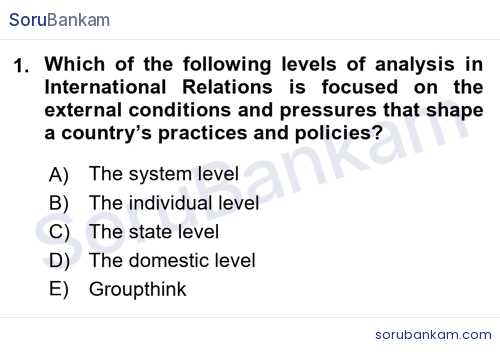
Which of the following levels of analysis in International Relations is focused on the external conditions and pressures that shape a country's practices and policies? A) The system level B) The individual level C) The state level D) The domestic level E) Groupthink
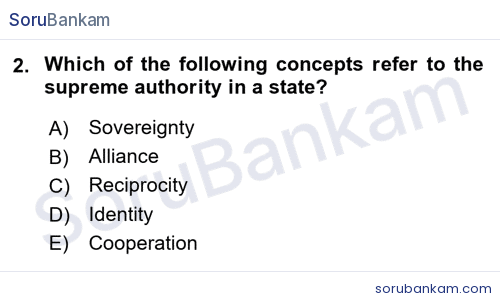
Which of the following concepts refer to the supreme authority in a state? A) Sovereignty B) Alliance C) Reciprocity D) Identity E) Cooperation
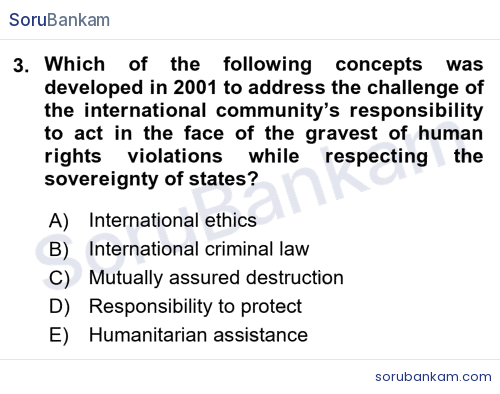
Which of the following concepts was. developed in 2001 to address the challenge of the international community's responsibility to act in the face of the gravest of human rights violations while respecting the sovereignty of states? A) International ethics B) International criminal law C) Mutually assured destruction D) Responsibility to protect E) Humanitarian assistance
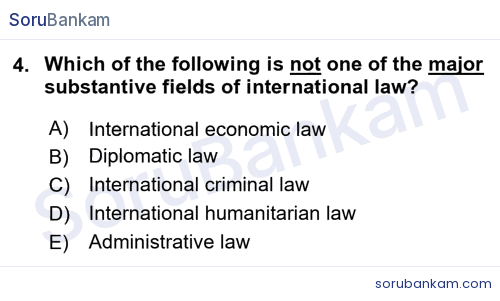
4. Which of the following is not one of the major? substantive fields of international law? A) International economic, law Diplomatic law „'C) International criminal law D) International humanitarian law E) Administrative law
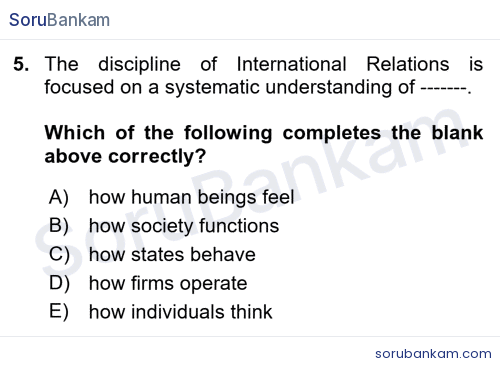
The discipline of Interational Relations is focused on a systematic understanding of --. Which of the following completes the blank above correctly? A) how human beings feel B) how society functions C) how states behave D) how firms operate E) how individuals think
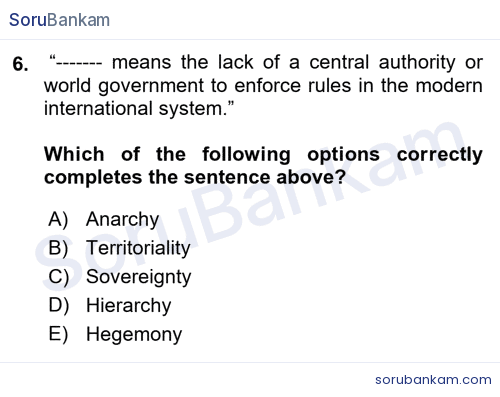
- means the lack of a central authority or world government to enforce rules in the modern international system." Which of the following options correctly completes the sentence above? A) Anarchy B) Territonialty C) Sovereignty D) Hierarchy E) Hegemony
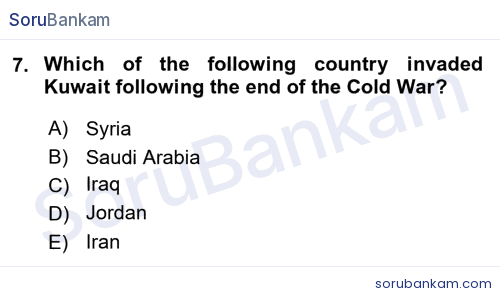
Which of the following country invaded Kuwait following the end of the Cold War? A) Syria B) Seudi Arabia C) Irad D) Jordan E) Iran
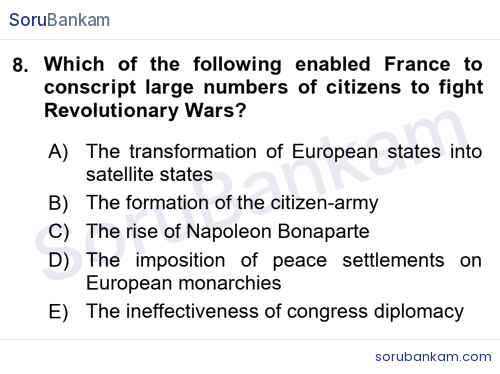
Which of the following enabled France to conscript large numbers of citizens to fight Revolutionary Wars? A) The tránsformation of European states into satellite states B) The formation of the citizen-army C) The rise of Napoleon Bonaparte D) The imposition of peace settlements on European monarchies E) *E) The ineffectiveness of congress diplomacy
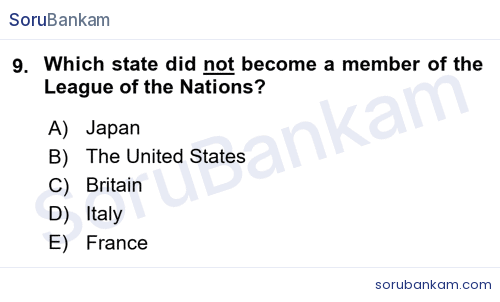
Which state did not become a member of the League of the Nations? A) Japan B) The United States C) Britain D) Italy E) France
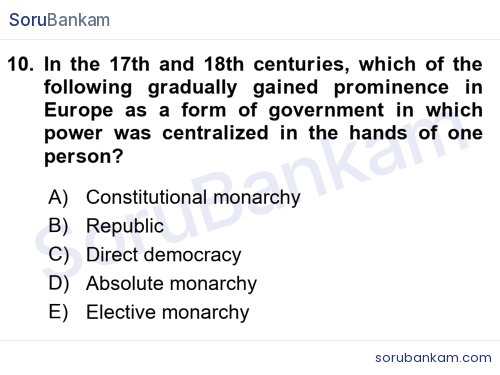
In the 17th and 18th centuries, which of the following gradually gained prominence in Europe as a form of government in which power was centralized in the hands of one person? A) Constitutional monarchy B) Republic C) Direct democracy D) Absolute monarchy E) Elective monarchy
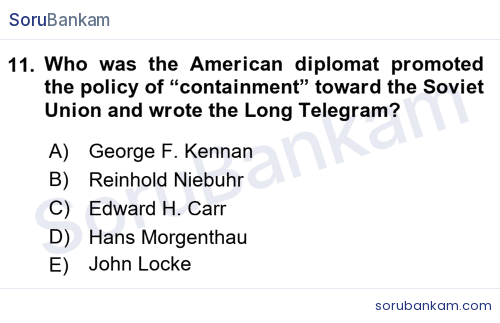
Who was the American diplomat promoted the policy of "containment" toward the Soviet Union and wrote the Long Telegram? A) George F. Kennan B) Reinhold Niebuhr C) Edward H. Carr D) Hans Morgenthau E) John Locke
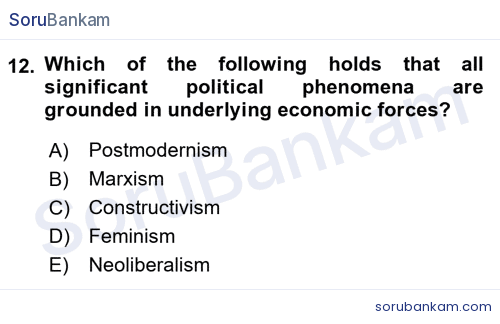
Which of the following holds that all significant political phenomena are grounded in underlying economic forces? A) Postmodernism B) Marxism C) Constructivism D) Feminism. E) Neoliberalism
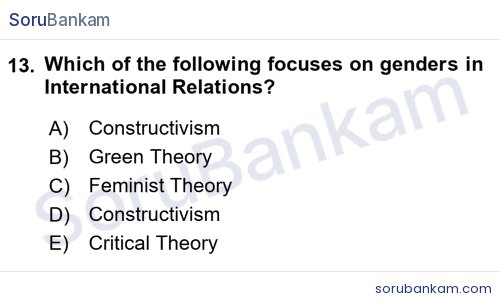
Which of the following focuses on genders in! International Relations? A) Constructivism B) Green Theory C) Feminist Theory D) Constructivism к. ' E) Critical Theory
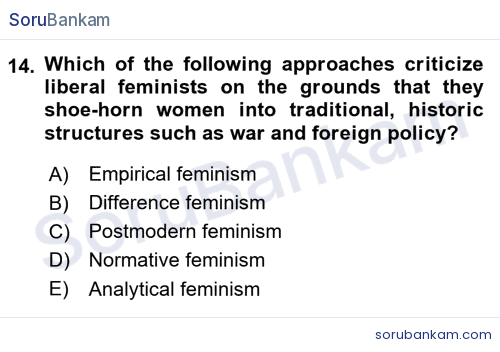
Which of the following approaches criticiza. liberal feminists on the grounds that they shoe-horn women into traditiohal, historic structuręș such as war apdyforeign policy? A) 'Empirical feminism B) Difference feminişm C) Postmodern feminism D) Normative feminism E) .. E) Analytical feminism
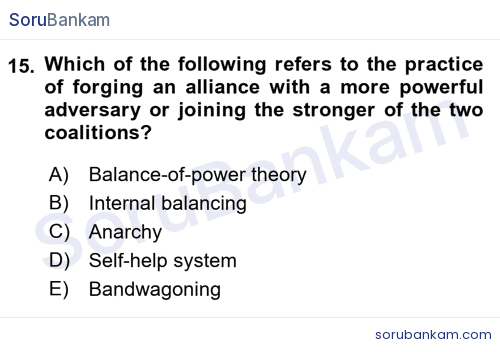
Which of the following refers to the practice of forging an alliance with a more powerful adversary or joining the stronger of the two coalltions? A) Balance-of-power theory B) Internal balancing C) Anarchy D) Self-help system E) Bandwagoning
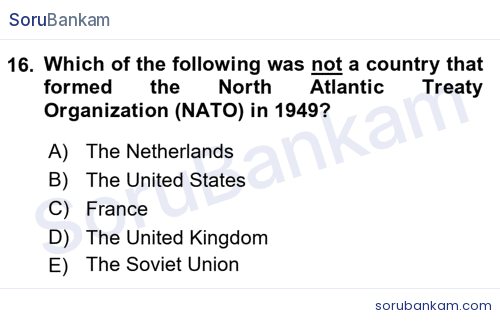
Which of the following was not a country that formed the North Atlantic Treaty Organization (NATO) in 1949? A) The Netherlands B) The United States C) France ... D) The United Kingdom E) The Soviet Union
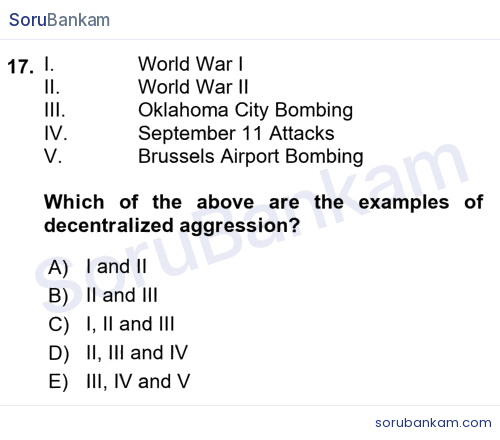
1. World War l II. word war.! III. Oklahora City Bombing IV. September 11 Attacks V. Brussels Airport Bombing Which of the above are the examples of decentralized aggression? A) landip" B) ~ NE) Tand III C) I, li and Ill D) II, Ill and E) III, iV and
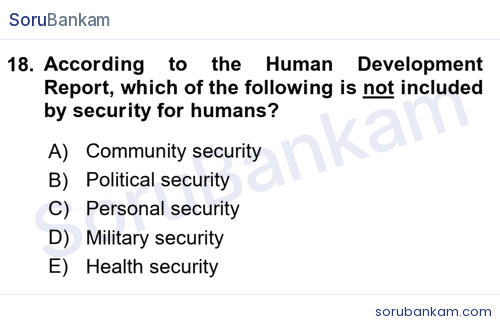
18. According to the Human Development Report, which of the following Is not included by security for humans? A) Community security Political security Personal security D) Military securty E) Health security
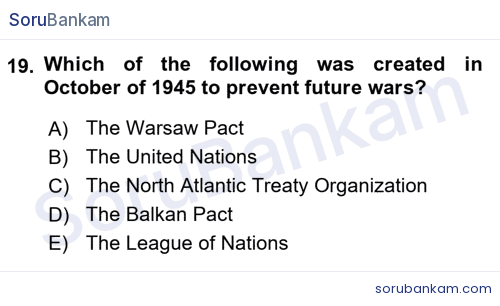
Which of the following was created in October of 1945 to prevent future wars? A) The Warsaw Pact B) The United Nations C) The North Atlantic Treaty Organization D) The Balkan Pact E) The League of Nations
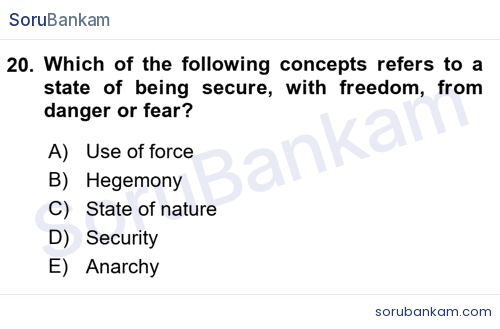
Which of the following concepts refers to a state of being secure, with freedom, from danger or fear? A) Use of force B) Hegemony C) State of nature D) Security E) Anarchy