ULI103U Introduction to International Relations 2023-2024 Final Soruları
20 soru · Final · 2023-2024
ULI103U Introduction to International Relations dersinin 2023-2024 final sınavı 20 sorudan oluşur; ders AÖF Siyaset Bilimi ve Kamu Yönetimi (İngilizce) bölümünde okutulur. Sorular aşağıda sırasıyla yer alır. Doğru cevaplar ve sonucun, testi çözdüğünde görünür.
Önizleme · 20 soru. Cevaplamak ve sonucunu görmek için sınavı başlat.
Sorular
20 soru
Soru 1
Soru 2
Soru 3
Soru 4
Soru 5
Soru 6
Soru 7
Soru 8
Soru 9
Soru 10
Soru 11
Soru 12
Soru 13
Soru 14
Soru 15
Soru 16
Soru 17
Soru 18
Soru 19
Soru 20
Sınav modunda süre tutulur, doğru cevaplar ve sonucun sınav bitince görünür.
Dersin üniteleri
Ünite özetleri ve konu anlatımları
- 1. Ünite: The Study Of International Relations
- 2. Ünite: The Historical Evolution Of The International System
- 3. Ünite: Theories Of International Relations
- 4. Ünite: International Security
- 5. Ünite: International Law
- 6. Ünite: International Organizations
- 7. Ünite: Global Political Economy
- 8. Ünite: Globalization And Global Society
ULI103U Introduction to International Relations ders sayfası: bütün sınavlar ve üniteler
Soruların metni (otomatik okuma)
Görsellerden otomatik okunmuştur; hata içerebilir. Sorular, görsellerdeki hâliyle geçerlidir.
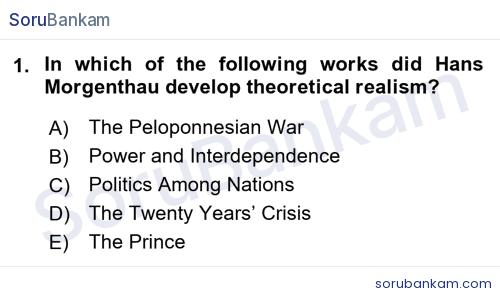
In which of the following works did Hans Morgenthau develop theoretical realism? A) The Peloponnesian War B) Power and Interdependence C) Politics Among Nations D) The Twenty Years' Crisis E) The Prince
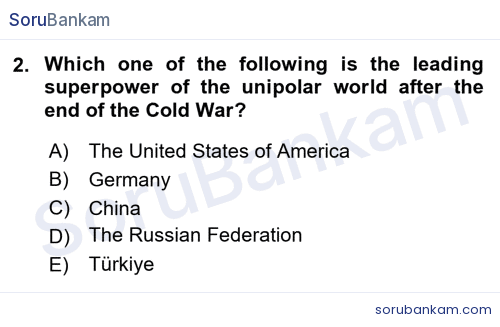
Which one of the following is the leading superpower of the unipolar world after the end of the Cold War? A) The United States of America B) Germany C) China D) The Russian Federation E) Turkiye
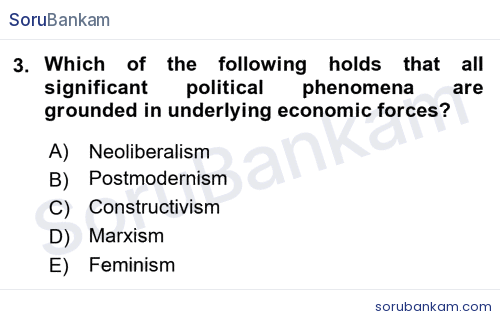
Which of the following holds that alt significant political phenomena. are grounded in underlying economic forces? A) Neoliberalism B) Postmodernism C) Constructivism D) Marxism E) Fertinism
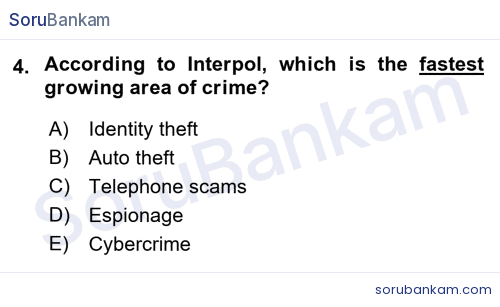
According to Interpol, which is the fastest growing area of crime? A) Identity theft B) Auto theft C) Telephone scams D) Espionage E) Cybercrime
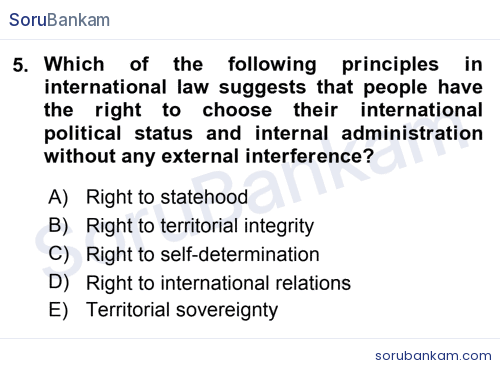
Which of the following principles in international law suggests that people have the right to choose their international political status and internal administration without any external interference? A) Right to statehood B) Right to territorial integrity C) Right to self-determination D) Right to international relations E) Territorial sovereignty
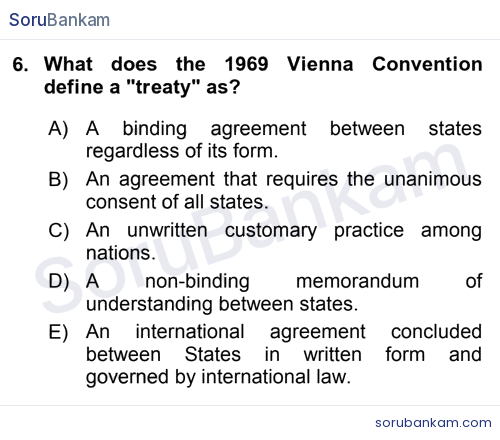
6. What does the 1969 Vienna Convention datine a "treaty a5?y A) A binding ' agreement between states regardless of its form. " "'B)' An agreement that requires the unanimous consent of all states. C) An unwritten customary practice among nations. non-binding memorandum of understanding between states. E) An international agreement concluded between. States in written form and governed by international law.
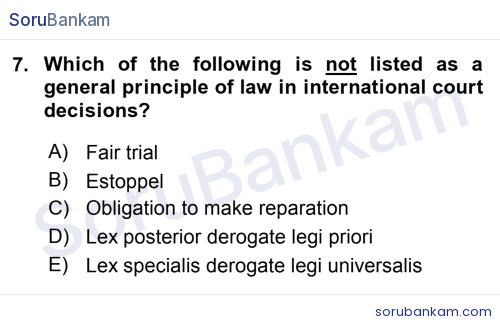
Which of the following is not listed as a general principle of law in international court decislons? A) Fair trial B) Estoppel C) Obligation to make reparation D) Lex posterior derogate legi priori E) Lex specialis derogate legi universalis
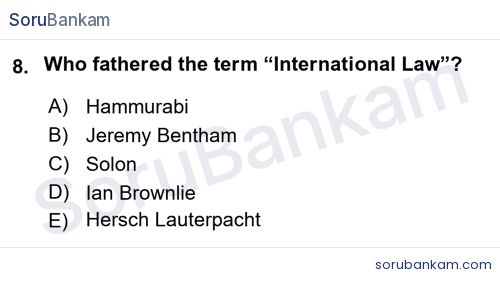
Who fathered the term "International Law"? A) Hammurabi B) Jeremy Bentham C) Solon D) lan Brownlie E) Hersch Lauterpacht
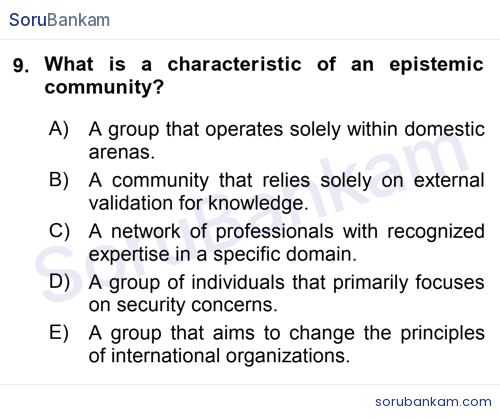
What is a characteristic of an epistemic community? A) A group that operates solely within domestic arenas. B) A community that relies solely on external validation for knowledge. C) A network of professionals with recognized expertise in a specific domain. D) A group of individuals that primarily focuses on security conces. E) A group that aims to change the principles of international organizations.
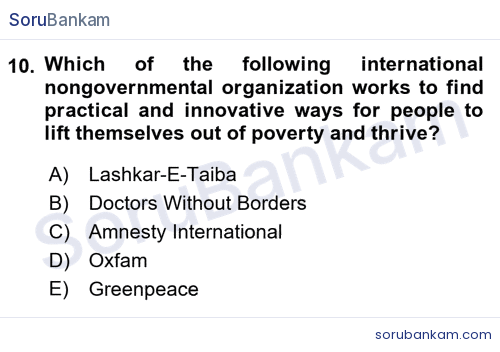
Which of the following international nongovernmental organization works to find practical and innovative ways for people to lift themselves out of poverty and thrive? A) Lashkar-E-Taiba B) Doctors Without Borders C) Amnesty Intemational D) Oxfam E) Greenpeace
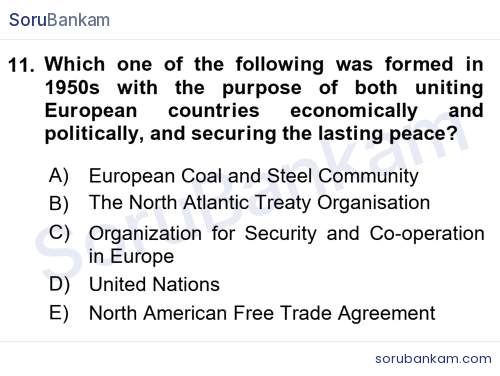
Which one of the following was formed in 1950s with the purpose of both uniting European countries economically and politically, and securing the lasting peace? A) European Coal and Steel Community B) The North Atlantic Treaty Organisation C) Organization for Security and Co-operation in Europe D) United Nations E) North American Free Trade Agreement
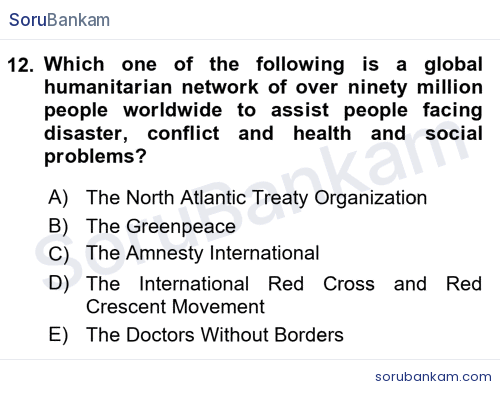
Which one of the following is a global humanitarian network of over ninety million people worldwide to assist people facing disaster, conflict and health and social problems? A) The North Atlantic Treaty Organization B) The Greenpeace C) The Amnesty Intemational D) The International Red Cross and Red Crescent Movement E) The Doctors Without Borders
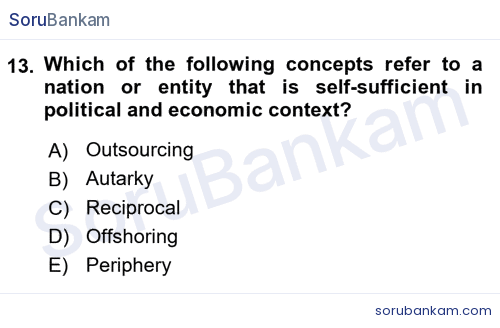
Which of the following concepts refer to a nation or entity that is self-sufficient in political and ecenomic context? A) Outsourcing B) Autarky C) Reciprocal D) Offshoring E) Periphery
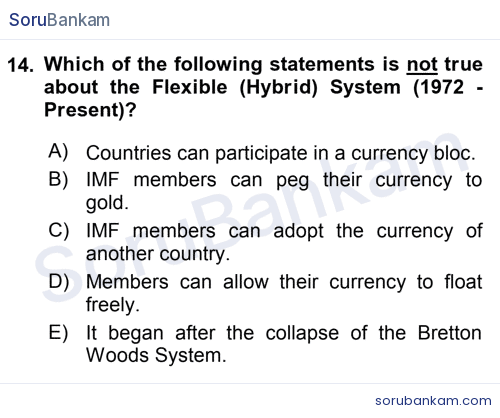
Which of the following statements is not true about the Flexible (Hybrid) System (1972 - Present)? A) Countries can participate in a currency bloc. B) IMF members can peg their currency to gold. C) IMF members can adopt the currency of another country. D) Members can allow their currency to float freely. E) It began after the collapse of the Bretton Woods System.
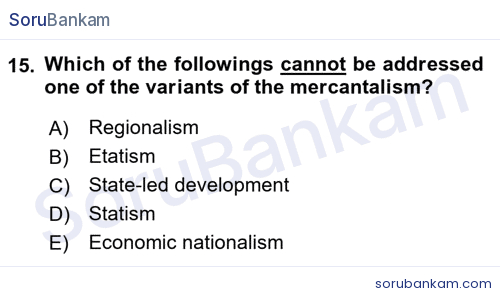
Which of the followings cannot be addressed one of the variants of the mercantalism? A) Regionalism B) Etatism C) State-led development D) Statism E) Economic nationalism
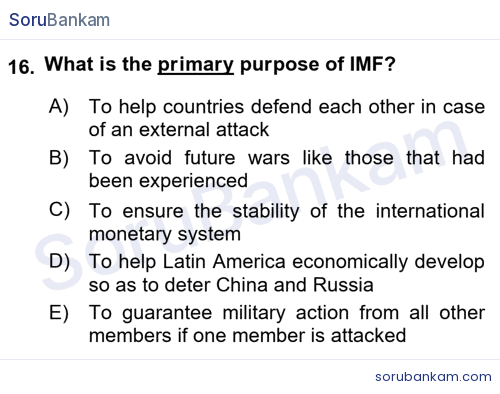
What is the primary purpose of IMF? A) To help countries defend each other in case of an external attack B) To avoid future wars like those that had been experienced C) To ensure the stability of the international monetary system D) To help Latin America economically develop so as to deter China and Russia E) To guarantee military action from all other members if one member is attacked
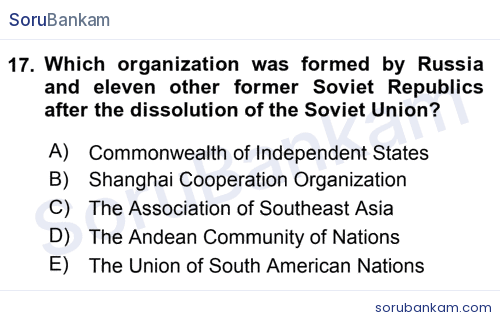
Which organization was formed by Russia and eleven other former Soviet Republics after the dissoluțion of the Soviet Union? 1- A) Commonwealth of Independent States B) Shanghai Cooperation Organization C) The Association of Southeast Asią ^ D) The Andean Community of Nations E) _The Union of South American Nations
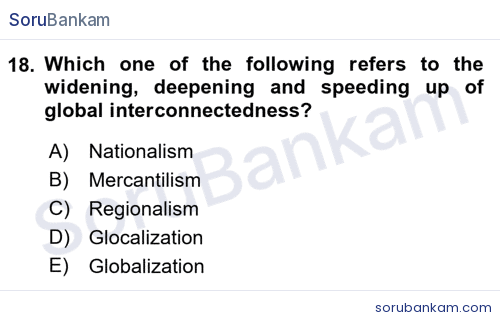
Which one of the following refers to the widening, deepening and speeding up of global interconnectedness? A) Nationalism B) Mercantilism C) Regionalism D) Glocalization E) Globalization
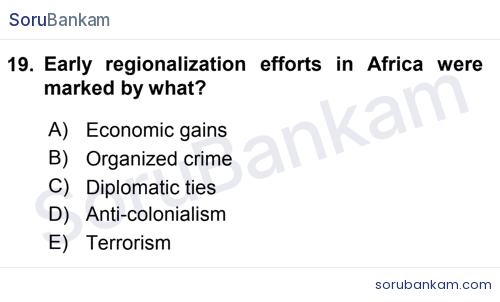
Early regionalization efforts in Africa were marked by what? A) Economic gains B) Organized crime C) Diplomatic ties (1.~ D) Anti-colonialism E) Terrorism
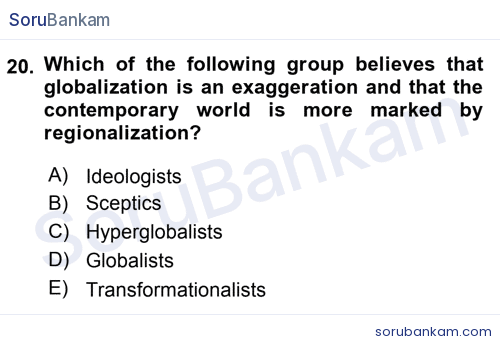
Which of the following group believes that globalization is an exaggeration and that the contemporary world is more marked by regionalization? A) Ideologists B) Sceptics C) Hyperglobalists D) Globalists E) Transformationalists