ULI103U Introduction to International Relations 2017-2018 Vize Soruları
20 soru · Vize · 2017-2018
ULI103U Introduction to International Relations dersinin 2017-2018 vize sınavı 20 sorudan oluşur; ders AÖF Siyaset Bilimi ve Kamu Yönetimi (İngilizce) bölümünde okutulur. Sorular aşağıda sırasıyla yer alır. Doğru cevaplar ve sonucun, testi çözdüğünde görünür.
Önizleme · 20 soru. Cevaplamak ve sonucunu görmek için sınavı başlat.
Sorular
20 soru
Soru 1
Soru 2
Soru 3
Soru 4
Soru 5
Soru 6
Soru 7
Soru 8
Soru 9
Soru 10
Soru 11
Soru 12
Soru 13
Soru 14
Soru 15
Soru 16
Soru 17
Soru 18
Soru 19
Soru 20
Sınav modunda süre tutulur, doğru cevaplar ve sonucun sınav bitince görünür.
Dersin üniteleri
Ünite özetleri ve konu anlatımları
- 1. Ünite: The Study Of International Relations
- 2. Ünite: The Historical Evolution Of The International System
- 3. Ünite: Theories Of International Relations
- 4. Ünite: International Security
- 5. Ünite: International Law
- 6. Ünite: International Organizations
- 7. Ünite: Global Political Economy
- 8. Ünite: Globalization And Global Society
ULI103U Introduction to International Relations ders sayfası: bütün sınavlar ve üniteler
Soruların metni (otomatik okuma)
Görsellerden otomatik okunmuştur; hata içerebilir. Sorular, görsellerdeki hâliyle geçerlidir.
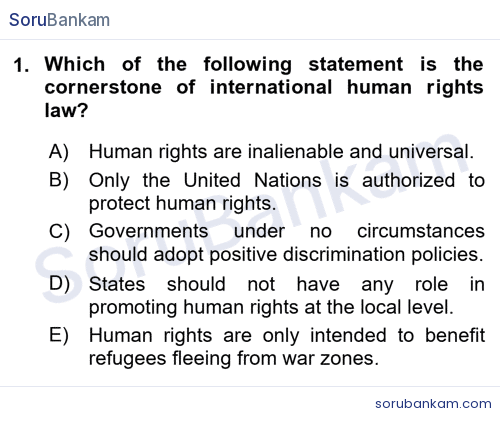
Which of the following statement is the cornerstone of international human rights law? A) Human rights are inalienable and universal. B) By Only the United Nations is authorized to protect human rights. C) Goverments under no circumstances should adopt positive discrimination policies. D) States should not have any role in promoting human rights at the local level. E) Human rights are only intended to benefit refugees fleeing from war zones.
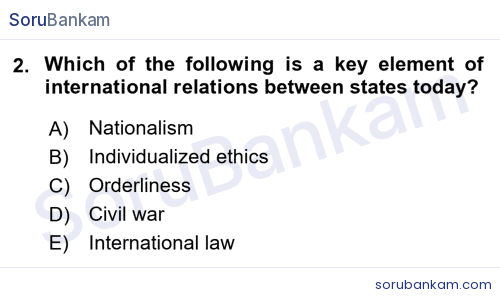
Which of the following is a key element of international relations between states today? A) Nationalism B) Individualized ethics C) Orderliness D) Civil war E) International law
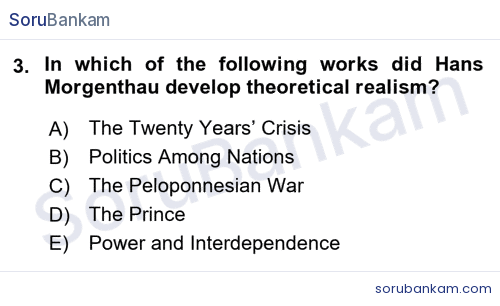
In which of the following works did Haps Morgenthau develop theoretical realism?' A) The Twenty Years' Crisis B) Politics Among Nations C) The Peloponnesian War D) The Prince E) E Powef and Interdependence
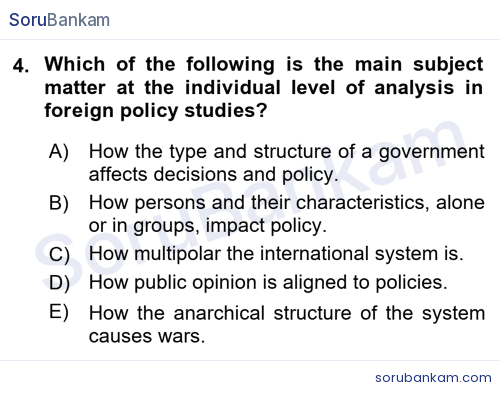
Which of the following is the main subject matter at the Individual level of analysis in foreign policy studies? A) How the type and structure of a government affects decisions and policy. B) _ How persons and their characteristics, alone or in groups, impact policy. C) How multipolar the international system is. D) How public opinion is aligned to policies. E) How the anarchical structure of the system causes wars.
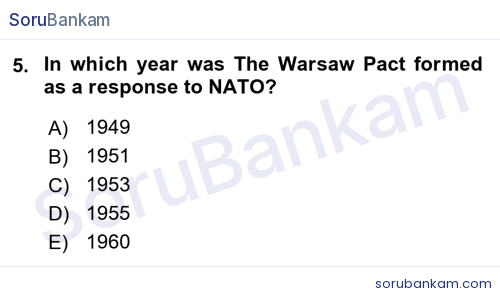
In which year was The Warsaw Pact formed A) as a response to NATO? 1949 B) 1951 C) 1953 D) 1955 E) 1960
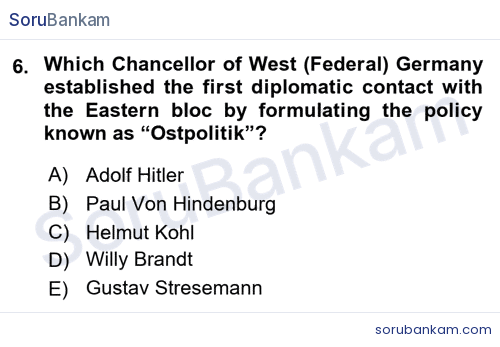
Which Chancellor of West (Federal) Germany established the first diplomatic contact with the Eastern bloc›by formulating the policy known as "Ostpolitik"? 7 A) Adolf Hitler B) Paul Von Hindenourg C) Helmut Kon!. D) Willy Brandt E) „E) Gustav Stresemann
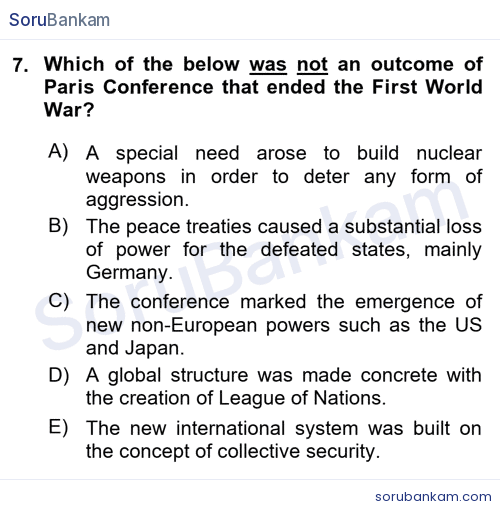
Which of the below was not an outcome of Paris Conference that ended the First World War? A) A special need arose to build nuclear • weapons in order to deter any form of aggression. B) The peace treaties caused a substantial loss of power for the defeated states, mainly Germany. C) The conference marked the emergence of new non-European powers such as the US and Japan. D) A global structure was made concrete with the creation of League of Nations. E) The new international system was built on the concept of collective security.
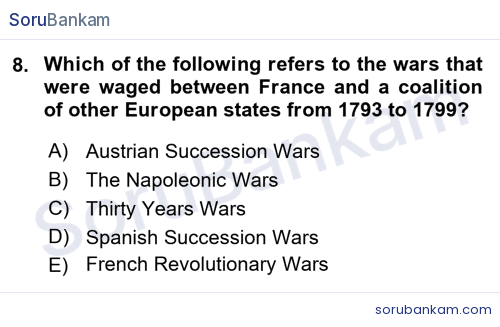
Which of the following refers to the wars that were waged between France and a coalition of other European states from 1793 to 1799? A) Austrian Succession Wars B) The Napoleonic Wars C) Thirty Years Wars D) Spanish Succession Wars E) French Revolutionary Wars
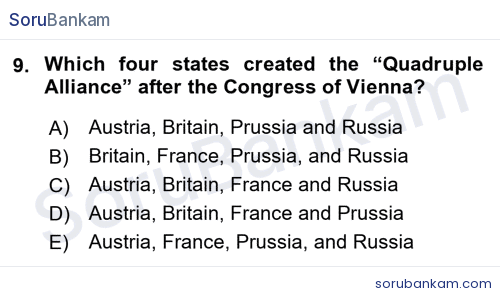
Which four states created the "Quadruple Alliance" after the Congress of Vienna? A) Austria, Britain, Prussia and Russia B) Brtain, France, Prussia, and Russia C) Austria, Britain, France and Russia D) Austria, Britain, France and Prussia E) Austria, France, Prussia, and Russia
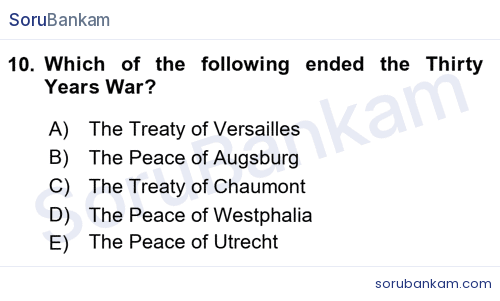
Which of the following ended the Thirty Years War? A) The Treaty of Versailles B) The Peace of Augsburg C) The Treaty of Chaumont D) The Peace of Westphalia E) The Peace of Utrecht
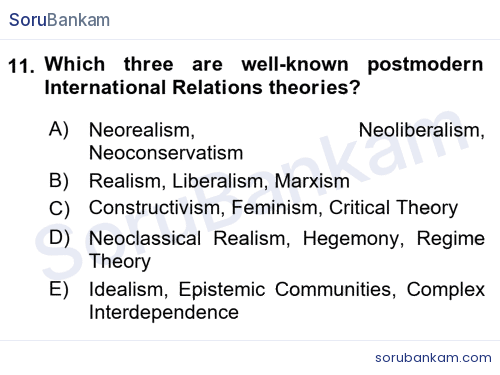
11. Which three are well-known postmodern. International Relations theories? A) Neorealism, 1. Neoliberalism, Neoconservatism B) Realism, Liberalism, Marxism C) Constructivism, Feminism, Critical Triedry D) Neoclassicat Realism, Hegemony, Regime Theory Idealism, Epistemic Communities, Complex' Interdependence
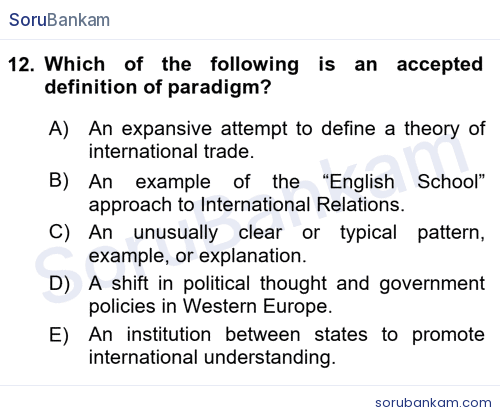
Which of the following is an accepted definition of paradigm? A) An expansive attempt to define a theory of international trade. B) An example of the "English School" approach to International Relations. C) An unusually clear or typical pattern, example, or explanation. D) A shift in political thought and government policies in Western Europe. E) An institution between states to promote international understanding.
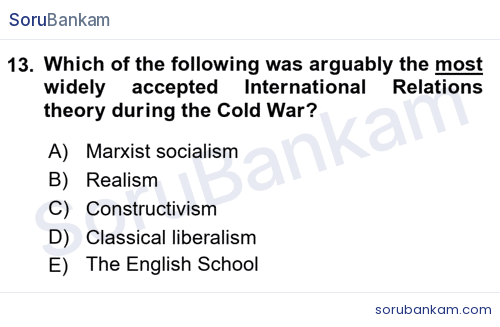
Which of the following was arguably the most widely accepted International Relations theory during the Cold War? A) Marxist socialism B) Realism C) Constructivism '. D) Classical liberalism E) The English School
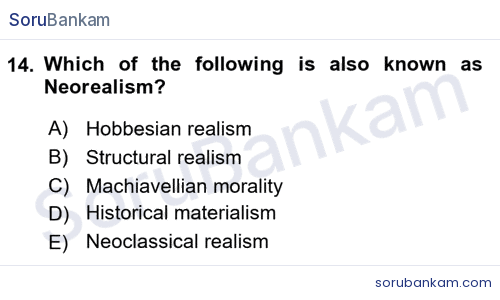
14. Which of the following is also known as Neorealism? Hobbesian realism Structural realism «' Machiavellian morality D) Historical materialism E) Neoclassical realism
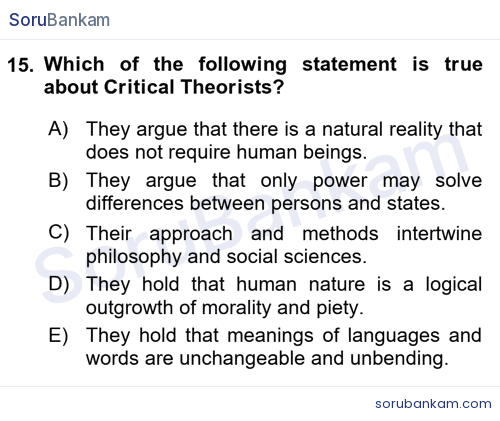
Which of the following statement is true about Critical Theorists? A) They argue that there is a natural reality that does not require human beings. B) .. B) They argue that only power may solve differences between persons and states. C) Their approach and methods intertwine philosophy and social sciences. D) They hold that human nature is a logical outgrowth of morality and piety. E) They hold that meanings of languages and words are unchangeable and unbending.
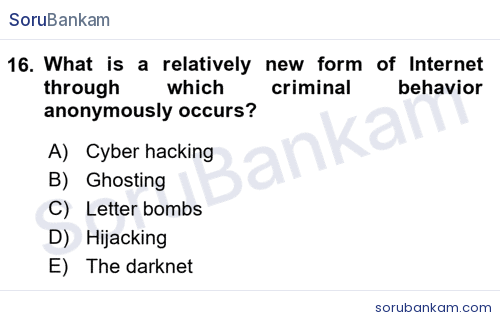
What is a relatively new form of Internet through which criminal behavior anonymously oçcurs? A) Cyber hacking B) Ghosting C) Letter bombs D) Hijacking • E) The darknet
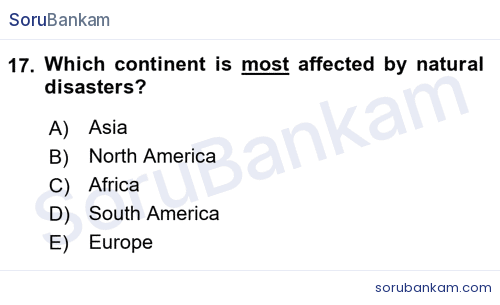
17. Which continent is most affected by natural disasters? A) Asia North America Africa D) South America E) Europe
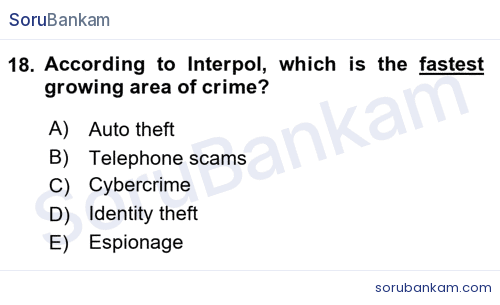
18. According to Interpol, which is the fastest growing area of crime? A) Auto theft Telephone scams C) Cybercrime D) Identity theft Espionage
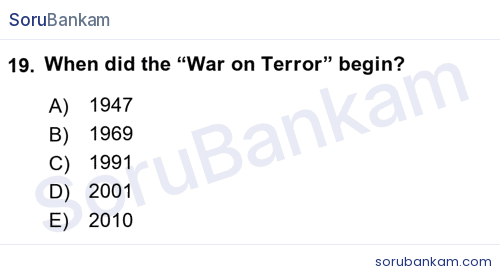
19. When did the "War on Terror" begin? 1947 1969 C) 1991 D) 2001 E) 2010
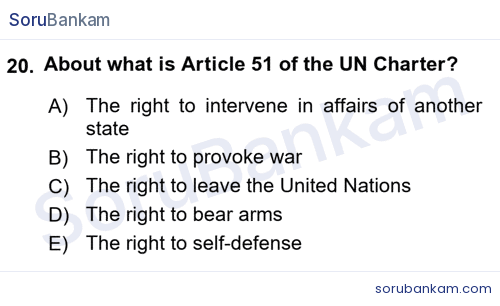
About what is Article 51 of the UN Charter? A) The right to intervene in affairs of another state B) The right to provoke war C) The right to leave the United Nations D) The right to bear arms 1'.. E) The right to self-defense