ISL114U Business Management 2018-2019 Final Soruları
20 soru · Final · 2018-2019
ISL114U Business Management dersinin 2018-2019 final sınavı 20 sorudan oluşur; ders AÖF İşletme (İngilizce) bölümünde okutulur. Sorular aşağıda sırasıyla yer alır. Doğru cevaplar ve sonucun, testi çözdüğünde görünür.
Önizleme · 20 soru. Cevaplamak ve sonucunu görmek için sınavı başlat.
Sorular
20 soru
Soru 1
Soru 2
Soru 3
Soru 4
Soru 5
Soru 6
Soru 7
Soru 8
Soru 9
Soru 10
Soru 11
Soru 12
Soru 13
Soru 14
Soru 15
Soru 16
Soru 17
Soru 18
Soru 19
Soru 20
Sınav modunda süre tutulur, doğru cevaplar ve sonucun sınav bitince görünür.
Dersin üniteleri
Ünite özetleri ve konu anlatımları
- 1. Ünite: Fundamentals Management
- 2. Ünite: The History Of Management Thought
- 3. Ünite: Management Environment
- 4. Ünite: Managerial Planning And Decision Making
- 5. Ünite: The Fundamentals Of Strategic Management
- 6. Ünite: Organizational Design, Teamwork, And Organizational Change
- 7. Ünite: Leadership, Diversity, And Motivation
- 8. Ünite: Managerial Control
ISL114U Business Management ders sayfası: bütün sınavlar ve üniteler
Soruların metni (otomatik okuma)
Görsellerden otomatik okunmuştur; hata içerebilir. Sorular, görsellerdeki hâliyle geçerlidir.
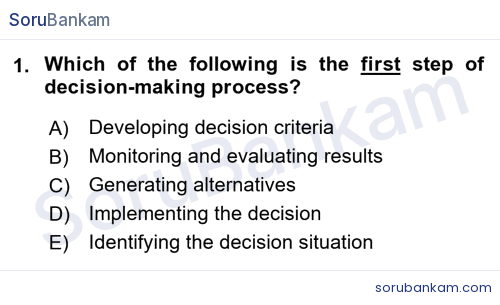
1. Which of the following is the first step of decision-making process? A) l Developing decision crițeria Monitoring and evaluating results C) Generating altematives D) Implementing the decision Identifying the decision situation
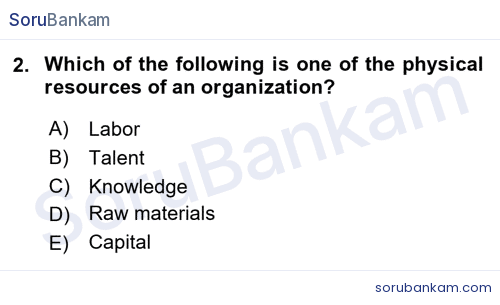
Which of the following is one of the physical resources of an organization? A) Labor B) Talent C) Knowledge D) Raw materials E) Capital
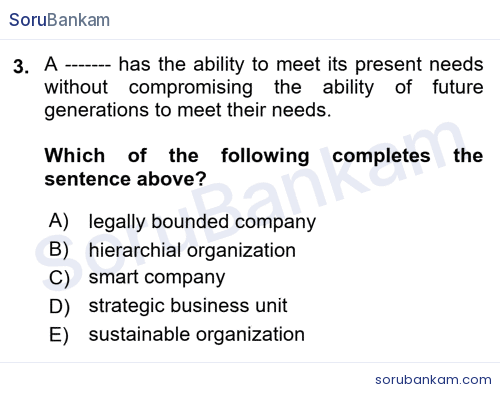
A -— has the ability to meet its present needs" without compromising the ability of future generations to meet their needs. Which of the following completes the sentence above? A) legally bounded company - '* B) hierarchial organization C) smart company D) strategic business unit E) sustainable organization
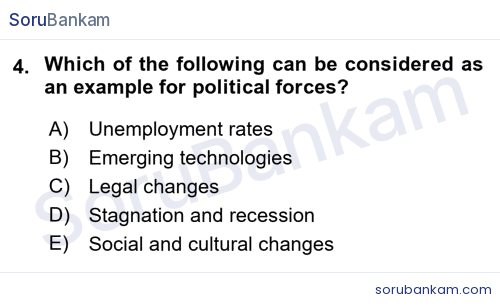
Which of the following can be considered as an example for polițical forces? A) Unemployment rates B) Emerging technologies C) Legal changes D) Stagnation and recession E) Social and cultural changes
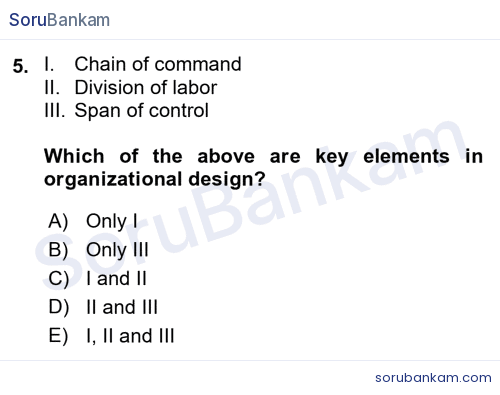
1. Chain of command II. Division of labor Ili. Span of control Which of the above are key elements in organizational design? A) Only B) Only lil C) I and D) Il and III E) I, Il and I!l
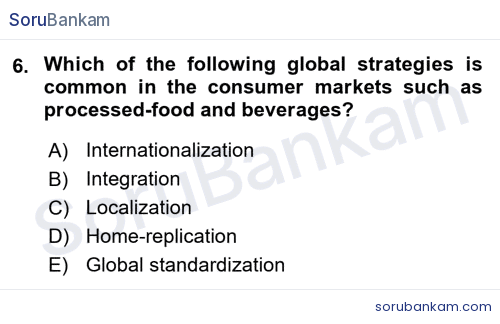
Which of the following global strategies is common in the consumer markets such as processed-food and'beverages? A) Internationalization B) • Li B) Integration C) Localization D) Home-replication E) Global standardization
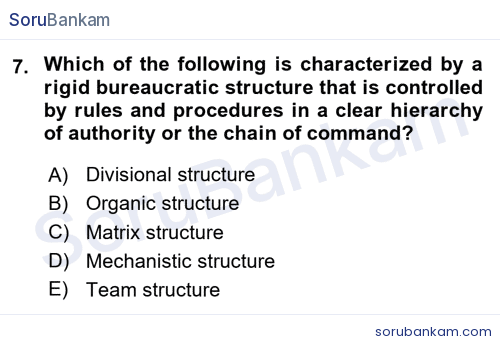
Which of the following is characterized by a rigid bureaucratic structure that is controlled by rules and procedures in a clear hierarchy of authority or the chain of command? A) Divisional structure B) Organic structure C) Matrix structure D) Mechanistic structure E) Team structure
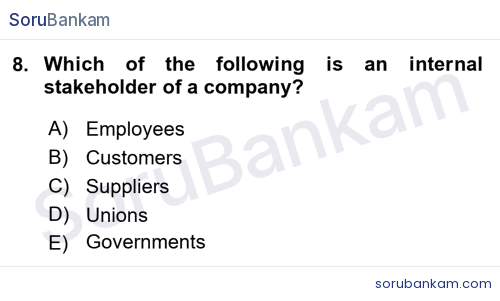
Which of the following is an internal. stakeholder of a company? A) Employees B) Customers C) Suppliers D) Unions E) Govemments
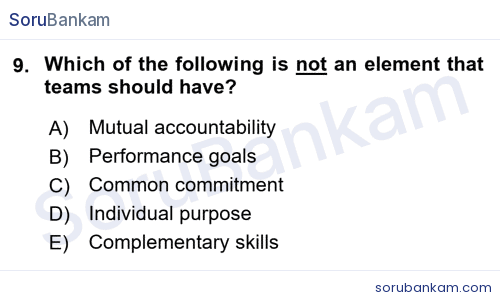
Which of the following is not an element that teams should have? A) Mutual accountability B) Performance goals C) Common commitment D) Individuai purpose E) Complementary skilis
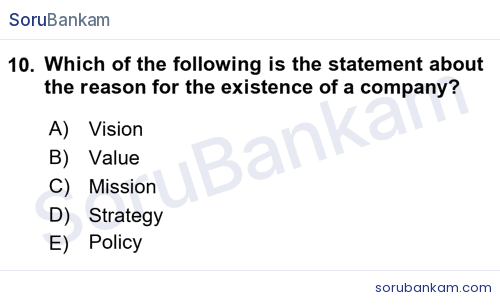
Which of the following is the statement about the reason for the existence of a company? A) Vision B) Value C) Mission D) Strategy E) Policy
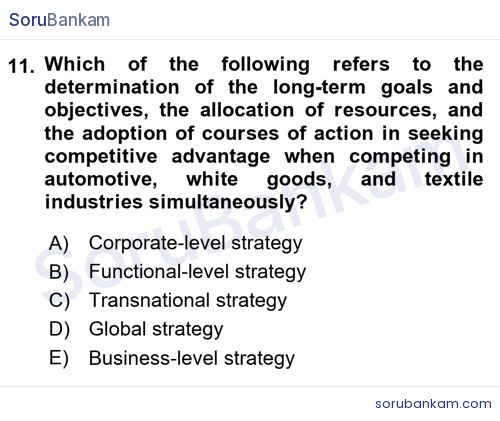
Which of the foliowing refers to the determination of the long-term goals and objectives, the allocation of resources, and the adoption of courses, of action in seeking competitive advantage when competing in automotive, white goods, and textile industries simultaneously? A) Corporate-level strategy B) Functional-level strategy C) Transnational strategy D) Global strategy ‹ E) Business-level strategy
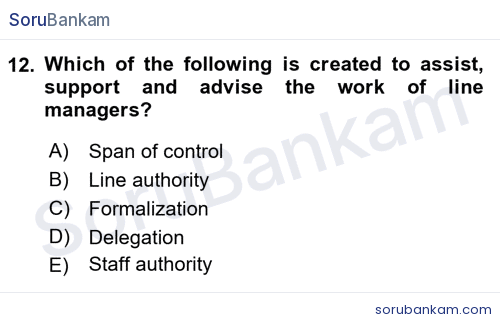
Which of the following is created to assist, support and advise the work of line managers? A) Span of control B) Line authority C) Formalization D) Delegation E) Staff authority
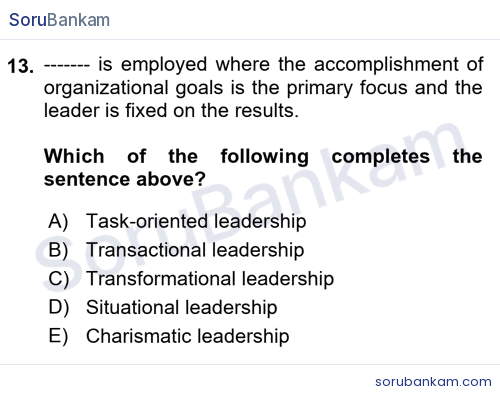
— is employed where the accomplishment of organizational goals is the primary focus and the leader is fixed on the results. Which of the following completes the sentence above? A) Task-oriented leadership B) Transactional leadership C) Transformational leadership D) Situational leadership E) Charismatic leadership
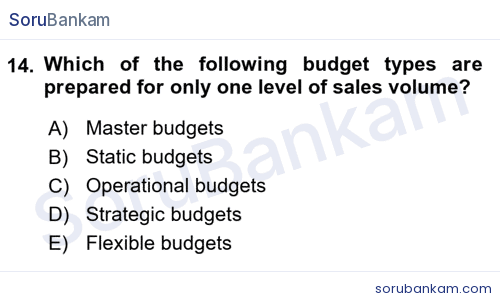
Which of the following budget types are prepared for only one level of sales volume? A) Master,budgets B) Static budgets C) • C) Operational budgets D) Strategic budgęts E) Flexible büdgets
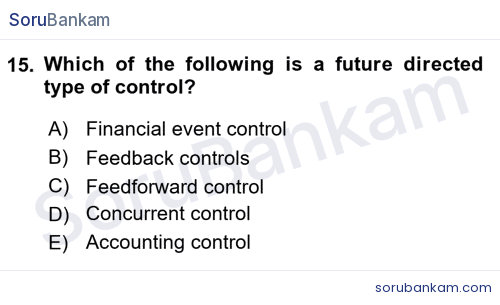
Which of the following is a future directed type of control? A) Financial event control B) Feedback controls C) Feedforward control D) S Concurrent control E) Accounting control
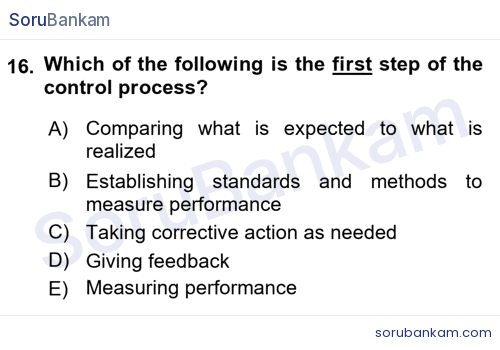
Which of the following is the first step of the control process? A) Comparing what is expected to what is realized B) Establishing standards and methods to measure performance C) Taking corrective action as needed D) Giving feedback E) Measuring performance
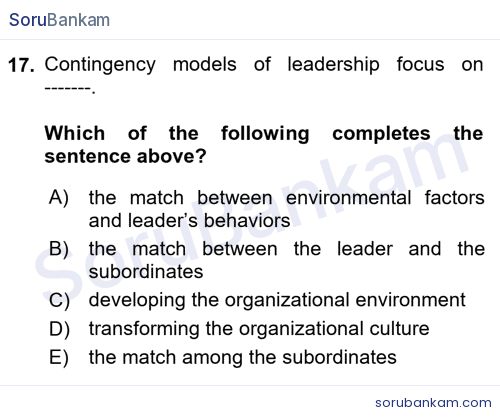
Contingency models of leadership focus on ------. Which of the following completes the sentence above? A) the match between environmental factors and leader's behaviors B) the match between the leader and the subordinates C) developing the organizational environment D) transforming the organizational culture E) the match among the subordinates
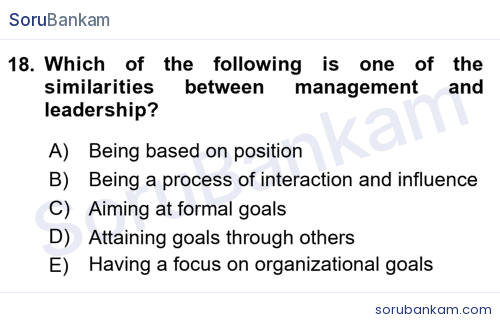
Which of the following is one of the similarities between management and leadership? A) Being based on position B) Being a process of interaction and influenge C) Aiming at formal goals D) Attaining goals through others E) Having a focus on organizational goals
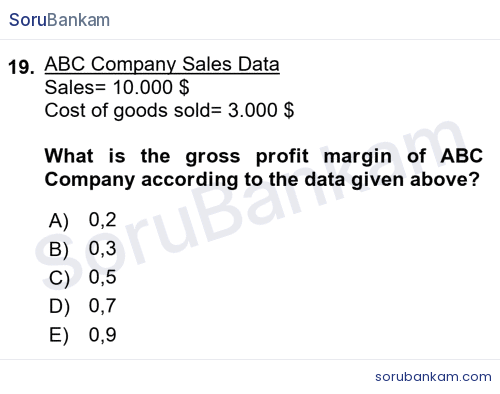
ABC Company Sales Data Sales= 10.000 $ Cost of goods sold- 3.000 $ What is the gross profit margin of ABC Company according to the data given above? A) 0,2 B) 0,3 C) 0,5 D) 0,7 E) 0,9
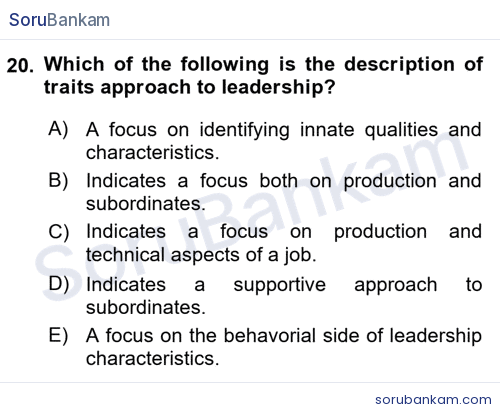
Which of the following is the description of traits approach to leadership? A) A focus on identifying innate qualities and characteristics. B) Indicates a focus both on production, and subordinates. C) Indicates a focus on prodúction and technical aspects of a job. D) Indicates a supportive approach to subordinates. E) A focus on the behavorial side of leadership characteristics.