ISL114U Business Management 2023-2024 Vize Soruları
20 soru · Vize · 2023-2024
ISL114U Business Management dersinin 2023-2024 vize sınavı 20 sorudan oluşur; ders AÖF İşletme (İngilizce) bölümünde okutulur. Sorular aşağıda sırasıyla yer alır. Doğru cevaplar ve sonucun, testi çözdüğünde görünür.
Önizleme · 20 soru. Cevaplamak ve sonucunu görmek için sınavı başlat.
Sorular
20 soru
Soru 1
Soru 2
Soru 3
Soru 4
Soru 5
Soru 6
Soru 7
Soru 8
Soru 9
Soru 10
Soru 11
Soru 12
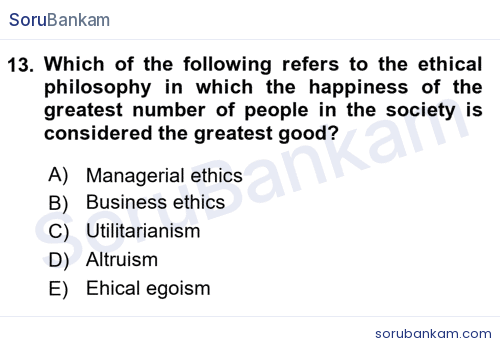
Soru 13
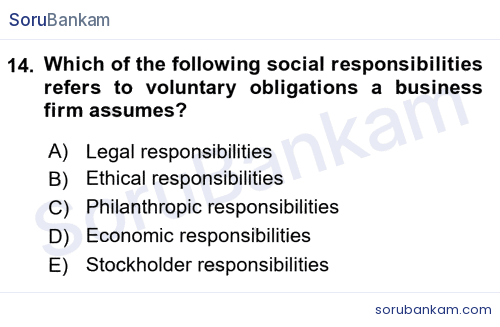
Soru 14
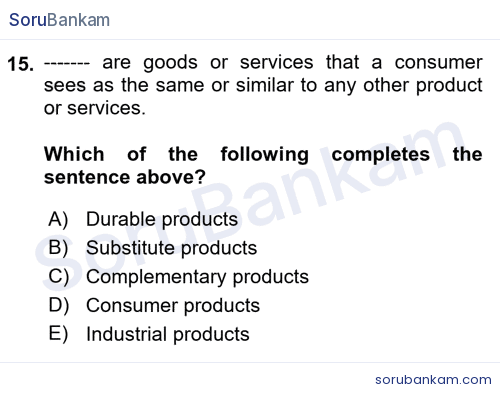
Soru 15
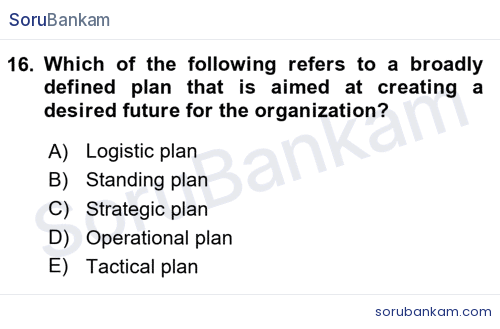
Soru 16
Soru 17
Soru 18
Soru 19
Soru 20
Sınav modunda süre tutulur, doğru cevaplar ve sonucun sınav bitince görünür.
Dersin üniteleri
Ünite özetleri ve konu anlatımları
- 1. Ünite: Fundamentals Management
- 2. Ünite: The History Of Management Thought
- 3. Ünite: Management Environment
- 4. Ünite: Managerial Planning And Decision Making
- 5. Ünite: The Fundamentals Of Strategic Management
- 6. Ünite: Organizational Design, Teamwork, And Organizational Change
- 7. Ünite: Leadership, Diversity, And Motivation
- 8. Ünite: Managerial Control
ISL114U Business Management ders sayfası: bütün sınavlar ve üniteler
Soruların metni (otomatik okuma)
Görsellerden otomatik okunmuştur; hata içerebilir. Sorular, görsellerdeki hâliyle geçerlidir.
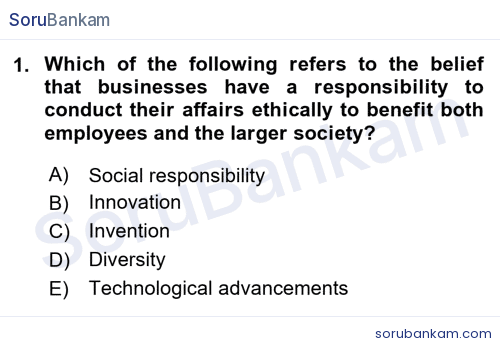
Which of the following refers to the belief that businesses have a responsibility to conduct their affairs ethically to benefit both employees and the larger society? A) Social responsibility B) Innovation C) Invention D) Diversity E) Technological advancements
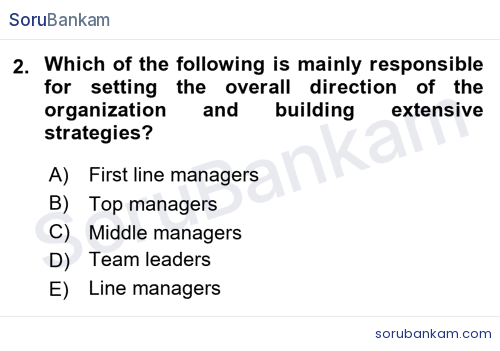
Which of the following is mainly responsible for setting the overall direction of the organization and building extensive strategies? A) First line managers B) Top managers C) Middle managers D) Team leaders E) Line managers
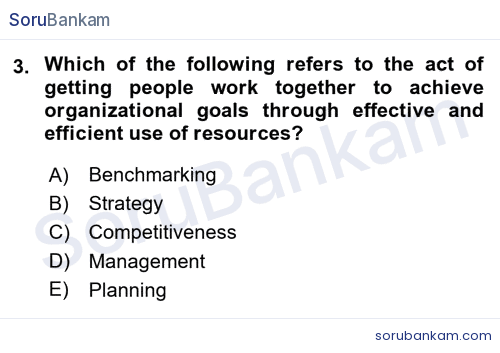
Which of the following refers to the act of getting people work together to achieve organizationa goals through aftective and efficient use ofresources?~i A) Benchmarking B) Strategy C) Competitiveness D) Management E) • Planning
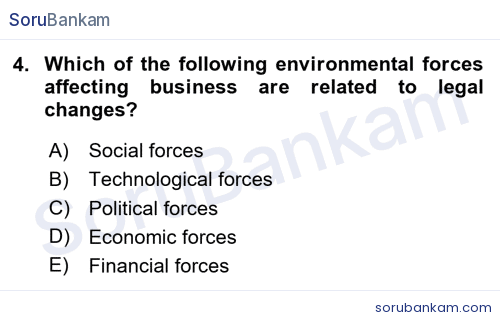
Which of the following environmental forces affecting business are related to legal changes? A) Social forces B) Technological forces C) Political forces D) Economic forces E) Financial forces
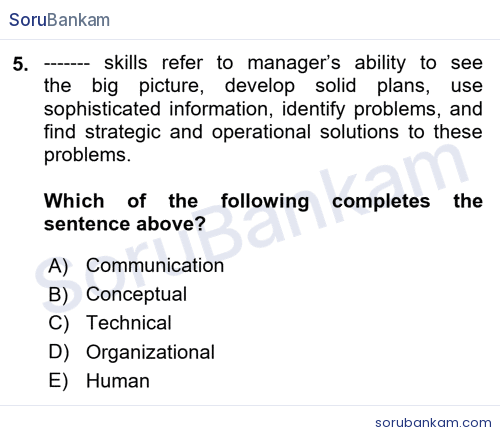
-- skills refer to managers ability to see the big picture, develop solid plans, use sophisticated information, identify problems, and find strategic and operational solutions to these problems. Which of the following completes. sentence above? A) Communication B) Conceptual C) Technical D) Organizational • E) Human
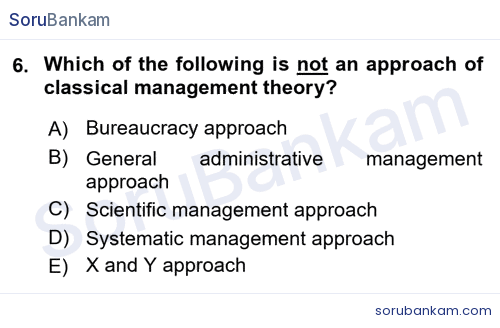
Which of the following is not an approach of classical managemęnt theory? A) Bureaucracy approach B) General administrative management approach C) Scientific management approach D) Systematic management approach E) X-and Y approach
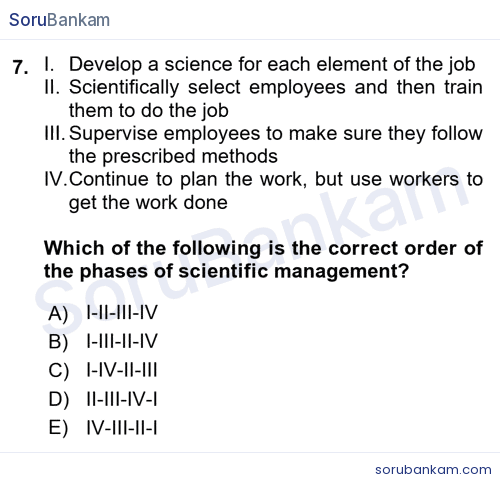
1. Develop a science for each element of the job II. Scientifically select employees and then train them to do the job III. Supervise employees to make sure they follow the prescribed methods IV. Continue to plan the work, but use workers to get the work done Which of the following is the correct order of the phases of scientific management? A) I-II-III-IV B) I-III-II-IV C) I-/V-il-I- D) II-III-IV-I E) IV-III-II-
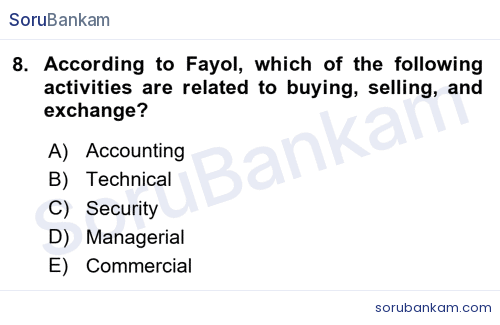
According to Fayol, which of the following activities are related to buying, selling, and exchange? A) Accounting B) Technical C) Secunty D) Managerial E) Commercial
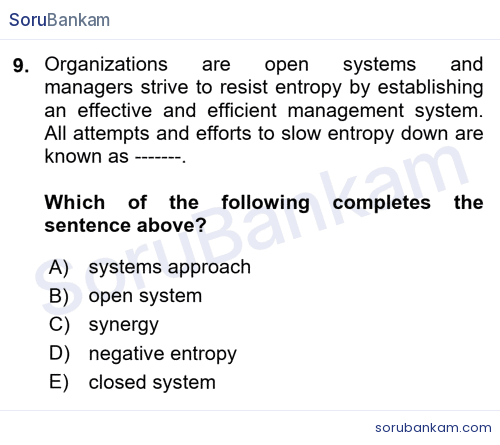
Organizations are open systems and managers strive to resist entropy by establishing an effective and efficient management system. All attempts and efforts to slow entropy down are known as —-. Which of the following completes the sentence above? A) systems approach B) open system C) synergy D) negative entropy E) closed system
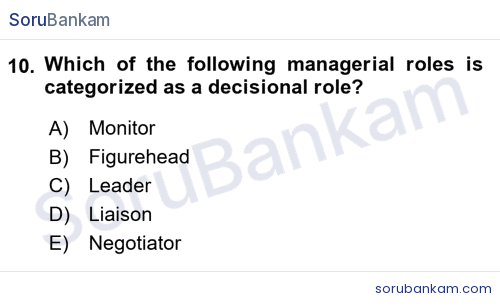
Which of the following managerial roles is categorized as a decisional role? A) Monitor B) Figurehead C) Leader D) Liaison E) Negotiator
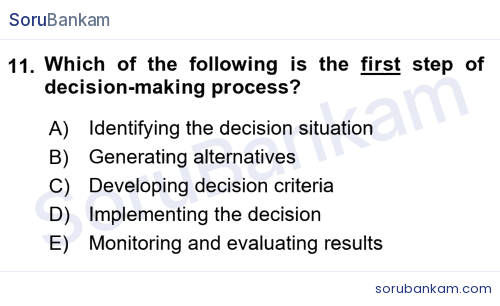
Which of the following is the first step of decision-making process? A) Identifying the decision situation B) Generating alteratives C) Developing decision criteria D) Implementing the decision E) Monitoring and evaluating results
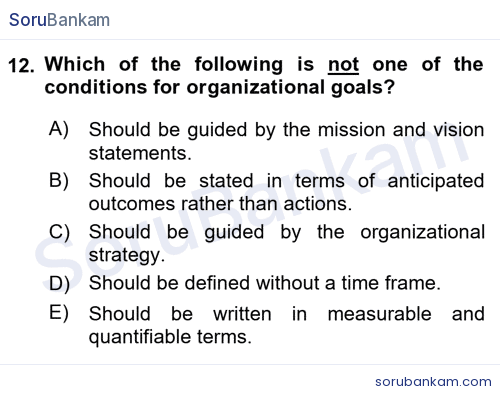
Which of the following is not one of the conditions for organizational goals? A) Should be guided by the mission and vision statements. B) Should be stated in terms of anticipated outcomes rather than actions. C) Should be guided by the organizational strategy. D) Should be defined without a time frame. E) Should be written in measurable and quantifiable terms.
Which of the following refers to the ethical philosophy in which the happiness of the greatest number of people in the society is considered the greatest good? A) Managerial ethics B) Business ethics C) Utilitarianism D) Altruism E) Ehical egoism
Which of the following social responsibilities refers to voluntary obligations a business firm assumes? A) Legal responsibilties B) Ethical responsibilities C) Philanthropic responsibilities D) Economic responsibilities E) Stgckholder responsibilities
- are goods or services that a consumer sees as the same or similar to any other product or services. Which of the following completes the sentence above? A) Durable products B) Substitute products C) Complementary products D) Consumer products E) Industrial products
Which of the following refers to a broadly defined plan that is aimed at creating a desired future for the organzation? A) Logistic plan B) Standing plan C) Strategic plan D) Operational plan E) Tactical plan
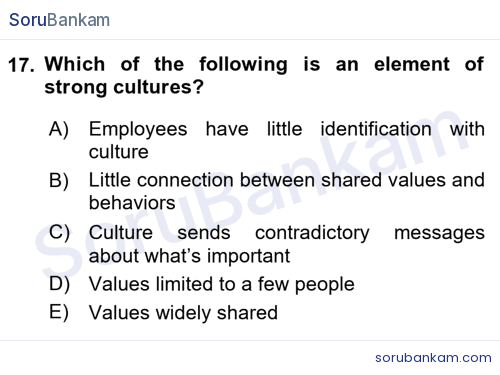
Which of the following is an element of A) strong cultures? Employees have little identification with culture B) Little connection between shared values and behaviors C) Culture sends contradictory messages about what's important D) Values limited to a few people E) Values widely shared
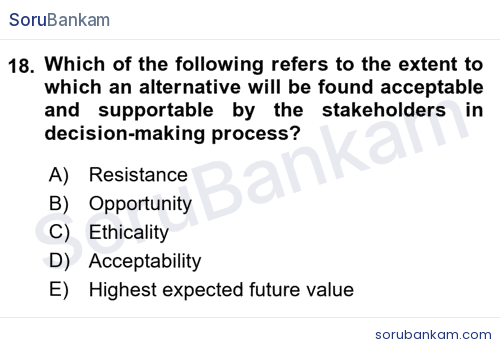
Which of the following refers to the extent to which an alternative will be found acceptable and supportable by the stakeholders in decision-making process? A) Resistance B) Opportunity C) Ethicality D) Acceptability E) Highest expected future value
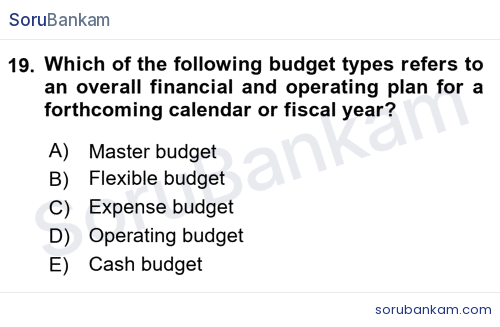
Which of the following budget types refers to an overall financial and operating plan for a forthcoming calendar or fiscal year? A) Master budget B) Flexible budget C) Expense budget D) Operating budget E) Cash budget
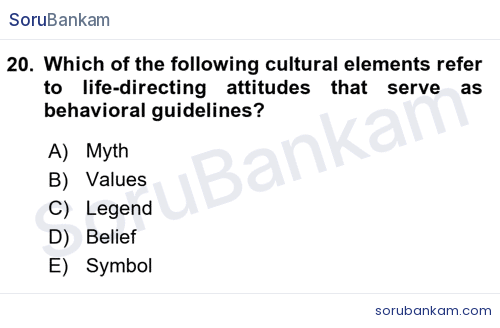
Which of the following cultural elements refer to life-directing attitudes that serve as behavioral guidelines? A) Myth B) Values C) Legend • 1' D) Belief E) Symbol