ULI101U Introduction to World Civilization 2023-2024 Yaz Okulu Soruları
20 soru · Yaz okulu · 2023-2024
ULI101U Introduction to World Civilization dersinin 2023-2024 yaz okulu sınavı 20 sorudan oluşur; ders AÖF Siyaset Bilimi ve Kamu Yönetimi (İngilizce) bölümünde okutulur. Sorular aşağıda sırasıyla yer alır. Doğru cevaplar ve sonucun, testi çözdüğünde görünür.
Önizleme · 20 soru. Cevaplamak ve sonucunu görmek için sınavı başlat.
Sorular
20 soru
Soru 1
Soru 2
Soru 3
Soru 4
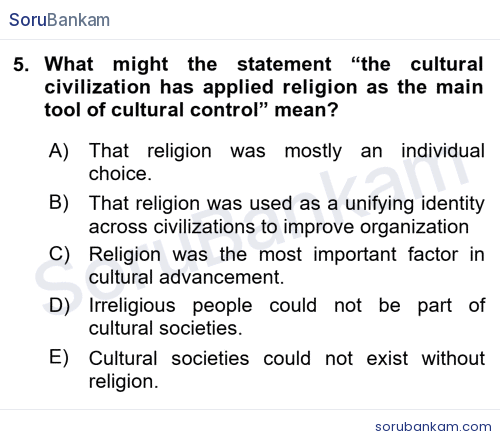
Soru 5
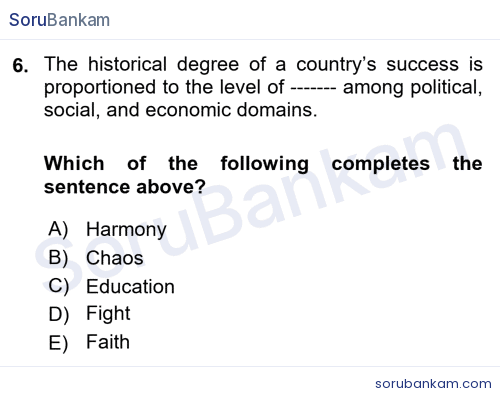
Soru 6
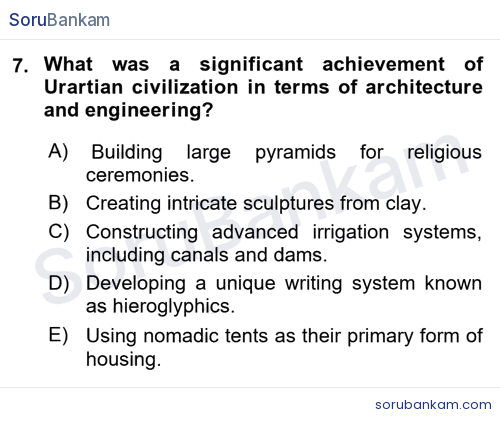
Soru 7
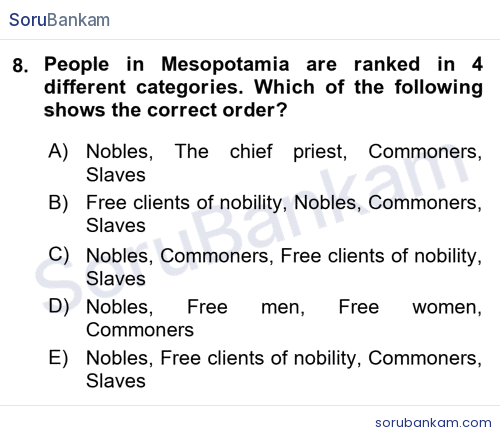
Soru 8
Soru 9
Soru 10
Soru 11
Soru 12
Soru 13
Soru 14
Soru 15
Soru 16
Soru 17
Soru 18
Soru 19
Soru 20
Sınav modunda süre tutulur, doğru cevaplar ve sonucun sınav bitince görünür.
Dersin üniteleri
Ünite özetleri ve konu anlatımları
- 1. Ünite: The Civilization Approach To Human Development
- 2. Ünite: The Mesopotamian Civilization
- 3. Ünite: The Egyptian Civilization
- 4. Ünite: Anatolian Civilizations
- 5. Ünite: The Hellenic Civilization
- 6. Ünite: The Roman Civilization
- 7. Ünite: The Byzantine Civilization
- 8. Ünite: The Sinic Civilization
ULI101U Introduction to World Civilization ders sayfası: bütün sınavlar ve üniteler
Soruların metni (otomatik okuma)
Görsellerden otomatik okunmuştur; hata içerebilir. Sorular, görsellerdeki hâliyle geçerlidir.
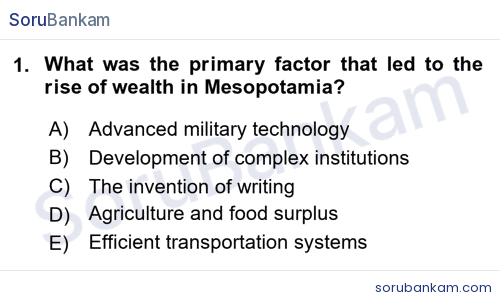
What was the primary factor that led to the rise of wealth in Mesopotamia? A) Advanced military technology B) Development of complex institutions C) The invention of writing D) Agricuture and food surplus E) Efficient transportation systems
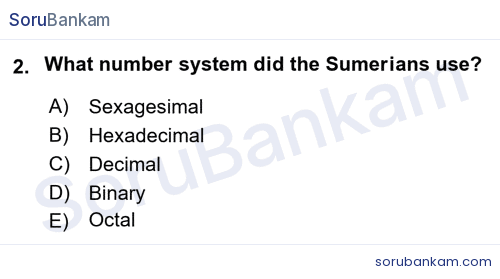
What number system did the Sumerians use? A) Sexagesimal B) Hexadecimal C) Decimal D) Binary E) Octal
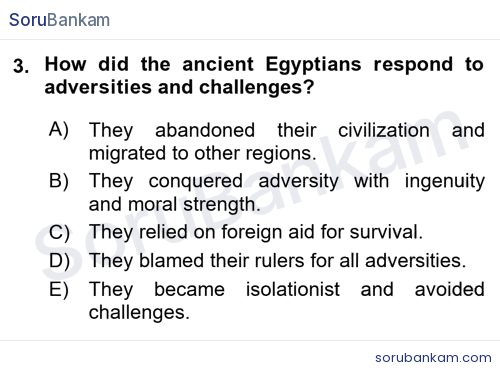
How did the ancient Egyptians respond to adversities and challenges? A) They abandoned their civilization and migrated to other regions. B) They conquered adversity with ingentity and moral strength. C) They relied on foreign aid for survival. D) They blamed their rulers for all adversities. E) e) They became isolationist and avoided challenges.
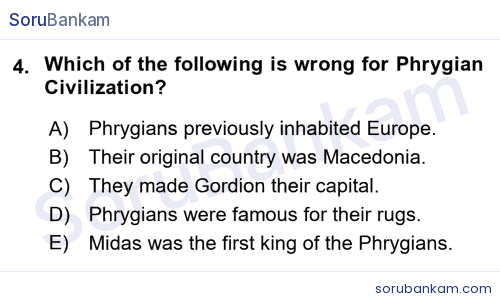
Which of the following is wrong for Phrygian Civilizatlon? A) Phrygians préviously inhabited Europe. B) Their original country was Macedonia. C) They made Gordion their capital. D) Phrygians were famous for their rugs. E) Midas was the first king of the Phrygians.
What might the statement "the cultural civilization has applied religion as the main tool of cultural control" mean? A) That religion was mostly an individual choice. B) That religion was used as a unifying identity across civilizations to improve organization C) Religion was the most important factor in cultural advancement. D) Irreligious people could not be part of cultural societies. E) Cultural societies could not exist without religion.
The historical degree of a country's success is proportioned to the level of -.- among political, social, and economic domains. Which of the following completes the sentence above? A) Harmony B) Chaos C) Education D) Fight E) Faith
What was a significant achievement of Urartian civilization in terms of architecture and engineering? A) Building large pyramids for religious ceremonies. B) Creating intricate sculptures from clay. C) Constructing advanced irrigation systems, including canals and dams. D) Developing a unique writing system known as hieroglyphics. E) Using nomadie tents as their primary form of housing:
People in Mesopotamia are ranked in 4 different categories. Which of the following shows the correct order? A) Nobles, The chief priest, Commoners, Slaves B) Free clients of nobility, Nobles, Commoners, Slaves C) Nobles; Commoners, Free clients of nobility, Slaves D) Nobles, Free men, Free women, Commoners E) Nobles, Free clients of nobility, Commoners, Slaves
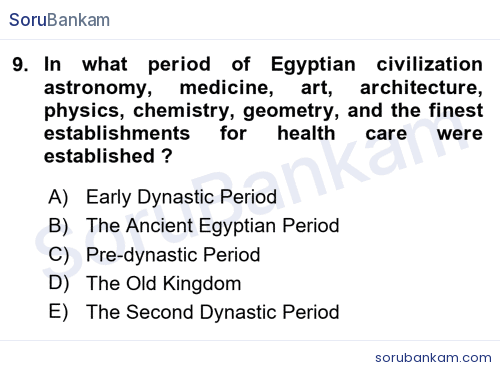
In what period of Egyptian civilization astronomy, medicine, art, architecture, physics, chemistry, geometry, and the finest establishments for health care were established ? A) Early Dynastic Period B) The Ancient Egyptian Period C) Pre-dynastic Period D) The Old Kingdom E) The Second Dynastic Period
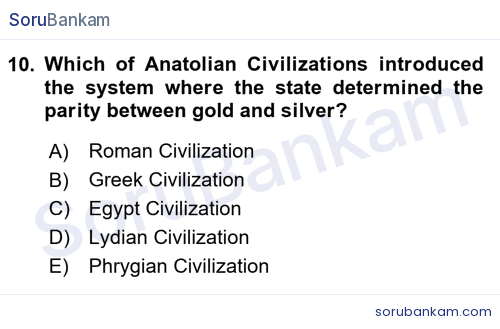
Which of Anatolian Civilizations introduced the system where the state determined the parlty between gold and silver? A) Roman Civilization B) Greek Civilization C) Egypt Civilization D) Lydian Civilization E) Phrygian Civilization
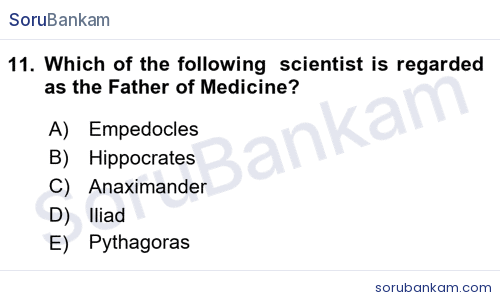
Which of the following scientist is regarded as the Father of Medicine? A) Empedocles B) Hippocrates C) Anaximander D) Iliad E) S Pythagoras
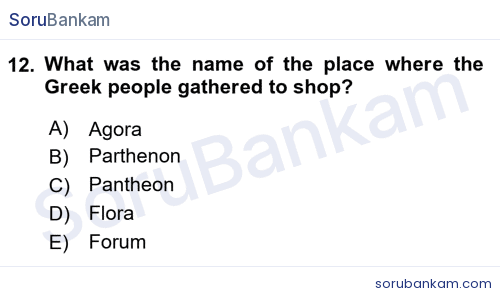
What was the name of the place where the Greek people gathered to shop? A) Agora B) Parthenon C) Pantheon D) Flora E) Forum
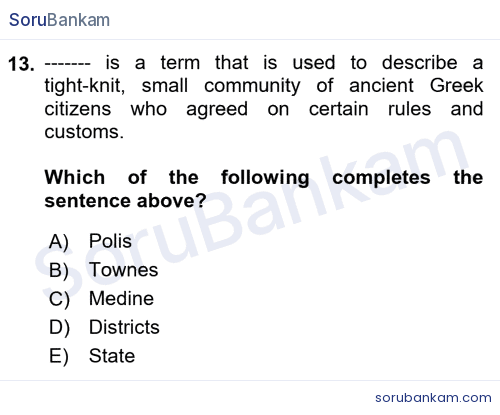
—— is a term that is used to describe a tight-knit, small community of ancient Greek citizens who agreed on certain rules and customs. Which of the following completes thre sentence above? A) Polis B) . C) VC) Medine D) Districts E) State
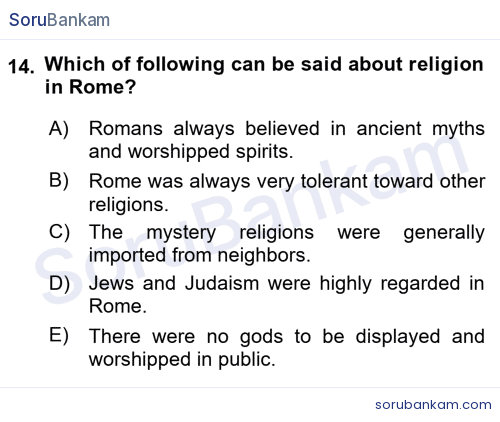
Which of following can be said about religion in Rome? A) Romans always believed in ancient myths and worshipped spirits. B) Rome was always very tolerant toward other religions. C) The mystery religions were generally imported from neighbors. D) Jews and Judaism were highly regarded in Rome. E) There were no gods to be displayed and worshipped in public.
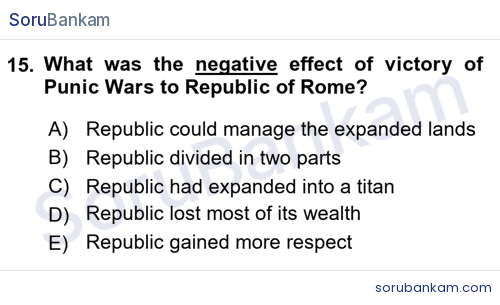
What was the negative effect of victory of Punic Wars to Republic of Rome? A) Republic could manage the expanded lands B) Republic divided in two parts C) Republic had expanded into a titan D) Republic lost most of its wealth E) Republic gained more respect
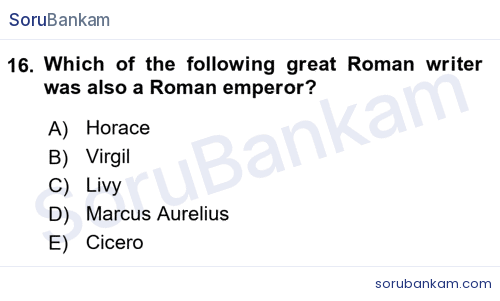
16. Which of the following great Roman writer was also a Roman emperor? A) Horace Virgil Livy D) Marcus Aurelius' E) Cicero :
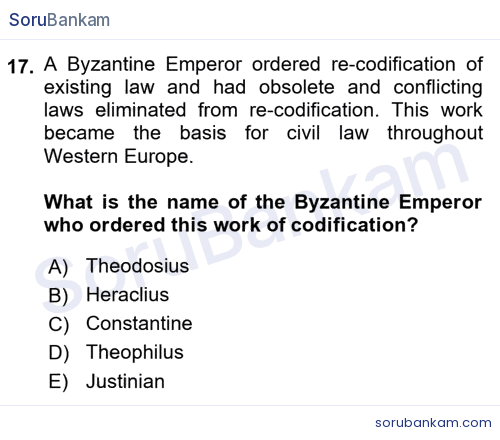
17. A Byzantine Emperor ordered re-codification of existing law and had obsolete and conflicting laws eliminated from re-codification. This work became the •basis for civil law throughout Western Europe. .1 What is the name of the Byzantine Emperor who ordered this work of codification? 4) Theodosius By • Heraclius C) Constantine D) Theophilus E) Justinian
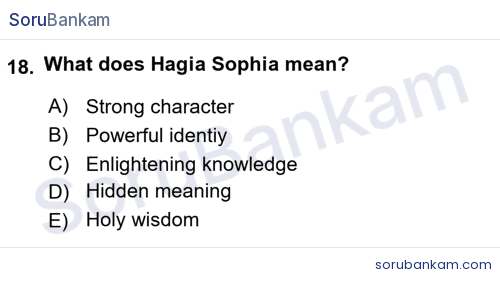
What does Hagia Sophia mean? A) Strong character B) Powerful identiy C) Enlightening knowledge D) Hidden meaning E) Holy wisdom
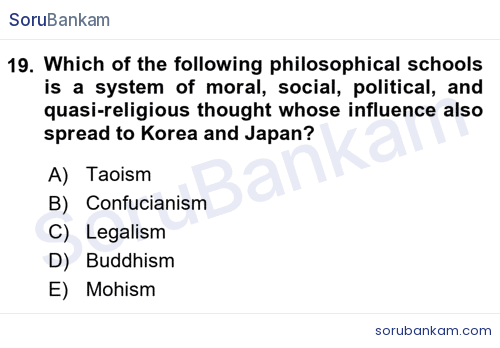
Which of the following philosophical schools is a system of moral, social, political, and quasi-religious thought whose influence also spread to Korea and Japan? A) Taoism B) Confucianism C) Legalism D) Budahism E) Mohism
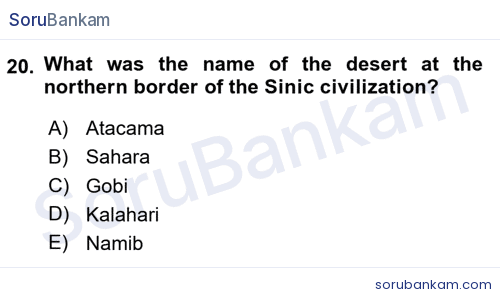
What was the name of the desert at the northern border of the Sinic civilization? A) Atacama B) Sahara C) Gobi D) Kalahari E) Namib