ULI101U Introduction to World Civilization 2024-2025 Vize Soruları
20 soru · Vize · 2024-2025
ULI101U Introduction to World Civilization dersinin 2024-2025 vize sınavı 20 sorudan oluşur; ders AÖF Siyaset Bilimi ve Kamu Yönetimi (İngilizce) bölümünde okutulur. Sorular aşağıda sırasıyla yer alır. Doğru cevaplar ve sonucun, testi çözdüğünde görünür.
Önizleme · 20 soru. Cevaplamak ve sonucunu görmek için sınavı başlat.
Sorular
20 soru
Soru 1
Soru 2
Soru 3
Soru 4
Soru 5
Soru 6
Soru 7
Soru 8
Soru 9
Soru 10
Soru 11
Soru 12
Soru 13
Soru 14
Soru 15
Soru 16
Soru 17
Soru 18
Soru 19
Soru 20
Sınav modunda süre tutulur, doğru cevaplar ve sonucun sınav bitince görünür.
Dersin üniteleri
Ünite özetleri ve konu anlatımları
- 1. Ünite: The Civilization Approach To Human Development
- 2. Ünite: The Mesopotamian Civilization
- 3. Ünite: The Egyptian Civilization
- 4. Ünite: Anatolian Civilizations
- 5. Ünite: The Hellenic Civilization
- 6. Ünite: The Roman Civilization
- 7. Ünite: The Byzantine Civilization
- 8. Ünite: The Sinic Civilization
ULI101U Introduction to World Civilization ders sayfası: bütün sınavlar ve üniteler
Soruların metni (otomatik okuma)
Görsellerden otomatik okunmuştur; hata içerebilir. Sorular, görsellerdeki hâliyle geçerlidir.
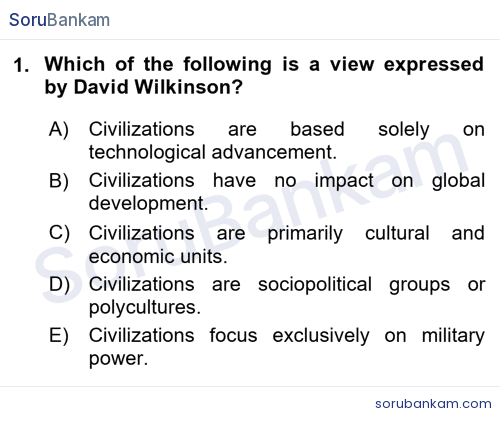
Which of the following is a view expressed by David Wilkinson? A) Civilizations are based solely on technological advancement. B) Civilizations have no impact on global development. C) Civilizations are primarily cultural and economic units. D) Civilizations are sociopolitical groups or polycultures. E) Civilizations focus exclusively on military power.
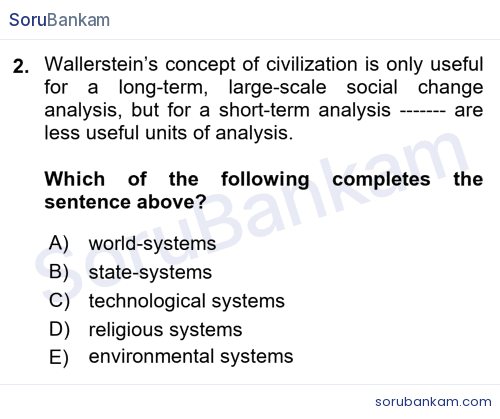
Wallerstein's concept of civilization is only useful for a long-term, large-scale social change analysis, but for a short-term analysis - are less useful units of analysis. Which of the following completes the sentence above? A) world-systems B) state-systems C) technological systems D) religious systems "5"" E) environmental systems
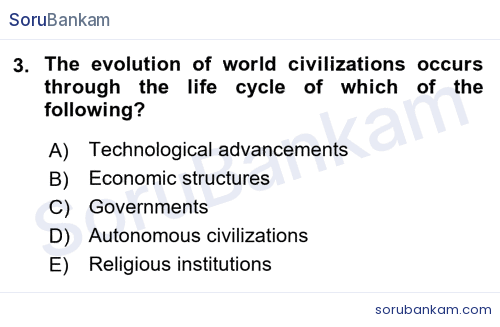
The evolution of world civilizations occurs\ through the life cycle of which of the following? A) Technological advancements B) + By Economic structures C) Governments D) S Autonomous civilizations E) Religious institutions
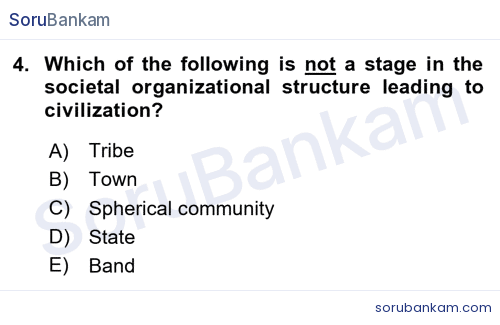
Which of the following is not a stage in the societal organizational structure leading to civilization? A) Tribe B) Town C) Spherical community D) State E) Band
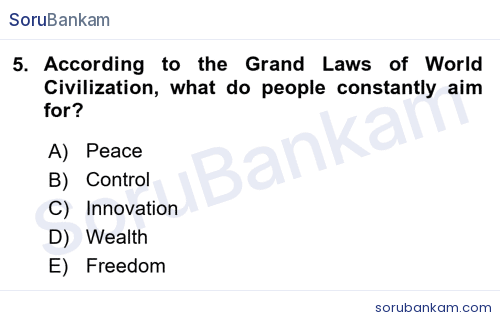
According to the Grand Laws of World Clvillzation, what do people constantly aim for? A) Peace B) Control C) Innovation D) Wealth E) Freedom
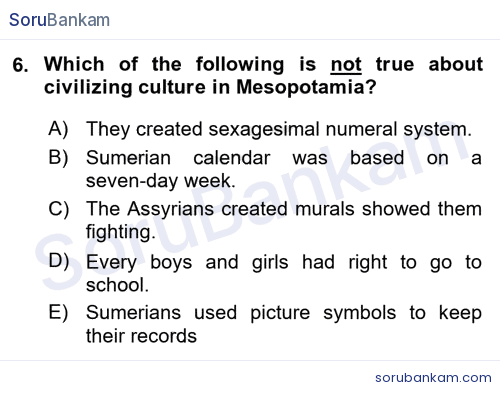
6. Which of the following is not true about civilizing culture in Mesopotamia? A) They greated sexagesimal numeral system. BY. Sumerian calendar was based on a seven-day week. C) The Assyrians created murals showed them fighting. 1' D) Evéry boys and girls had right to go to School. • "E) Sumerians used picture symbols to keep their records.
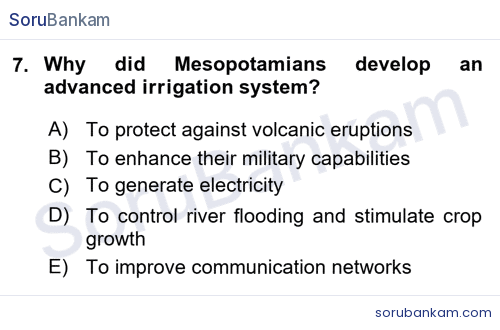
Why did Mesopotamians develop advanced irrigation system? A) To protect against volcanic eruptions B) To enhance their military capabilities C) To generate electricity D) To control river flooding and stimulate crop growth E) To improve communication networks
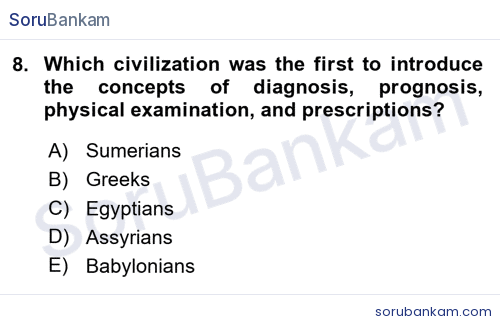
Which civilization was the first to introduce the concepts of diagnosis, prognosis, physical examination, and prescriptions? A) Sumerians B) Greeks C) Egyptians D) Assyrians E) Babylonians
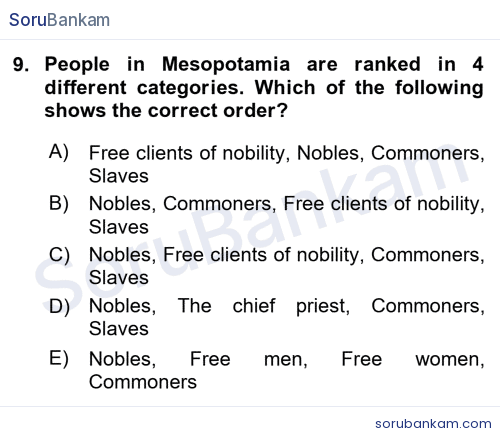
People in Mesopotamia are ranked in 4 different categories. Which of the following shows the correct order? A) Free clients of nobility, Nobles, Commoners, Slaves B) Nobles, Commoners, Free clients of nobility, Slaves C) Nobles, Free clients of nobility, Commoners, Slaves D) Nobles, The chief priest, Commoners, Slaves E) Nobles, Free men, Free women, Commoners
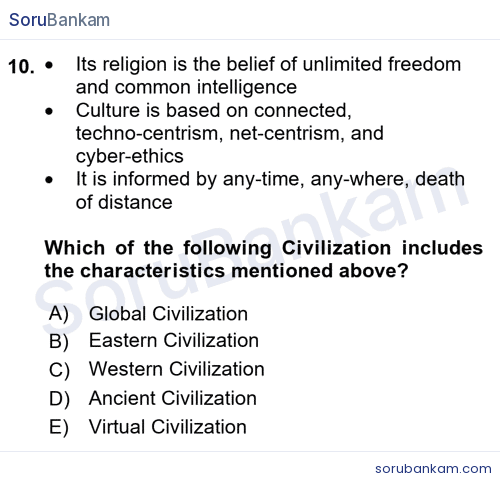
Its religion is the belief of unlimited freedom and common intelligence • Culture is based on connected, techno-centrism, net-centrism, and cyber-ethics • It is informed by any-time, any-where, death of distance Which of the following Civilization includes the characteristics mentioned above? A) Global Civilization B) Eastern Civilization C) Western Civilization D) Ancient Civilization E) Virtual Civilization
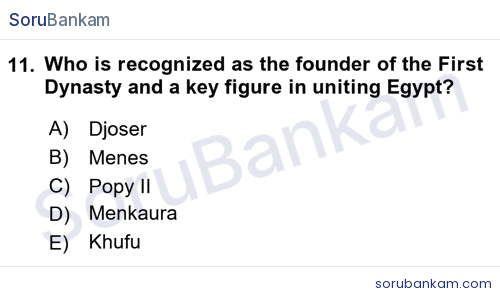
11. Who is recognized as the founder of the First Dynasty and a key fiqure in uniting Egypt? A) Djoser Menes Popy I D) Menkaura E) Khufu
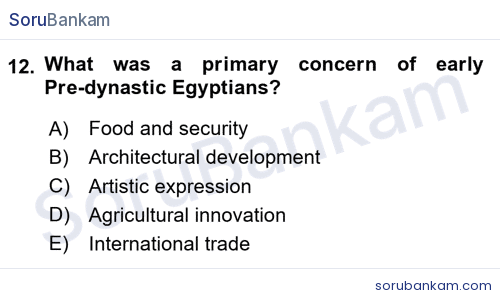
What was a primary concern of early Pre-dynastic Egyptians? A) Food and security B) Architectural development C) Artistic expression D) Agricultural innovation E) International trade
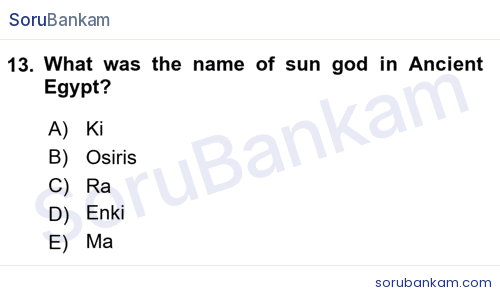
13. What was the name of sun god in Ancient Egypt? A) Ki B) Osins C) D) Enki E) Ma
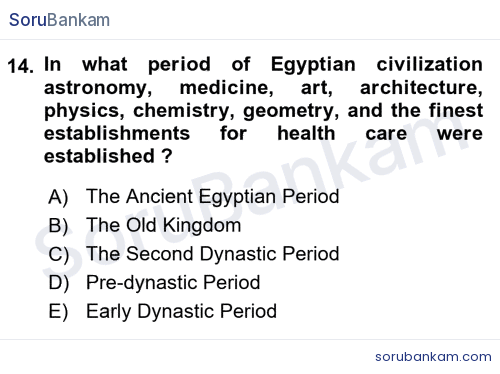
In what period of Egyptian civilization astronomy, medicine, art, architecture, physics, chemistry, geometry, and the finest establishments health care were , establistied? A) The Ancient Egyptian Period B) The Old Kingdom C) Thą Second Dynastic Period D) Pre-dynastic Period E) Early Dynastic Period
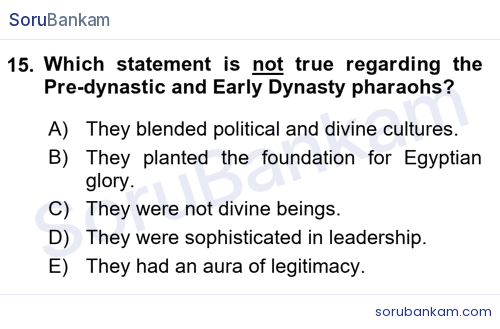
Which statement is not true regarding the Pre-dynastic and Early Dynasty pharaohs? A) They blended political and divine cultures. B) They planted the foundation for Egyptian glory. C) They were not divine beings. D) They were sophisticated in leadership. E) They had an aura of legitimacy.
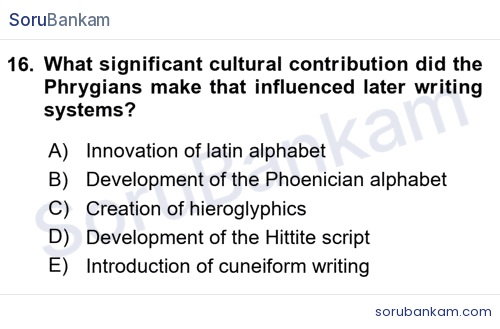
What significant cultural contribution did the Phrygians make that influenced later writing systems? A) Innovation of latin alphabet B) Development of the Phoenician alphabet C) Creation of hieroglyphics D) Development of the Hiftite script E) Introduction of cuneiform writing
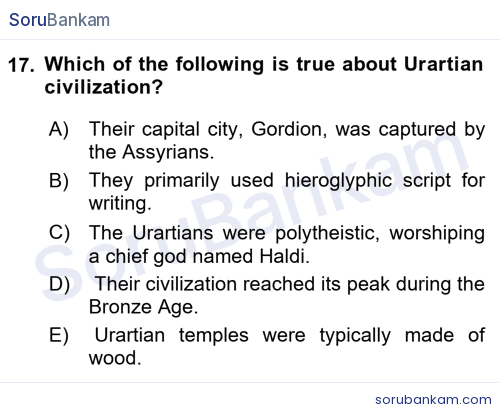
17. Which of the following is true about Urartian civilization? A) Their capital city, Gordion, was captured by the Assyrians. B) They primarily used hieroglyphic script for writing. C) The Urartians were polytheistic, worshiping a chief god named Haidi. D) Their civilization reached its peak during the Bronze Age. Urartian temples were typically made of wood.
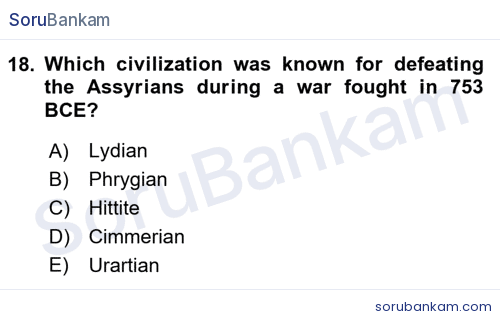
Which civilization was known for defeating the Assyrians during a war fought In 753 BCE? A) Lydian B) Phrygian C) Hittite D) Cimmerian E) Urartian
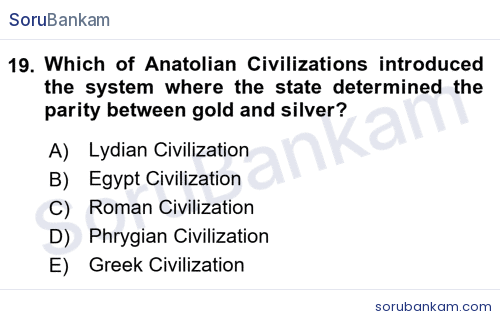
Which of Anatolian Civilizations introduced the system where the state determined the parity between gold and silver? A) Lydian Civilization B) Egypt Civilization C) Roman Civilization D) Phrygian Civilization E) Greek Civilization
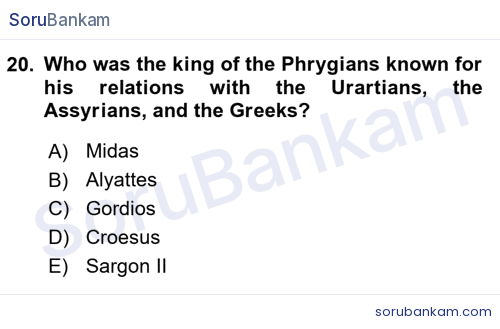
Who was the king of the Phrygians known for his relations with the Urartians, the Assyrlans, and the Greeks? A) Midas B) Alyattes C) Gordios D) Croesus E) Sargon