ULI101U Introduction to World Civilization 2023-2024 Final Soruları
20 soru · Final · 2023-2024
ULI101U Introduction to World Civilization dersinin 2023-2024 final sınavı 20 sorudan oluşur; ders AÖF Siyaset Bilimi ve Kamu Yönetimi (İngilizce) bölümünde okutulur. Sorular aşağıda sırasıyla yer alır. Doğru cevaplar ve sonucun, testi çözdüğünde görünür.
Önizleme · 20 soru. Cevaplamak ve sonucunu görmek için sınavı başlat.
Sorular
20 soru
Soru 1
Soru 2
Soru 3
Soru 4
Soru 5
Soru 6
Soru 7
Soru 8
Soru 9
Soru 10
Soru 11
Soru 12
Soru 13
Soru 14
Soru 15
Soru 16
Soru 17
Soru 18
Soru 19
Soru 20
Sınav modunda süre tutulur, doğru cevaplar ve sonucun sınav bitince görünür.
Dersin üniteleri
Ünite özetleri ve konu anlatımları
- 1. Ünite: The Civilization Approach To Human Development
- 2. Ünite: The Mesopotamian Civilization
- 3. Ünite: The Egyptian Civilization
- 4. Ünite: Anatolian Civilizations
- 5. Ünite: The Hellenic Civilization
- 6. Ünite: The Roman Civilization
- 7. Ünite: The Byzantine Civilization
- 8. Ünite: The Sinic Civilization
ULI101U Introduction to World Civilization ders sayfası: bütün sınavlar ve üniteler
Soruların metni (otomatik okuma)
Görsellerden otomatik okunmuştur; hata içerebilir. Sorular, görsellerdeki hâliyle geçerlidir.
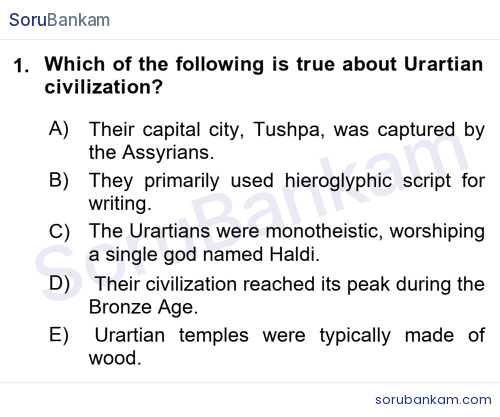
Which of the following is true about Urartian civilization? A) Their capital city, Tushpa, was captured by the Assyrians. B) They primarily used hieroglyphic script for writing. C) The Urartians were monotheistic, worshiping a single god named Haldi. D) Their civilization reached its peak during the Bronze Age. E) Urartian temples were typically made of wood.
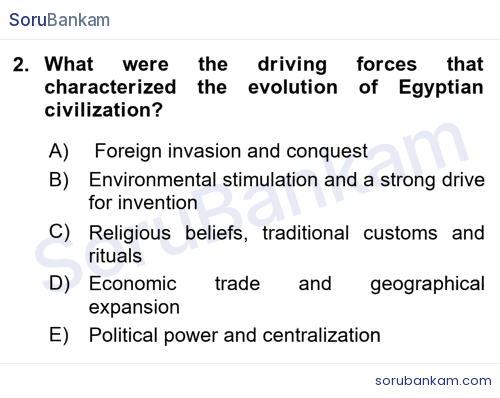
What were the driving forces that characterized the evolution of Egyptian civilization? A) Foreign invasion and conquest B) Environmental stimulation and a strong drive for invention C) Religious beliefs, traditional customs and rituals D) Economic trade and geographiçal expansion E) Political power and centralization
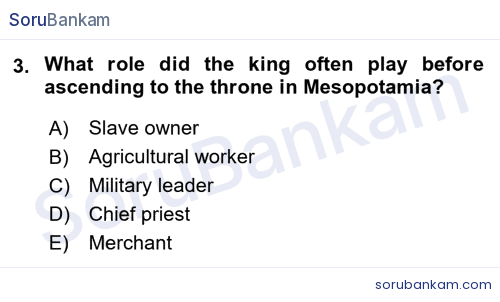
What role did the king often play before ascending to the throne in Mesopotamia? A) Slave owner B) Agricultural worker C) Military leader D) Chief priest E) Merchant
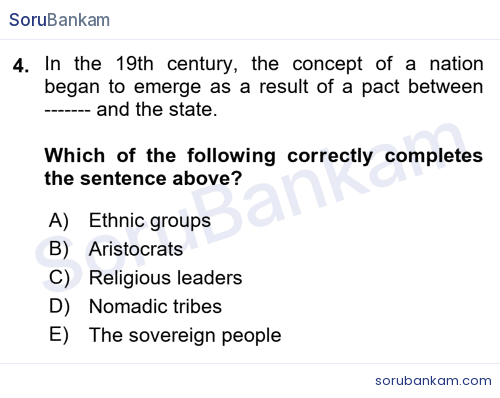
In the 19th century, the concept of a nation began to emerge as a result of a pact between -- and the state. Which of the following correctly completes the sentence above? A) Ethnic groups B) Aristocrats C) Religious leaders D) Nomadic tribes E) The sovereign people
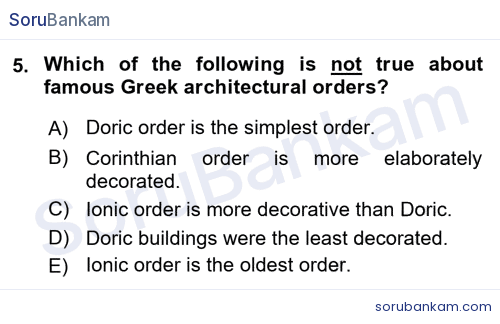
Which of the following is not true about famous Greek architectural orders? A) Doric order is the simplest order. B) Corinthian order is more elaborately,. decorated. C) Ionic order is more decorative than-Doric. D) Doric buildings were the least decorated. E) lonic order is the oldest order.
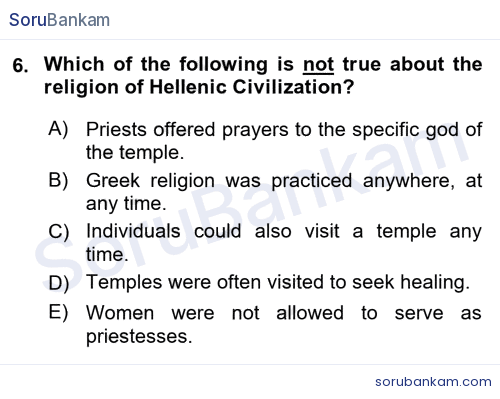
6. Which of the following is not true about the religion of Hellenic Civilization? Priests offered prayers to the specific god of the temple. B) Greek religion was practiced anywhere, at any time. Individuals , could also vist, a temple any time. ( D) Temples were often visited to seek healing. E) Women were not allowed to serve as priestesses, > .
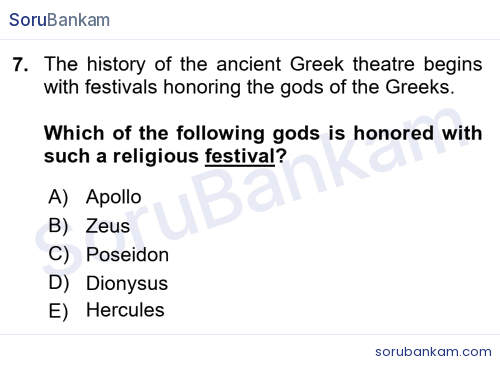
The history of the ancient Greek theatre begins with festivals honoring the gods of the Greeks. Which of the following gods is honored with such a religious festival? A) Apollo B) Zeus C) Poseidon D) Dionysus E) Hercules
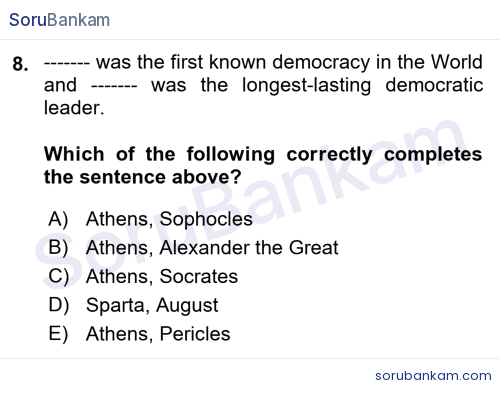
- was the first known democracy in the Word and -ome was the longest-lasting democratic leader. Which of the following correctly completes the sentence above? A) Athens, Sophocles B) Athens, Alexander the Great C) Athens, Socrates D) Sparta, August E) Athens, Pericles
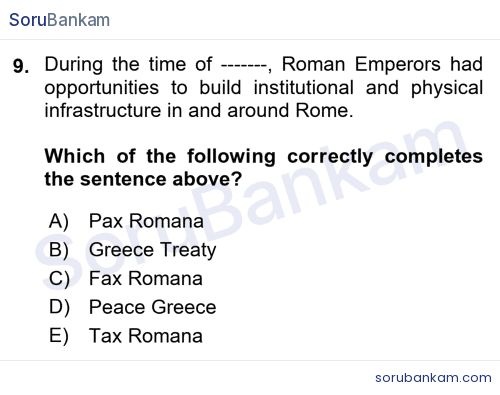
During the time of -, Roman Emperors had opportunities to build institutional and physical infrastructure in and around Rome. Which of the following correctly completes the sentence above? A) Pax Romana B) Greece Treaty C) Fax Romana D) Peace Greece E) Tax Romana
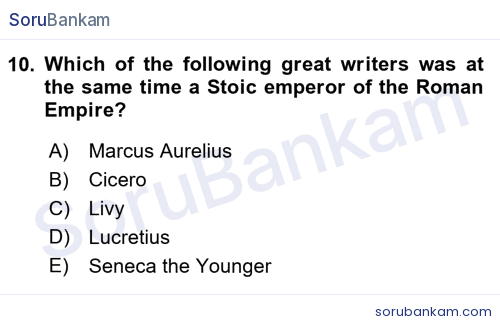
Which of the following great writers was at the same time a Stoic emperor of the Roman Empire? A) Marcus Aurelius B) Cicero C) Livy D) Lucretius . E) Seneca the Younger
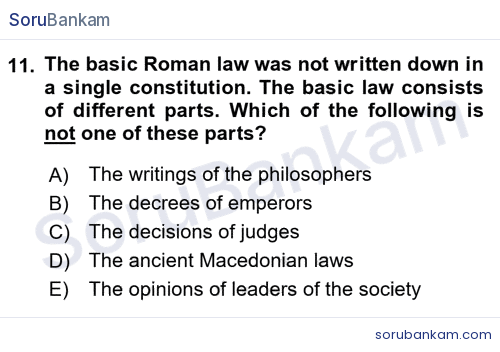
The basic Roman law was not written down-jn a single constitution. The basic law consists of different parts. Which of the following is not one of these parts? A) The writings of the philosophers B) The decrees of emperors C) The decisions of judges D) The sancient Macedonian laws E) The opinions of leaders of the society
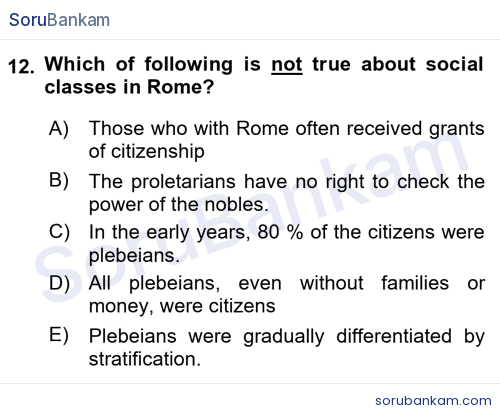
Which of following is not true about social classes in Rome? A) Those who with Rome often received grants of citizenship B) The proletarians have no right to check the power of the nobles. C) In the early years, 80% of the citizens were plebeians. D) All plebeians, even without families or money, were citizens E) Plebeians were gradually differentiated by stratification.
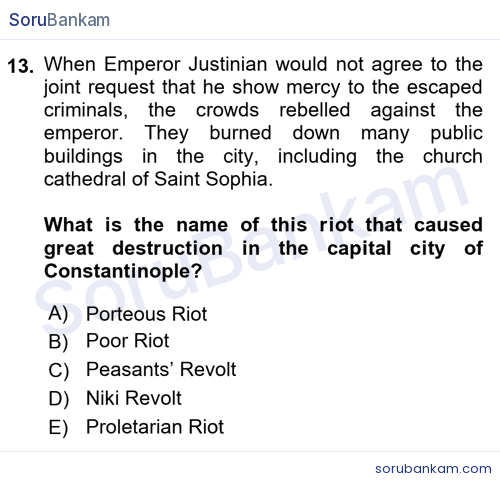
When Emperor Justinian would not agree to the joint request that he show mercy to the escaped criminals, the crowds rebelled against the emperor. They bumed down many public buildings in the city, including the church cathedral of Saint Sophia. т. What is the naras of this riot that caused great destruction in the capital city of Constantinople? A) Porteous Riot B) Poor Riot C) Peasants' Revolt D) Niki Revolt E) Proletarian Riot
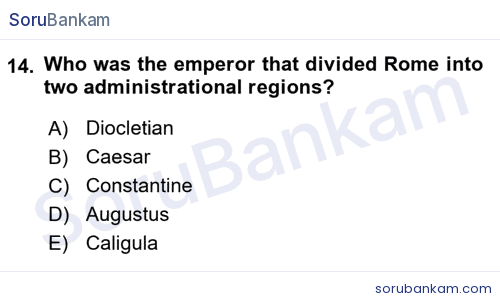
Who was the emperor that divided Rome into two administrational regions? A) Diocletian • • N• B) Caesar C) • C) Constantine D) Augustus E) Caligula 4:∞•
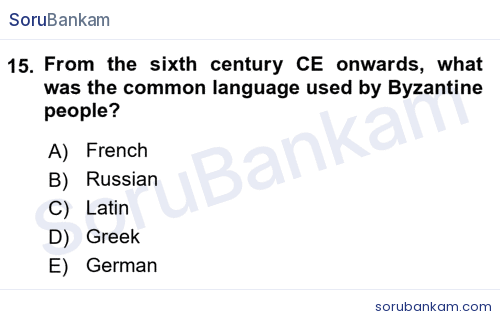
From the sixth century CE onwards, what was the common language used by Byzantine people? A) French B) Russian C) Latin D) Greek E) German
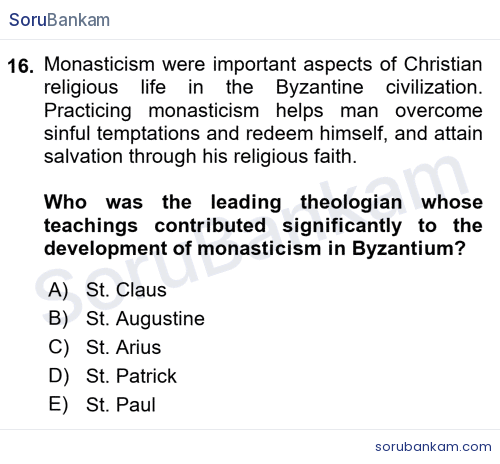
Monasticism were important aspects of Christian religious life in the Byzantine civilization. Practicing monasticism helps man overcome sinful temptations and redeem himself, and attain salvation through his religious faith. Who was the leading theologian whose teachings contributed significantly to the development of monasticism in Byzantium? A) St. Claus B) St. Augustine C) St. Arius D) St. Patrick E) St. Paul
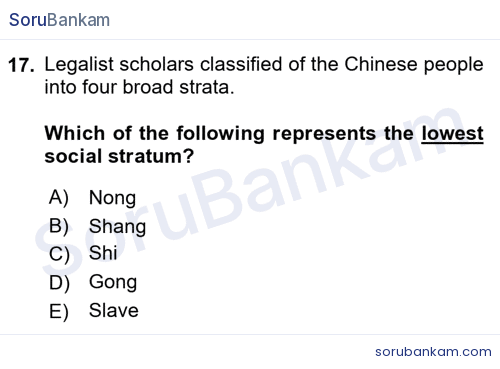
Legalist scholars classified of the Chinese people into four broad strata. Which of the following represents the lowest social stratum? A) Nong B) Shang C) Shi D) Gong E) Slave
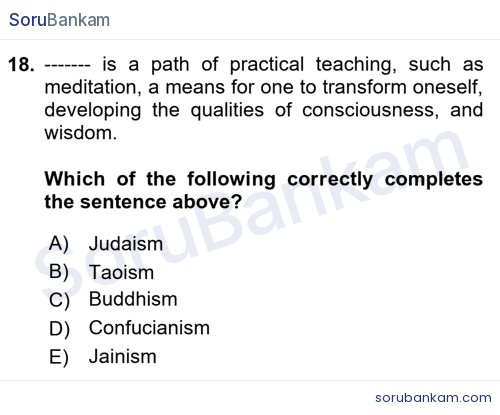
is a path of practical teaching, such as meditation, a means for one to transform oneself, developing the qualities of consciousness, and wisdom. Which of the following correctly completes the sentence above? A) Judaism B) Taoism C) Buddhism D) Confucianism E) Jainism
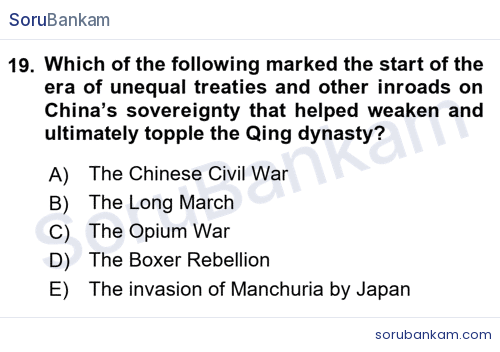
Which of the following marked the start of the era of unequal treaties and other inroads on China's sovereignty that helped weaken and ultimately topple the Qing dynasty? A) The Chinese Civil War B) The Long March C) The Opium War D) The Boxer Rebellion E) The invasion of Manchuria by Japan
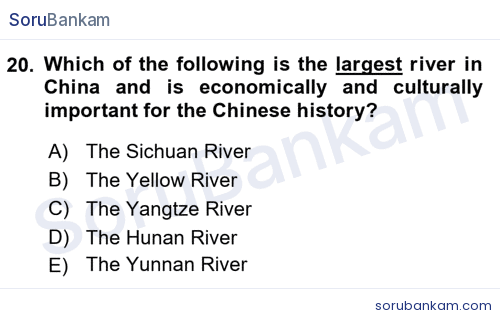
Which of the following is the largest river in China and is economically and culturally important for the Chinese history? A) The Sichuan River B) The Yellow River 61." C) The Yangtze River .'.... D) The Hunan River E) The Yunnan River