ULI101U Introduction to World Civilization 2017-2018 Final Soruları
20 soru · Final · 2017-2018
ULI101U Introduction to World Civilization dersinin 2017-2018 final sınavı 20 sorudan oluşur; ders AÖF Siyaset Bilimi ve Kamu Yönetimi (İngilizce) bölümünde okutulur. Sorular aşağıda sırasıyla yer alır. Doğru cevaplar ve sonucun, testi çözdüğünde görünür.
Önizleme · 20 soru. Cevaplamak ve sonucunu görmek için sınavı başlat.
Sorular
20 soru
Soru 1
Soru 2
Soru 3
Soru 4
Soru 5
Soru 6
Soru 7
Soru 8
Soru 9
Soru 10
Soru 11
Soru 12
Soru 13
Soru 14
Soru 15
Soru 16
Soru 17
Soru 18
Soru 19
Soru 20
Sınav modunda süre tutulur, doğru cevaplar ve sonucun sınav bitince görünür.
Dersin üniteleri
Ünite özetleri ve konu anlatımları
- 1. Ünite: The Civilization Approach To Human Development
- 2. Ünite: The Mesopotamian Civilization
- 3. Ünite: The Egyptian Civilization
- 4. Ünite: Anatolian Civilizations
- 5. Ünite: The Hellenic Civilization
- 6. Ünite: The Roman Civilization
- 7. Ünite: The Byzantine Civilization
- 8. Ünite: The Sinic Civilization
ULI101U Introduction to World Civilization ders sayfası: bütün sınavlar ve üniteler
Soruların metni (otomatik okuma)
Görsellerden otomatik okunmuştur; hata içerebilir. Sorular, görsellerdeki hâliyle geçerlidir.
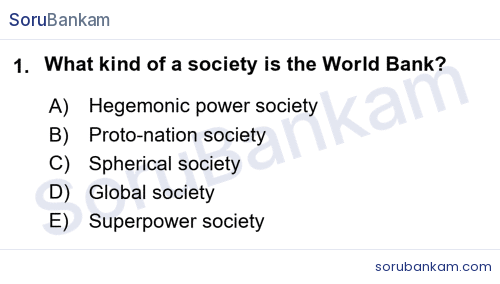
What kind of a society is the World Bank? A) Hegemonic power society B) Proto-nation society C) Spherical society D) Global society E) Superpower society
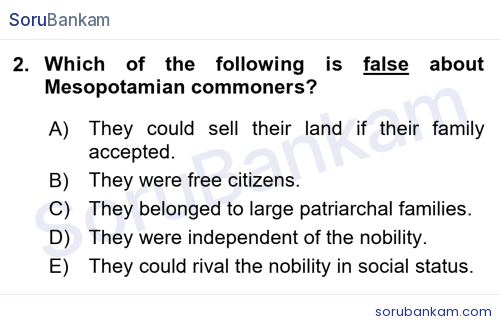
Which of the following is false about Mesopotamian commoners? A) They could sell their land if their family accepted. B) They were free citizens. C) They belonged to large patriarchal families. D) They were independent of the nobility. E) They could rival the nobility in social status.
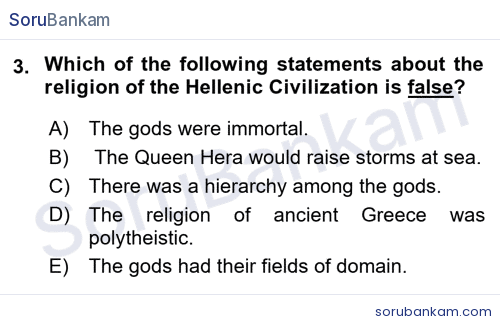
Which of the following statements about the? religion of the Hellenic Civilization is false? A) The gods were immortal. B) The Queen Hera would raise storms at sea. C) There was a hierarchy among the gods. D) The religion ofancient Greece was polytheistic. E) The gods had their fields of domain.
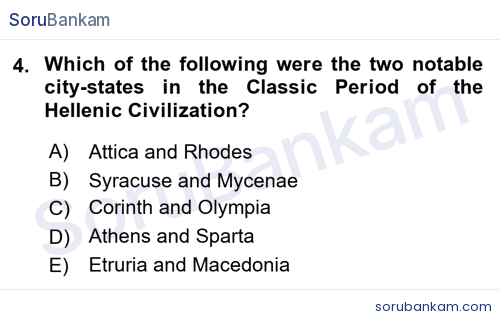
Which of the following were the two notable city-states in the Classic Period of the Hellenic Civilization? A) Attica and Rhodes; B) Syracuse and Mycenae C) Corinth and Olympia D) Athens and Sparta E) Etruna and Macedonia
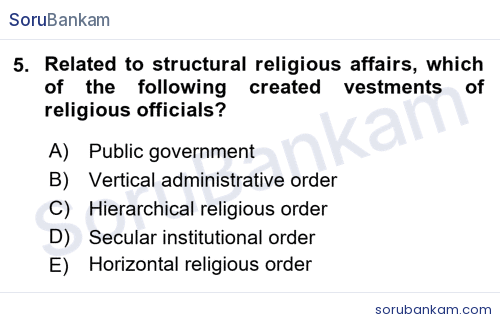
Related to structural religious affairs, which of the following created vestments religious officials? A) Public government B) Vertical administrative order C) Hierarchical religious order D) Secular institutional order E) Horizontal religious order
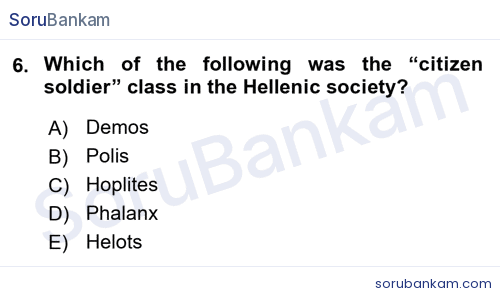
Which of the following was the "citizen soldier" class in the Hellenic society? A) Demos B) Polis C) Hoplites D) Phalanx "''• E) Helots
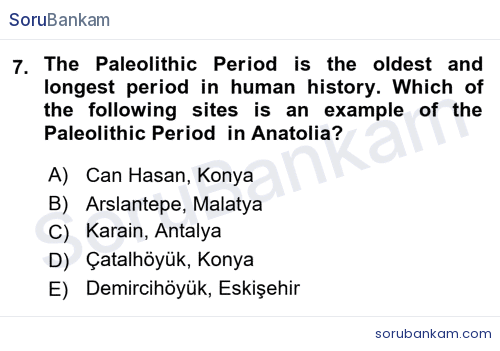
The Paleolithic Period is the oldest and longest period in human history. Which of the following sites • is an example of the Paleolithic Period in Anatolia? A) Can Hasan, Konya B) Arslantepe, Malatya C) Karain, Antalya D) Çatathöyük, Konya »' E) … E) • Demircihöyük, Eskişehir
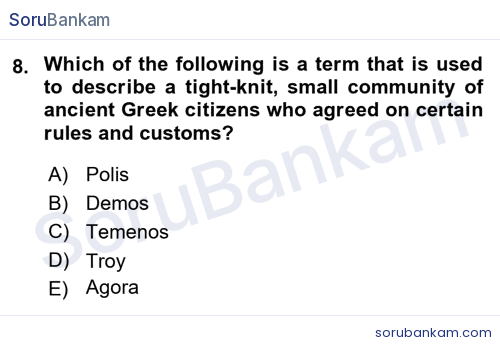
8. Which of the following is a term that is used to describe a tight-knit, small community of ancient Greek citizens who agreed on certain rules and customs? ..A) Polis B) Demos C) Temenos D) Troy Agora
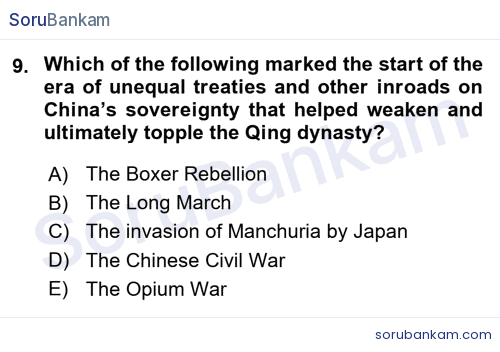
Which of the following marked the start of the era of unequal treaties and other inroads on China's sovereignty that helped weaken and ultimately topple the Qing dynasty? A) The Boxer Rebellion B) The Long March C) The invasion of Manchuria by Japan D) The Chinese Civil War E) The Opium War
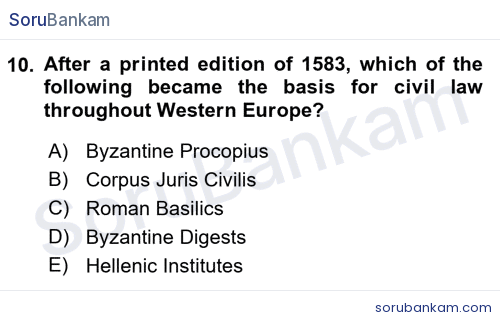
After a printed edition of 1583, which of the following became the basis for civil law throughout Western Europe? A) Byzantine Procopius B) Corpus Juris Civilis C) Roman Basilics D) Byzantine Digests E) Hellenic Institutes
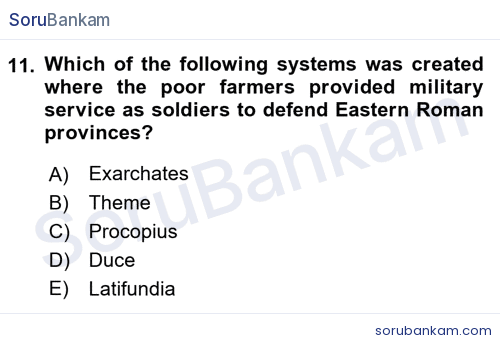
Which of the following systems was created where the poor farmers provided military service as soldiers to defend Eastern Roman provinces? A) Exarchates B) Theme C) Procopius. D) Duce E) E Latifundia
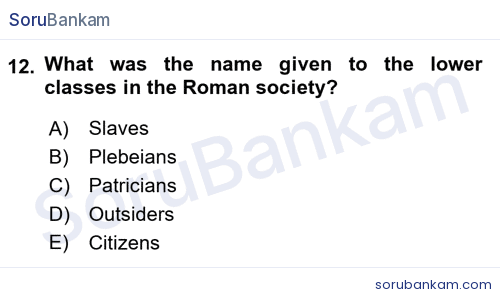
What was the name given to the lower classes in the Roman society? A) Slaves B) Plebeians C) Patricians D) Outsiders E) Citizens
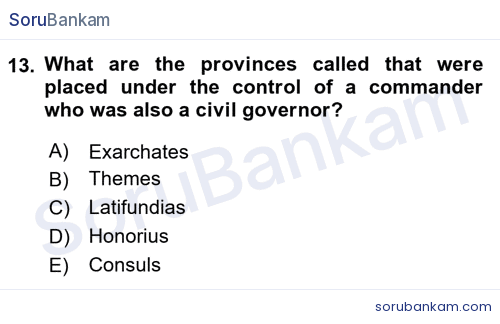
What are the provinces called that were placed under the control of a commander who was also a civil governor? A) Exarchates B) Themes C) Latifundias D) Honorius. E) Consuls
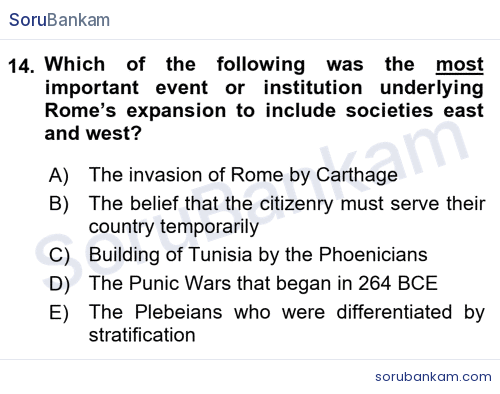
Which of the following was the most Important event pr institution underlying Rome's expansion to include • societies east and west? A) The invasion of Rome by Carthage B) The belief that the citizenry must serve their country temporarily C) Building of Tunisia by the Phoenicians D) The Punic Wars that began in 264 BCE • 1' E) The Plebeians who were differentiated by stratification
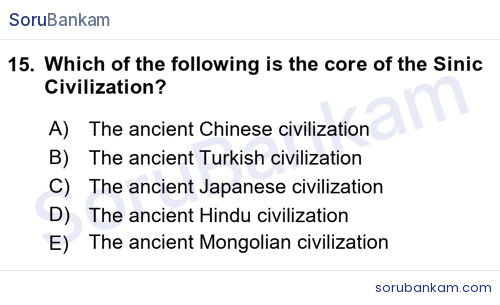
Which of the following is the core of the Sinic Civilization? A) The ancient Chinese civilization B) The ancient Turkish civilization C) The ancient Japanese civilization D) The ancient Hindu civilization E) The ancient Mongolian civilization
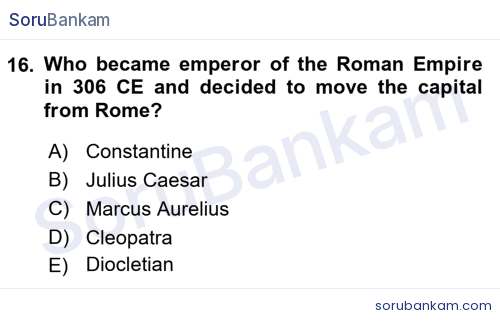
Who became emperor of the Roman Empire in 306 CE and decided to move the capital from Rome? A) Constantine B) Julius Caesar C) Marcus Aurelius ,.1. D) Cleopatra • E) Diocletian
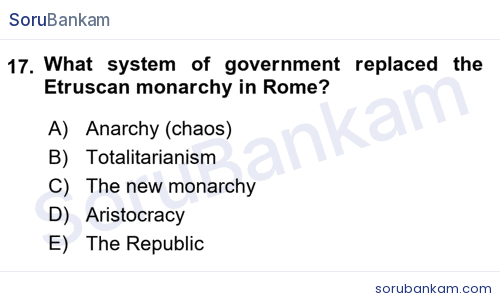
What system of government replaced the Etruscan monarchy in Rome? A) Anarchy, (chaos) B) Totalitarianism C) The new monarchy D) Aristocracy E) The Republic
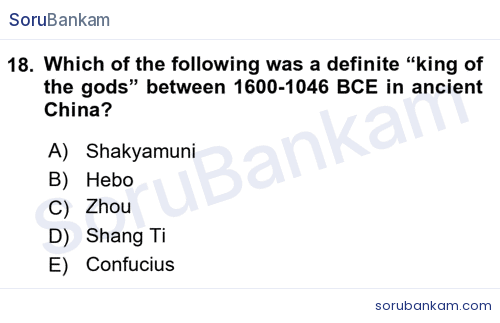
Which of the following was a definite "king of the gods" between 1600-1046 BCE in ancient China? A) Shakyamuni B) Hebo C) Zhou D) Shang E) Confucius
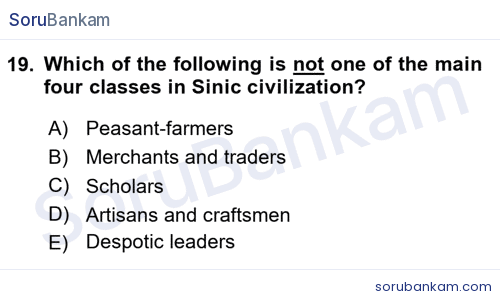
Which of the following is not one of the main four classes in Sinic civilization? A) Peasant-farmers B) Merchants and traders C) Scholars D) Artisans and craftsmen E) Despotic leaders
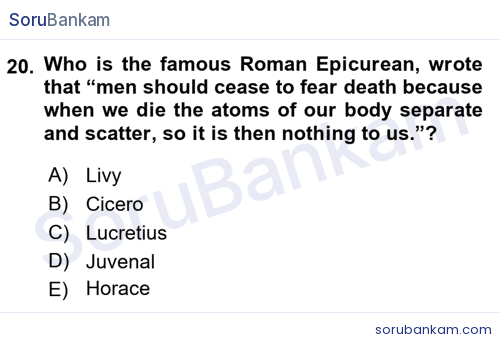
Who is the famous Roman Epicurean, wrote that "men should cease to fear death because when we die the atoms of our body separate and scatter, so it is then nothing to us."? A) Livy B) Cicero C) Lucretius D) Juvenal E) Horace