ULI101U Introduction to World Civilization 2018-2019 Vize Soruları
20 soru · Vize · 2018-2019
ULI101U Introduction to World Civilization dersinin 2018-2019 vize sınavı 20 sorudan oluşur; ders AÖF Siyaset Bilimi ve Kamu Yönetimi (İngilizce) bölümünde okutulur. Sorular aşağıda sırasıyla yer alır. Doğru cevaplar ve sonucun, testi çözdüğünde görünür.
Önizleme · 20 soru. Cevaplamak ve sonucunu görmek için sınavı başlat.
Sorular
20 soru
Soru 1
Soru 2
Soru 3
Soru 4
Soru 5
Soru 6
Soru 7
Soru 8
Soru 9
Soru 10
Soru 11
Soru 12
Soru 13
Soru 14
Soru 15
Soru 16
Soru 17
Soru 18
Soru 19
Soru 20
Sınav modunda süre tutulur, doğru cevaplar ve sonucun sınav bitince görünür.
Dersin üniteleri
Ünite özetleri ve konu anlatımları
- 1. Ünite: The Civilization Approach To Human Development
- 2. Ünite: The Mesopotamian Civilization
- 3. Ünite: The Egyptian Civilization
- 4. Ünite: Anatolian Civilizations
- 5. Ünite: The Hellenic Civilization
- 6. Ünite: The Roman Civilization
- 7. Ünite: The Byzantine Civilization
- 8. Ünite: The Sinic Civilization
ULI101U Introduction to World Civilization ders sayfası: bütün sınavlar ve üniteler
Soruların metni (otomatik okuma)
Görsellerden otomatik okunmuştur; hata içerebilir. Sorular, görsellerdeki hâliyle geçerlidir.
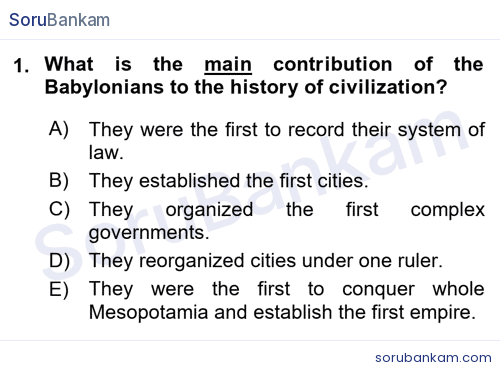
What is the main contribution of the Babylonians to the history of civilization? A) They were the first to record their system of law. B) They established the first cities. C) They organized the first complex governments. D) They reorganized cities under one ruler. E) They were the first conquer whole Mesopotamia and establish the first empire.
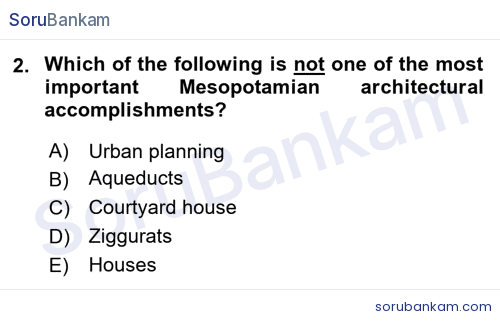
Which of the following is not one of the most important Mesopotamian architectural accomplishments? A) Urban planning B) Aqueducts C) Courtyard house D) Ziggurats E) Houses
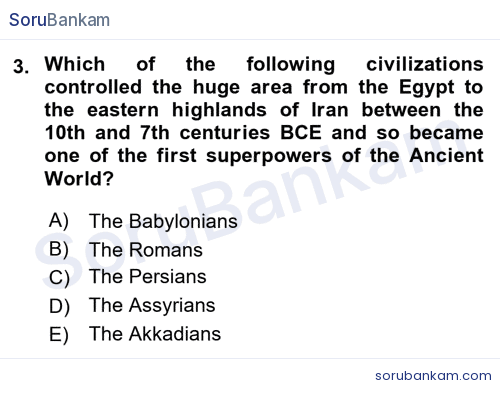
Which of the following civilizations controlled the huge area from the Egypt to the eastern highlands of Iran between the 10th and 7th centuries BCE and so became one of the first superpowers of the Ancient World? A) The Babylonians B) The Romans C) The Persians D) The Assyrians E) The Akkadians
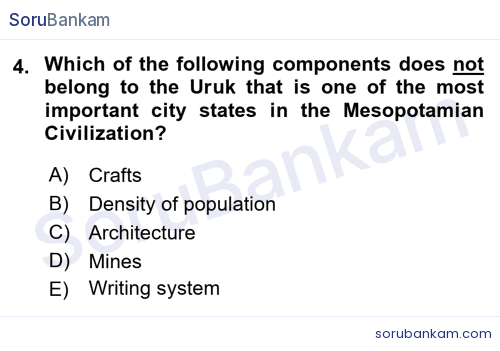
Which of the following components does not belong to the Uruk that is one of the most important city states in the Mesopotamian Civilization? A) Crafts B) S Density of population C) Architecture • D) Mines E) Writing system
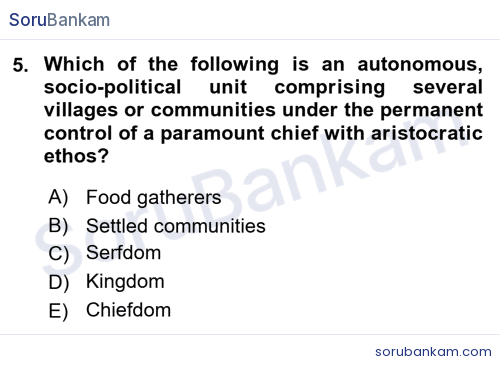
Which of the following is an autonomous, socio-political unit comprising several villages or communities under the permanent control of a paramount chief with aristocratic ethos? A) Food gatherers B) Settled communities C) Serfdam D) Kingdom E) Chiefdom
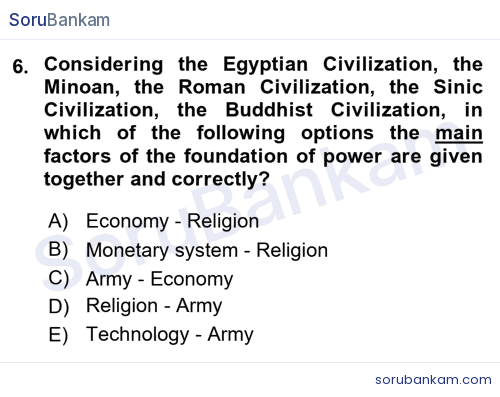
Considering the Egyptian Civilization, the Minoan, the Roman Civilization, the Sinic Civilization, the Buddhist Civilization, in which of the following options the main factors of the foundation of power are given together and correctly? A) Economy - Religion B) Monetary system - Religion C) Army - Economy D) " • D) Religion - Army E) Technology - Ary
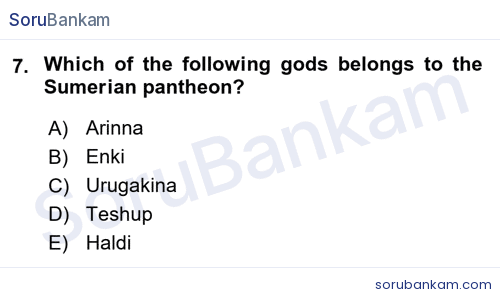
Which of the following gods belongs to the Sumerian pantheon? A) Arinna B) Eriki C) Urugakina D) Teshup E) Haldi
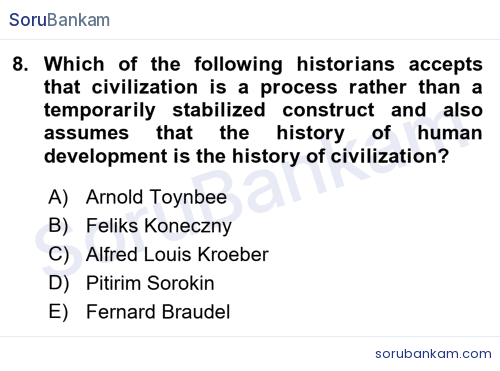
Which of the following historians accepts that civilization is a process rather than a temporarily stabilized construct and also assumes that the history of human development is the history of civilization? A) Arnold Toynbee B) Feliks Koneczny C) Alfred Louis Kroeber D) Pitirim Sorokin E) Fernard Braudel
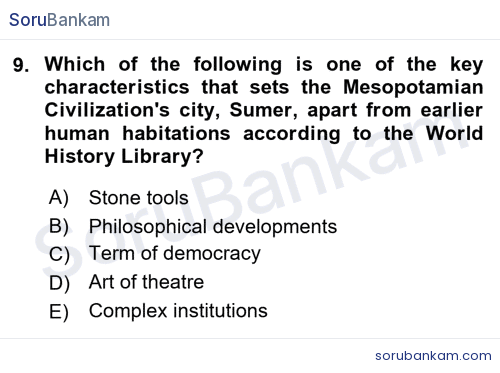
Which of the following is one of the key characteristics that sets the Mesopotamian Civilization's city, Sumer, apart from earlier human habitations according to the World History Library? A) Stone tools B) Philosophical developments C) Term of democracy D) Art of theatre E) Complex institutions
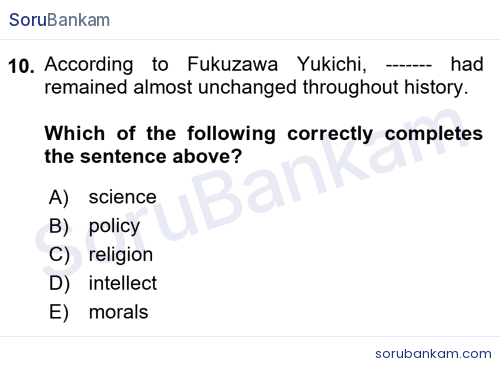
According to Fukuzawa Yukichi, —- hạd remained almost unchanged throughout history. Which of the following correctly completes the sentence above? A) science B) policy C) religion D) intellect E) morals
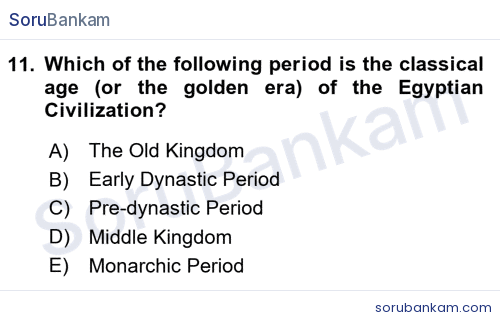
Which of the following period is the classical age for the golden era) of the Egyptian Civilization? A) The Old Kingdom B) Early Dynastic Period C) Pre-dynastic Period D) Middle Kingdom E) Monarchic Period
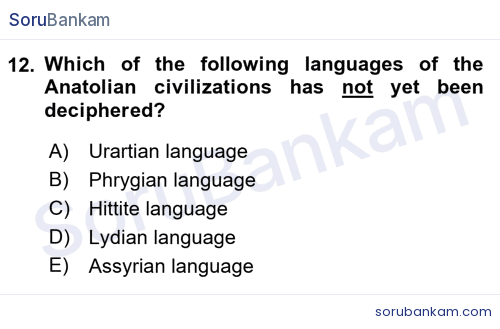
Which of the following languages of the Anatolian civilizations has not yet been deciphered? A) Urartian language B) E Phrygian language C) Hittite language D) Lydian language E) Assyrian language
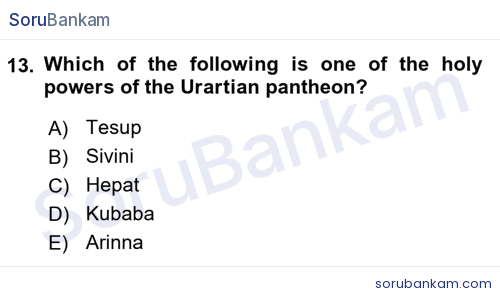
Which of the following is one of the holy powers of the Urartian pantheon? A) Tesup B) Sivini C) Hepat D) Kubaba E) Arinna
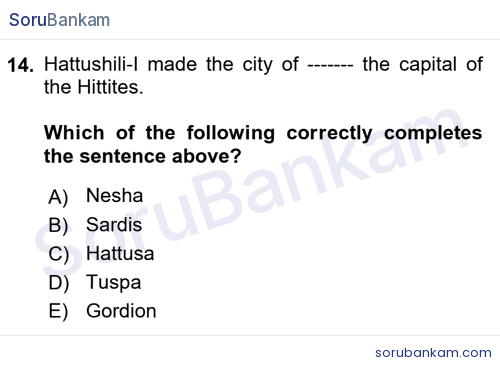
Hattushili- made the city of -- the capital of the Hittites. the senfence above? " Correctly completes Which of the following A) Nesha B) Sardis C) Hattusa D) Tuspa E) Gordion
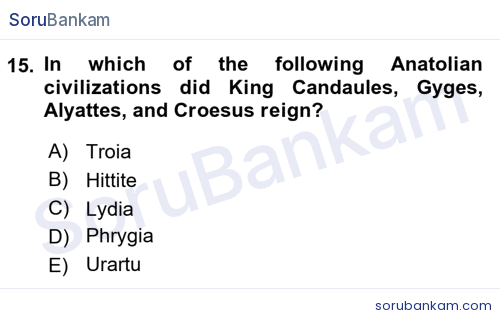
In which of the following Anatolian civilizations did King Candaules, Gyges, Alyattes, and Croesus reign? A) Trola B) Hittite C) Lydia D) Phrygia E) Urartu
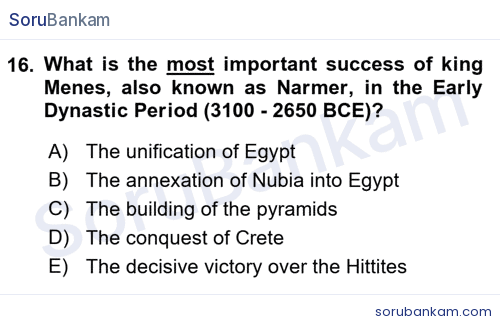
What is the most important success of king Menes, also known as Narmer, In the Early Dynastic Period (3100 - 2650 BCE)? A) The unification of Egypt B) The annexation of Nubia into Egypt C) The building of the pyramids D) The conquest of Crete E) The decisive victory over the Hittites
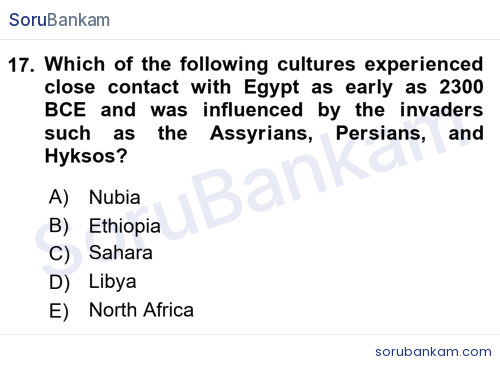
Which of the following cultures experienced close contact with Egypt as early as 2300 BCE and was influenced by the invaders such as the Assyrians, Persians, and Hyksos? A) Nubia B) Ethiopia C) Sahara D) Libya E) North Africa
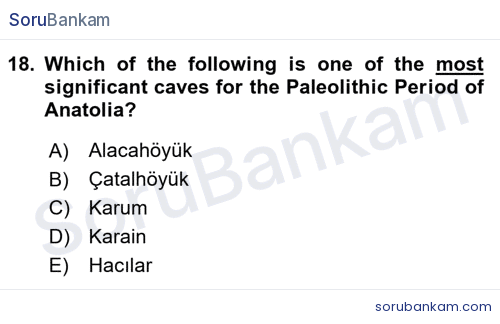
Which of the following is one of the most significant caves for the Paleolithic Period of Anatolia? A) Alacahöyük B) Çatalhöyük C) Karum D) Karain 1.2: E) Hacilar
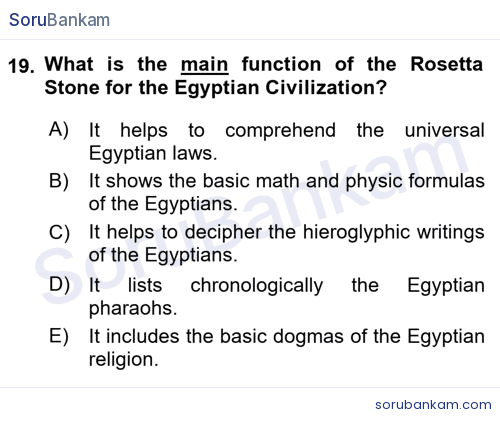
19. What is the main function of the Rosetta Stone for the Egyptian Civllization? A) It helps to comprehend the universal Egyptian laws. It shows the basic math and physic formulas of the Egyptians. C) It helps to decipher the hieroglyphic writings of the Egyptians. D) It lists chronologically the Egyptian pharaohs. It includes the basic dogmas of the Egyptian religion.
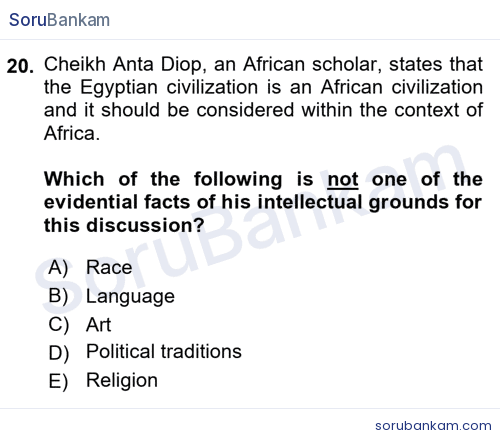
Cheikh Anta Diop, an African scholar, states that the Egyptian civilization is an African civilization and it should be considered within the context of Africa. Which of the following is not one of the evidential facts of his intellectual grounds for this discussion?. A) Race B) Language C) Art D) Political traditions E) Religion