ULI101U Introduction to World Civilization 2021-2022 Vize Soruları
20 soru · Vize · 2021-2022
ULI101U Introduction to World Civilization dersinin 2021-2022 vize sınavı 20 sorudan oluşur; ders AÖF Siyaset Bilimi ve Kamu Yönetimi (İngilizce) bölümünde okutulur. Sorular aşağıda sırasıyla yer alır. Doğru cevaplar ve sonucun, testi çözdüğünde görünür.
Önizleme · 20 soru. Cevaplamak ve sonucunu görmek için sınavı başlat.
Sorular
20 soru
Soru 1
Soru 2
Soru 3
Soru 4
Soru 5
Soru 6
Soru 7
Soru 8
Soru 9
Soru 10
Soru 11
Soru 12
Soru 13
Soru 14
Soru 15
Soru 16
Soru 17
Soru 18
Soru 19
Soru 20
Sınav modunda süre tutulur, doğru cevaplar ve sonucun sınav bitince görünür.
Dersin üniteleri
Ünite özetleri ve konu anlatımları
- 1. Ünite: The Civilization Approach To Human Development
- 2. Ünite: The Mesopotamian Civilization
- 3. Ünite: The Egyptian Civilization
- 4. Ünite: Anatolian Civilizations
- 5. Ünite: The Hellenic Civilization
- 6. Ünite: The Roman Civilization
- 7. Ünite: The Byzantine Civilization
- 8. Ünite: The Sinic Civilization
ULI101U Introduction to World Civilization ders sayfası: bütün sınavlar ve üniteler
Soruların metni (otomatik okuma)
Görsellerden otomatik okunmuştur; hata içerebilir. Sorular, görsellerdeki hâliyle geçerlidir.
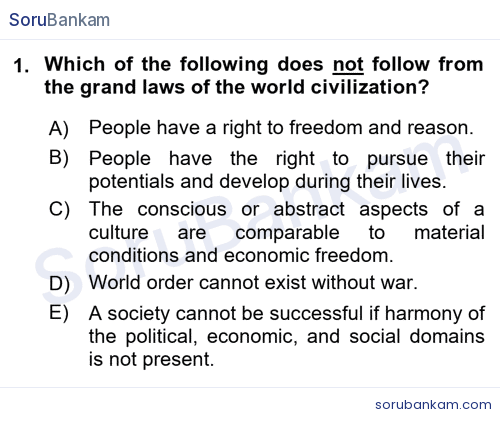
Which of the following does not follow from the grand laws of the world civilization? A) People have a right to freedom and reason. B) People have the right to pursue their potentials and develop during their lives. C) The conscious or abstract aspects of a culture are comparable to material conditions and economic freedom. D) World order cannot exist without war. E) A society cannot be successful if harmony of the political, economic, and social domains is not present.
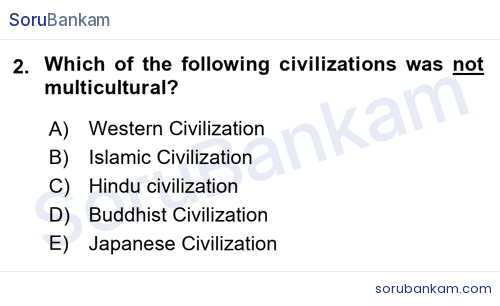
Which of the following civilizations was not multicultural? A) Western Civilization B) Islamic Civilization C) Hindu civilization D) Buddhist Civilization E) Japanese Civilization
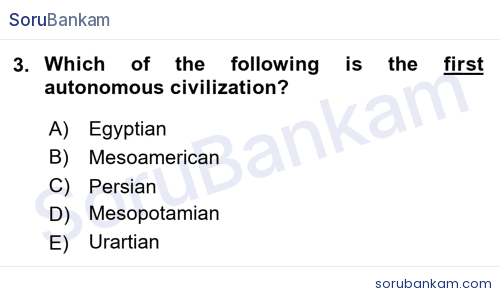
Which of the following the TEst autonomous civilization? A) Egyptian B) Mesoamerican C) Persian D) Mesopotamian E) Urartian
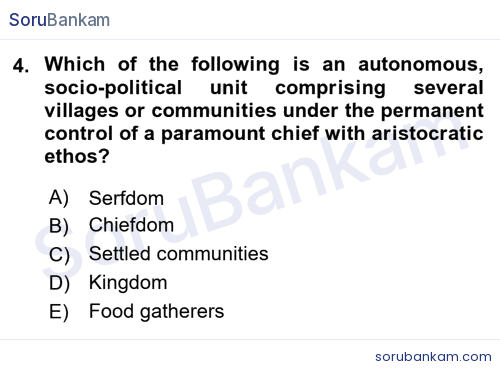
Which of the following is an autonomous. socio-political un|t comprising several villages or communities under the permanent control of a paramount chief with aristocratic ethog? A) Serfdom B) Chiefdom C) Settled communities D) Kingdom E) Food gatherers
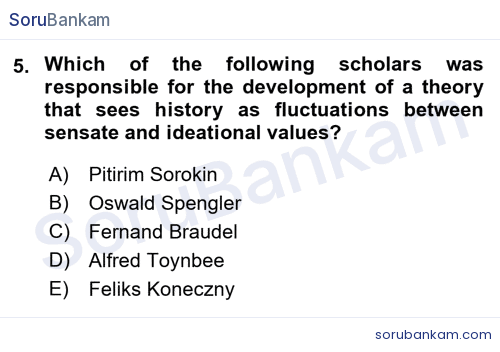
Which of the following scholars was responsible for the development of a theory that sees history as fluctuations between sensate and ideational values? A) Pitirim Sorokin B) Oswald Spengler C) Fernand Braudel D) Alfred Toynbee E) Feliks Koneczny
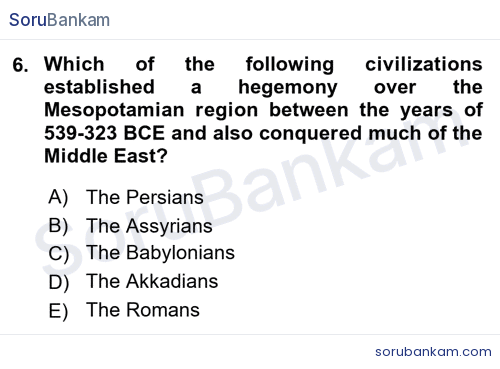
Which of the following civilizations established hegemony over the Mesopotamian region between the years of 539-323 BCE and also conquered much of the Middle East? A) The Persians 21. B) The Assyrians C) The Babylonians D) The Akkadians E) The Romans
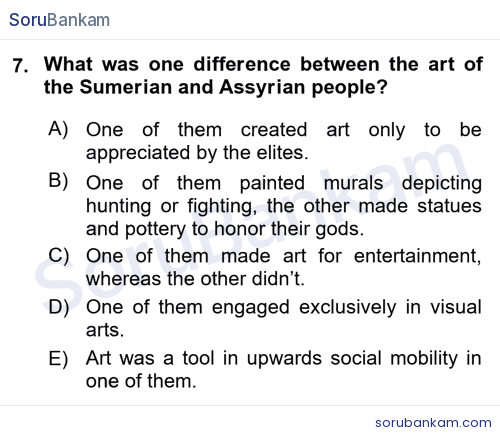
What was one difference between the art of the Sumerian and Assyrian people? A) One of, them created, art only to be appreciated by the elites. B) One of them painted murals depicting hunting or fightipg, the other made statues and pottery to honor their gods. C) One of them made art for entertainment, D) whereas the other didn't. One of them engaged exclusively in visual arts. E) Art was a tool in upwards social mobility in one of them.
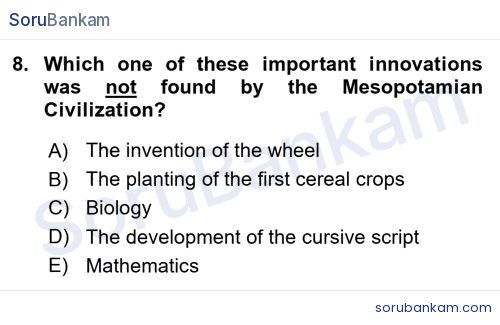
Which one of these important innovations was not found by the Mesopotamian Civilization? A) The invention of the wheel B) The planting of the first cereal crops C) Biology D) The development of the cursive script E) Mathematics
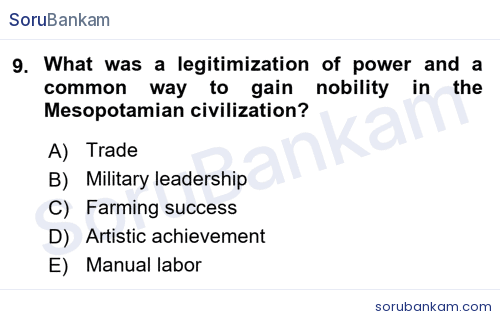
What was a legitimization of power and a common way to gain nobility in the Mesopotamian civilization? A) Trade B) Military leadership C) Farming success D) Artistic achievement E) Manual labor
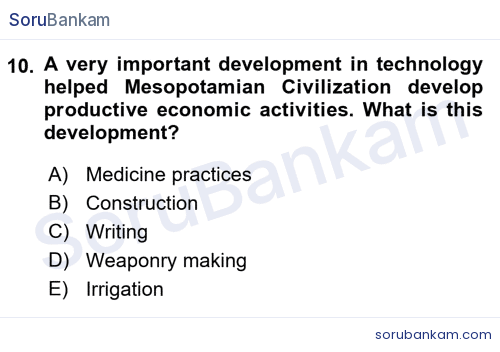
A very important development in technology helped Mesopotamian Civilization develop productive economic activities. What is this development? A) Medicine practices B) Construction C) Writing D) Weaponry making E) Irrigation
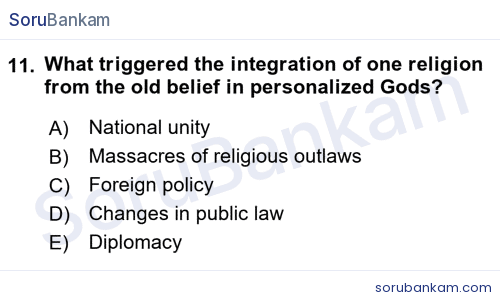
What triggered the integration of one religion from the old belief in personalized Gods? A) National unity B) Massacres of religious outlaws C) Foreign policy D) S Changes in public law E) Diplomacy
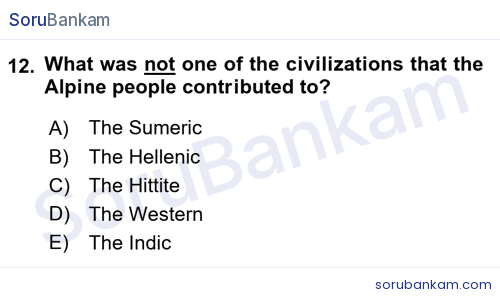
What was not one of the civilizations that the Alpine people contributed to? A) The Sumeric B) The Hellenic C) The Hittite D) The Western E) The Indic
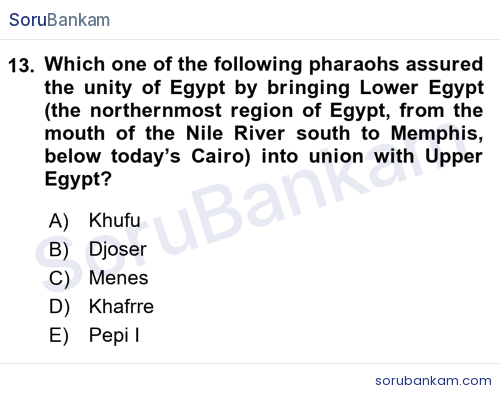
Which one of the following pharaohs assured the unity of Egypt by bringing Lower Egypt (the northernmost region of Egypt, from the mouth of the Nile River south to Memphis, below today's Cairo) into union with Upper Egypt? A) Khufu B) Djoser C) Menes D) Khafrre E) Pepi
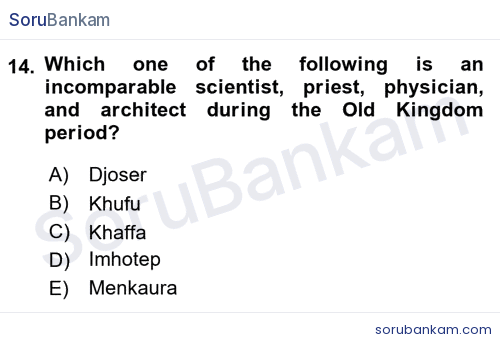
Which one of the following is incomparable scieptist, priest, physician, and architect during the Old Kingdom period? A) Djoser B) Khufu C) Khaffa D) Imhotep E) Te Menkaura
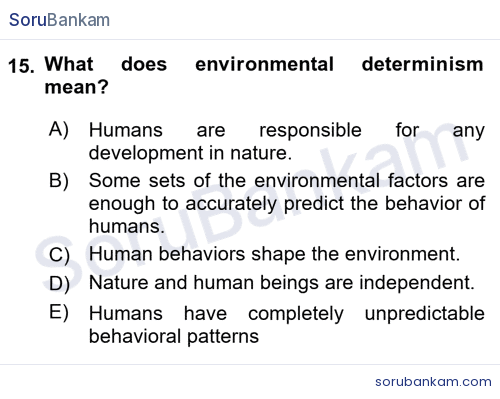
What does environmental determinism mean? A) Humans are responsible for any development in nature. B) Some sets of the environmental factors are enough to accurately predict the behavior of humans. C) Human behaviors shape the environment. D) Nature and human beings are independent. E) Humans have completely unpredictable behavioral patters
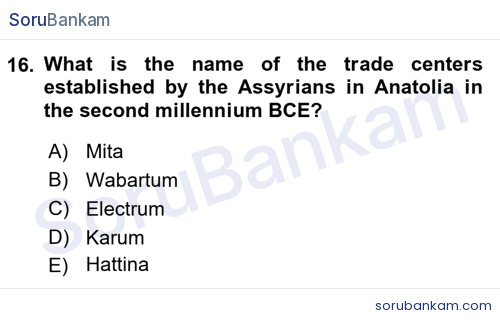
What is the name of the trade centers established by the Assyrians in Anatolia in the second millennium BCE? A) Mita B) Wabartum (1." C) Electrum *. D) Karum E) Hattina
Where is the modern location of Kanesh (Kültepe) where the Assyrian merchants resided? 1.C) A) Corum B) Malatya C) Kayseri D) Konya E) Niğde
Which Hittite king was the most succesfull statesman of his era? A) Shuppilliuma B) Zidanta C) Tuthalia III D) Huzziya I/ E) Amuvanda
The art forms of the Hittite Period continued into the Late Hittite city states, varying in nature according to the regions where they existed and the ethnic groups that populated them. Which is not one of these artistic styles that have been detected in Late Hittite art? A) Traditional style B) _ Arami and Phoenician style C) Assyrian style D) Late Hittite style E) Urartian Style
What city, given below, is the capital city of the Lydians? A) Tushpa B) Gordion C) Sardes D) Troy E) Hattusa