ISL351U Foreign Trade 2020-2021 Yaz Okulu Soruları
20 soru · Yaz okulu · 2020-2021
ISL351U Foreign Trade dersinin 2020-2021 yaz okulu sınavı 20 sorudan oluşur; ders AÖF Uluslararası İlişkiler (İngilizce) bölümünde okutulur. Sorular aşağıda sırasıyla yer alır. Doğru cevaplar ve sonucun, testi çözdüğünde görünür.
Önizleme · 20 soru. Cevaplamak ve sonucunu görmek için sınavı başlat.
Sorular
20 soru
Soru 1
Soru 2
Soru 3
Soru 4
Soru 5
Soru 6
Soru 7
Soru 8
Soru 9
Soru 10
Soru 11
Soru 12
Soru 13
Soru 14
Soru 15
Soru 16
Soru 17
Soru 18
Soru 19
Soru 20
Sınav modunda süre tutulur, doğru cevaplar ve sonucun sınav bitince görünür.
Dersin üniteleri
Ünite özetleri ve konu anlatımları
- 1. Ünite: Introduction To International Trade
- 2. Ünite: Classical Trade Theory And Standard Theory Of International Trade
- 3. Ünite: Factor Endowments And The Heckscher-Ohlin Theory
- 4. Ünite: Post-Heckscher-Ohlin Theories
- 5. Ünite: Trade Barriers: Tariffs And Non-Tariff Restrictions
- 6. Ünite: Multilateral Trading System And Economic Integrations
- 7. Ünite: Foreign Exchange Market And Foreign Exchange Rate
- 8. Ünite: International Capital Movements
ISL351U Foreign Trade ders sayfası: bütün sınavlar ve üniteler
Soruların metni (otomatik okuma)
Görsellerden otomatik okunmuştur; hata içerebilir. Sorular, görsellerdeki hâliyle geçerlidir.
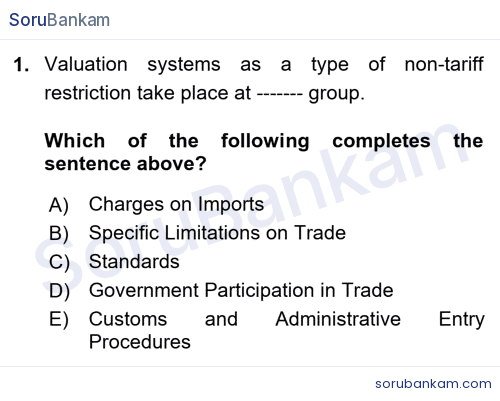
1. Valuation systems as a type of non-tariff restriction take place at — group. Which of the following completes the sentence above? A) Charges on Imports B) Specific Limitations on Trade C) Standards D) Government Participation in Trade Customs and Administrative Entry Procedures
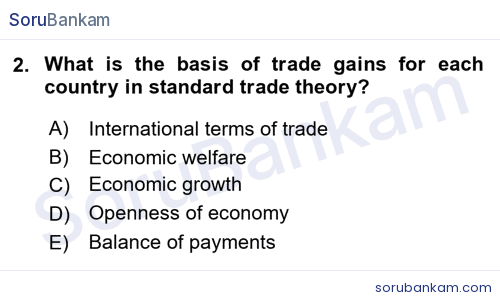
2. What is the basis of trade gains for each country in standard trade theory? A) International terms of trade Economic welfare c) Economic growth D) Openness of economy E) Balance of payments
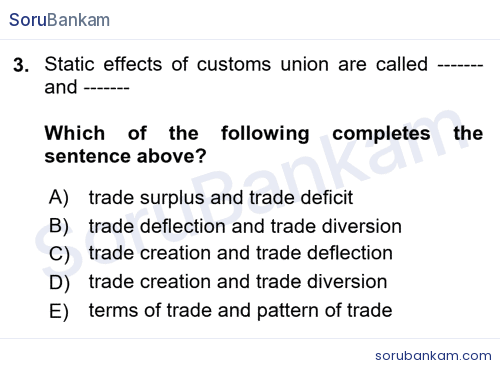
Static effects of customs union are called and-.....- Which of the following completes the sentence above? A) trade surplus and trade deficit B) trade deflection and trade diversion C) trade creation and tragle deflection D) trade creation and trade diversion E) terms of trade and pattern of trade
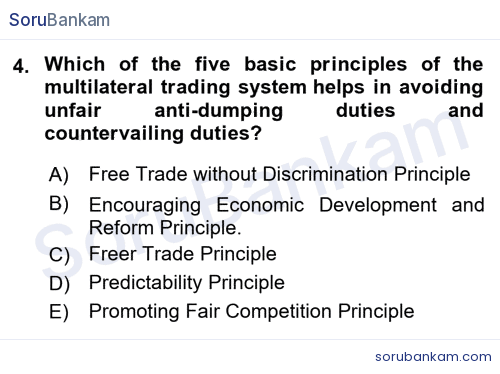
Which of the five basic principles of multilateral trading system helps in avoiding unfair anti-dumping duties' and countervailing duties? A) • Free Trade without Discrimination Principle B) Encouraging Economic Development and Reform Principle. C) Freer Trade Principle D) Predictability Principle E) Promoting Fair Competition Principle
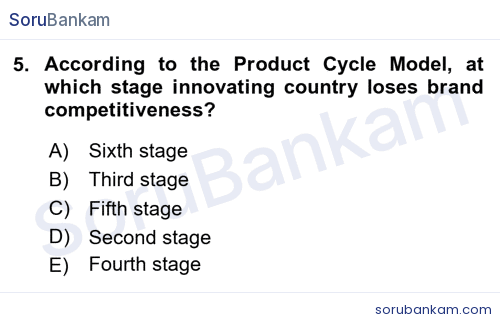
According to the Product Cycle Model, at which stage innovating country loses brand competitiveness? A) Sixth stage B) Third stage C) Fifth stage D) Second stage E) e) Fourth stage
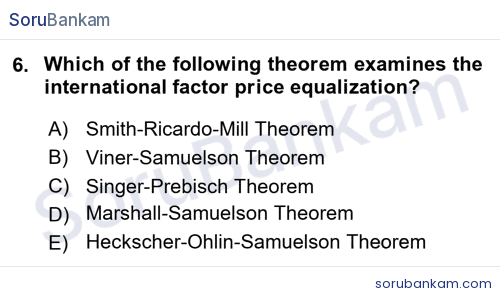
Which of the following theorem examines the international factor price equalization? A) Smith-Ricardo-Mill Theorem B) Viner-Samuelson Theorem C) Singer-Prebisch Theorem D) Marshall-Samuelson Theorem E) Heckscher-Ohlin-Samuelson Theorem
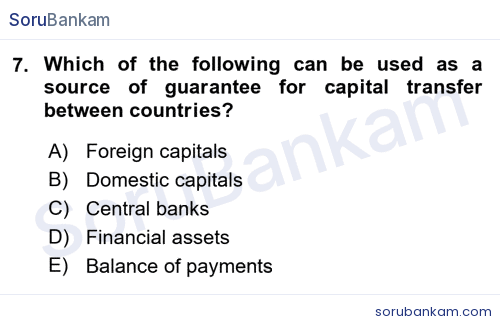
Which of the following can be used as a source of guaranțee for capital transfer between countries? A) Foreign capitals B) Domestic capitals C) Central banks . D) Financialassets E) Balance of payments'
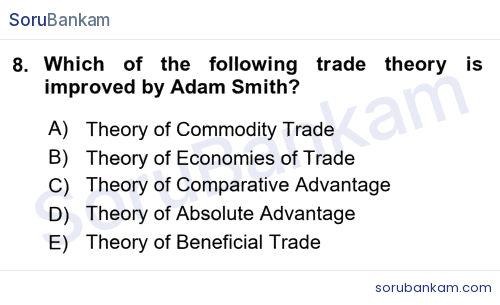
8. Which of the following trade theory is improved by Adam Smith? A) Theoryon Commodity Trade Theory of Economies of Trade " C) ' Theory of Comparative Advantage D) Theory of Absqlute Advantage. E) Theory of.Beneficial Trade
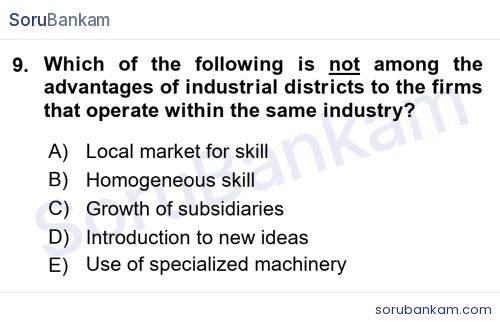
Which of the following is not among the advantages of industrial districts to the firms that operate within the same industry? A) Local market for skill B) Nv.B) Homogeneous skill C) Growth of subsidiaries D) Introduction to new ideas E) Use of specialized machinery
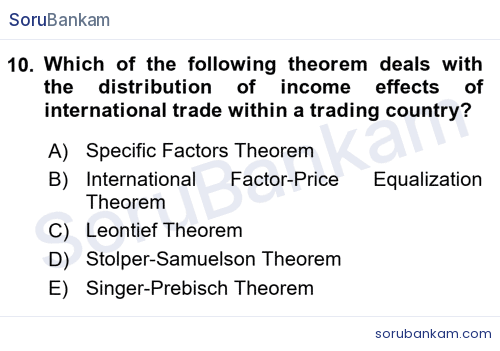
10. Which of the following theorem deals with the distribution of income effects of international trade within a trading country? A) Specific Factors Theorem B) International Factor-Price Equalization Theorem Leontief Theorem D) Stolper-Samuelson Theorem E) Singer-Prebisch Theorem
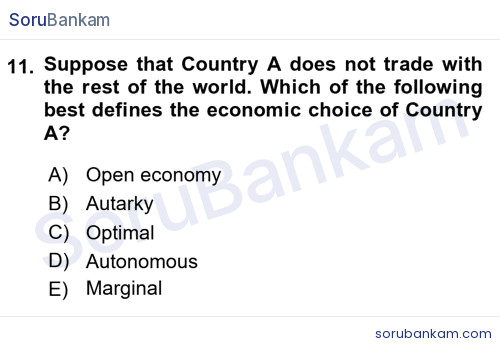
Suppose that Country A does not trade with the rest of the world. Which of the following best defines the economic choice of Country A? A) Open economy B) Autarky C) Optimal D) Autonomous E) Marginal
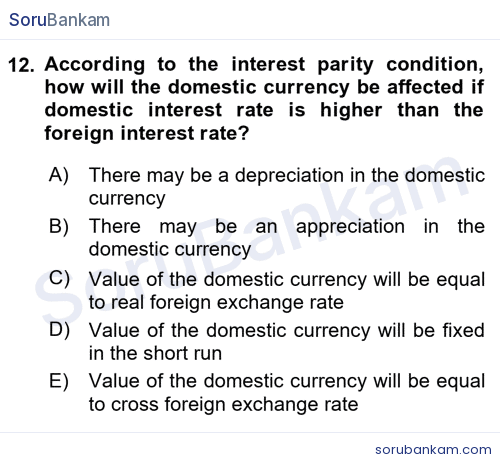
12. According to the interest parity condition, how will the domestic currency be affected if domestic interest rate is higher than the foreign interest rate? A) There may be a depreciation in the domestic currency B) There may be an appraciation in the domestic currency C) Value of the domestic currency will be equal to real foreign exchange rate D) Value of the domestic currency will be fixed in the short run Value of the domestic currency will be equal to cross foreign exchange rate
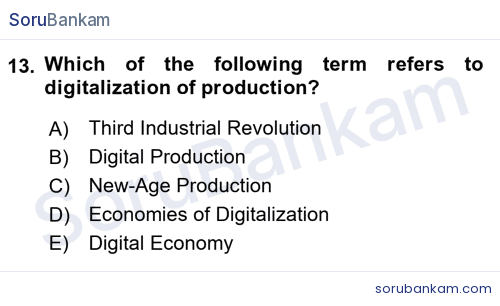
Which of the following term refers to digitalization of productlon? A) Third Industrial Revolution B) Digital Production C) New-Age Production D) Economies of Digitalization E) Digital Economy
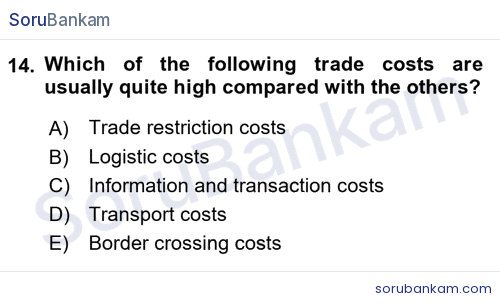
Which of the following trade costs are usually quite high compared with the others? A) Trade restriction costs B) Logistic costs C) Information and transaction costs D) Transport costs E) S Border çrossing costs
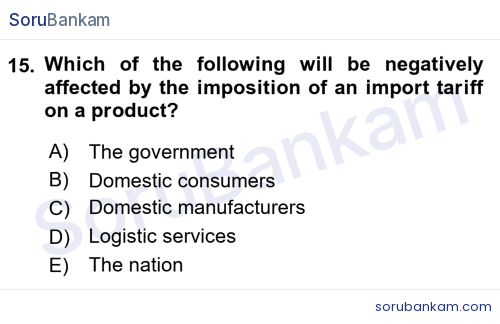
Which of the following will be negatively affected by the Imposition of an Import tariff on a product? A) The government B) Domestic consumers C) Domestic manufacturers D) Logistic services E) The nation
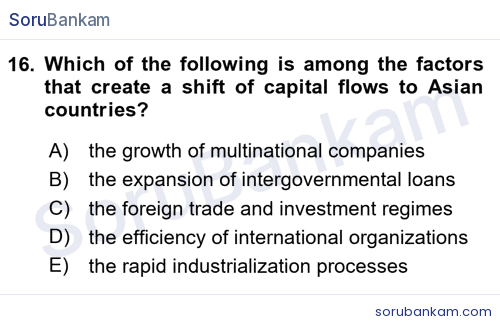
Which of the following is among the factors that create a shift of capital flows to Asian countries? A) the growth of multinational companies B) the expansion of intergovernmental loans C) the foreign trade and investment regimes D) the efficiency of international organizations E) the rapid industrialization processes
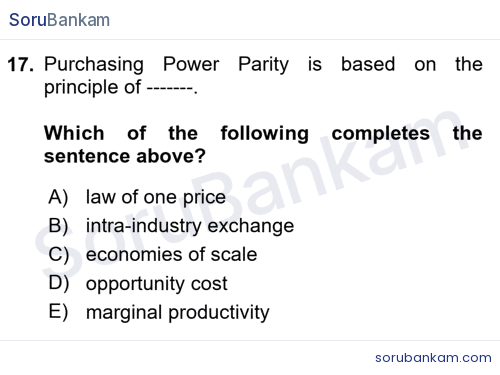
Purchasing Power Parity is based on the principle of -....-. Which of the following completes the sentence above? A) law of one price B) intra-industry exchange C) economies of scale D) opportunity cost E) marginal productivity
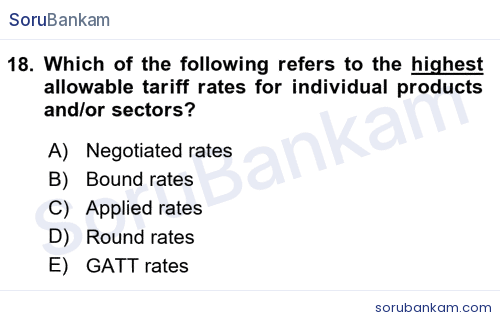
Which of the following refers to the highest allowable tariff rates for individual products and/or sectors? ¿* A) Negotiated rates B) . B) Bound rates C) Applied rates D) Round rates E) GATT rates
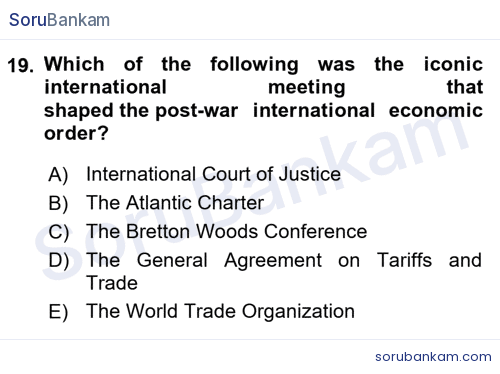
Which of the following was the iconic international meeting that shaped the post-war international economic order? A) International Court of Justice B) The Atlantic Charter C) The Bretton Woods Conference D) The General Agreement on Tariffs and Trade E) The World Trade Organization
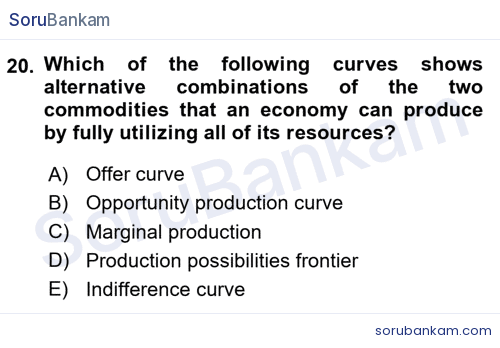
Which of the following curves shows alternative combinations of the two commodities that an economy can produce by fully utilizing all of its resources? A) Offer curve B) Opportunity production curve C) Marginal production D) Production possibilities frontier E) Indifference curve