ISL351U Foreign Trade 2019-2020 Vize Soruları
20 soru · Vize · 2019-2020
ISL351U Foreign Trade dersinin 2019-2020 vize sınavı 20 sorudan oluşur; ders AÖF Uluslararası İlişkiler (İngilizce) bölümünde okutulur. Sorular aşağıda sırasıyla yer alır. Doğru cevaplar ve sonucun, testi çözdüğünde görünür.
Önizleme · 20 soru. Cevaplamak ve sonucunu görmek için sınavı başlat.
Sorular
20 soru
Soru 1
Soru 2
Soru 3
Soru 4
Soru 5
Soru 6
Soru 7
Soru 8
Soru 9
Soru 10
Soru 11
Soru 12
Soru 13
Soru 14
Soru 15
Soru 16
Soru 17
Soru 18
Soru 19
Soru 20
Sınav modunda süre tutulur, doğru cevaplar ve sonucun sınav bitince görünür.
Dersin üniteleri
Ünite özetleri ve konu anlatımları
- 1. Ünite: Introduction To International Trade
- 2. Ünite: Classical Trade Theory And Standard Theory Of International Trade
- 3. Ünite: Factor Endowments And The Heckscher-Ohlin Theory
- 4. Ünite: Post-Heckscher-Ohlin Theories
- 5. Ünite: Trade Barriers: Tariffs And Non-Tariff Restrictions
- 6. Ünite: Multilateral Trading System And Economic Integrations
- 7. Ünite: Foreign Exchange Market And Foreign Exchange Rate
- 8. Ünite: International Capital Movements
ISL351U Foreign Trade ders sayfası: bütün sınavlar ve üniteler
Soruların metni (otomatik okuma)
Görsellerden otomatik okunmuştur; hata içerebilir. Sorular, görsellerdeki hâliyle geçerlidir.
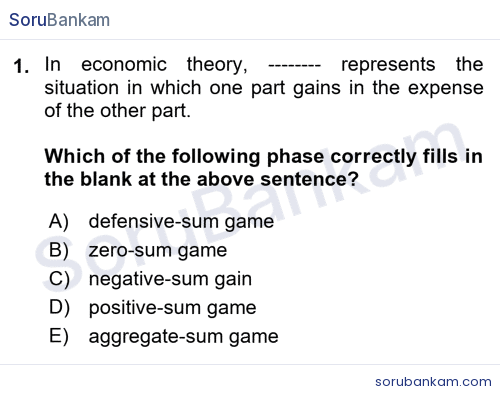
In economic theory, - represents the situation in which one part gains in the expense of the other part. Which of the following phase correctly fills in the blank at the above sentence? A) defensive-sum game B) zero-sum game C) negative-sum gain D) positive-sum game E) aggregate-sum game
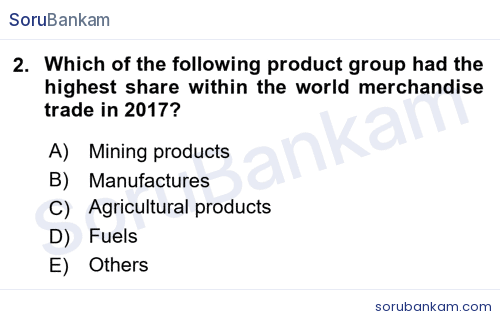
Which of the following product group had the highest share within the world merchandise trade in 2017? A) Mining products B) Manufactures C) Agricuitural products D) Fuels E) Others
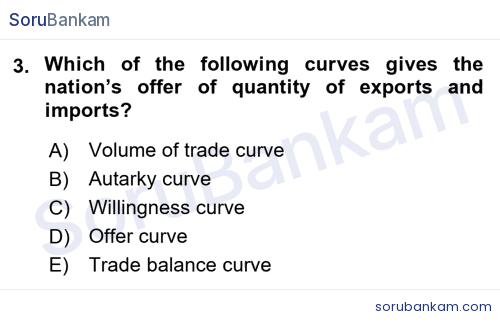
Which of the following curves gives, the nation's offer of quantity of exports and imports? A) Volume of trade curve B) Autarky curve C) Willingness curve D) Offer curve. E) Trade balance curve"'**
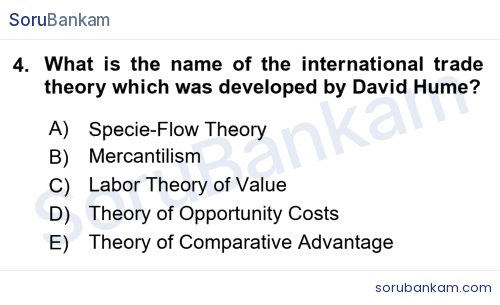
4. What is the name of the international trade theory which was developed by David Hume? A) Specie Flow Theory mercantilism « C) Labor Theory of Value D) Theory of Opportunity Costs E) Theory of Comparative Advantage
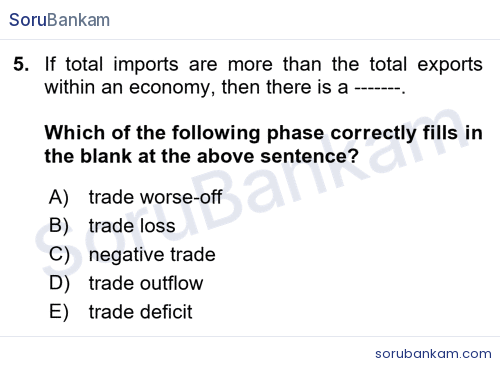
If total imports are more than the total exports within an economy, then there is a-. Which of the following phase correctly fills in the blank at the above sentence? A) trade worse-off B) trade loss C) negative trade D) trade outflow E) trade deficit
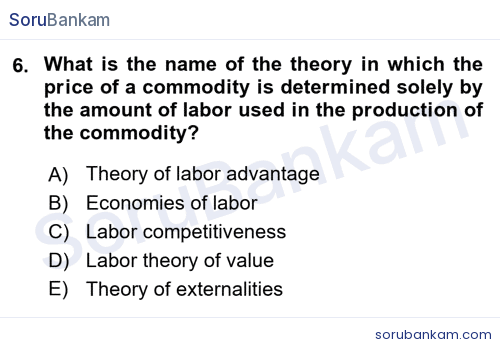
What is the name of the theory in which the price of a commodity is determined solely by the amount of labor used in the production of the commodity? A) Theory of labor advantage B) Economies of labor .. C) Labor competitiveness D) Labor theory of value E) Theory of externalities
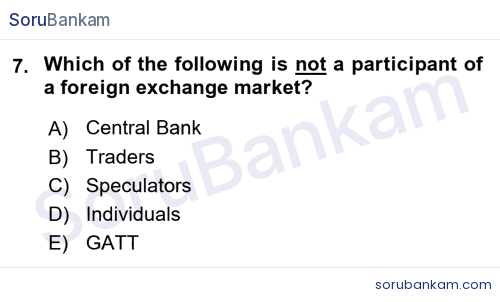
Which of the following is not a participant of a foreign exchange market? A) Central Bank' B) Traders C) Speculators D) Individuals E) GATT,
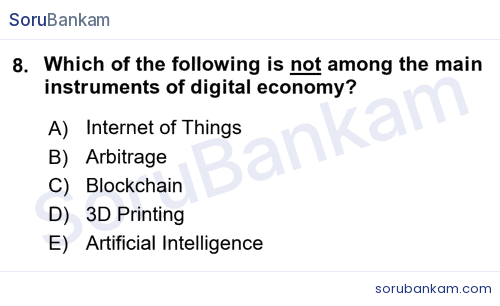
8. Which of the following is not among the main instruments of digital economy? A) Internet of Things B) roltrage «°C) Blockchain D) 3D Printing e) Artificial intelligence
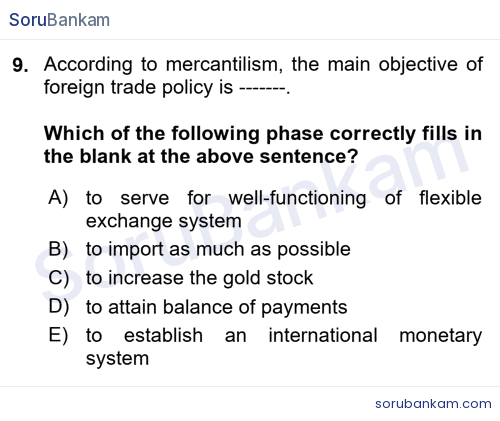
According to mercantilism, the main objective of foreign trade policy is..... Which of the following phase correctly fills in the blank at the above sentence? A) to serve for well-functioning of flexible exchange system B) to import as much as possible C) to increase the gold stock D) to attain balance of payments E) to establish an international monetary system
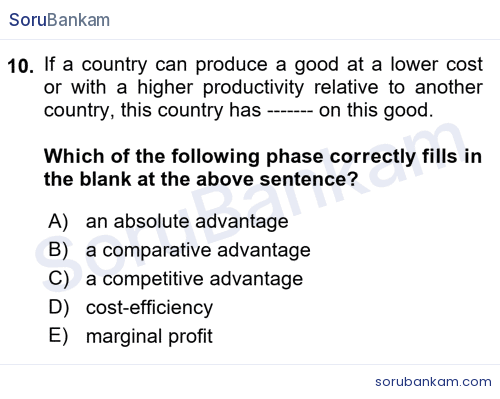
If a country can produce a good at a lower cost or with a higher productivity relative to another country, this country has - on this good. Which of the following phase correctly fills in the blank at the above sentence? A) an absolute advantage B) a comparative advantage C) a competitive advantage D) cost-efficiency E) marginal profit
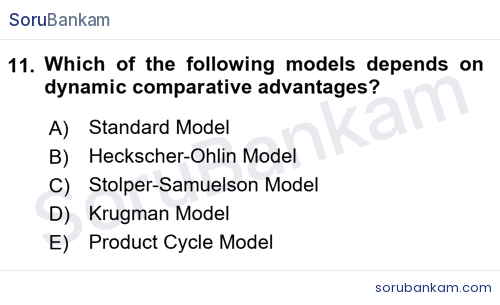
Which of the following models depends on dynamic comparative advantages? A) Standard Model B) Heckscher-Ohlin Model C) Stolper-Samuelson Model D) Krugman Model E) Product Cycle Model
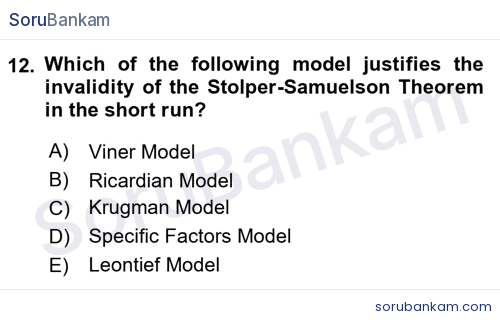
Which of the following model justifies the invalidity of the Stolper-Samuelson Theorem in the short run? A) Viner Model B) Ricardian Model C) Krugman Model D) Specific Factors Model E) Leontief Model
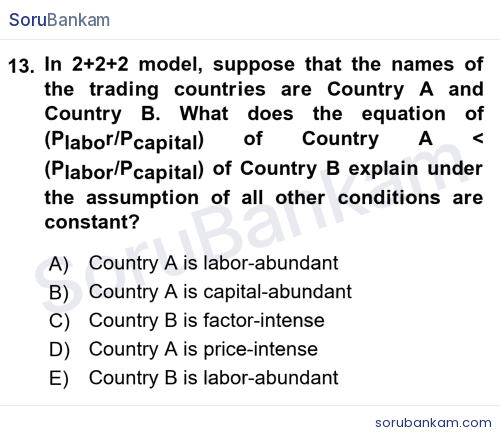
In 2+2+2 model, suppose that the names of. the trading countries are Country A and Country B. What does the equation of (Plabor/Pcapital) of Country A < (Plabor/P capital) of Country B explain under the assumptlon of all other conditions are constant? A) Country A is labor-abundant B) Country A is capital-abundant T' C) Country B is factor-intense D) Country A is price-intense E) Country 8 is labor-abundant
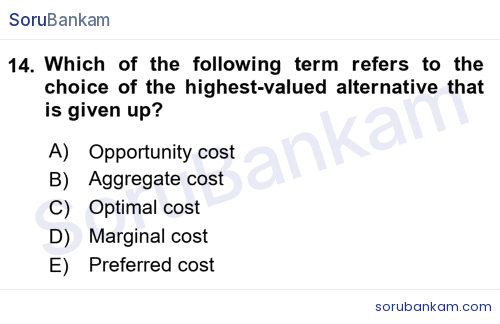
Which of the following term refers to the choice of the highest-valued alternative that is given up? A) Opportunity cost B) \B) Aggregate cost C) Optimal cost D) Marginal cost E) Preferred cost
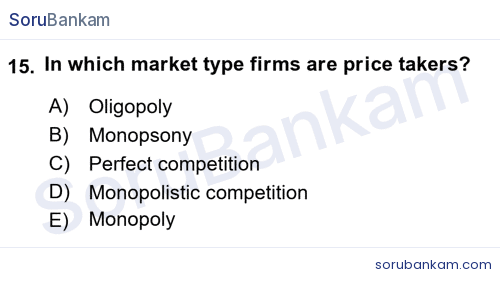
In which market type firms are price takers? A) Oligopoly B) Monopsony C) Perfect competition D) Monopolistic competition E) Monopoly
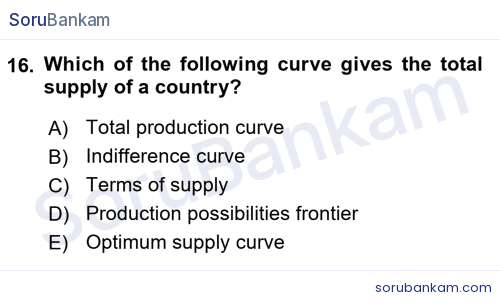
Which of the following curve gives the total supply of a country? A) Total production curve B) Indifference curve C) Terms of supply D) Production possibilities frontier. 3'*. E) Optimum supply curve
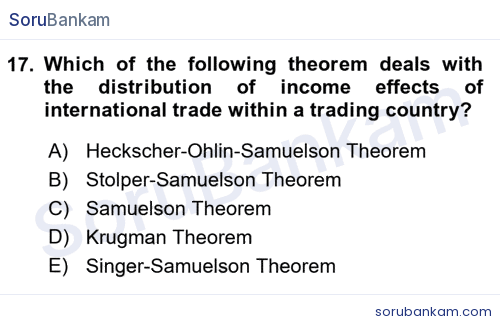
Which of the following theorem deals with the distribution of income effects of international trade within a trading country? A) Heckscher-Ohlin-Samuelson Theorem B) Stolper-Samuelson Theorem C) Samuelson Theorem D) Krugman Theorem E) Singer-Samuelson Theorem
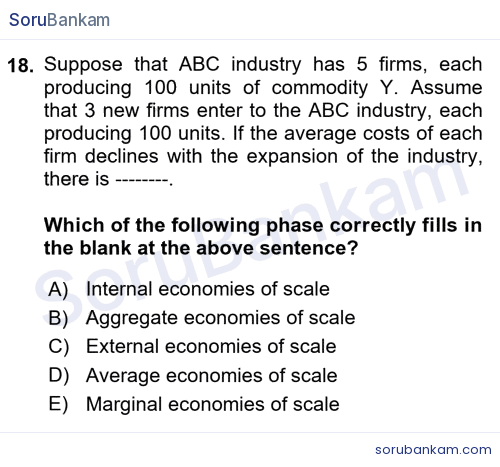
Suppose that ABC industry has 5 firms, each producing 100 units of commodity Y. Assume that 3 new firms enter to the ABC industry, each producing 100 units. If the average costs of each firm getlines with the expansion of the industry, "thère is - Which of the following phase correctly fills in the blank atthe above sentence? A) ¡Ay Internal economies of scale B) Aggregate economies of scale C) External economies of scale D) Average economies of scale E) Marginal economies of scale
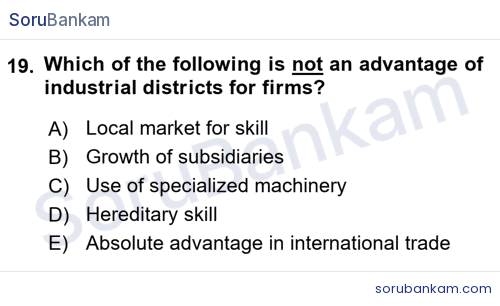
Which of the following is not an advantage of industrial districts for firms? A) Local market for skill B) Growth of subsidiaries C) Use of specialized machinery D) Hereditary skill E) Absolute advantage in international trade
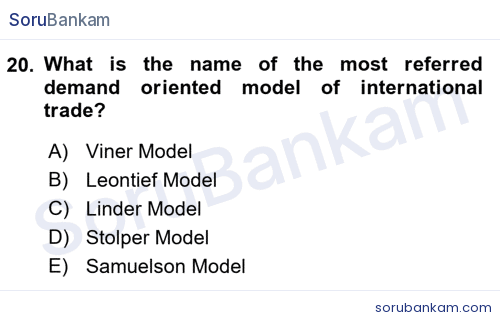
What is the name of the most referred demand oriented model of international trade? A) Viner Model B) Leontief Model C) Linder Model D) Stolper Model E) Samuelson Model