ISL351U Foreign Trade 2022-2023 Final Soruları
20 soru · Final · 2022-2023
ISL351U Foreign Trade dersinin 2022-2023 final sınavı 20 sorudan oluşur; ders AÖF Uluslararası İlişkiler (İngilizce) bölümünde okutulur. Sorular aşağıda sırasıyla yer alır. Doğru cevaplar ve sonucun, testi çözdüğünde görünür.
Önizleme · 20 soru. Cevaplamak ve sonucunu görmek için sınavı başlat.
Sorular
20 soru
Soru 1
Soru 2
Soru 3
Soru 4
Soru 5
Soru 6
Soru 7
Soru 8
Soru 9
Soru 10
Soru 11
Soru 12
Soru 13
Soru 14
Soru 15
Soru 16
Soru 17
Soru 18
Soru 19
Soru 20
Sınav modunda süre tutulur, doğru cevaplar ve sonucun sınav bitince görünür.
Dersin üniteleri
Ünite özetleri ve konu anlatımları
- 1. Ünite: Introduction To International Trade
- 2. Ünite: Classical Trade Theory And Standard Theory Of International Trade
- 3. Ünite: Factor Endowments And The Heckscher-Ohlin Theory
- 4. Ünite: Post-Heckscher-Ohlin Theories
- 5. Ünite: Trade Barriers: Tariffs And Non-Tariff Restrictions
- 6. Ünite: Multilateral Trading System And Economic Integrations
- 7. Ünite: Foreign Exchange Market And Foreign Exchange Rate
- 8. Ünite: International Capital Movements
ISL351U Foreign Trade ders sayfası: bütün sınavlar ve üniteler
Soruların metni (otomatik okuma)
Görsellerden otomatik okunmuştur; hata içerebilir. Sorular, görsellerdeki hâliyle geçerlidir.
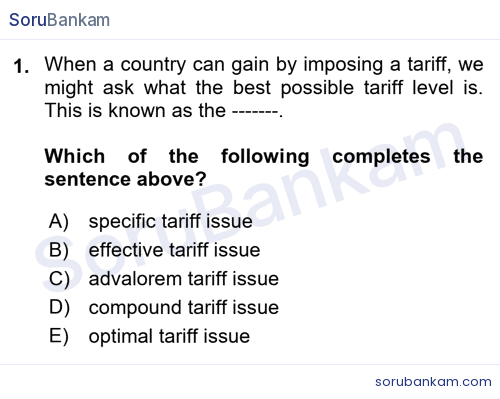
When a country can gain by imposing a tariff, we might ask what the best possible tariff level is. This is known as the -—---. Which of the following completes the sentence above? A) specific tariff issue B) effective tariff issue C) advalorem tariff issue D) compound tariff issue E) optimal tariff issue
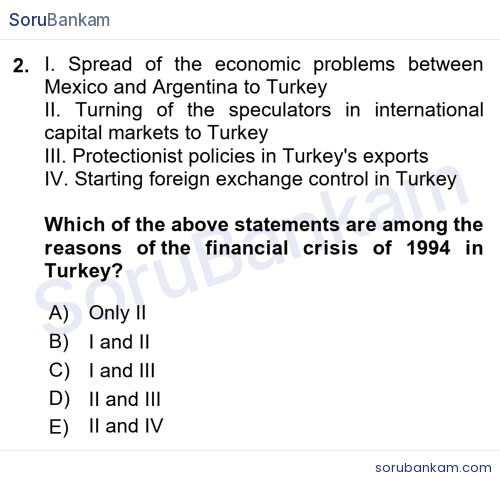
I. Spread of the economic problems between Mexico and Argentina to Turkey I. Turning of the speculators in international capital markets to Turkey III. Protectionist policies in Turkey's exports IV. Starting foreign exchange control in Turkex Which of the above statements are among the reasons of the financial crisis of 1994 in Turkey? A) Only B) I and C) I and III D) Il and Ill E) Il and
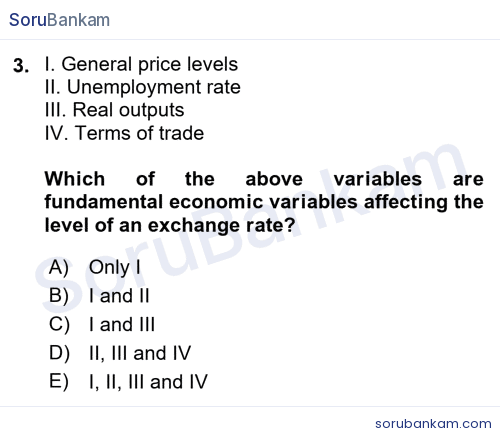
I. General price levels II. Unemployment rate III. Real outputs IV. Terms of trade Which of the above variables are fundamental economic variables affecting the level of an exchange rate? A) Only B) land C) I and Ill D) II, Ill and E) I, li, til and
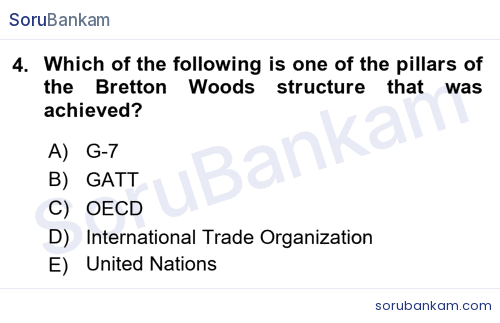
Which of the following is one of the pillars of the Bretton Woods structure that was achieved? A) G-7 B) GATT C) OECD D) International Trade Organization E) United Nations
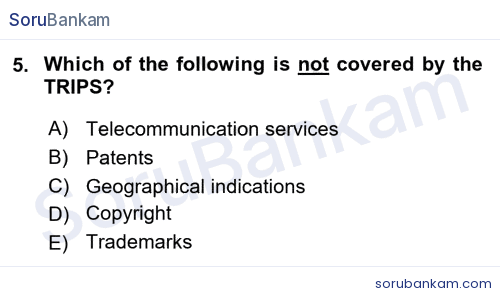
Which of the following is not covered by the TRIPS? A) Telecommunication services B) Patents C) Geographical indications D) Copyright E) Trademants
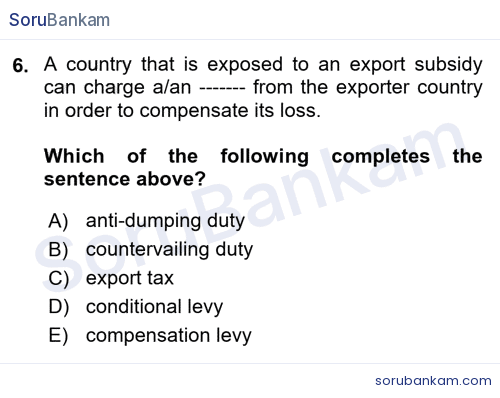
A country that is exposed to an export subsidy can charge a/an-. from the exporter country in order to compensate its loss. Which of the following completes the sentence above? A) anti-dumping duty B) countervailing duty C) export tax D) conditional levy E) compensation levy
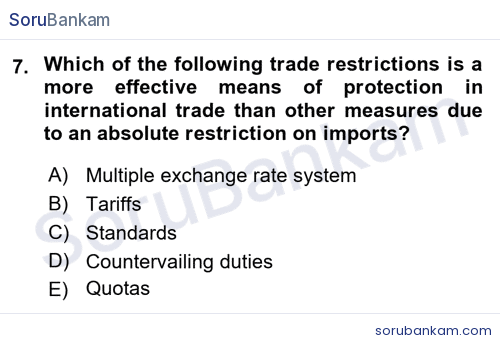
Which of the following trade restrictions is a more effective means of protection in international trade than other measures due to an absolute restriction on imports? A) Multiple exchange rate system B) Tariffs C) Standards D) Countervailing duties E) Quotas
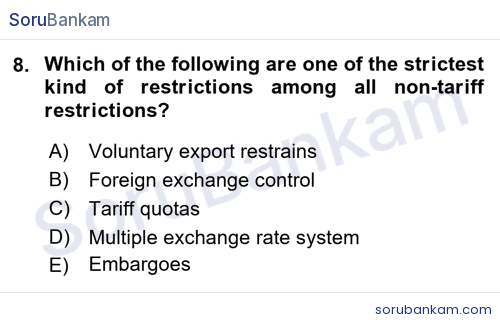
Which of the following are one of the strictest kind of restrictions among all non-tariff restrictions? A) Voluntary export restrains B) Foreign exchange control C) Tariff quotas D) Multiple exchange rate system E) Embargoes
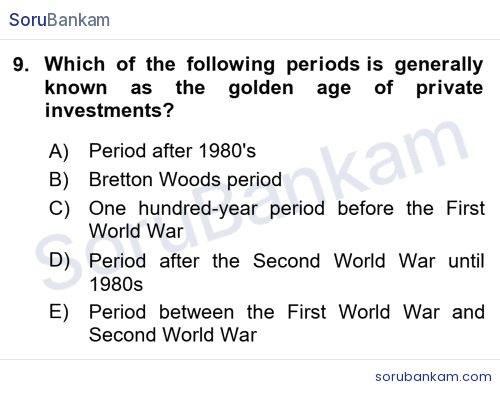
Which of the following periods is generally known as the golden age of private investments? A) Period after 1980's B) Bretton Woods period C) One hundred-year period before the First World War D) Period after the Second World War until 1980s E) Period between the First World War 'and Second World War
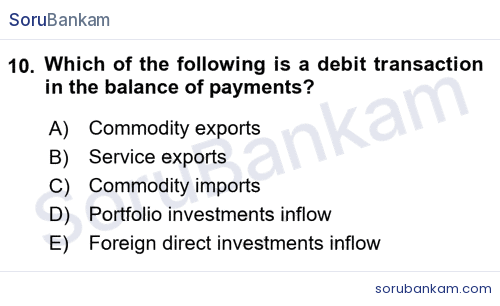
Which of the following is a debit transaction in the balance of payments? A) Commodity exports B) Service exports C) Commodity imports D) Portfolio investments inflow stei E) Foreign direct investments inflow
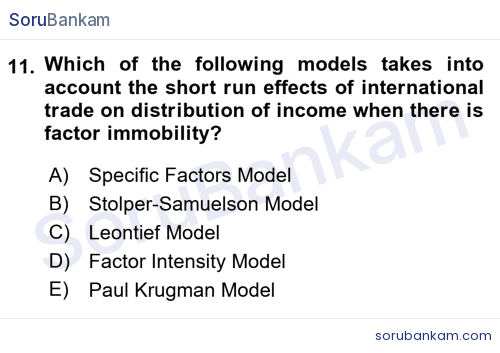
Which of the following models takes into account the short run effects of internat/onal trade on distribution of income when there is factor immobility? A) Specific Factors Model B) Stolper-Samuelson Model C) Leontief Model D) Factor Intensity Model E) Paul Krugman Model
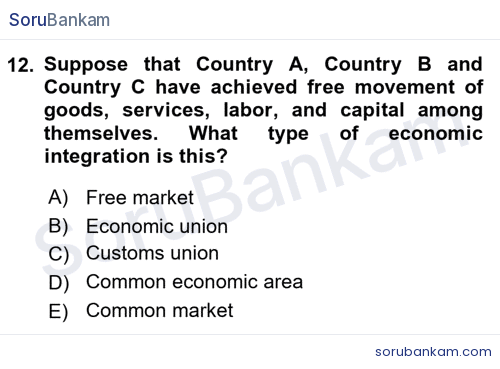
Suppose that Country A, Country B and Country C have achieved free movement of goods, services, labor, and capital among themselves. What type of economic integration is this? 1. A) Free market B) Economic union C) Customs union D) Common economic area E) Common market
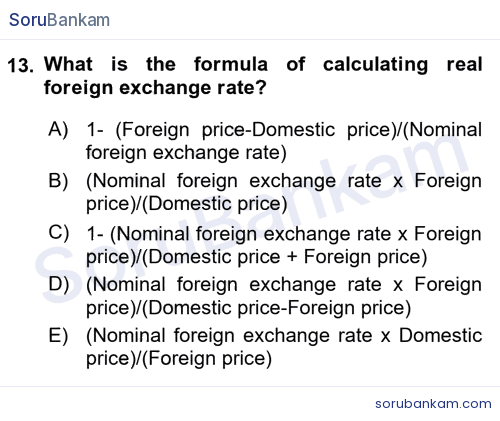
13. What is the formula of calculating real foreign exchange rates A) 1- (Foreign price-Domestic price)/(Nominal foreign exchange rate) 'B)' (Nominal foreign exchange rate x Foreign price)/(Domestic price) C) 1- (Nominal foreign exchange rate x Foreign pricey (Domestic price + Foreign price) Di (Nominal foreign exchange rate x Foreign price)/(Domestic price-Foreign price) (Nominal foreign exchange rate x Domestic price)/(Foreign price)
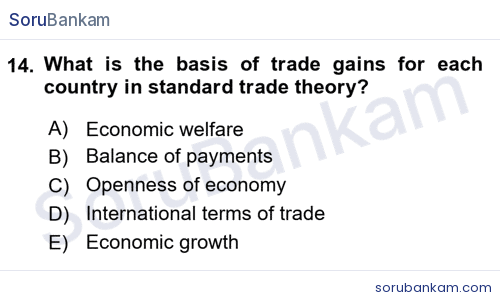
What is the basis of trade gains for each country in standard trade theory? A) Economic welfare B) Balance of payments C) Openness of economy D) International terms of trade E) Economic growth
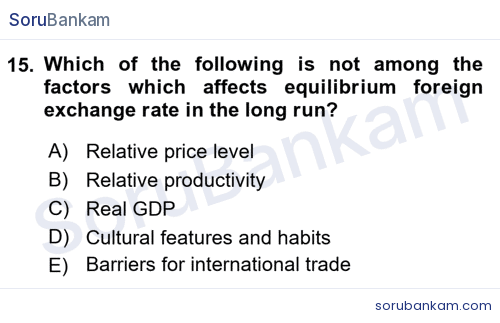
Which of the following is not among the factors which affects equilibrium foreign exchange rate in the long run? A) Relative price level B) Relative productivity C) Real GDP D) Cultural features and habits E) Barriers for international trade
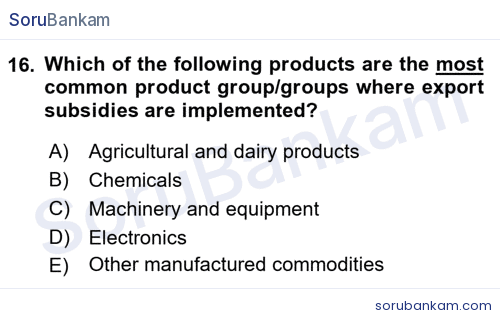
Which of the following products are the most common product group/groups where export subsidies are implemented? A) Agricultural and dairy products B) Chemicals C) Machinery and equipment D) Electronics E) Other manufactured commodities
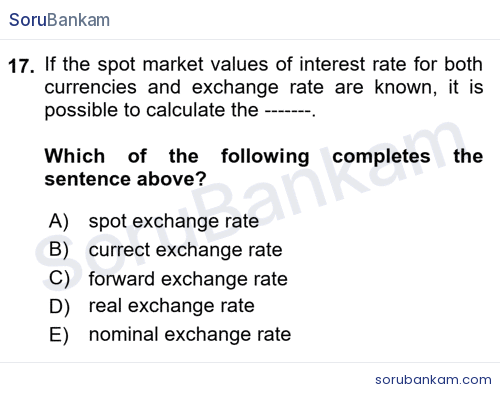
If the spot market values of interest rate for both currencies and exchange rate are known, it is possible to calculate the __. Which of the following completes the sentence above? A) spot exchange rate B) currect exchange rate C) forward exchange rate D) real exchange rate E) nominal exchange rate
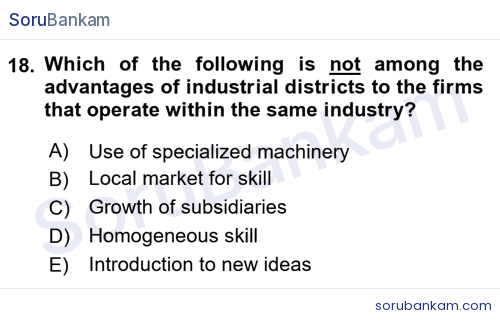
Which of the following is not among the advantages of industrial districts to the firms that operate within the same industry? A) Use of specialized machinery B) Local market for skill C) Growth of subsidiaries D) Homogeneous skill E) Introduction to new ideas
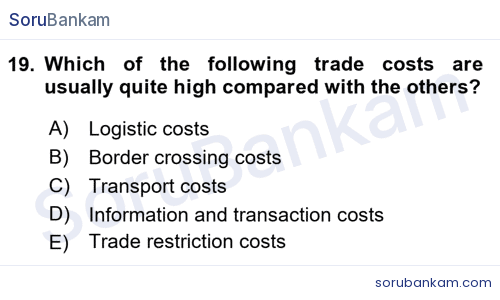
Which of the following trade costs are usually quite high compared with the others? A) Logistic costs B) Border crossing costs C) Transport costs D) Information and transaction costs E) Trade restriction costs
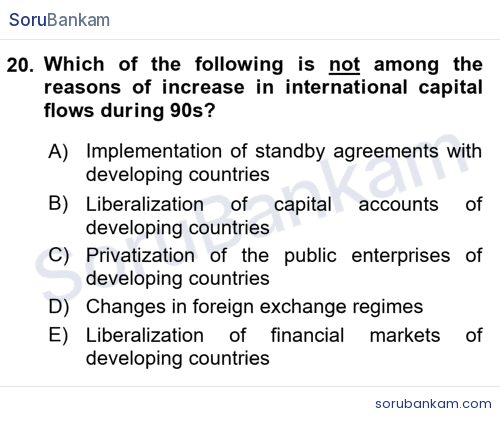
Which of the following is not among the reasons of increase in international capital flows during 90$? A) Implementation of standby agreements with developing countries B) Liberalization of capital acçqunts developing countries C) Privatization of the public enterprises of developing countries D) Changes in foreign exchange regimes E) Liberalization of financial markets of developing countries