ISL351U Foreign Trade 2021-2022 Final Soruları
20 soru · Final · 2021-2022
ISL351U Foreign Trade dersinin 2021-2022 final sınavı 20 sorudan oluşur; ders AÖF Uluslararası İlişkiler (İngilizce) bölümünde okutulur. Sorular aşağıda sırasıyla yer alır. Doğru cevaplar ve sonucun, testi çözdüğünde görünür.
Önizleme · 20 soru. Cevaplamak ve sonucunu görmek için sınavı başlat.
Sorular
20 soru
Soru 1
Soru 2
Soru 3
Soru 4
Soru 5
Soru 6
Soru 7
Soru 8
Soru 9
Soru 10
Soru 11
Soru 12
Soru 13
Soru 14
Soru 15
Soru 16
Soru 17
Soru 18
Soru 19
Soru 20
Sınav modunda süre tutulur, doğru cevaplar ve sonucun sınav bitince görünür.
Dersin üniteleri
Ünite özetleri ve konu anlatımları
- 1. Ünite: Introduction To International Trade
- 2. Ünite: Classical Trade Theory And Standard Theory Of International Trade
- 3. Ünite: Factor Endowments And The Heckscher-Ohlin Theory
- 4. Ünite: Post-Heckscher-Ohlin Theories
- 5. Ünite: Trade Barriers: Tariffs And Non-Tariff Restrictions
- 6. Ünite: Multilateral Trading System And Economic Integrations
- 7. Ünite: Foreign Exchange Market And Foreign Exchange Rate
- 8. Ünite: International Capital Movements
ISL351U Foreign Trade ders sayfası: bütün sınavlar ve üniteler
Soruların metni (otomatik okuma)
Görsellerden otomatik okunmuştur; hata içerebilir. Sorular, görsellerdeki hâliyle geçerlidir.
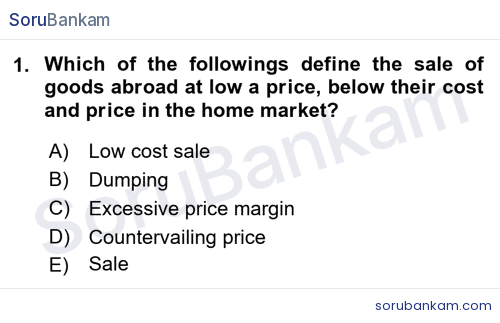
Which of the followings define the sale of goods abroad at low a price, below their cost and price in the home market? A) Low cost sale B) Dumping C) Excessive price margin D) Countervailing price E) Sale
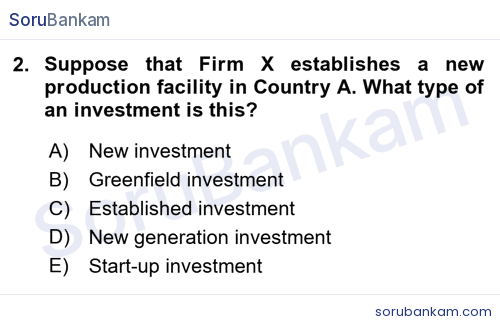
Suppose that Firm X establishes a new production facility in Country A. What type of an investment is this? A) New Investment B) Greenfield investment C) Established investment D) New generation investment E) Start-up investment
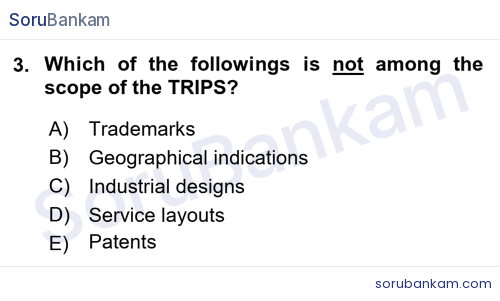
Which of the followings is not among ther scope of the TRIPS? A) Trademarks B) Geographical indications C) Industrial designs D) Service layouts E) Patents
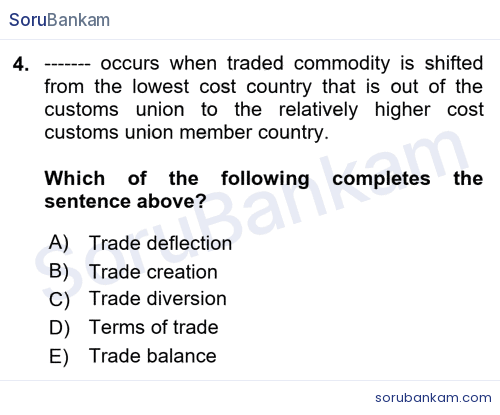
- occurs when traded commodity is shifted from the lowest cost country that is out of the customs union to the relatively higher cost customs union member county. Which of the Tollowing completes the sentence above? A) Trade deflection B) , Trade creation C) Trade diversion D) Terms of trade E) Trade balance
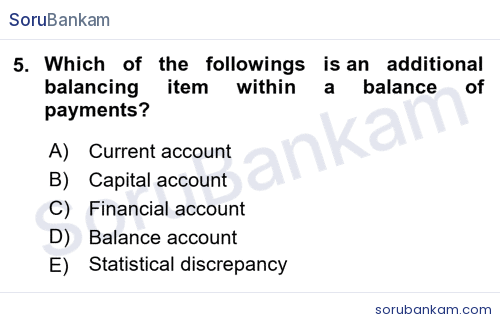
Which of the followings is an additional balancing item within balance of payments? A) Current account B) Capital account C) Financial account D) Balance account E) Statistical discrepancy
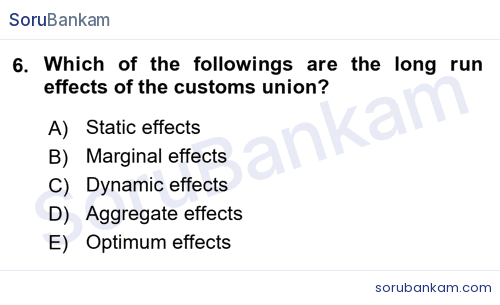
6. Which of the followings are the long run effects of the customs union? A) Static effects Marginal effects Dynamic effects D) Aggregate effects .. L E) Optimum effects
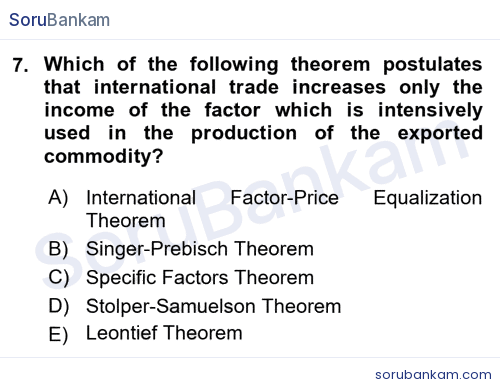
Which of the following theorem postulates that international trade increases only the income of the factor which is intensively used in the production of the exported commodity? A) International Factor-Price/ Equalization Theorem B) Singet Prebisch Theorem C) Specific Factors Theorem D) " D) Stolper-Samuelson Theorem E) Leontief Theorem
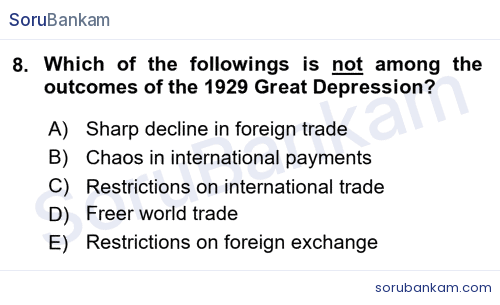
Which of the followings is not among the outcomes of the 1929 Great Depression? A) Ay Sharp gecline in foreign trade B) Chaos in international payments C) Restrictions on international trade D) Freer world trade E) Restrictions on foreign exchange
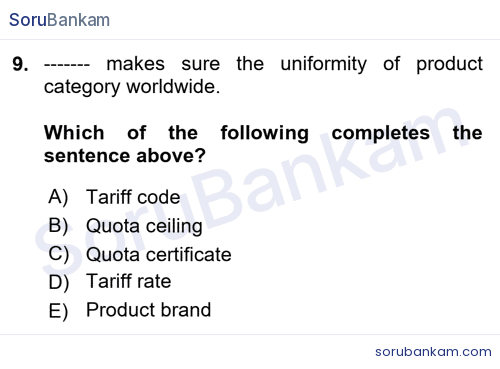
- makes sure the uniformity of product category worldwide. Which of the following completes the sentence above? A) Tariff code B) Quota ceiling C) Quote certificate D) Tariff rate E) Product brand
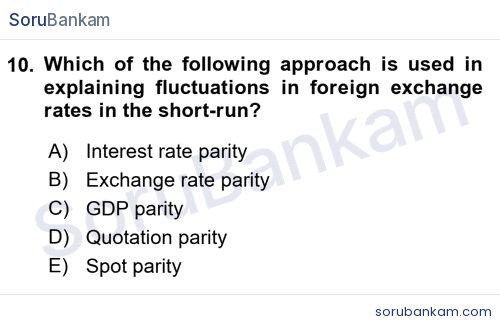
Which of the following approach is used in explaining fluctuations in foreign exchange rates in the short-run? A) Interest rate parity B) S Exchange rate parity C) GDP parity D) Quotation parity E) Spot parity
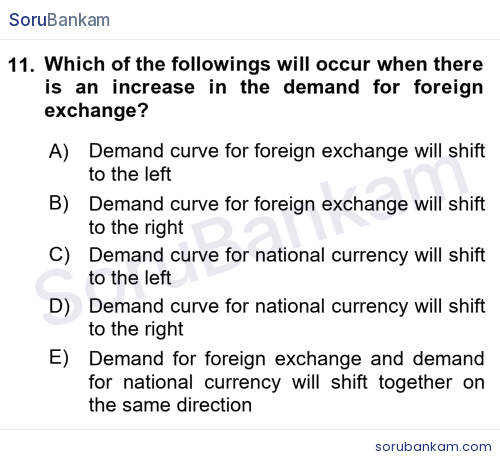
Which of the followings will occur when there is an increase in the demand for foreign exchange? A) Demand curve for foreign exchange will shift to the left B) Demand curve for foreign exchange will shift to the right C) Demand curve for national currency will shift to the left D) Demand curve for national currency will shift to the right E) Demand for foreign exchange and demand for national currency will shift together on the same direction
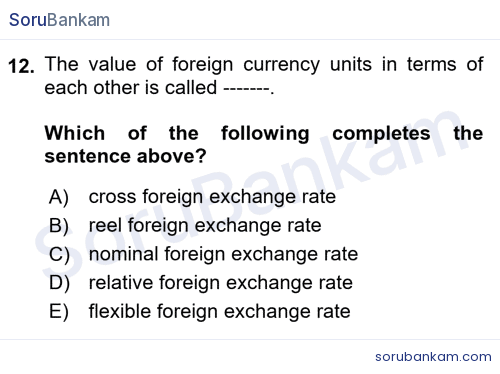
The value of foreign currency units in terms of each other is called -_ Which of . the following completes the sentence above? A) cross foreign exchange rate B) reel foreign exchange rate C) nominal foreign exchange rate D) relative foreign exchange rate E) flexible foreign exchange rate
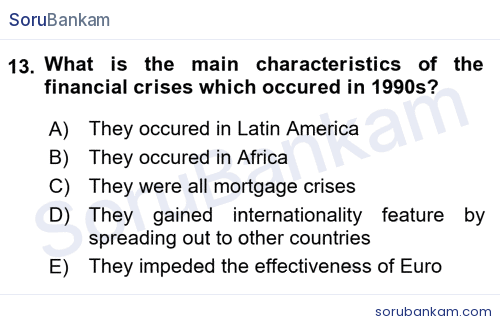
What is the main characteristics of the financial crises which occured in 1990s? A) They occured in Latin America B) They occured in Africa* C) They were all mortgage crises D) They gained spreading, out tracionali, feature E) They impeded the effectiveness of Euro
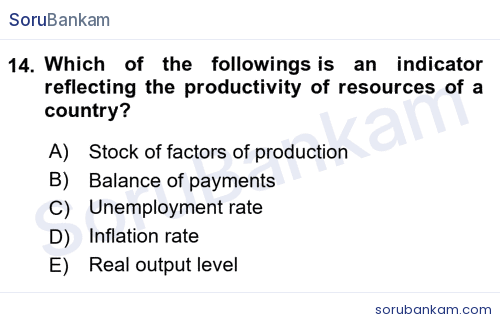
Which of the followings is an indicator reflecting the productivity of resources of a country? A) Stock of factors of production B) 'вУ Balance of payments C) Unemployment rate D) Inflation rate E) Real output level
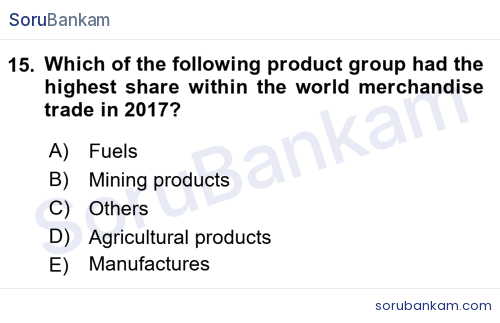
Which of the following product group had the highest share within the world merchandise trade in 2017? A) Fuels B) Mining products C) Others D) Agricultural products E) Manufactures
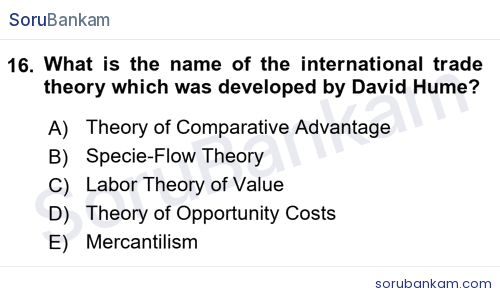
What is the name of the international trade theory which was developed by David Hume? A) Theory of Comparative Advantage B) Specie-Flow Theory C) Labor Theory of Value D) Theory of Opportunity Costs E) Mercantilism
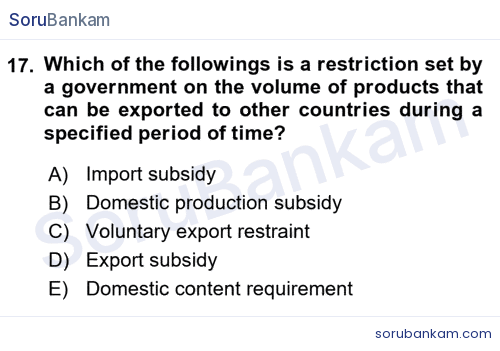
Which of the followings is a restriction set by a government on the volume of products thai can be exported to other countries during a specified period of time? A) Import subsidy B) Domestic production subsidy C) Voluntary export restraint D) Expart-subsidy E) • Domestic content requirement
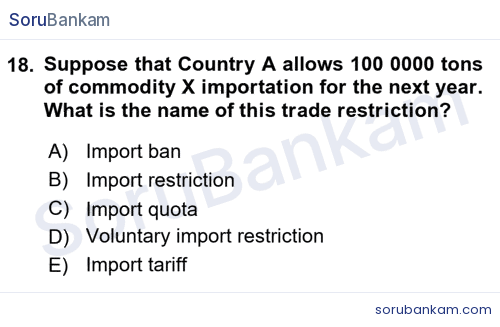
Suppose that Country A allows 100 0000 tons of commodity X importation for the next year. What Is the name of this trade restriction: A) Import ban B) Import restriction C) Import quota D) Voluntary import restriction E) Import tariff
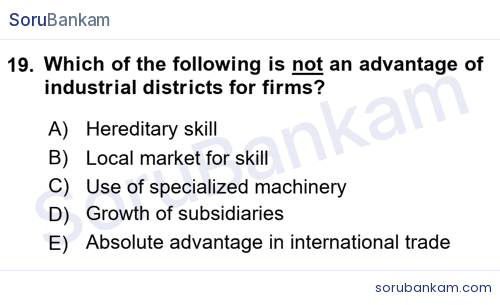
Which of the following is not an advantage of industrial districts for firms? A) Hereditary skill B) Local market for skill C) Use of specialized machinery D) Growth of subsidiaries E) Absolute advantage in international trade
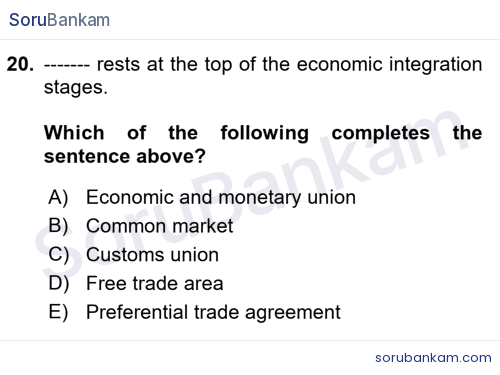
rests at the top of the economic integration stages. Which of the following completes • the sentence above? A) Economic and monetary union B) Common market C) Customs union D) Free trade area E) Preferential trade agreement