ISL351U Foreign Trade 2019-2020 Final Soruları
20 soru · Final · 2019-2020
ISL351U Foreign Trade dersinin 2019-2020 final sınavı 20 sorudan oluşur; ders AÖF Uluslararası İlişkiler (İngilizce) bölümünde okutulur. Sorular aşağıda sırasıyla yer alır. Doğru cevaplar ve sonucun, testi çözdüğünde görünür.
Önizleme · 20 soru. Cevaplamak ve sonucunu görmek için sınavı başlat.
Sorular
20 soru
Soru 1
Soru 2
Soru 3
Soru 4
Soru 5
Soru 6
Soru 7
Soru 8
Soru 9
Soru 10
Soru 11
Soru 12
Soru 13
Soru 14
Soru 15
Soru 16
Soru 17
Soru 18
Soru 19
Soru 20
Sınav modunda süre tutulur, doğru cevaplar ve sonucun sınav bitince görünür.
Dersin üniteleri
Ünite özetleri ve konu anlatımları
- 1. Ünite: Introduction To International Trade
- 2. Ünite: Classical Trade Theory And Standard Theory Of International Trade
- 3. Ünite: Factor Endowments And The Heckscher-Ohlin Theory
- 4. Ünite: Post-Heckscher-Ohlin Theories
- 5. Ünite: Trade Barriers: Tariffs And Non-Tariff Restrictions
- 6. Ünite: Multilateral Trading System And Economic Integrations
- 7. Ünite: Foreign Exchange Market And Foreign Exchange Rate
- 8. Ünite: International Capital Movements
ISL351U Foreign Trade ders sayfası: bütün sınavlar ve üniteler
Soruların metni (otomatik okuma)
Görsellerden otomatik okunmuştur; hata içerebilir. Sorular, görsellerdeki hâliyle geçerlidir.
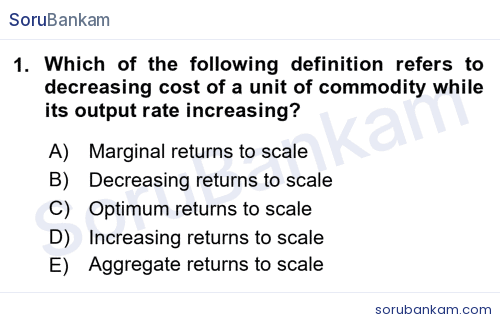
Which of the following definition refers to decreasing cost of a unit of commodity while its output rate increasing? A) Marginal returns to scale B) Decreasing returns to scale C) Optimum retums to scale D) Increasing returns to scale E) Aggregate returns to scale
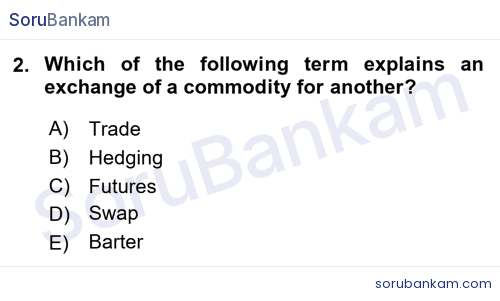
Which of the following term explains an exchange of a commodity for another? A) Trade B) Hedging C) Futures D) Swap E) Barter
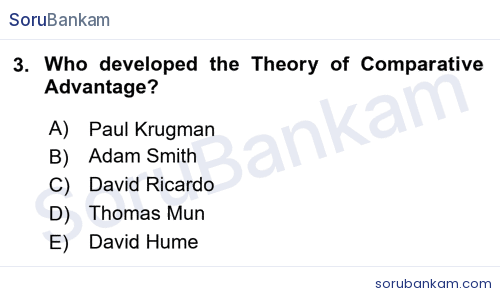
3. Who developed the Theory of Comparațive Advantage? A) Paul Krugman Adam Smith David Ricardo D) Thomas Mun E) David Hume
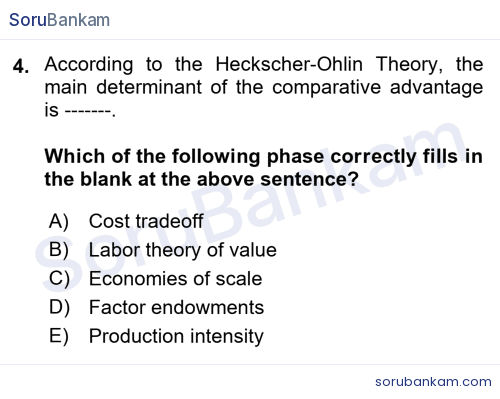
According to the Heckscher-Ohlin Theory, the main determinant of the comparative advantage Which of the following phase correctly fills in the blank at the above sentence? A) Cost tradeoff B) Labor theory of value C) Economies of scale D) Factor endowments E) Production intensity
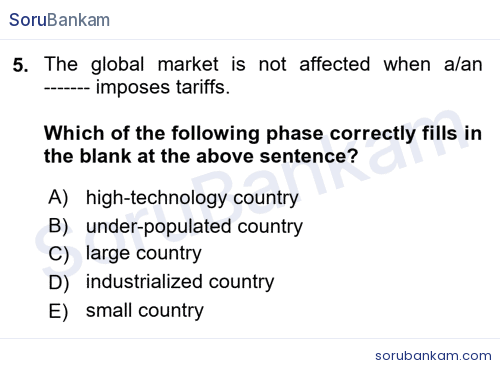
The global market is not affected when a/an - imposes tariffs. Which of the following phase correctly fills in the blank at the above sentence? A) high-technology country B) under-populated country "''' C) large country D) industrialized country E) smail country
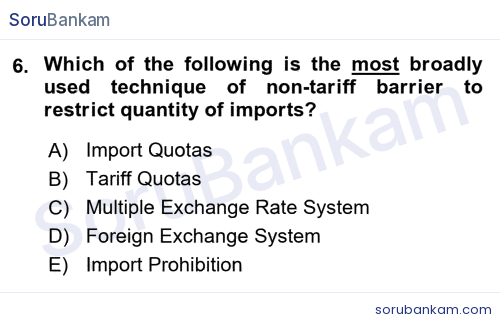
6. Which of the following is the most broadly ised technique of non-tariff barrier to 'estrict quantity of imports' A) Import Quotas j "B) Tariff Quotas Multiple Exchange Rate System D) Foreign Exchange System E) Import Prohibition
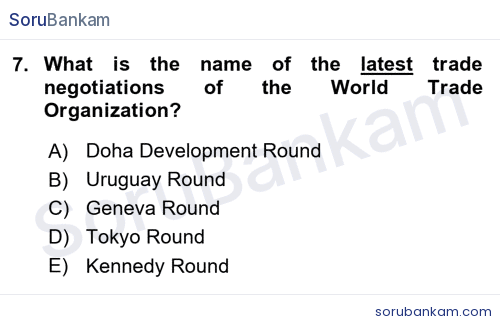
What is the name of the latest trade negotiations of the World Trade Organization? A) Doha Development Round B) Uruguay Round C) Geneva Round D) Tokyo Round E) Kennedy Round
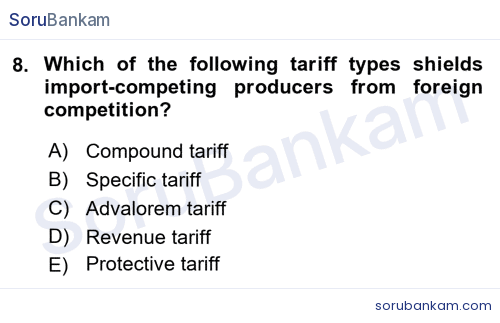
Which of the following tariff types shields import-competing producers from foreign competition? A) Compound tariff B) Specific tariff C) Advalorem tariff D) Revenue tariff E) Protective tariff
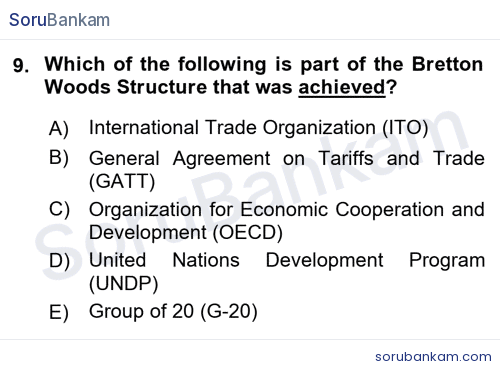
Which of the following is part of the Bretton Woods Structure that was achieved? A) International Trade Organization (ITO) B) General Agreement on Tariffs and Trade (GATT) C) Organization for Economic Cooperation and Development (OECD) D) I United Nations Development Program (UNDP) E) Group of 20 (G-20)
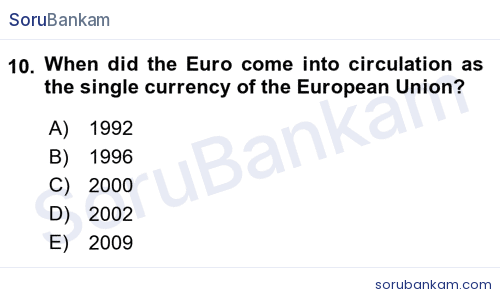
When did the Euro come into circulation as the single currency of the European Union? A) 1992 B) 1996 C) 2000 D) 2002 E) 2009
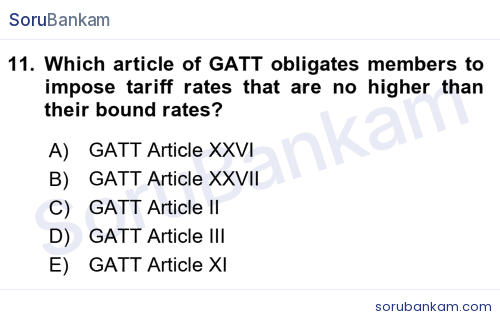
Which article of GATT obligates members fo impose tariff rates that are no highęr Man their bound rates? • A) GATT Article XXVI B) GATT Article XXVII ...iCin C) GATT Article D) GATT Article I!! E) GATT Article
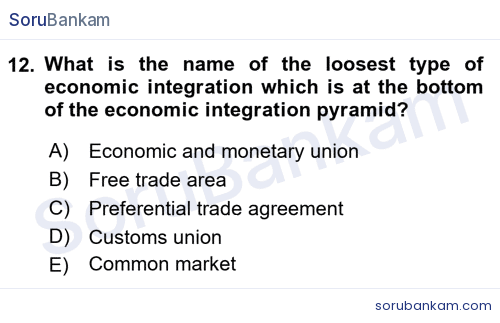
What is the name of the loosest type of economic integration which is at the bottom of the economic integration pyramid? A) Economic and monetary union B) Free trade area C) Preferential trade agreement D) Customs union E) Common market
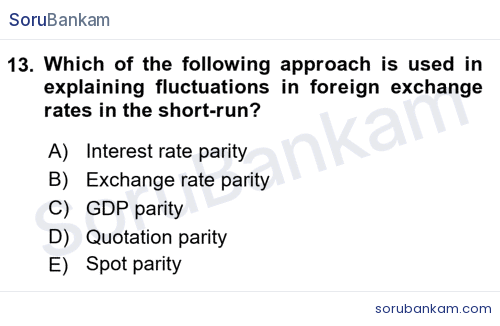
Which of the following approach is used in explaining fluctuations in foreign exchange rates in the short-run? A) Interest rate party B) Exchange rate parity C) GDP parity D) Quotation parity E) Spot parity
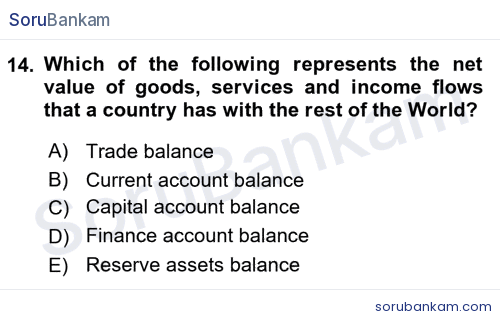
Which of the following represents the net value of goods, services and income flows that a country has with the rest of the World? A) Trade balance B) , "1B) ' Current account balance C) Capital account balance D) Finance, account balance E) Reserve assets balance
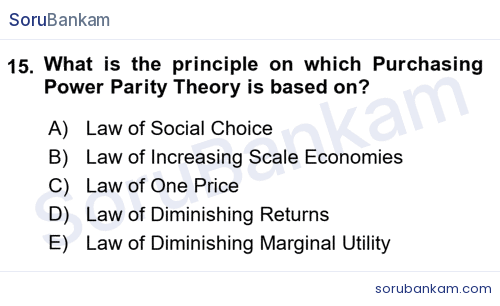
What is the principle on which Purchasing A) Power Parity Theory is based on? Law of Social Choice B) Law of Increasing Scale Economies C) Law of One Price D) Law of Diminishing Returns E) Law of Diminishing Marginal Utility
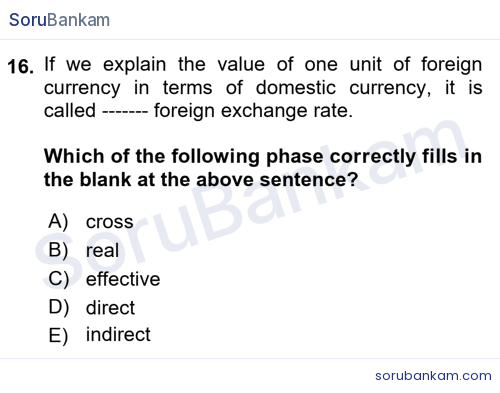
If we explain the value of one unit of foreign currency in terms of domestic currency, it is called ---- foreign exchange rate. Which of the following phase correctly fills in the blank at the above sentence? A) cross B) real C) effective D) direct E) indirect
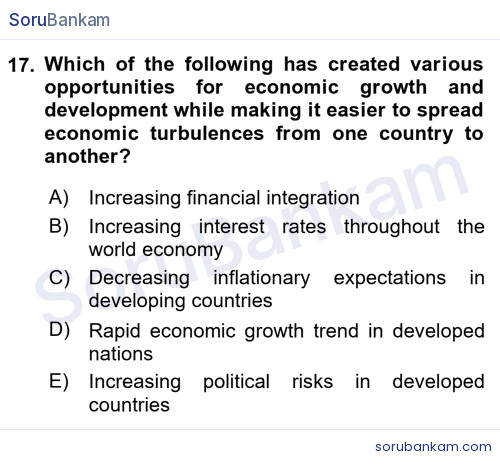
Which of the following has created various opportunities for economic growth and development while making it easier to spread economic turbulences from one country to another? A) Increasing financial integration B) Increasing interest rates throughout the world economy C) Decreasing inflationary expectations in developing countries D) Rapid economic growth trend in developed nations E) Increasing political risks in developed countries
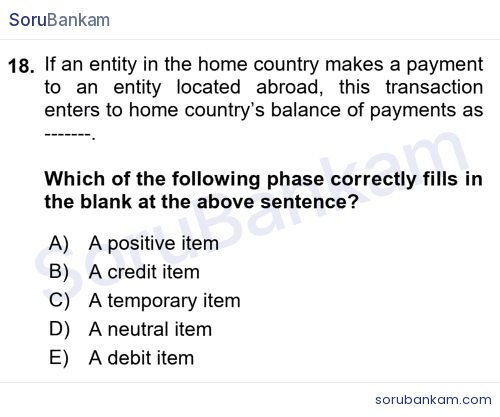
If an entity in the home country makes a payment to an entity located abroad, this transaction enters to home country's balance of payments as Which of the following phase correctly fills in the blank at the above sentence? A) A positive item B) A credit item C) A temporary item D) A neutral item E) A debit item
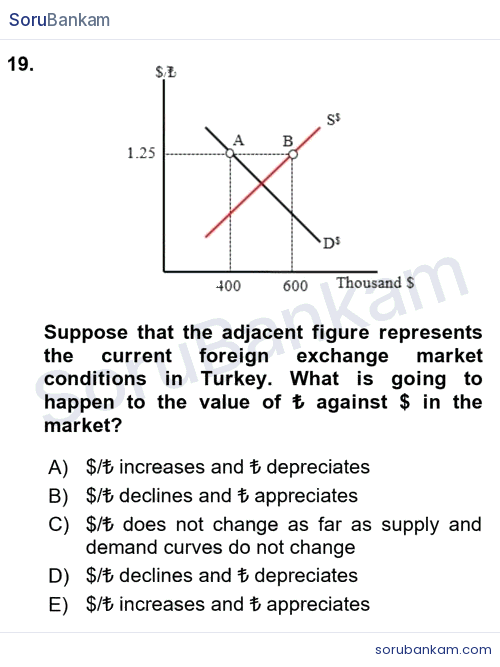
$/t 1.25 400 600 Thousand $ Suppose that the adjacent figure represents the current foreign exchange market conditions In Turkey What is going to happen to the value of t against $ in the market? A) sit increases and t depreciates B) $fe/declines and # appreciates C) G) $/ does not change as far as supply and demand curves do not change D) Sit declines aad # deprecjates E) $/trincreases and $ appreciates
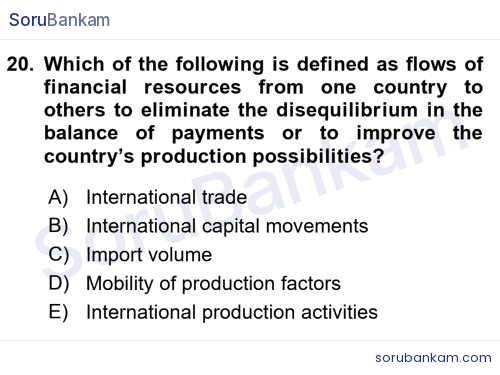
Which of the following is defined as flows of financial resources from one country to others to eliminate the disequilibrium in the balance of payments or to improve the country's production possibilities? A) International trade B) International capital movements C) Import volume D) Mobility of production factors E) International production activities