ISL351U Foreign Trade 2022-2023 Vize Soruları
20 soru · Vize · 2022-2023
ISL351U Foreign Trade dersinin 2022-2023 vize sınavı 20 sorudan oluşur; ders AÖF Uluslararası İlişkiler (İngilizce) bölümünde okutulur. Sorular aşağıda sırasıyla yer alır. Doğru cevaplar ve sonucun, testi çözdüğünde görünür.
Önizleme · 20 soru. Cevaplamak ve sonucunu görmek için sınavı başlat.
Sorular
20 soru
Soru 1
Soru 2
Soru 3
Soru 4
Soru 5
Soru 6
Soru 7
Soru 8
Soru 9
Soru 10
Soru 11
Soru 12
Soru 13
Soru 14
Soru 15
Soru 16
Soru 17
Soru 18
Soru 19
Soru 20
Sınav modunda süre tutulur, doğru cevaplar ve sonucun sınav bitince görünür.
Dersin üniteleri
Ünite özetleri ve konu anlatımları
- 1. Ünite: Introduction To International Trade
- 2. Ünite: Classical Trade Theory And Standard Theory Of International Trade
- 3. Ünite: Factor Endowments And The Heckscher-Ohlin Theory
- 4. Ünite: Post-Heckscher-Ohlin Theories
- 5. Ünite: Trade Barriers: Tariffs And Non-Tariff Restrictions
- 6. Ünite: Multilateral Trading System And Economic Integrations
- 7. Ünite: Foreign Exchange Market And Foreign Exchange Rate
- 8. Ünite: International Capital Movements
ISL351U Foreign Trade ders sayfası: bütün sınavlar ve üniteler
Soruların metni (otomatik okuma)
Görsellerden otomatik okunmuştur; hata içerebilir. Sorular, görsellerdeki hâliyle geçerlidir.
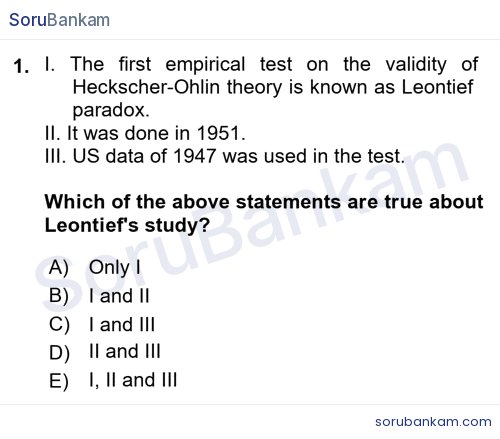
I. The first empirical test on the validity of Heckscher-Ohlin theory is known as Leontief paradox. II. It was done in 1951. III. US data of 1947 was used in the test. Which of the above statements are true about Leontief's study? A) Only B) I and i/ C) I and Ill D) I and i!! E) I, li and I|l
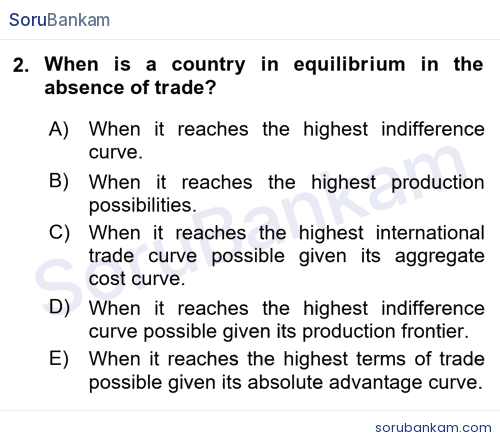
When is a country in equilibrium in ther absence of trade? A) When it reaches the highest indifference curve. B) When it reaches the highest production possibilities. C) When it reaches the highest International trade curve possible given its aggregate cost curve. D) When it reaches the highest indifference curve possible given its production frontier. E) When it reaches the highest terms of trade possible given its absolute advantage curve.
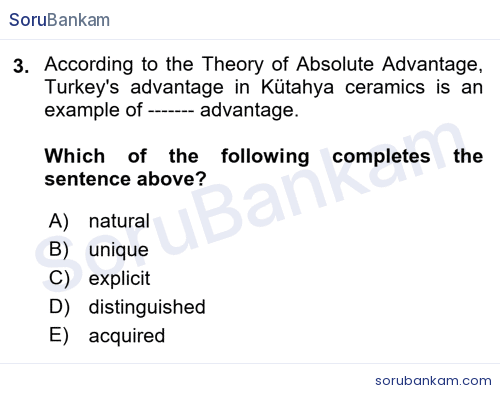
According to the Theory of Absolute Advantage, Turkey's advantage in Kütahya ceramics is an example of -- advantage. Which of the following completes the sentence above? A) natural B) unique C) explicit D) distinguished E) acquired
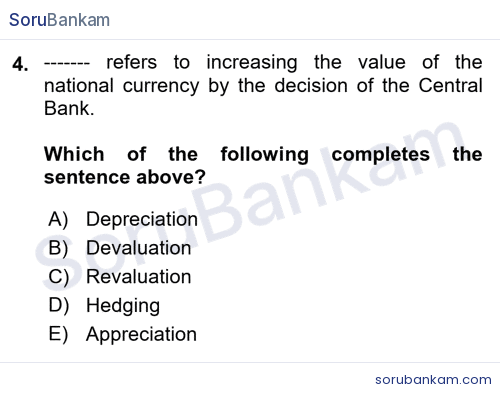
.. refers to increasing the value of the national currency by the decision of the Central Bank. Which of the following completes the sentence above? A) Depreciation B) Devaluation C) Revaluation D) Hedging E) Appreciation
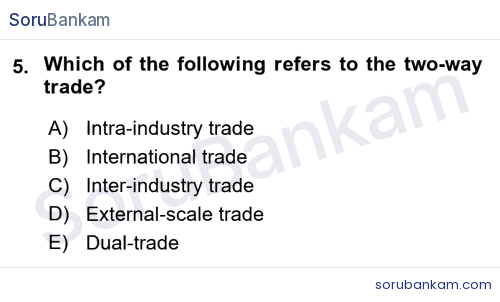
Which of the following refers to the two-way trade? A) Intra-ingustry trade B) International trade C) 1 "C) Inter-industry trade D) External-scale trade E) Dual-trade
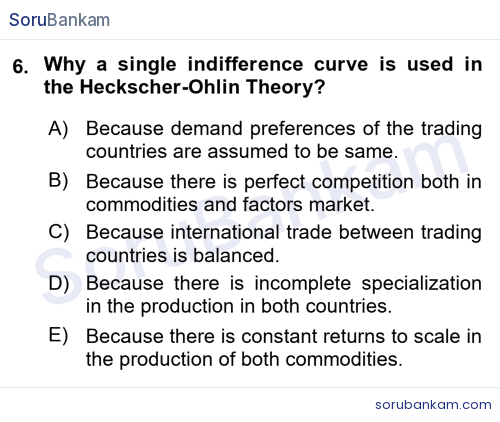
Why a single indifference curve is used in the Heckscher-Ohlin Theory? A) Because demand preferences of the trading countries are assumed to be same. B) Because there is perfect competition both in commodities and factors market. C) Because ințemational trade between trading countries is balanced. D) Because there is incomplete specialization in the production in both countries. E) Because there is constant returns to scale in the production of both commodities.
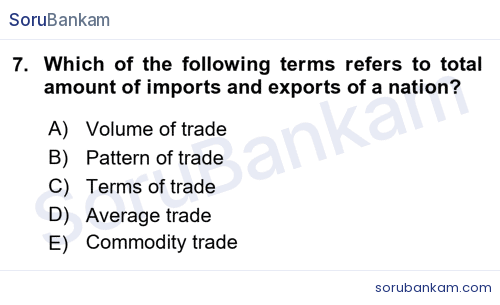
Which of the following terms refers to total amount of imports and exports of a nation? A) Volume of trade B) Pattern of trade C) Terms of trade D) Average trade E) Commodity trade
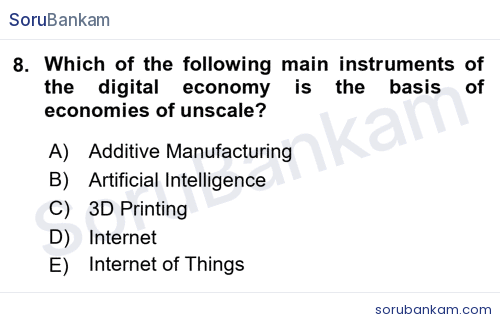
Which of the following main instruments of the digital economy is the basis of economies of unscale? A) Additive Manufacturing B) Artificial Intelligence C) 3D Printing D) Internet E) Intemet of Things
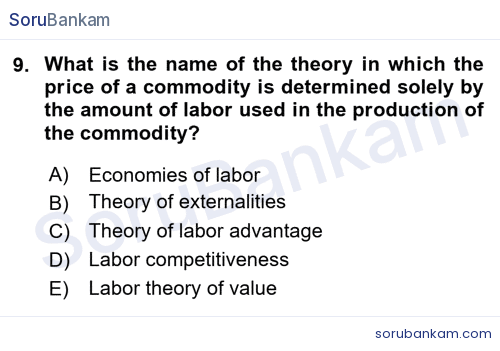
What is the name of the theory in which the price of a commodity is determined solely by the amount of labor used in the production of the commodity? A) Economies of labor B) Theory of externalities C) Theory of labor advantage D) Labor competitiveness E) Labor theory of value
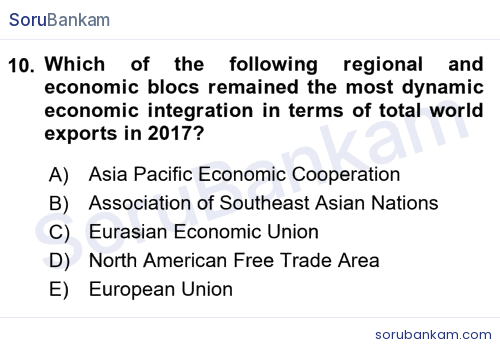
Which of the following regional and economic blocs remained the most dynamic economic integration in terms of total world exports in 2017? A) Asia Pacific Economic Cooperation B) Association of Southeast Asian Nations C) Eurasian Economic Union D) Norto American Free Trade Area E) Ey European Union
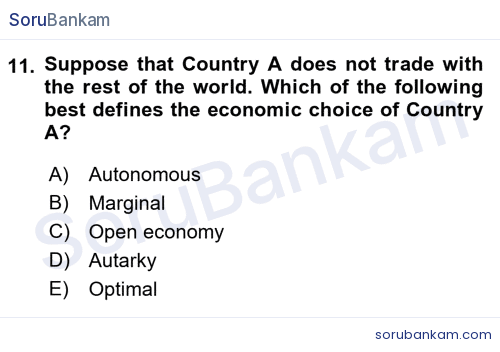
Suppose that Country A does not trade with the rest of the world. Which of the following best defines the economic choice of Country A? A) Autonomous B) Marginal C) Open economy D) Autarky E) Optimal
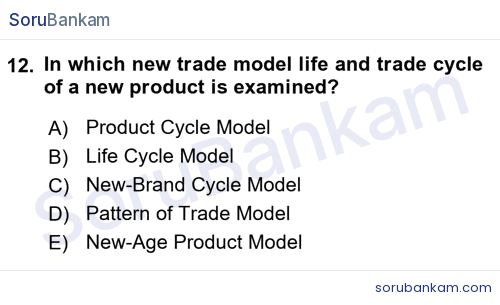
In which new trade model life and trade cycle of a new product is examined? A) Product Cycle Model B) Life Cycle Model C) New-Brand Cycle Model D) Pattern of Trade Model E) New-Age Product Model
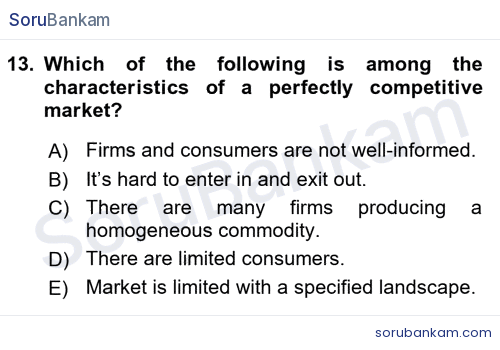
Which of the following is among the characteristics of a perfectly competitive market? A) Firhs and consumers are not well-informed. B) It's hard to enter in and exit out. C) There are many firms producing a homogeneous.commodity. D) There are limited consumers. E) Market is limited with a specified landscape.
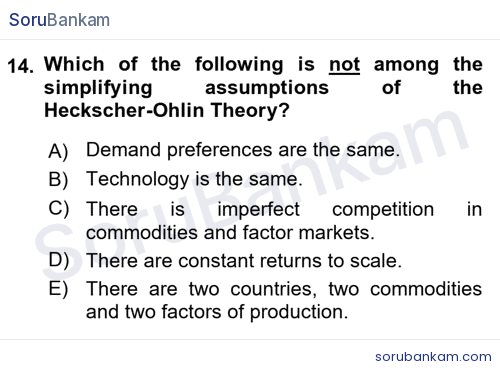
Which of the following is not among the simplitying assumptions of . the Heckscher-Ohlin Theory? A) Demand preferences are the same. B) Technology is the same. C) There imperfect competition commodities and factor markets. D) There are constant returns to scale. E) There are two countries, two commodities and two factors of production.
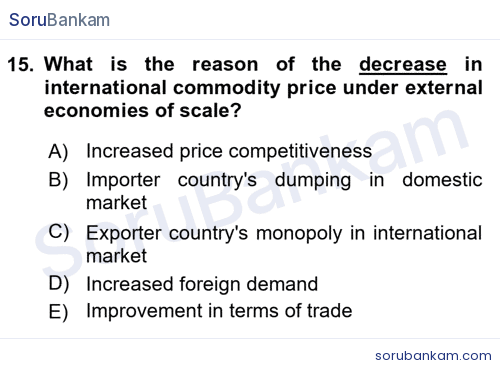
What is the reason of the decrease in international commodity price under external economies of scale? A) Increased price competitiveness B) Importer country's dumping in domestic market C) Exporter couritry's monopoly in international market D) Increased foreign demand E) Improvement in terms of trade
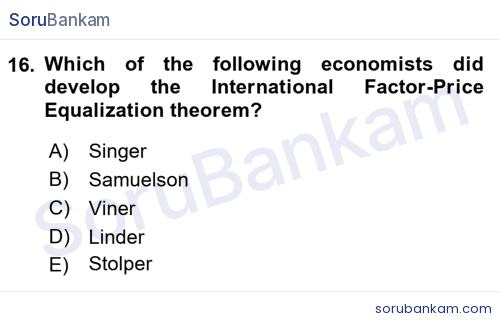
Which of the following economists did develop the International Factor-Price Equalization theorem? A) Singer B) Samuelson C) Viner D) Linder E) Stolper
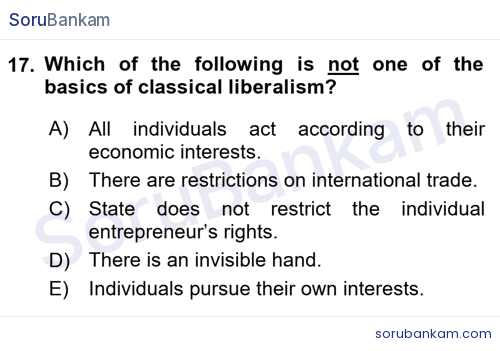
Which of the following is not one of the basics of classical liberalism? A) All individuals act according to their economic interests. B) There are restrictions on international trade. C) State does restrict the individual entrepreneur's rights. D) There is an invisible hand. E) Individuals pursue their own interests.
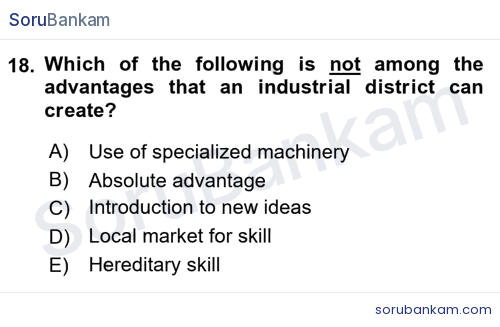
Which of halow indus no most che create? A) Use of specialized machinery B) Absolute advantage C) Introduction to new ideas D) Local market for skill E) Hereditary skill
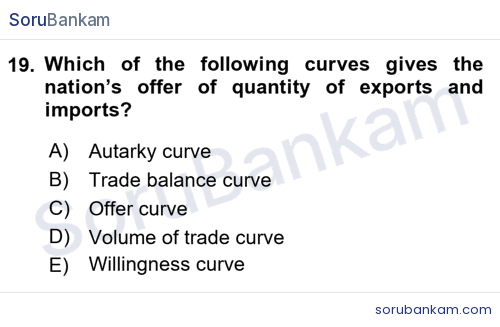
Which of the following curves gives the nation's offer of quantity of exports and imports? A) Autarky curve B) Trade balance curve C) Offer curve D) E Volume of trade curve E) Willingness curve
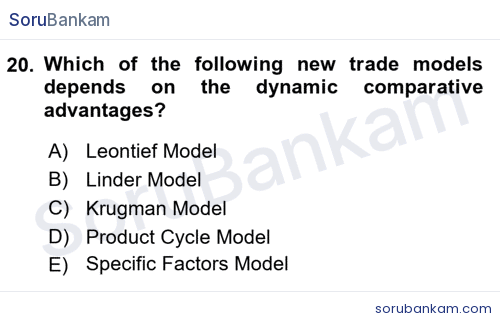
Which of the following new trade models depends on the dynamic comparative advantages? A) Leontief Model B) Linder Model C) Krugman Model D) Product Cycle Model E) Specific Factors Model