SOS210U Organizational Behavior 2018-2019 Vize Soruları
19 soru · Vize · 2018-2019
SOS210U Organizational Behavior dersinin 2018-2019 vize sınavı 19 sorudan oluşur; ders AÖF İktisat (İngilizce) bölümünde okutulur. Sorular aşağıda sırasıyla yer alır. Doğru cevaplar ve sonucun, testi çözdüğünde görünür.
Önizleme · 19 soru. Cevaplamak ve sonucunu görmek için sınavı başlat.
Sorular
19 soru
Soru 1
Soru 2
Soru 3
Soru 4
Soru 5
Soru 6
Soru 7
Soru 8
Soru 9
Soru 10
Soru 11
Soru 12
Soru 13
Soru 14
Soru 15
Soru 16
Soru 17
Soru 18
Soru 19
Sınav modunda süre tutulur, doğru cevaplar ve sonucun sınav bitince görünür.
Dersin üniteleri
Ünite özetleri ve konu anlatımları
- 1. Ünite: Introduction To Organizational Behavior
- 2. Ünite: Individual Differences: Personality, Perception, And Employee Attitudes
- 3. Ünite: Motivation Management
- 4. Ünite: Organisational Culture And Climate
- 5. Ünite: Groups And Work Teams İn Organizations
- 6. Ünite: Leadership İn Organizations
- 7. Ünite: Conflict Management
- 8. Ünite: Organizational Structure And Design
SOS210U Organizational Behavior ders sayfası: bütün sınavlar ve üniteler
Soruların metni (otomatik okuma)
Görsellerden otomatik okunmuştur; hata içerebilir. Sorular, görsellerdeki hâliyle geçerlidir.
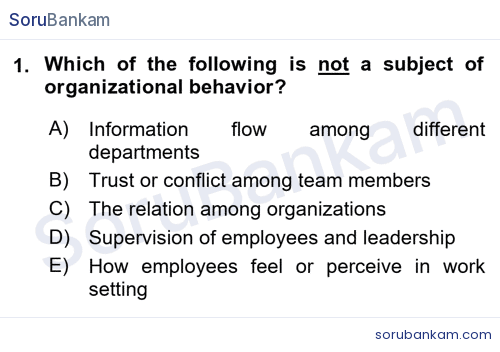
Which of the following is not a subject of organizational behavior? A) Information flow among different departments B) Trust or conflict among team members C) The relation among organizations D) Supervision of employees and leadership E) How employees feel or perceive in work setting
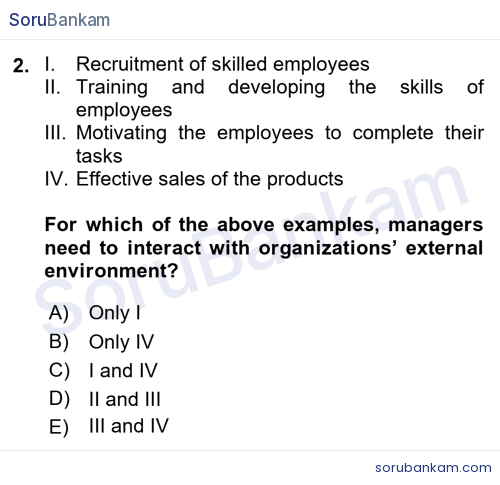
I. Recruitment of skilled employees II. Training and developing the skills of employees III. Motivating the employees to complete their tasks IV. Effective sales of the products For which of the above examples, managers need to interact with organizations' external environment? A) Only ! B) Only C) 1 and D) Il and Ill E) EIll and
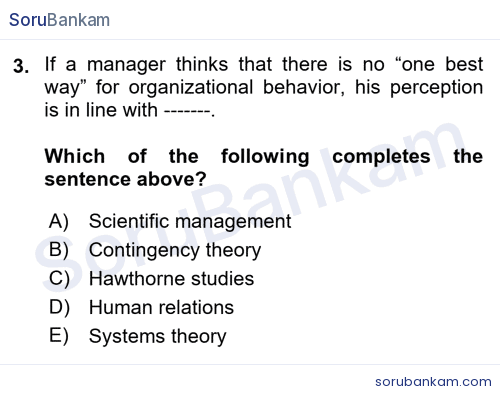
If a manager thinks that there is no "one best way" for organizational behavior, his perception is in line with ---- Which of the following completes the sentence above? A) Scientific management B) Contingency theory C) Hawthorne studies D) Human relations E) Systems theory
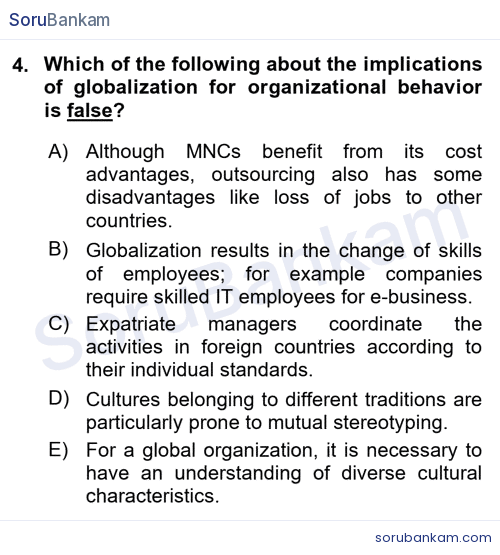
Which of the following about the implications of globalization for organizational behavior is false? A) Although MNCs benefit from its cost advantages, outsourcing also has some disadvantages like loss of jobs to other countries. B) Globalization results in the change of skills of employees; for example companies require skilled IT employees for e-business. C) Expatriate managers coordinate the activities in foreign countries according to their individual standards. D) Cultures belonging to different traditions are particularly prone to mutual stereotyping. E) For a global organization, it is necessary to have an understanding of diverse cultural characteristics.
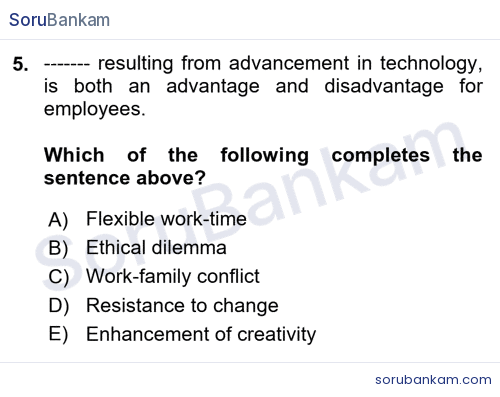
- resulting from advancement in technology, is both an advantage and disadvantage for employees. Which 'of the following completes the , 'sehtence above? A) Flexible work-time B) Ethical dilemma C) Work-family conflict D) Resistance to change E) Enhancement of creativity
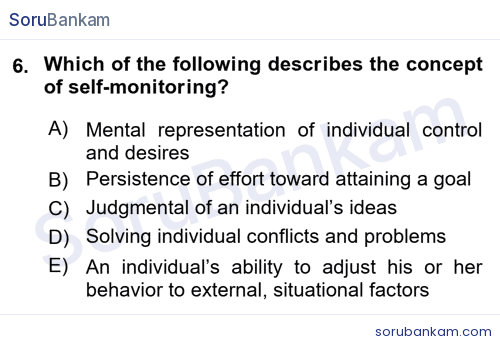
Which of the following describes the concept of self-monitoring? A) Mental representation of individual control and desires B) Persistence of effort toward attaining a goal C) Judgmental of an individual's ideas D) Solving individual conflicts and problems E) An individual's ability to adjust his or her behavior to extemai, situational factors
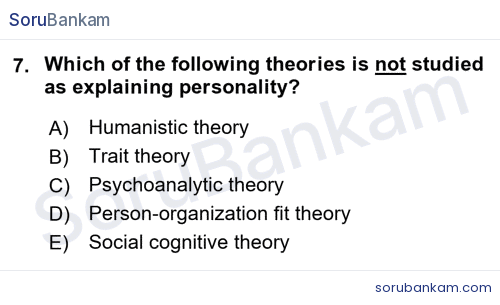
Which of the following theories is not studied as explaining personality? A) Humanistic theory B) Trait theory C) Psychoanalytic theory D) Person-organization fit theory E) Social cognitive theory
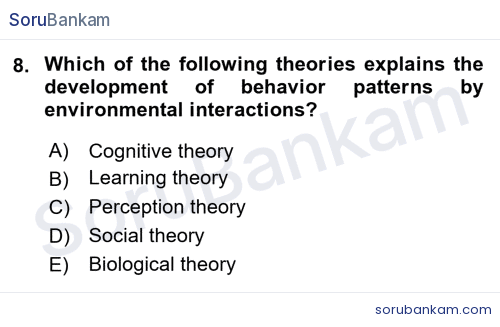
Which of the following theories explains the development of behavior patterns environmental interactions? A) Cognitive theory B) Learning theory C) Perception theory D) Social theory E) Biological theory
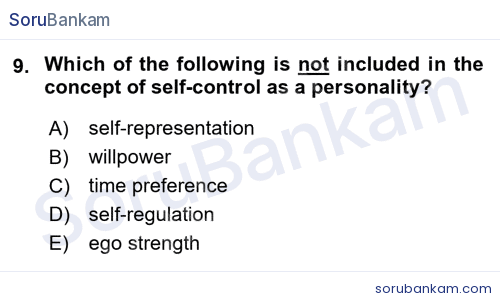
Which of the following is not included in the! concept of self-control as a personality?. A) self-representation B) willpower C) time preference D) self-regulation E) ego strength
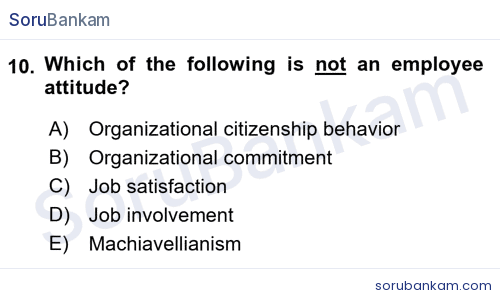
Which of the following is not an employee attitude? A) Organizational citizenship behavior B) Organizational commitment C) Job satisfaction D) Job involvement E) Machiavellianism
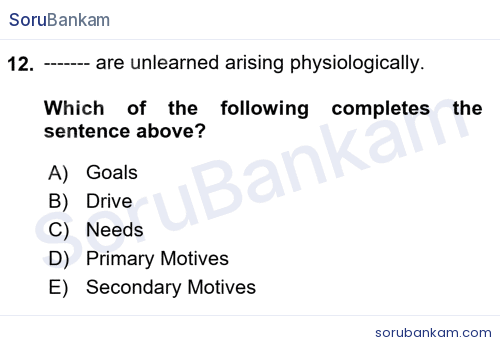
— are unlearned arising physiologically. Which of the following completes the sentence above? A) : Goals B) Drive C) Needs D) Primary Motives E) Secondary Motives
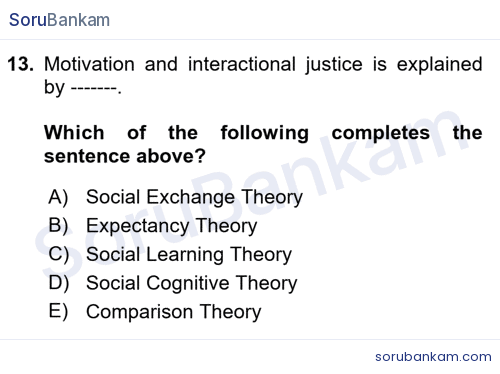
Motivation and interactional justice is explained by -... Which of the following completes the sentence above? A) Social Exchange Theory B) Expectancy Theóry C) Social Learning Theory D) Social Cognitive Theory E) Comparison Theory
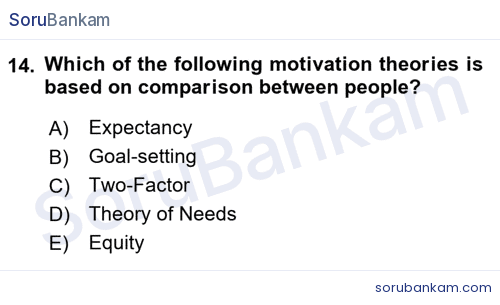
Which of the following motivation theories is based on comparison between people? A) Expectancy B) Goal-setting C) Two-Factor D) Theory of Needs E) Equity
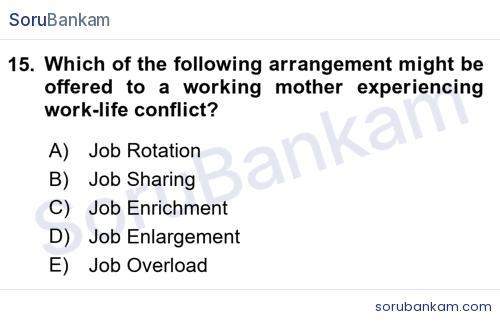
Which of the following arrangement might be offered to a working mother experiencing work-life conflict? A) Job Rotation B) Job Sharing C) Job Enrichment D) Job Enlargement E) Job Overload
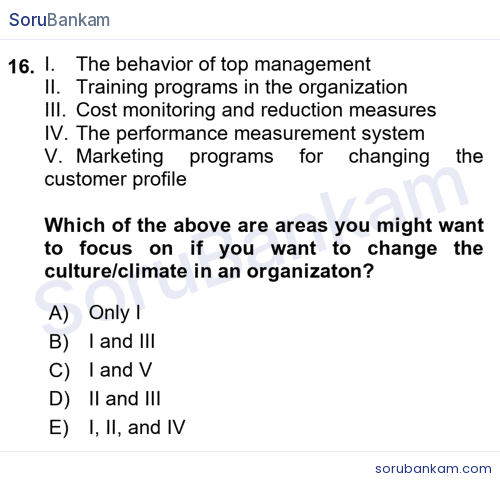
1. The behavior of top management r's II. Training programs in the organization » I!. Cost monitoring and reduction measures IV. The performance measurement system V. Marketing programs for changing the customer profile Which of the above are areas you might want to focus on if you want to change the culture/climate in an organizaton? A) Only B) I and ill C) I and D) Wand III E) I, ll, and
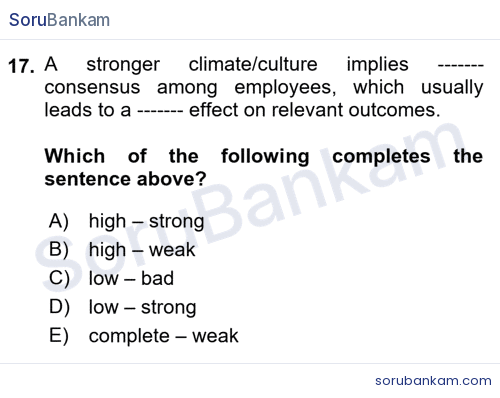
A stronger climate/culture implies -...- consensus among employees, which usually leads to a -- effect on relevant outcomes. Which of the following completes the sentence above? A) high - strong B) high -weak C) low - bad D) low - strong E) complete - weak
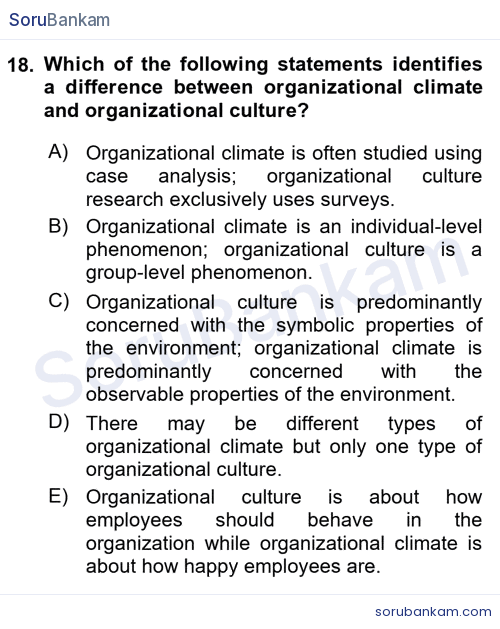
Which of the following statements identifies a difference between organizational climate and organizational culture? A) Organizational climate is often studied using case analysis; organizational culture research exclusively uses surveys. B) Organizational climate is an individual-level phenomeron; organizational culture is a group-level phenomenon. C) Organizational culture is predominantly concerned with the symbolic properties of the environment; organizational climate is predominantly concerned with the observable properties of the environment. D) There may be different types of organizational climate but only one type of organizational culture.., " E) Organizational culture is about how , employees should behave in the organization while organizatiopal climate is about how happy employees are.
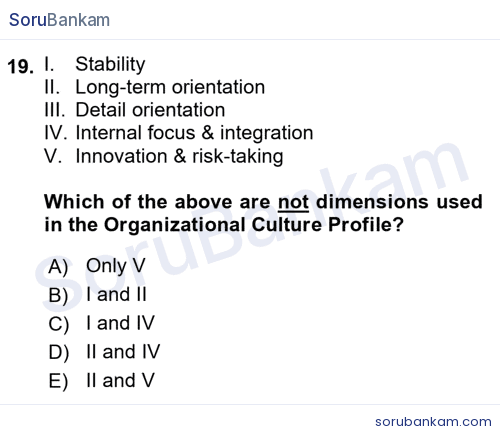
1. Stability II. Long-term orientation III. Detail orientation IV. Internal focus & integration V. Inpovation & risk-taking Which of the above are not dimensions used in the Organizational Culture Profile? A) Only B) I and C) I and D) I and E) Il and
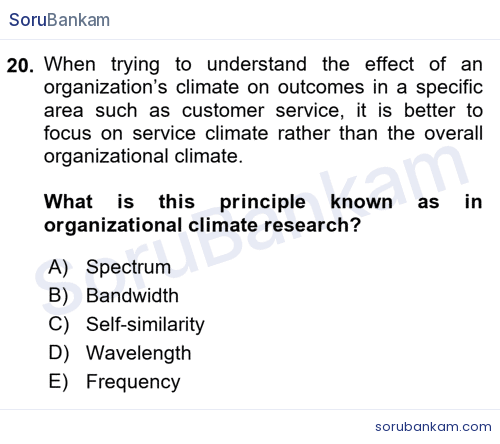
When trying to understand the effect of an organization's climate on outcomes in a specific area such as customer service, it is better to focus on service climate rather than the overall organizational climate. What is this principle known as in organizational climate research? A) Spectrum B) Bandwidth C) Self-similarity D) Wavelength E) Frequency