SOS210U Organizational Behavior 2023-2024 Vize Soruları
20 soru · Vize · 2023-2024
SOS210U Organizational Behavior dersinin 2023-2024 vize sınavı 20 sorudan oluşur; ders AÖF İktisat (İngilizce) bölümünde okutulur. Sorular aşağıda sırasıyla yer alır. Doğru cevaplar ve sonucun, testi çözdüğünde görünür.
Önizleme · 20 soru. Cevaplamak ve sonucunu görmek için sınavı başlat.
Sorular
20 soru
Soru 1
Soru 2
Soru 3
Soru 4
Soru 5
Soru 6
Soru 7
Soru 8
Soru 9
Soru 10
Soru 11
Soru 12
Soru 13
Soru 14
Soru 15
Soru 16
Soru 17
Soru 18
Soru 19
Soru 20
Sınav modunda süre tutulur, doğru cevaplar ve sonucun sınav bitince görünür.
Dersin üniteleri
Ünite özetleri ve konu anlatımları
- 1. Ünite: Introduction To Organizational Behavior
- 2. Ünite: Individual Differences: Personality, Perception, And Employee Attitudes
- 3. Ünite: Motivation Management
- 4. Ünite: Organisational Culture And Climate
- 5. Ünite: Groups And Work Teams İn Organizations
- 6. Ünite: Leadership İn Organizations
- 7. Ünite: Conflict Management
- 8. Ünite: Organizational Structure And Design
SOS210U Organizational Behavior ders sayfası: bütün sınavlar ve üniteler
Soruların metni (otomatik okuma)
Görsellerden otomatik okunmuştur; hata içerebilir. Sorular, görsellerdeki hâliyle geçerlidir.
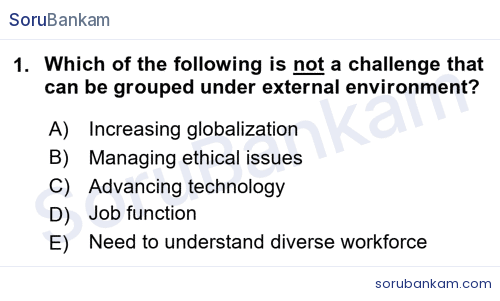
Which of the following is not a challenge that A) can be grouped under external environment? Increasing globalization B) Managing ethical issues C) Advancing technology D) Job function E) Need to understand diverse workforce
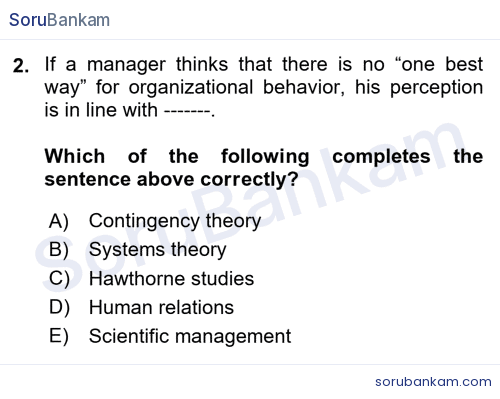
If a manager thinks that there is no one best way" for organizational behavior, his perception is in line with ---. Which of the following completes the sentence above correctly? A) Contingency theory B) Systems theory C) Hawthorne studies D) Human relations E) Scientific management
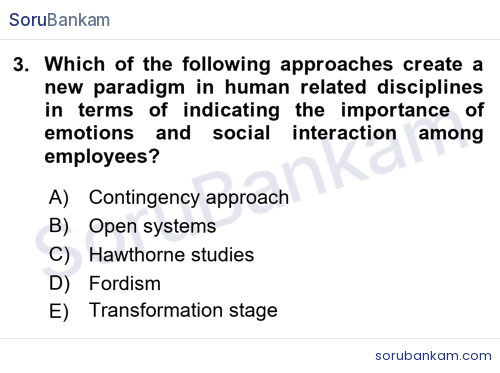
Which of the following approaches create a new paradigm in human related disciplines in terms of indicating the importance of emotions and social interaction among employees? A) Contingency approach B) Open systems C) Hawthorne studies D) Fordism E) Transformation stage ...°
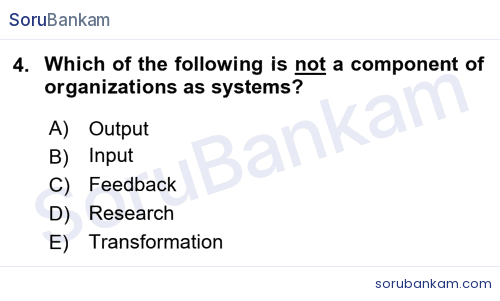
Which of the following is not a component of organizations as systems? A) Output B) Input C) Feedback D) Research E) Transformation
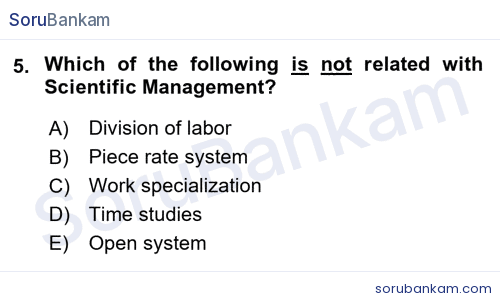
Which of the following is not related with Scientific Management? A) Division of labor B) Piece rate system C) Work specialization D) Time studies E) Open system
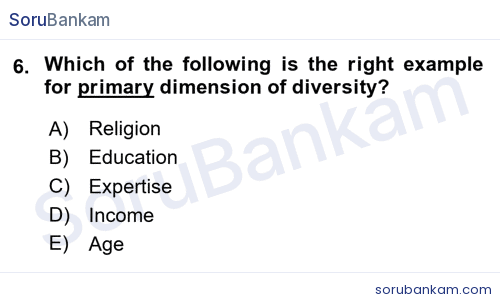
Which of the following is the right example for primary dimension of diversity? A) Religion B) Education C) Expertise D) Income E) Age
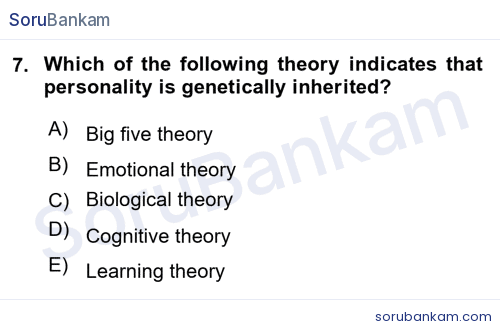
Which of the following theory indicates that personality is genetically inherited? A) Big five theory B) Emotional theory C) Biological theory D) Cognitive theory E) Learning theory
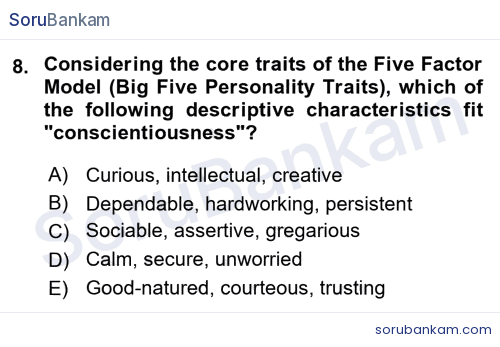
có Considering the core traits of the Five Factor Model (Big Five Personality Traits), which of the following descriptive characteristics fit "conscientiousness"? A) Curious, intellectual, creative B) Dependable, hardworking, persistent C) Sociable, assertive, gregarious D) Calm, secure, unworried E) Ex Good-natured, courteous, trusting
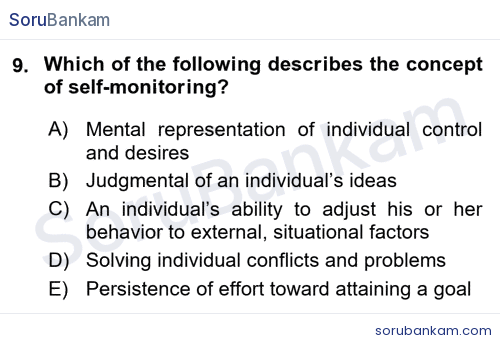
9. Which of the following describes the concept of self-monitoring? , A) Mental representation of individual control and desires wB} Judgmental of an individual's ideas C) An individual's ability to adjust his or her behavior to external, situational factors D) Solving individual conflicts and problems ) Persistence of effort toward attaining a goal
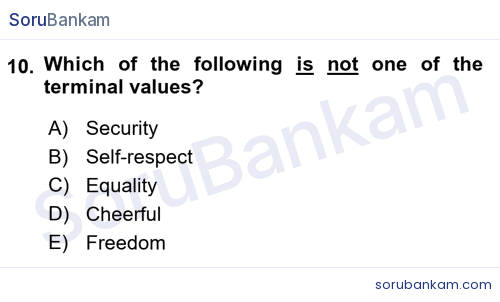
10. Which of the following is not one of the terminal values? A) Security Self-respect Equality D) Cheerful E) Freedom
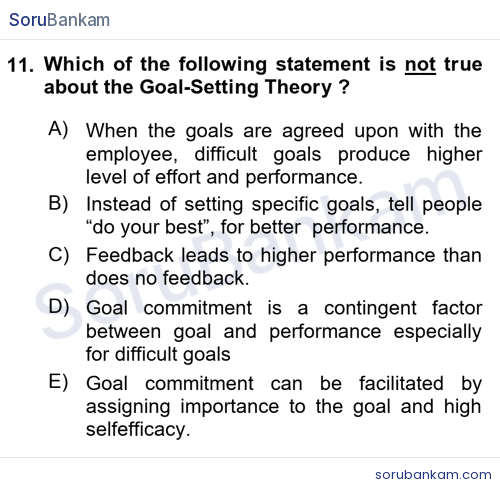
Which of the following statement is not true about the Goal-Setting Theory ? A) When the goals are agreed upon with the employee, difficult goals produce higher level of effort and performance. B) Instead of setting specific goals, tell people "do your best", for better performance. C) Feedback leads to higher performance than does no feedback. D) Goal commitment is a contingent factor between goal and performance especially for difficult goals E) Goal commitment can be facilitated by assigning importance to the goal and high selfefficacy.
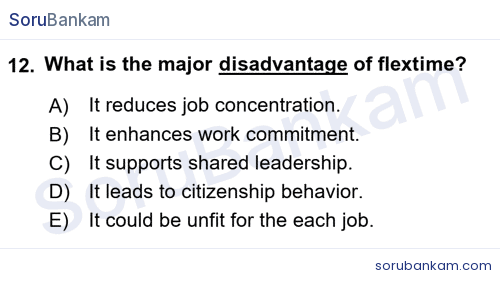
What is the major disadvantage of flextime? A) It reduces job concentration. B) It enhances work commitment. C) It supports shared leadership. D) It leads to citizenship behavior. E) It could be unfit for the each job.
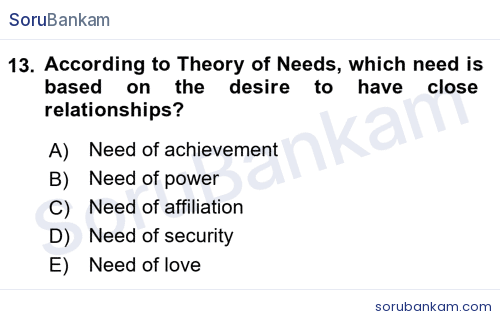
According to Theory of Needs, which need is based on the desire to have close relationships? A) Need of achievement B) Need of power C) Need of affiliation. D) Need of security E) Need of love
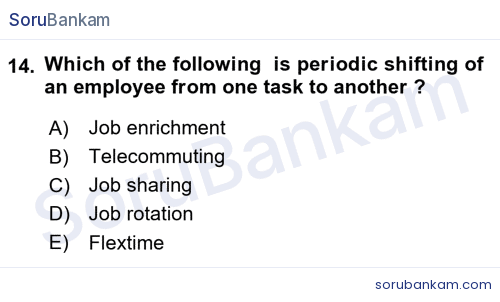
Which of the following is periodic shifting of. an employee from one task to another? A) Job enrichment B) Telecommuting C) Job sharing D) Job rotation E) Flextime
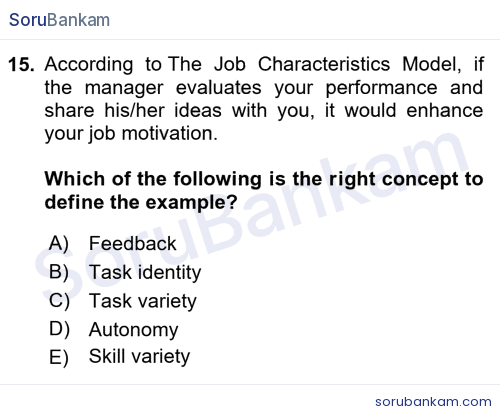
15. According to The Job Characteristics Model, it. the manager evaluates your performance and share his/her ideas with you, it would enhance your job motivation. Which of the following is the right concept to define the example? A) Feedback Task identity Task variety D) Autonomy E) Skill variety
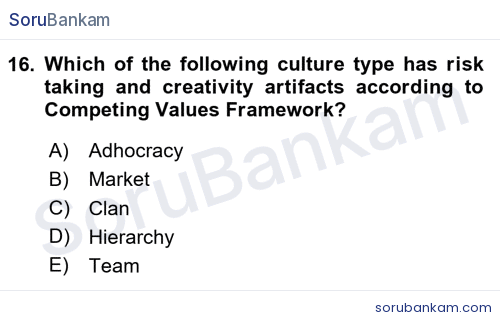
Which of the following culture type has risk taking and creativity artifacts according to Competing Values Framework? A) Adhocracy B) Market C) Clan D) Hierarchy E) Team
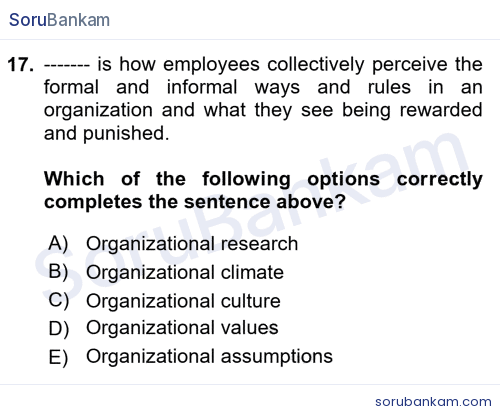
is how employees collectively perceive the formal and informal ways and rules in an organization and what they see being rewarded and punished. Which of the following options correctly completes the sentence above? A) Organizational research B) Organizational climate C) Organizational culture D) Organizational values E) Organizational assumptions
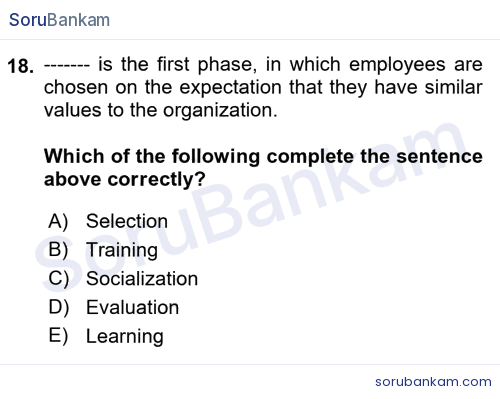
—— is the first phase, in which employees are chosen on the expectation that they have similar values to the organization. Which of the following complete the sentence w above correctly? A) Selection B) Training C) Cy Socialization D) Evaluation E) Learning
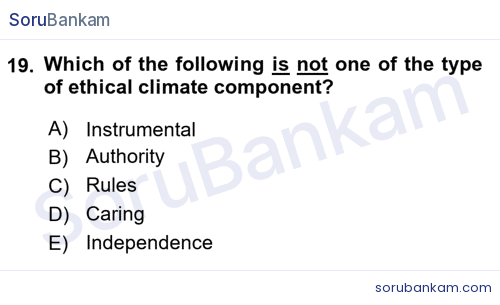
Which of the following is not one of the type of ethical climate component? A) Instrumental B) Authority C) Rules D) Caring E) Independence
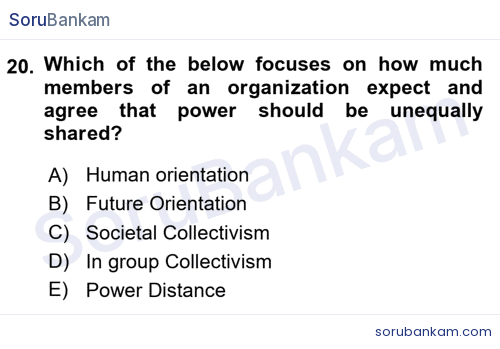
Which of the below focuses on how much members of an organization expect and agree that power should be unequally shared? A) Human orientation B) Future Orientation C) Societal Collectivism D) In group Collectivism E) Power Distance