SOS210U Organizational Behavior 2024-2025 Vize Soruları
20 soru · Vize · 2024-2025
SOS210U Organizational Behavior dersinin 2024-2025 vize sınavı 20 sorudan oluşur; ders AÖF İktisat (İngilizce) bölümünde okutulur. Sorular aşağıda sırasıyla yer alır. Doğru cevaplar ve sonucun, testi çözdüğünde görünür.
Önizleme · 20 soru. Cevaplamak ve sonucunu görmek için sınavı başlat.
Sorular
20 soru
Soru 1
Soru 2
Soru 3
Soru 4
Soru 5
Soru 6
Soru 7
Soru 8
Soru 9
Soru 10
Soru 11
Soru 12
Soru 13
Soru 14
Soru 15
Soru 16
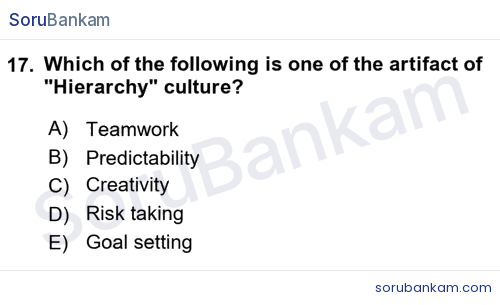
Soru 17
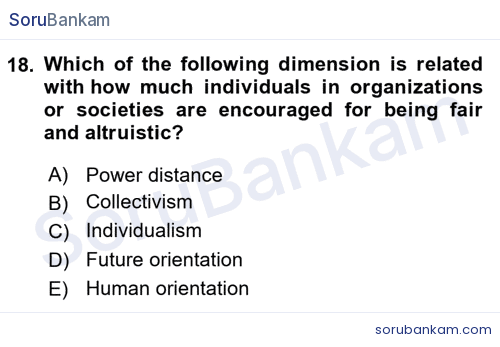
Soru 18
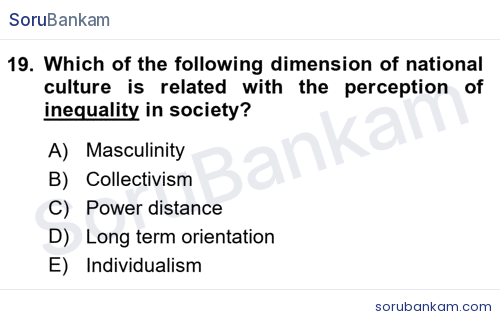
Soru 19
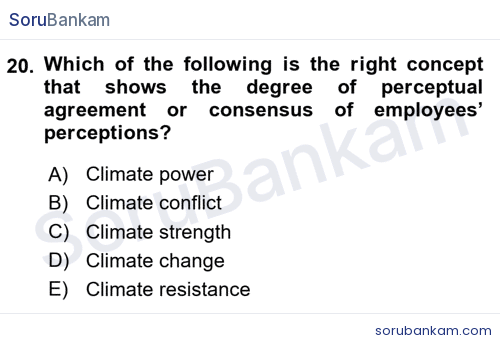
Soru 20
Sınav modunda süre tutulur, doğru cevaplar ve sonucun sınav bitince görünür.
Dersin üniteleri
Ünite özetleri ve konu anlatımları
- 1. Ünite: Introduction To Organizational Behavior
- 2. Ünite: Individual Differences: Personality, Perception, And Employee Attitudes
- 3. Ünite: Motivation Management
- 4. Ünite: Organisational Culture And Climate
- 5. Ünite: Groups And Work Teams İn Organizations
- 6. Ünite: Leadership İn Organizations
- 7. Ünite: Conflict Management
- 8. Ünite: Organizational Structure And Design
SOS210U Organizational Behavior ders sayfası: bütün sınavlar ve üniteler
Soruların metni (otomatik okuma)
Görsellerden otomatik okunmuştur; hata içerebilir. Sorular, görsellerdeki hâliyle geçerlidir.
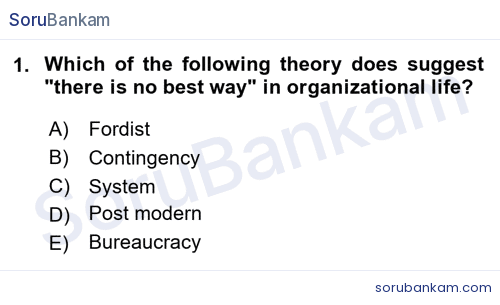
Which of the following theory does suggest "there is no best way" in organizational life? A) Fordist B) Contingency C) System D) Post modern E) Bureaucracy
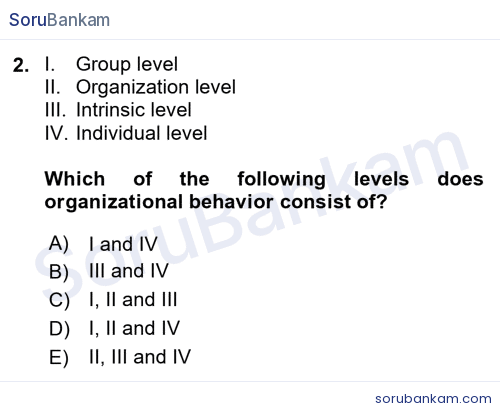
I. Group level II. Organization level III. Intrinsic level IV. Individual level Which of the following levels does organizational behavior consist of? A) I and B) lil and C) 1, ll and I! D) I, Il and E) Il, ill and
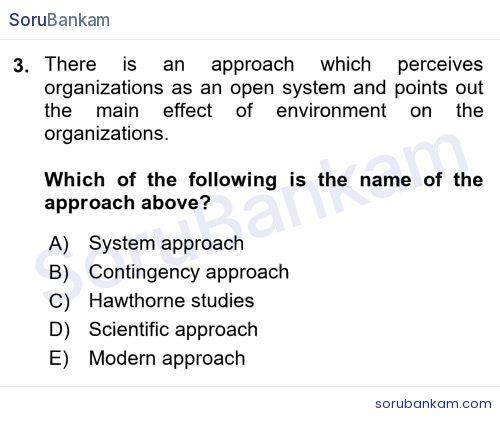
There is approach which perceives organizations as an open system and points out the main effect of environment on the organizations. Which of the following is the name of the approach above? A) System appibach B) Contingency approach C) Hawthorne studies D) Scientific approach .,!" 331. E) Modern approach
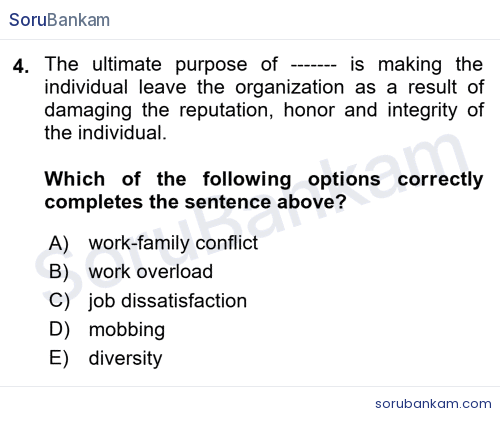
The ultimate purpose of - is making the individual leave the organization as a result of damaging the reputation, honor and integrity of the individual. Which of the following options correctly completes the sentence above? A) work-family conflict B) work overload C) job dissatisfaction D) mobbing E) diversity
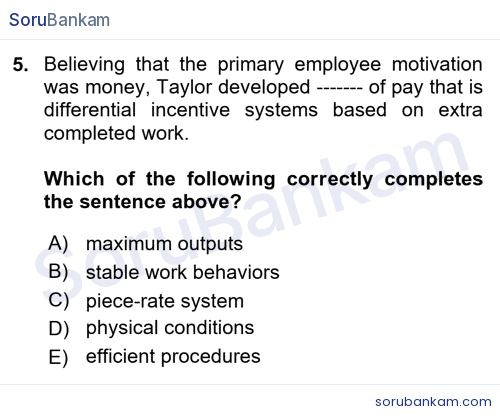
Believing that the primary employee motivation was money, Taylor developed -- of pay that is differential incentive systems based on extra completed work. Which of the following correctly completes the sentence above? A) maximum outputs B) stable work behaviors C) piece-rate system D) physical conditions E) efficient procedures
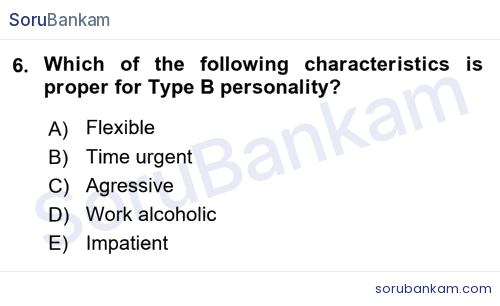
Which of the following characteristics is proper for Type B personality? A) Flexiblę B) Ilone urgent C) Agressive D) Work alcoholic E) Impatient » "
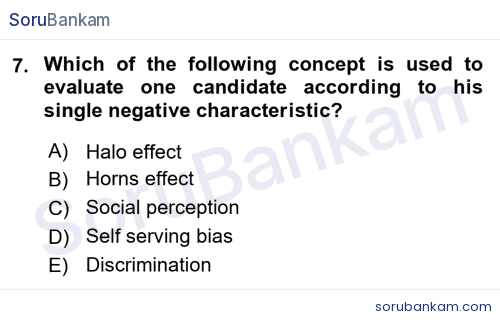
Which of the following concept is used to evaluate one candidate according to his single negative characteristic? A) Halo effect B) Horns effect C) Social perception D) Self serving bias E) Discrimination
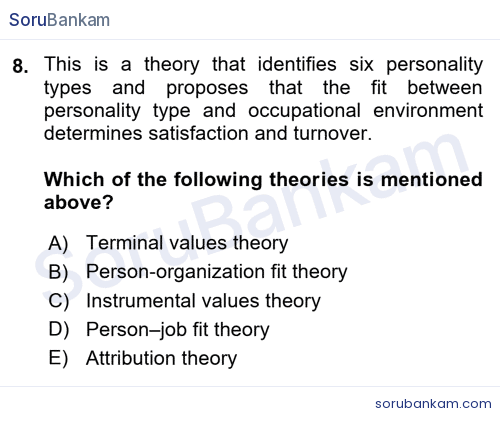
This is a theory that identifies six personality types and proposes that the fit between personality type and occupational environment determines satisfaction and turnover. Which of the following theories is mentoned above? A) Terminal values theory B) Person-organization fit theory C) Instrumental values theory D) Person-job fit theory E) Attribution theory
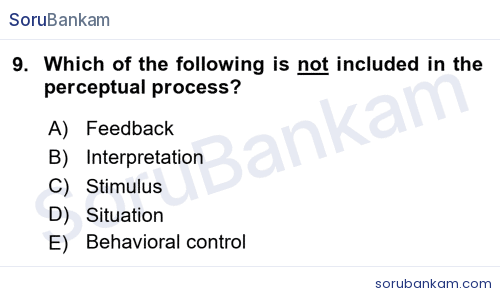
Which of the following is not included in the perceptual process? A) Feedback B) Interpretation C) Stimulus D) Situation E) Behavioral control
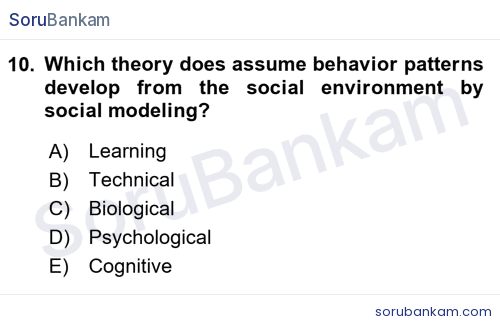
Which theory does assume behavior patterns develop from the social environment by social modeling? A) Learning B) Technical C) Biological D) Psychological E) Cognitive
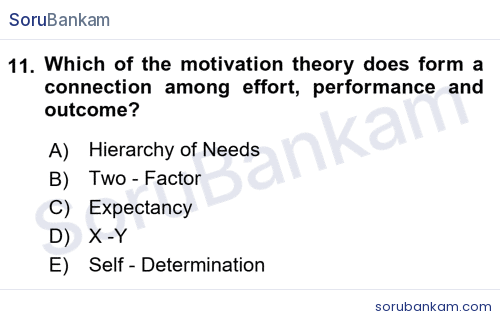
Which of the motivation theory does form a connection among effort, performance and outcome? A) Hierarchy of Needs B) Two-Factor C) Expectancy D) X-Y E) Self = Determination
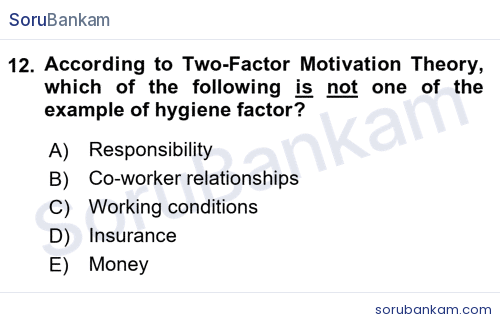
According to Two-Factor Motivation Theory, which of the following is not one of the example of hygiene factor? A) Responsibility B) Co-worker relationships C) Working conditions D) Insurance. E) Money
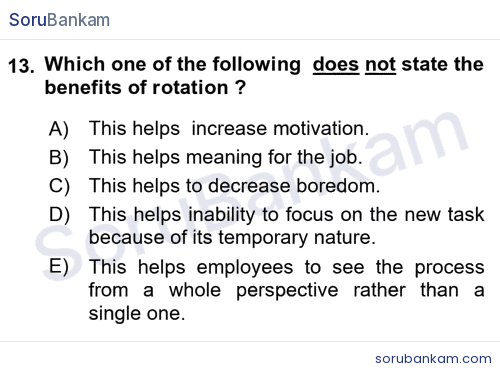
13. Which one of the following does not state the benefits of rotation ? A) This helps increase motiyation. B) This helps meaning vor the job. C) This helps to decrease boredom. D) This helps inability to focus or the new task because of its temporary natúre. This-helps employees to see the process Yrom a whole perspective rather thạn a single one.
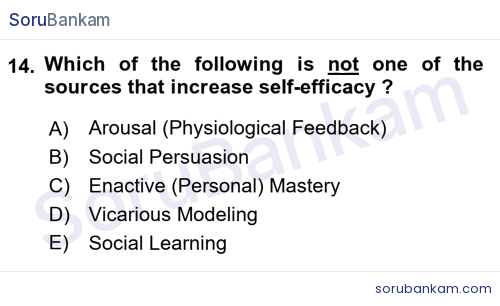
Which of the following is not one of the sources that increase self-efficacy ? A) Arousal (Physiological Feedback) B) Social Persuasion C) Enactive (Personal) Mastery D) Vicarious Modeling E) Social Learning
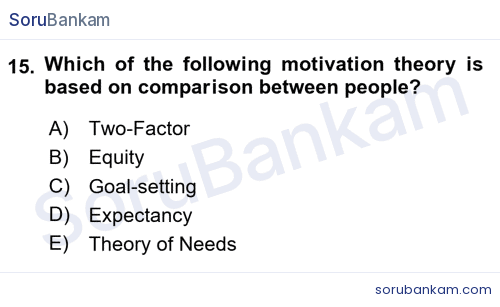
Which of the following motivation theory is based on comparison between people? A) Two-Factor B) Equity C) Goal-setting D) Expectancy E) Theory of Needs
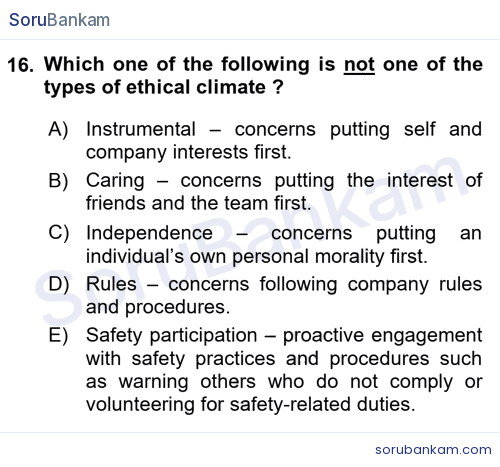
Which one of the following is not one of the types of ethical climate ? A) Instrumental - concerns putting self and company interests first. B) Caring - concerns putting the interest.of friends and the team first. C) Independence - concems putting individual's own personal morality first. D) Rules - concers following company rules and procedures. E) Safety participation - proactive engagement with safety practices and procedures such as warning othersywho do not comply or volunteering for safety-related duties.
Which of the following is one of the artifact of "Hierarchy" culture? A) Teamwork B) Predictability C) Creativity D) Risk taking E) Goal setting
Which of the following dimension is related with how much individuals in organizations or societies are encouraged for being fair and altruistic? i l A) Ay • Power distance B) Collectivism C) Individualism • D) Future orientation E) Human orientation
Which of the following dimension of national culture is related with the perception of inequality in society? A) Masculinity B) Collectivism C) Power distance D) Long term orientation E) Individualism
Which of the following is the right concept that shows the degree of perceptual agreement or consensus of employees' perceptions? A) Climate power B) Climate conflict C) Climate strength D) Climate change E) Climate resistance