IKT320U International Economics 2 2023-2024 Yaz Okulu Soruları
20 soru · Yaz okulu · 2023-2024
IKT320U International Economics 2 dersinin 2023-2024 yaz okulu sınavı 20 sorudan oluşur; ders AÖF İktisat (İngilizce) bölümünde okutulur. Sorular aşağıda sırasıyla yer alır. Doğru cevaplar ve sonucun, testi çözdüğünde görünür.
Önizleme · 20 soru. Cevaplamak ve sonucunu görmek için sınavı başlat.
Sorular
20 soru
Soru 1
Soru 2
Soru 3
Soru 4
Soru 5
Soru 6
Soru 7
Soru 8
Soru 9
Soru 10
Soru 11
Soru 12
Soru 13
Soru 14
Soru 15
Soru 16
Soru 17
Soru 18
Soru 19
Soru 20
Sınav modunda süre tutulur, doğru cevaplar ve sonucun sınav bitince görünür.
Dersin üniteleri
IKT320U International Economics 2 ders sayfası: bütün sınavlar ve üniteler
Soruların metni (otomatik okuma)
Görsellerden otomatik okunmuştur; hata içerebilir. Sorular, görsellerdeki hâliyle geçerlidir.
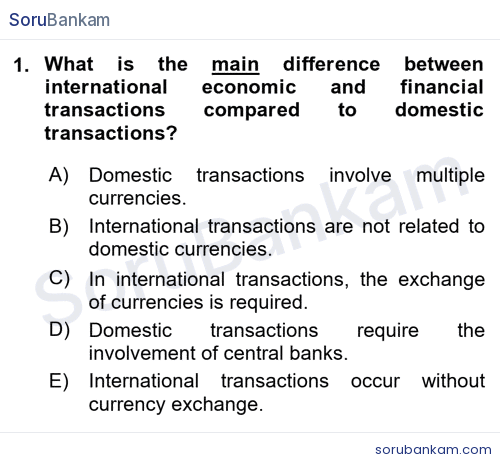
1. What is the main difference between international economic and financial transactions compared to domestic transactions? A) Domestic transactions involve multiple currencies. B) International transactions are not related to domestic currencies. C) In international transactions, the exchange of currencies is required. D) Domestic transactions require the involvement of central banks. Interational transactions occur without currency exchange.
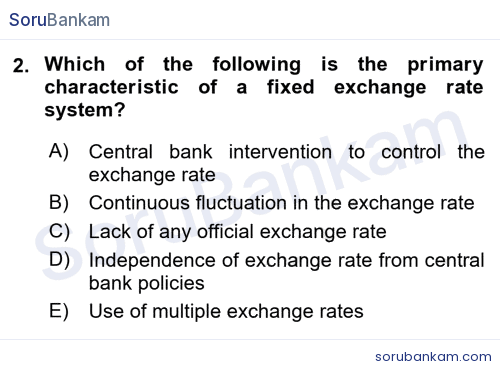
Which of the following is the primary characteristic of a fixed exchanga rate system? A) Central bank intervention to control the exchange rate B) Continuous fluctuation in the exchange rate C) Lack of any official exchange Tắte D) Independence of expliange rate from contral bank policies E) Use of multiple exchange rates ,
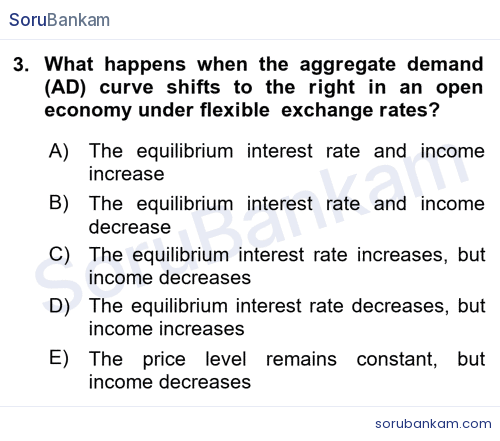
What happens when the aggregate demand (AD) curve shifts to the right in an open economy under flexible exchange rates? A) The equilibrium interest rate and income increase B) The equilibrium interest rate and income decrease C) The equilibrium interest rate increases, but income decreases D) The equilibrium interest rate decreases; but income increases E) The price level remains constant, but income decreases
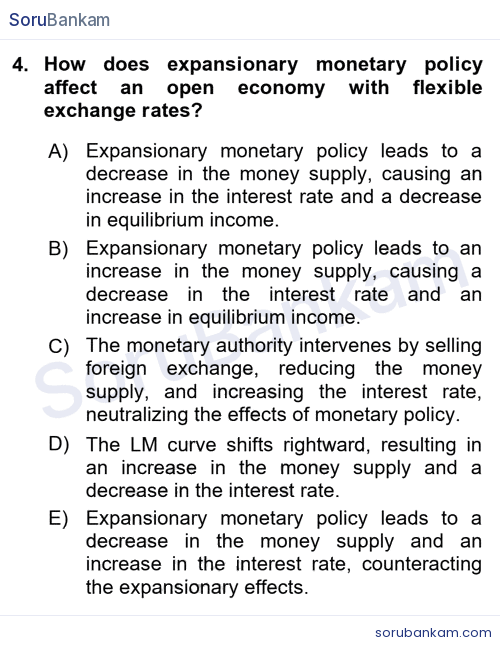
How does expansionary monetary policy affect an open economy with flexible exchange rates? A) Expansionary monetary policy leads to a decrease in the money supply, causing, an increase in the interest rate and a decrease in equilibrium income. B) Expansionary monetary policy leads to an increase in the money supply, causing a decrease in the interest rate and an increase in equilibrium income. C) The monetary authority intervenes by selling foreign exchange, reducing the money supply, and increasing the interest rate, neutralizing the effects of monetary palicy. D) The LM curve shifts rightward, resulting in an increase in the money supply and a decrease in the interest rate. E) Expansionary monetary policy leads to a decrease in the money supply and an increase in the interest rate, counteracting the expansionăry effects.
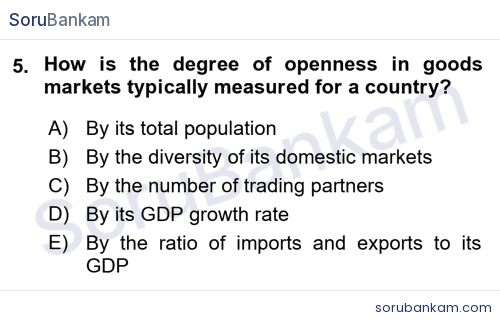
How is the degree of openness in goods markets typically measured for a country? • L A) By its total population B) By the diversity of its domestic markets C) By the number of trading partners D) By its GDP growth rate E) By the ratio of imports and exports to its GDP
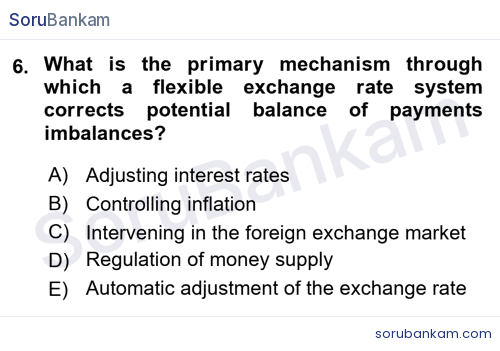
What is the primary mechanism through which a flexible exchange rate system corrects potential balance of payments îmbalances? A) Adjusting interest rates B) Controlling infiation C) Intervening in the foreign exchange market D) Regulation of money supply E) Automatic adjustment of the exchange rate
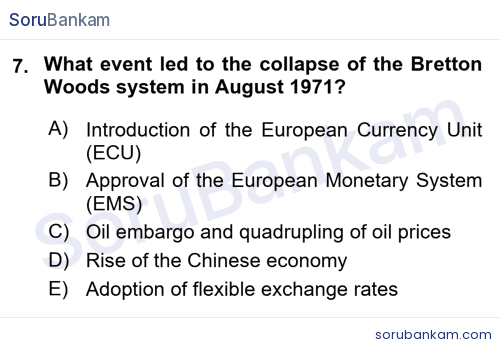
What event led to the collapse of the Bretton Woods system in August 1971? A) Introduction of the European Currency Unit (ECU) B) Approval of the European Monetary System (EMS) C) Oil embargo and quadrupling of oil prices D) Rise of the Chinese economy E) Adoption of flexible exchange rates
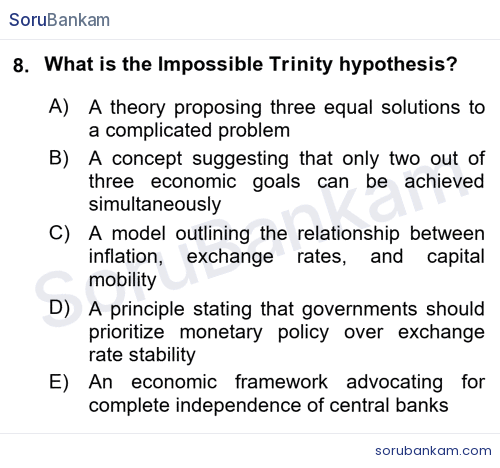
What is the Impossible Trinity hypothesis? A) A theory proposing three equal solutions to a complicated problem B) A concept suggesting that only two out of three economic goals can be achieved simultaneously C) A model outlining the relationship between inflation, exchange rates, and capital mobility D) A principle stating that governments should prioritize monetary policy over exchange rate stability E) An economic framework advocating for complete independence of central banks
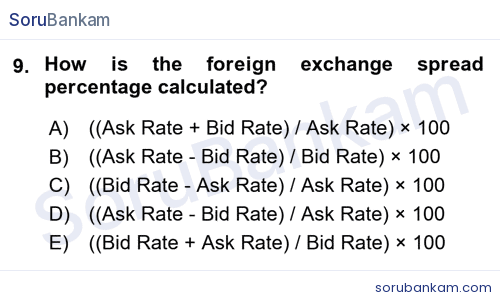
How is the foreign exchange spread percentage calculated? A) ((Ask Rate + Bid Rate) / Ask Rate) × 100 B) ((Ask Rate - Bid Rate) / Bid Rate) × 100 C) ((Bid Rate - Ask Rate) / Ask Rate) × 100 D) ((Ask Rate - Bid Rate) / Ask Rate) × 100 E) ((Bid Rate + Ask Rate) / Bid Rate) × 100
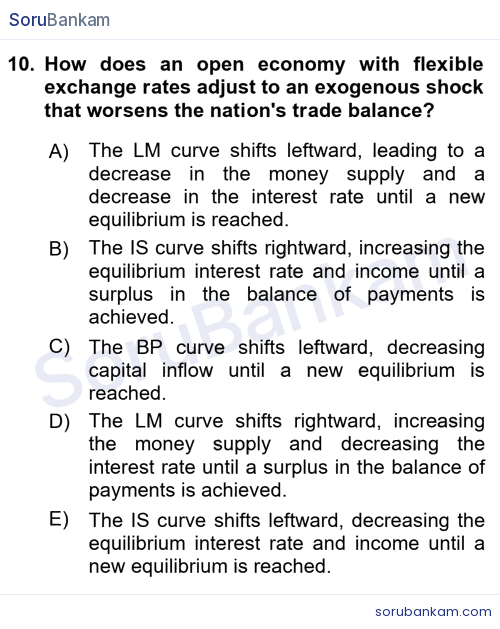
10. How does an open economy with flexible exchange rates adjust to an exogenous shock that worsens the nation's trade balance? A) The LM curve shifts leftward, leading to a decrease in the money supply and af decrease in the interest rate until a new equilibrium is reached. The IS curve shifts rightward, increasing the equilibrium interest tate and income until a surplus in the balance of payments is achieved. C) The BP curve shifts leftward, decreasing capital inflow until a' hew equilibrium is reached Dy The IM curve shifts rightward, increasin the money supply and decreasing the interest rate until a surplus in the balance of payments is achieved. ,Ey The IS curve shifts leftward, decreasing the equilibrium interest rate and income until a new equilibrium is reached.
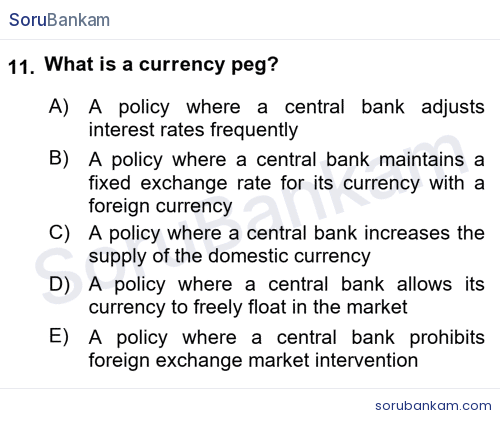
What is a currency peg? A) A policy where a central bank adjusts interest rates frequently B) A policy where a central bank maintains a fixed exchange rate for its currency with a foreign currency C) A policy where a central bank increases the supply of the domestic currency D) A policy where a central bank allows its currency to freely float in the market E) A policy where a central bank prohibits foreign exchange market intervention
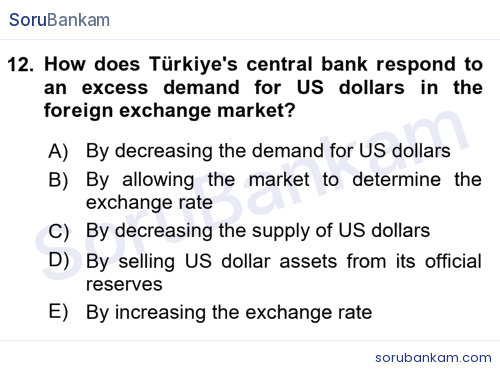
How does Türkiye's central bank respond to an excess demand for US dollars in the foreign exchange market? A) By decreasing the demand for US dollars B) By allowing the market to determine the exchange rate C) By decreasing the supply of US dollars D) By selling US dollar assets from its official reserves E) By increasing the exchange rate
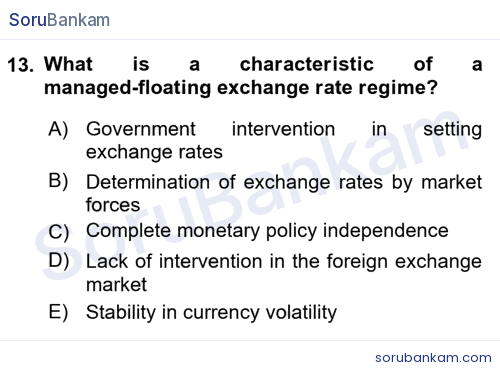
13. What characteristic managed-floating exchange rate regime? A) Govermeht intervention in setting exchenge rates B) Determination of exchange rates by market forces Complete monetary policy independence D) Lack of intervention in the foreign exchange market « E) Stability in currency volatility
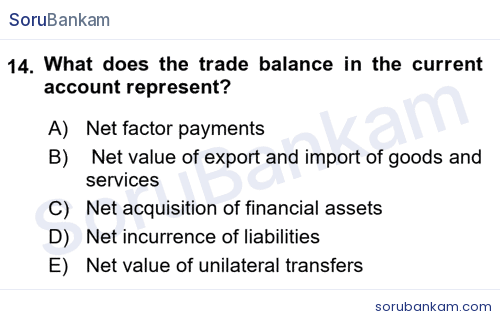
What does the trade balance in the current account represent? A) Net factor payments B) Net value of export and import of goods and services C) Net acquisition of financial assets D) Net incurrence of liabilities E) Net value of unilateral transfers
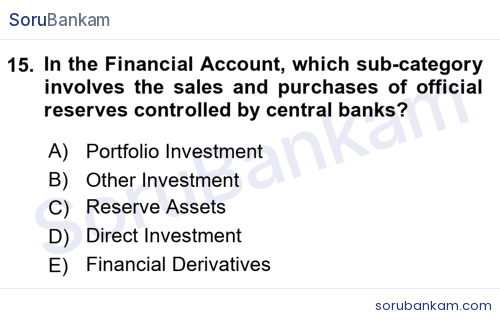
In the Financial Account, which sub-category involves the sales and purchases of official reserves controlled by central banks? A) Portfolio Investment B) Other Investment C) Reserve Assets D) Direct Investment E) Financial Derivatives
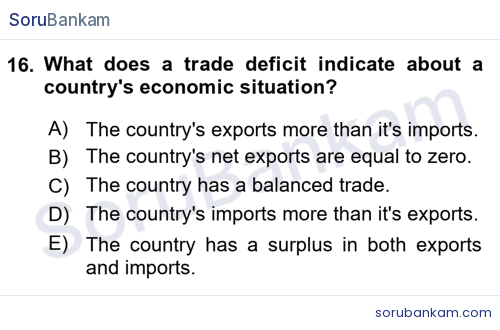
What does a trade deficit indicate about a country's economic șituation? A) The country's exports more than it's imports. B) The country's net exports are equal to zero. C) The country has a balanced trade. D) The country's imports more than it's exports. E) The country has a surplus in both exports and imports.
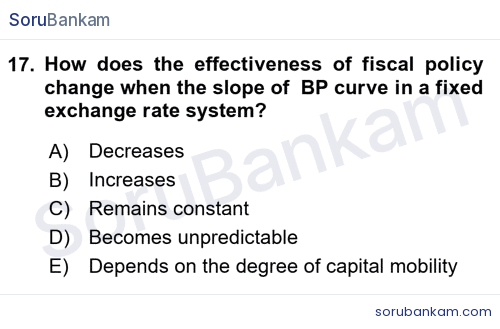
How does the effectiveness of fiscal policy change when the slope of BP curve In a fixed exchange rate system? A) Decreases B) Increases C) Remains constant D) Becomes unpredictable E) Depends on the degree of capital mobility
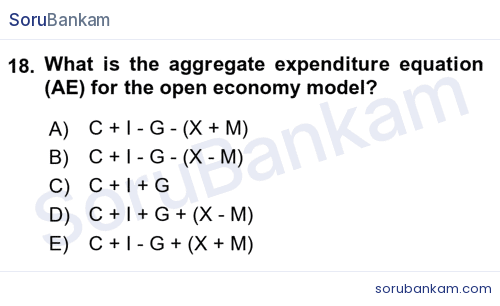
What is the aggregate expenditure equation (AE) for the open economy model? A) C + 1 - G- (X+M) B) C+ | - G - (X-M) C) C+ | + D) C+1+G+(X-M) E) C+| -G+ (X+M)
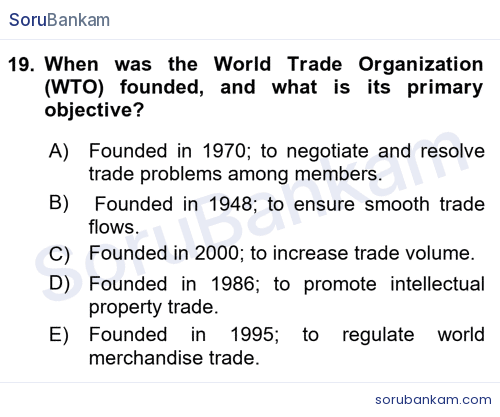
19. When was the World Trade Organization (WTO) founded, and what is its primary objective? A) Founded in 1970; to negotiate and resolve trade problems among members. B) Founded in 1948; to ensure smooth trade flows. C) Founded in 2000; to increase trade volume. D) Founded in 1986; to promote intellectual property trade. Founded in 1995; to regulate world merchandise trade.
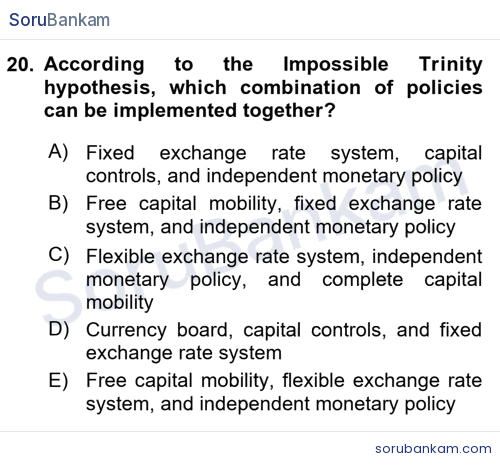
According to the Impossible Trinity hypothesis, which combination of policies can be implemented together? A) Fixed exchange rate system, capital controls, and independent monetary policy" B) Free capital mobility, fixed exchange rate system, and independent monetary policy C) Flexible exchange rate system, independent monetary policy, and complete capital mobility D) Currency board, capital controls, and fixed exchange rate system. E) Free capital mobility, flexible exchange rate system, and independent monetary policy