IKT320U International Economics 2 2024-2025 Final Soruları
20 soru · Final · 2024-2025
IKT320U International Economics 2 dersinin 2024-2025 final sınavı 20 sorudan oluşur; ders AÖF İktisat (İngilizce) bölümünde okutulur. Sorular aşağıda sırasıyla yer alır. Doğru cevaplar ve sonucun, testi çözdüğünde görünür.
Önizleme · 20 soru. Cevaplamak ve sonucunu görmek için sınavı başlat.
Sorular
20 soru
Soru 1
Soru 2
Soru 3
Soru 4
Soru 5
Soru 6
Soru 7
Soru 8
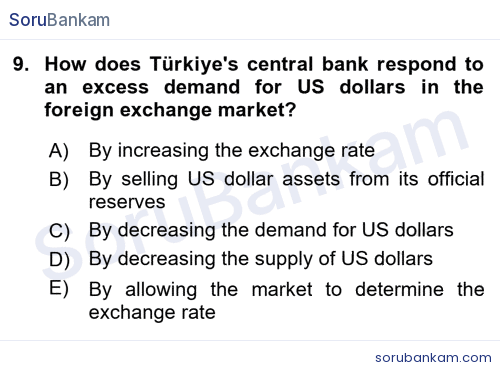
Soru 9
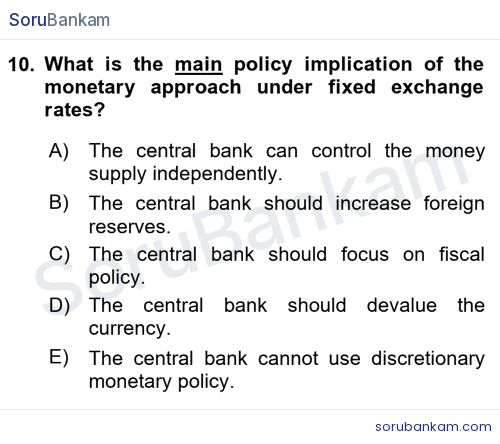
Soru 10
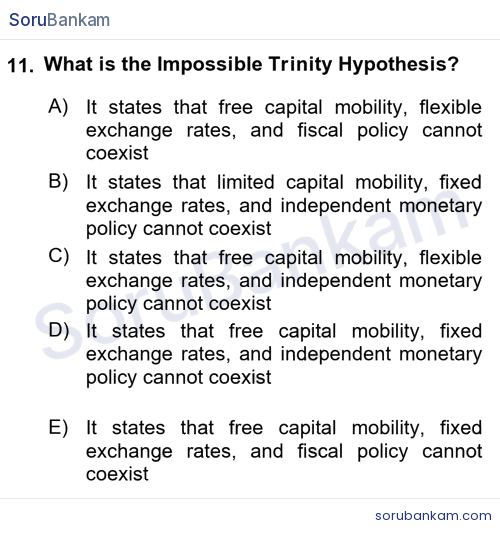
Soru 11
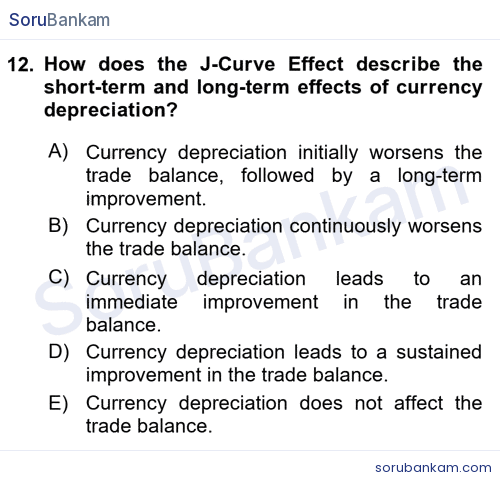
Soru 12
Soru 13
Soru 14
Soru 15
Soru 16
Soru 17
Soru 18
Soru 19
Soru 20
Sınav modunda süre tutulur, doğru cevaplar ve sonucun sınav bitince görünür.
Dersin üniteleri
IKT320U International Economics 2 ders sayfası: bütün sınavlar ve üniteler
Soruların metni (otomatik okuma)
Görsellerden otomatik okunmuştur; hata içerebilir. Sorular, görsellerdeki hâliyle geçerlidir.
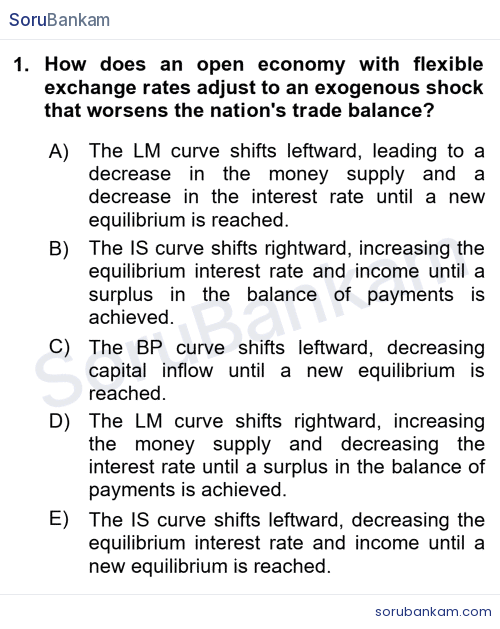
How does an open economy with flexible exchange rates adjust to an exogenous shock that worsens the nation's trade balance? A) The LM curve shifts leftward, leading to a decrease in the money supply and a decrease in the interest rate until a new equilibrium is reached. B) The IS curve shifts rightward, increasing the equilibrium interest rate and income until a surplus in the balance of payments is achieved. C) The BP curve shifts leftward, decreasing capital inflow until a new equilibrium is reached. D) The LM curve shifts rightward, increasing the money supply and decreasing the interest rate until a surplus in the balance of payments is achieved. E) • The IS curve shifts leftward, decreasing the equilibrium interest rate and income until a new equilibrium is reached.
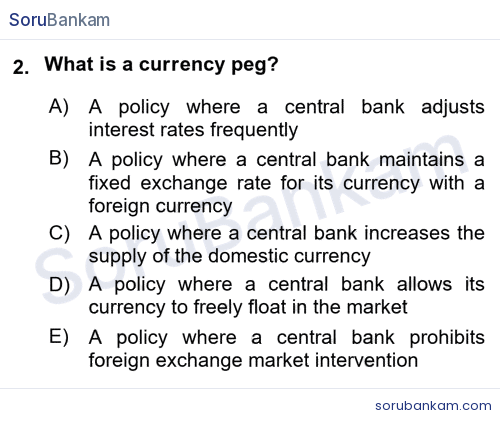
What is a currency peg? A) A policy where a central bank adjusts interest rates frequently. B) A policy where a central bank maintains a fixed exchange rate for its currency with a foreign currency - C) A policy where a central bank Increases the supply of the domestic currency D) A policy where a central bank allows._its currency to freely float in the market, E) A policy where a central bank prohibits foreign exchange market intervention
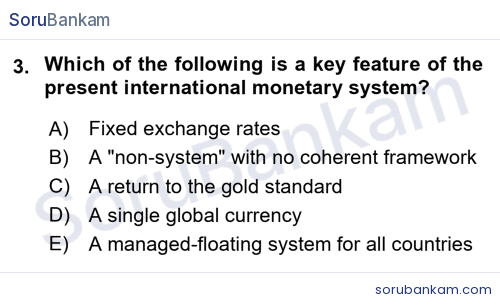
Which of the following is a key feature of the present International monetary system? A) Fixed exchange rates B) A "non-system" with no coherent framework C) A return to the gold standard D) A single global currency E) A managed-floating system for all countries
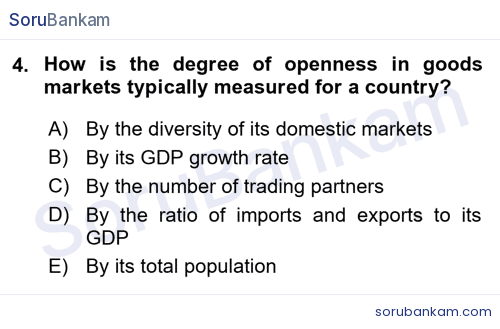
How is the degree of openness in goods markets typically measured for a country? A) By the diversity of its domestic markets B) By its GDP growth rate C) By the number of trading partners D) By the ratio of imports and exports to its GDP E) By its total population
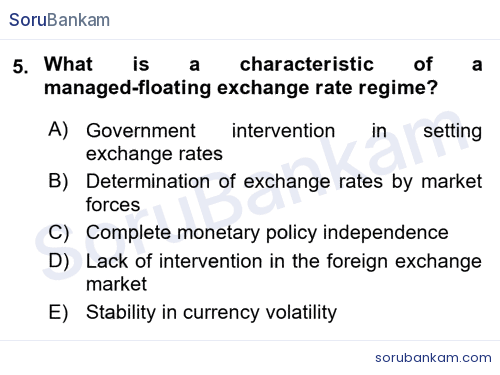
What characteristic nai managed-iloating exchange rate reg!me? A) Goyerment intervention setting exchange rates B) nvlB) Determination of exchange rates by market forces C) Complete monetary policy independence D) Lack of intervention in the foreign exchange ,.'y. • market E) Stability in currency volatility
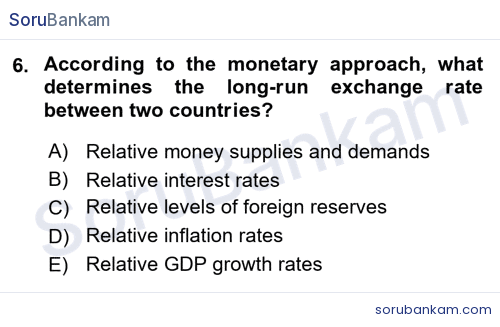
According to the monetary approach, what determines the long-run exchange rate between two countries? A) Relative money supplies and demands B) Relative interest rates C) Relative levels of foreign reserves D) Relative inflation rates E) Relative GDP growth rates
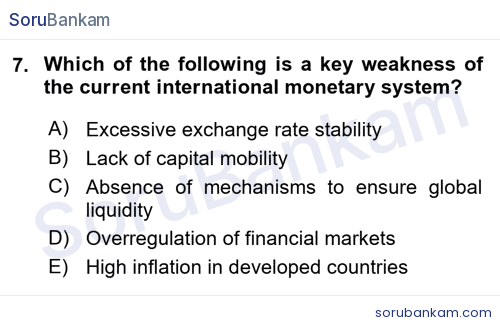
Which of the following is a key weakness of the current international monetary system? A) Excessive exchange rate stability B) Lack of capital mobility C) Absence of mechanisms to ensure global liquidity D) Overregulation of financial markets E) High inflation in developed countries
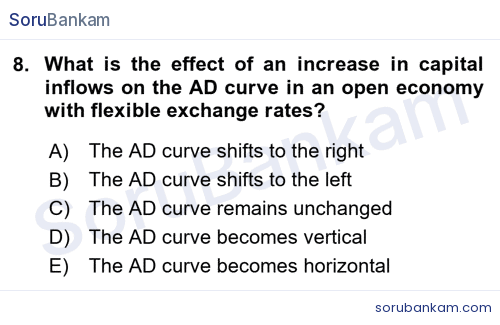
What is the effect of an increase in capital Inflows on the AD curve in an open economy with flexible exchange rates? A) The AD curve shifts to the right B) The AD curve shifts to the left C) The AD curve remains unchanged D) The AD curve becomes vertical E) The AD curve becomes horizontal
How does Türkiye's central bank respond to an excess demand for US dollars in the foreign exchange market? A) By increasing the exchange rate B) By selling US dollar assets from its offiejal reserves C) By decreasing the demand far US dollars D) By decreasing the supply of US dollars E) By allowing the market to determine, tha exchange rate
What is the main policy implication of the monetary approach, under fixed exchange rates? A) The central bank can control the money supply independently. B) The central bank should increase foreign reserves. C) The central bank should focus on fiscal policy. D) The central bank should devalue the currency. E) The central bank cannot use discretionary monetary policy.
11. What is the Impossible Trinity Hypothesis? A) It states that free capital mobility, flexible exchange rates, and fiscal policy cannot coexist B) It states that limited capital mobility, fixed. exchange rates, and independent mbretary policy cannot coexist It states that free capital mobility, flexible exchange rates, and independent monetary policy cannot coexist D) It states that free capital mobility, fixed exchange rates, and independent monetary policy cannot coexișt E) It states that free capital mobility, fixed exchange rates, and fiscalpolicy cannot coexist, 1•
How does the J-Curve Effect describe the short-term and long-term effects of currency depreciation? A) Carrency depreciation initially worsens the ' trade balance, followed by a long-term improvement. B) Currency depreciation continuously worsens the trade balance. C) Currency depreciation leads to an immediate improvement in the trade balance. D) Currency depreciation leads to a sustained improvement in the trade balance. E) Currency depreciation does not affect the trade balance.
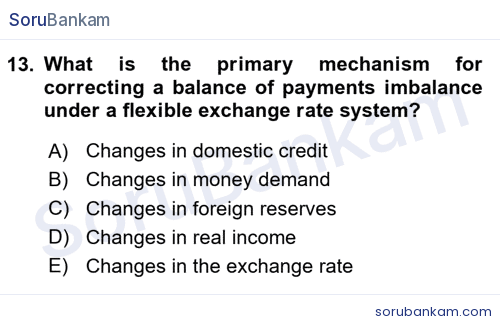
What the primary mechanism for correcting a balance of payments imbalance under a flexible exchange rate system? A) Changes in domestic credit B) Changes in money demand C) Changes in foreign reserves D) Changes in real income E) Changes in the exchange rate
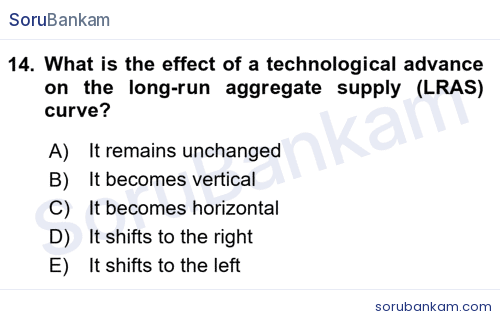
What is the effect of a technological advance on the long-run aggregate supply (LRAS) curve? A) Itremains unchanged B) It becomes vertical C) It becomes horizontal D) It shifts to the right E) It shifts to the left
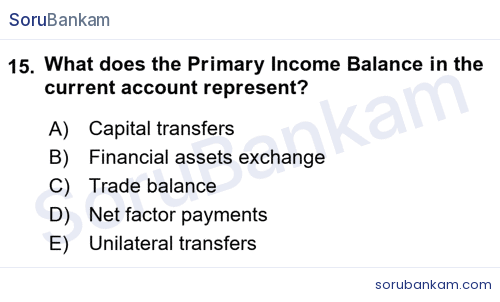
What does the Primary Income Balance in the current account represent? A) Capital transfers B) Pinancial assets exchange C) Trade balance D) Net factor payments E) Unilateral transfers
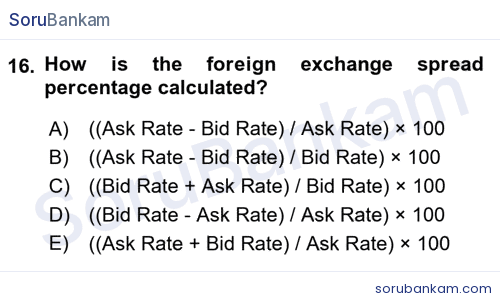
How is the foreign exchange spread percentage calculated? A) ((Ask Rate - Bid Rate) / Ask Rate) × 100 B) ({Ask Rate - Bid Rate) / Bid Rate) × 100 C) ((Bid Rate + Ask Rate) / Bid Rate) × 100 D) ((Bid Rate - Ask Rate) / Ask Rate) × 100 E) ((Ask Rate + Bid Rate) / Ask Rate) × 100
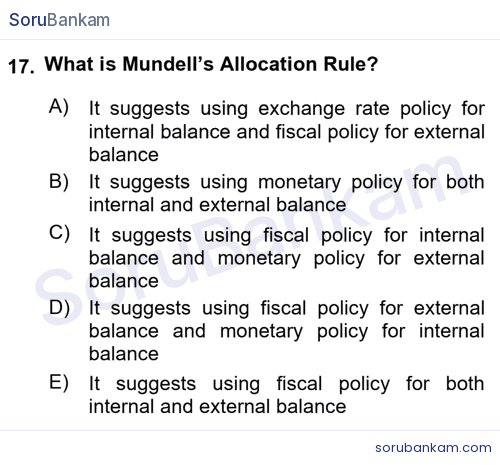
What is Mundell's Allocation Rule? A) It suggests using exchange rate policy for internal balance and fiscal policy for extemal balance B) It suggests using monetary policy for both internal and external balance C) It suggests using fiscal policy for intemal balance and monetary policy for external balance D) It suggests using fiscal policy for external balance and monetary policy for internal balance E) It suggests using fiscal policy for both internal and external balance
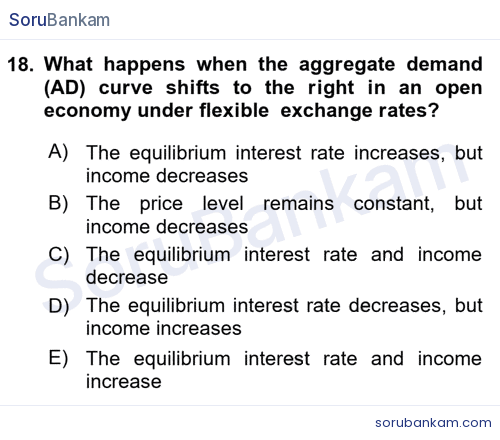
What happens when the aggregate demand (AD) curve shifts to the right in an open economy under flexible exchange rates? A) The equilibrium interest rate increases, but income decreases B) The price level remains constant; but income decreases C) The equilibrium interest rate and income decrease D) The equilibrium interest rate decreases, but income increases E) The equilibrium interest rate and income increase
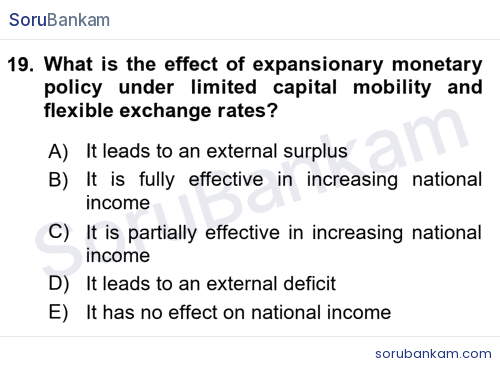
What is the effect of expansionary monetary policy under limited capital mobility and flexible exchange rates? A) ult leads to an external surplus B) 'By It is fully effective in increasing national income C) It is partially effective in increasing national income D) It leads to an external deficit E) It has no effect on national income
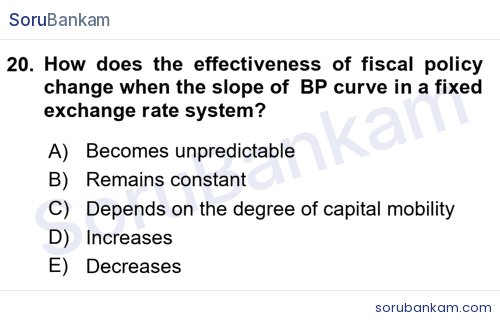
How does the effectiveness of fiscal policy change when the slope of BP curve in a fixed exchange rate system? A) Becomes unpredictable B) Remains constant C) Depends on the degree of capital mobility D) Increases E) Decreases