IKT320U International Economics 2 2023-2024 Final Soruları
20 soru · Final · 2023-2024
IKT320U International Economics 2 dersinin 2023-2024 final sınavı 20 sorudan oluşur; ders AÖF İktisat (İngilizce) bölümünde okutulur. Sorular aşağıda sırasıyla yer alır. Doğru cevaplar ve sonucun, testi çözdüğünde görünür.
Önizleme · 20 soru. Cevaplamak ve sonucunu görmek için sınavı başlat.
Sorular
20 soru
Soru 1
Soru 2
Soru 3
Soru 4
Soru 5
Soru 6
Soru 7
Soru 8
Soru 9
Soru 10
Soru 11
Soru 12
Soru 13
Soru 14
Soru 15
Soru 16
Soru 17
Soru 18
Soru 19
Soru 20
Sınav modunda süre tutulur, doğru cevaplar ve sonucun sınav bitince görünür.
Dersin üniteleri
IKT320U International Economics 2 ders sayfası: bütün sınavlar ve üniteler
Soruların metni (otomatik okuma)
Görsellerden otomatik okunmuştur; hata içerebilir. Sorular, görsellerdeki hâliyle geçerlidir.
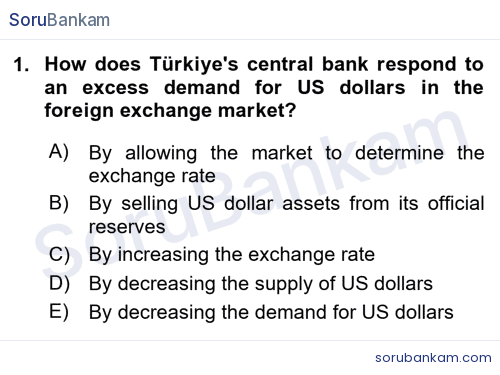
How does Türkiye's central bank respond to an excess demand for US dollars in the foreign exchange market? A) By allowing the market to determine the exchange rate B) By selling US dollar assets from its official reserves C) By increasing the exchange rate D) By decreasing the supply of US dollars E) By decreasing the demand for US dollars
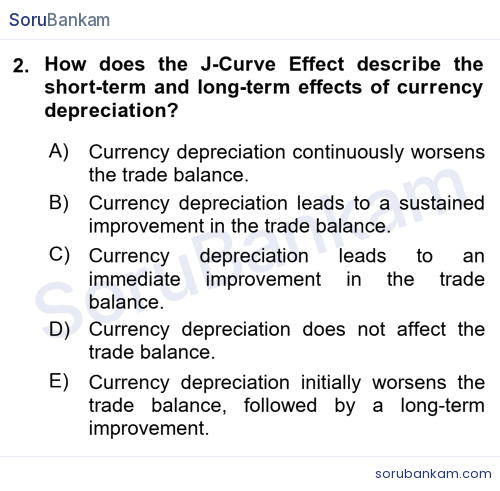
2. How does the J-Curve Effect describe the short-term and long-term effects of currency depreciation? A) Currency depreciation continuously worsens the trade balance. B) Currency depreciation leads to a sustained improvement in the trade balance. C) Currency depreciation leads immediate improvement in the trade balance. D) Currency depreciation does not affect the trade balance. Currency depreciation initially worsens the trade balance, followed by a long-term improvement.
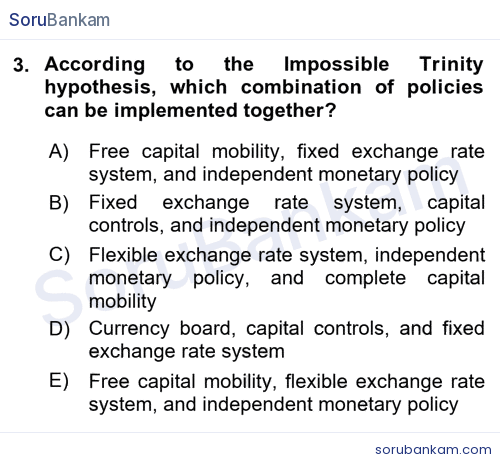
According to the Impossible Trinity hypothesis, which combination of policies can be implemented together? » " A) Free capital mobility, fixed exchange rate system, and independent monetary policy B) Fixed exchange rate system, capital controls, and independent monetary policy C) Flexible exchange rate system, independent monetary policy, and complete capita: mobility D) Currency board, capital controls, and fixed exchange rate system. E) Free capital mobility, flexible exchange rate pil'• system, and independent monetary policy
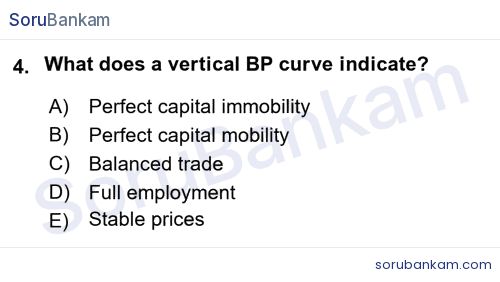
What doas a vertical BP curve indicate? A) Perfect capital immobility B) Perfect capital mobility C) Balanced trade D) Full employment E) Stable prices
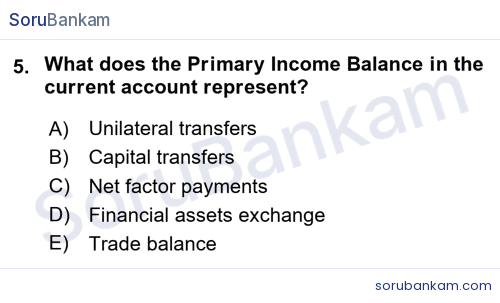
5. What does the Primary Income Balance in the current account represent? A) Unilateral transfers Capital transfers Net factor payments D) Financial assets exchange E) Trade balance
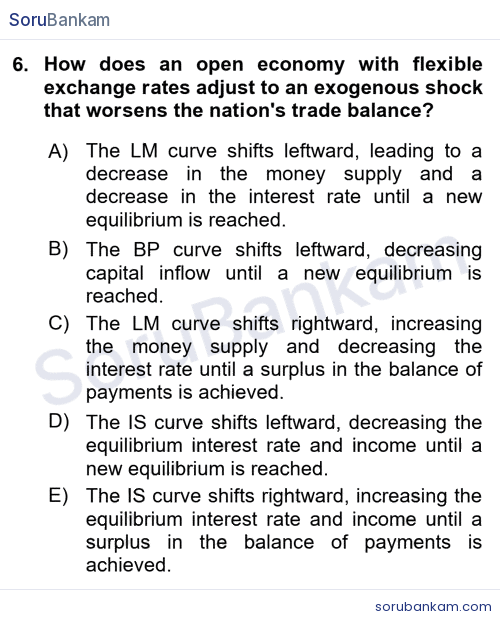
How does an open economy with flexible exchange rates adjust to an exogenous shock that worsens the nation's trade balance? A) The LM curve shifts leftward, leading to a decrease in ine money supply and, i decrease in the interest rate until, e. new equilibrium is reached. B) The BP curve shifts leftward, decreasing capital inflow untif a new equilibrium is reached. C) The LM curve shifts rightward, increasing the money supply and decreasing the interest rate until a surplus in the balance of payments is achieved. D) The IS curve shifts leftward, decreasing the equilibrium interest rate and income until a new equilbrium is reached: E) The, 18 curve shifts lightward, increasing the .. equilibrium interest rate and income until a surplus in the balance of payments is achieved.
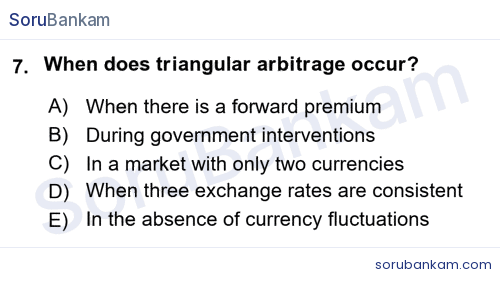
When does triangular arbitrage occur? A) When there is a forward premium B) During government interventions C) In a market with only two currencies D) When three exchange rates are consistent E) In the absence of currency fluctuations
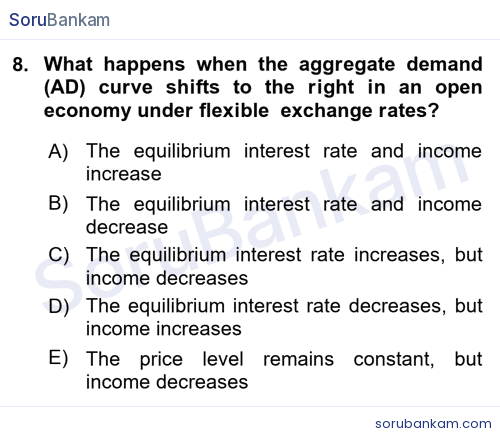
What happens when the aggregate demand (AD) curve shifts to the right in an open economy under flexible exchange rates? A) The equilibrium interest rate and income Increase B) The equilibrium interest rate and income decrease C) The equilibrium interest rate increases, but income decreases D) The equilibrium interest rate decreases, but income increases E) The price level remains constant, but income decreases
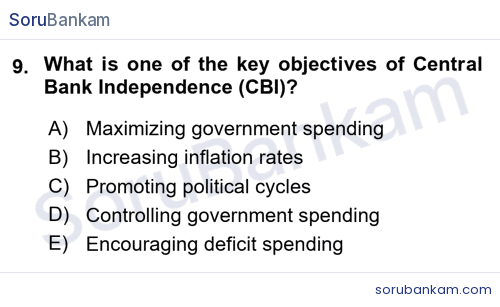
What is one of the key objectives of Central Bank Independence (CBI)? A) Maximizing government spending B) Increasing inflation rates C) Promoting political cycles D) Controlling government spending E) Encouraging deficit spending
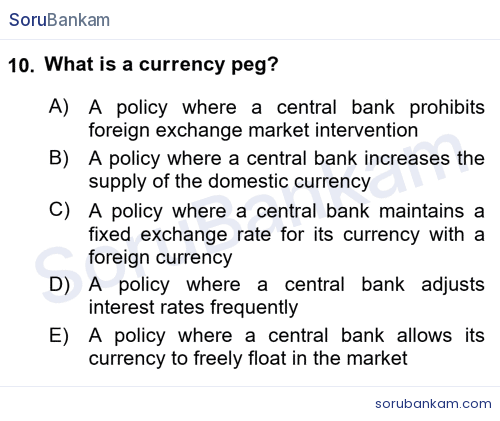
What is a currency peg? A) A policy where a central bank prohibits foreign exchange market intervention B) A policy where a central bank increases the supply of the domestic currency C) A policy where a central bank maintains a fixed exchange rate for its currency with a foreign currency D) A policy where a central bank adjusts interest rates frequently E) A policy where a central bank allows its currency to freely float in the market
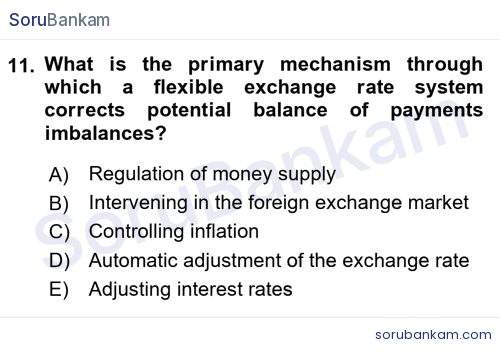
What is the primary mechanism through which a flexible exchange rate system corrects potential balance of payments imbalances? A) Regulation of money supply B) Intervening in the foreign exchangermarket C) Controlling inflation D) Automatic adjustment of the exchange rate E) Adjusting interest rates - г
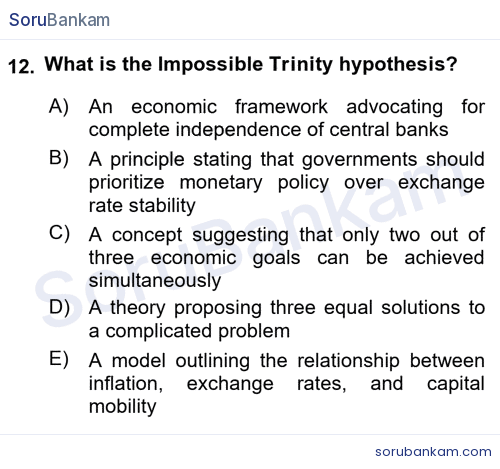
What is the Impossible Trinity hypothesis? A) An economiç \framework advocating for complete independence of central banks B) A principle stating that goverments should prioritize monetary policy over exchange rate stability C) A concept suggesting that only two out of three economic goals can be achieved simultaneously D) A theory proposing three equal solutions to a complicated problem E) A model outlining the relationship between inflation, exchange rates, and capital mobility
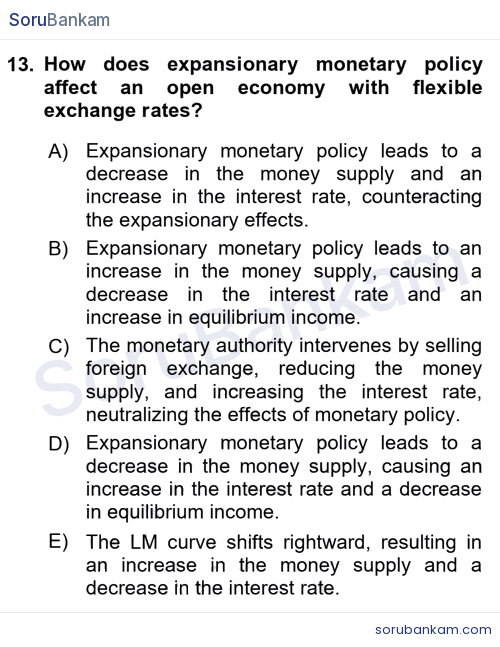
How does expansionary monetary policy affect an open economy with flexible exchange rates? A) Expansionary monetary policy leads to a decrease in the money supply and, increase in the interast rate, counteracting the expansionary effects. B) Expansionary monetary policy leads to an increase in the money supply, causing a decrease in the interest rate and an increase in equilibrium income. C) he monetary authority intervenes by selling foreigh exchange, reducing the money supply, and increasing the interest rate, neutralizing the effects of monetary policy. D) Expansionary monetary policy leads to a decrease, in the money supply, causing an increase in the interest rate and a decrease Th equilibrium income. E) The LM curve shifts rightward, resulting in an increase in the money supply and a decreasewn the interest rate.
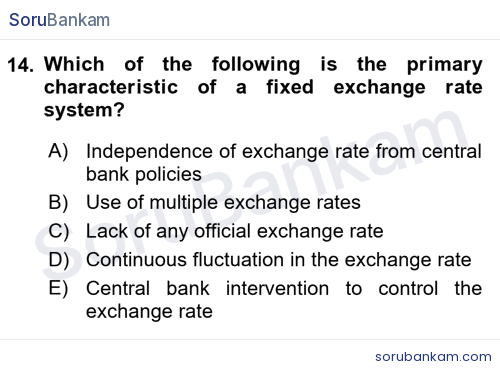
Which of the following is the primary characteristic of a fixed exchange rate system? A) Independence of exchange rate from central bank policies B) Use of multiple exchange rates C) Lack of any official exchange rate D) Continuous fluctuation in the exchange rate E) Central bank intervention to control the exchange rate
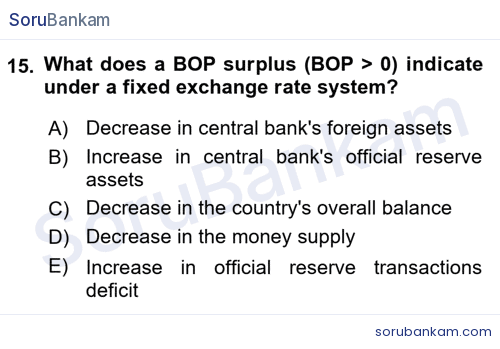
What does a BOP surplus (BOP > 0) indicate under a fixed exchange rate system? A) Decrease in central banks foreign assets B) Increase in central bank's official reserve assets C) Decrease in the country's overall balance D) Decrease in the money supply E) Increase in official reserve transactions deficit
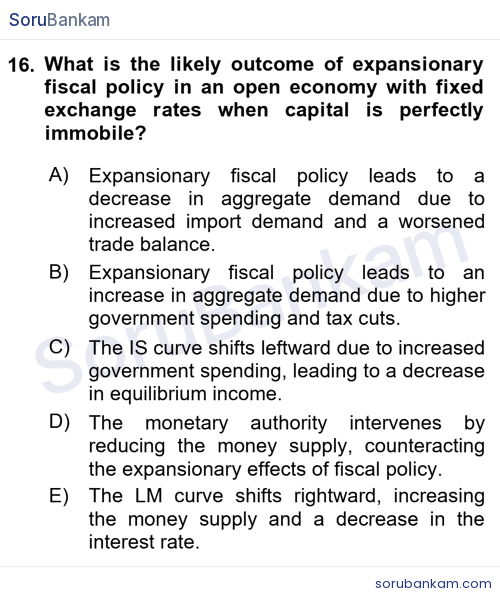
What is the likely outcome of expansionary fiscal policy in an open economy with fixed exchange rates when capital is perfectly immobile? A) Expansionary fiscal policy leads to a decrease in aggregate demand due to increased import demand and a worsened trade balance. B) Expansionary fiscal policy leads to an increase in aggregate demand due to higher government spending and tax cuts. C) The IS curve shifts leftward due to increased government spending, leading to a decrease in equilibrium income. D) The monetary authority intervenes by reducing the money supply, counteracting the expansionary effects of fiscal policy. E) The Li curve shifts rightward, increasing the money supply and a decrease in the interest rate.
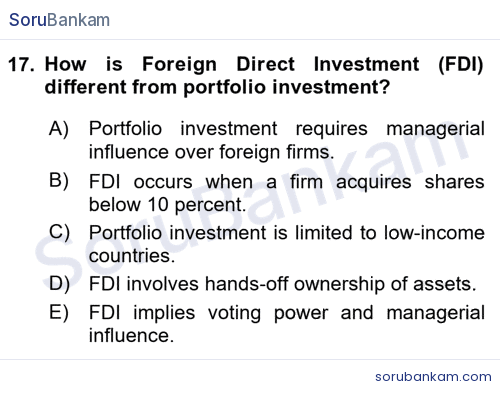
How is Foreign Direct Investment (FDI) different from portfolio investment? A) Portfolio investment requires managerial influence over foreign firms. B) FDI occurs when a firm acquires shares below 10 percent. C) Portfolio investment is limited fo low-income countries. D) FDI involves hands-off ownership of assets,.. E) FDI implies voting power and managerial influence.
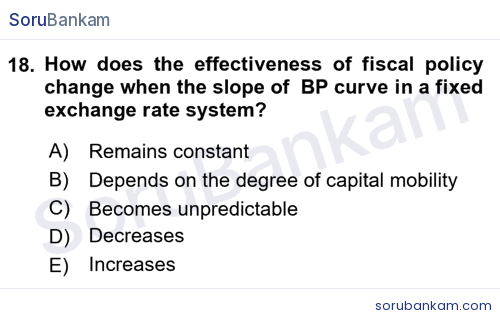
How does the effectiveness of fiscal poliçy change when the slope of BP curve in a fixed exchange rate system? A) Remains constant B) WBY Depends on the degree of capital mobility C) Becomes unpredictable D) Decreases E) Increases
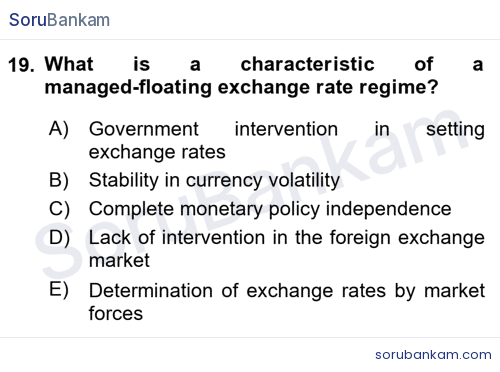
19. What characteristic managed-floating exchange rate regime? A) Government intervention in setting exchange rates Stability in currency volatility C) • Complete monetary policy independence D) Lack of intervention in the foreign exchange market E) Determination of exchange rates by market forces
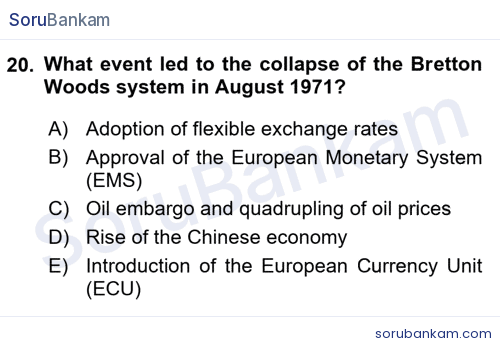
What event led to the collapse of the Bretton Woods system in August 1971? A) Adoption of flexible exchange rates B) Approval of the European Monetary System (EMS) C) Oil embargo and quadrupling of oil prices D) Rise of the Chinese economy E) Introduction of the European Currency Unit (ECU)