IKT320U International Economics 2 2023-2024 Vize Soruları
20 soru · Vize · 2023-2024
IKT320U International Economics 2 dersinin 2023-2024 vize sınavı 20 sorudan oluşur; ders AÖF İktisat (İngilizce) bölümünde okutulur. Sorular aşağıda sırasıyla yer alır. Doğru cevaplar ve sonucun, testi çözdüğünde görünür.
Önizleme · 20 soru. Cevaplamak ve sonucunu görmek için sınavı başlat.
Sorular
20 soru
Soru 1
Soru 2
Soru 3
Soru 4
Soru 5
Soru 6
Soru 7
Soru 8
Soru 9
Soru 10
Soru 11
Soru 12
Soru 13
Soru 14
Soru 15
Soru 16
Soru 17
Soru 18
Soru 19
Soru 20
Sınav modunda süre tutulur, doğru cevaplar ve sonucun sınav bitince görünür.
Dersin üniteleri
IKT320U International Economics 2 ders sayfası: bütün sınavlar ve üniteler
Soruların metni (otomatik okuma)
Görsellerden otomatik okunmuştur; hata içerebilir. Sorular, görsellerdeki hâliyle geçerlidir.
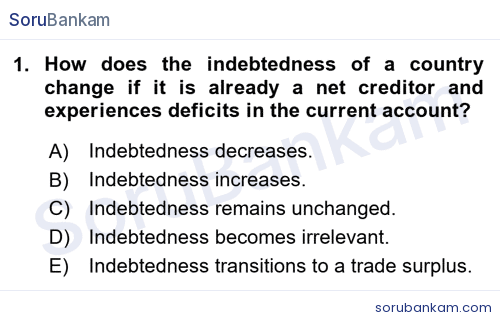
How does the indebtedness of a country change if it Is already a net creditor and experiences deficlts in the current account? A) Indebtedness decreases. B) Indebtedness increases. C) Indebtedness remains unchanged. D) Indebtedness becomes irrelevant. E) Indebtedness transitions to a trade surplus.
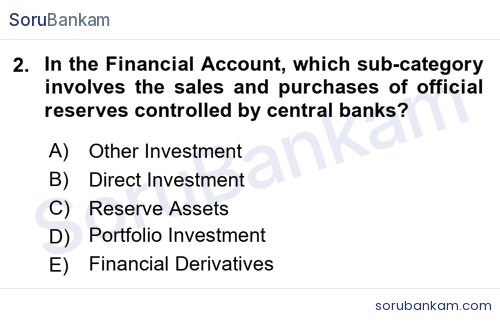
In the Financial Account, which sub-category involves the sales and purchases of official reserves controlled by central banks? A) Other investment B) Direct Investment C) Reserve Assets D) Portfolio Investment E) Financial Derivatives
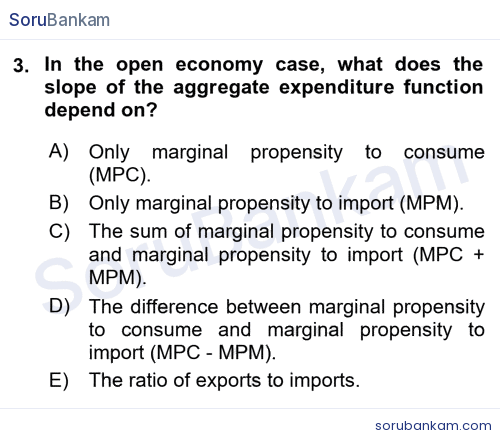
In the open economy case, what does the slope of the aggregate expenditure function depend on? A) Only marginal propensity to consume (MPC). B) Only marginal propensity to import (MP/). C) The sum of marginal propensity to consume and marginal propensity to import (MPC + MPM). D) The difference between marginal propensity to consume and margina propensity to import (MPC - MPM)..." E) The fatio of exports to imports.
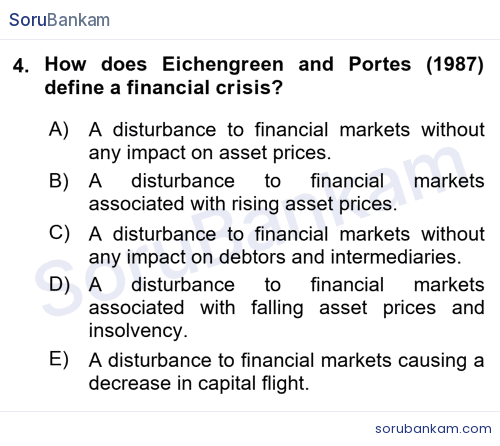
How does Eichengreen and Portes (1987) define a flnancial criss? A) A disturbance to financial markets without any impact on asset prices. B) A disturbance to financial markets associated with rising asset prices. C) A disturbance to financial markets without any impact on debtors and intermediaries. D) A disturbance to financial markets associated with falling asset prices and insolvency. E) A disturbance to financial markets causing a decrease in capital flight.
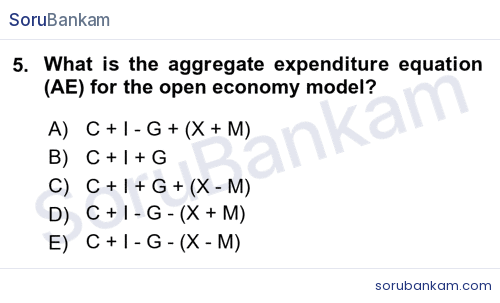
What is the aggregate expenditure equation (AE) for the open economy model? A) C+|-G* (X+M) B) C + C) C+ | + G + (X-M) D) C + 1 - G - (X + M) E) C+|-G-(X-M)
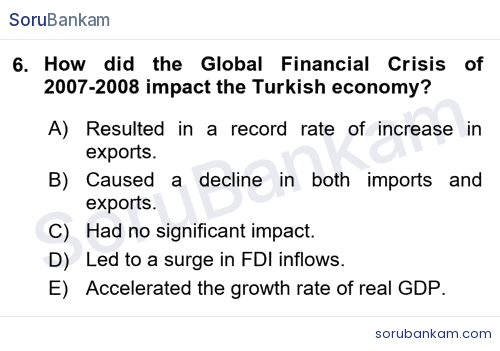
6. How did the Global Financial Crisis of 2007-2008 impact the Turkish onomy? A) Resulted in a record rate of increase in exports. •B) Caused a decline in both imports and exports. C) Had no significant impact. D) Ledłó a'surge in FDlihilows. • Accelerated the growth rate of real GDP.
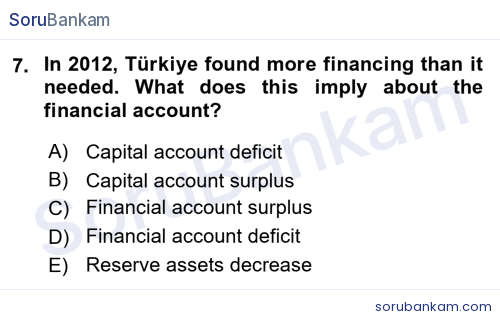
In 2012, Türkiye found more financing than it needed. What does this imply about the financial account? A) Capital account deficit B) Capital account surplus C) Financial account surplus D) Financial account deficit E) Reserve assets decrease
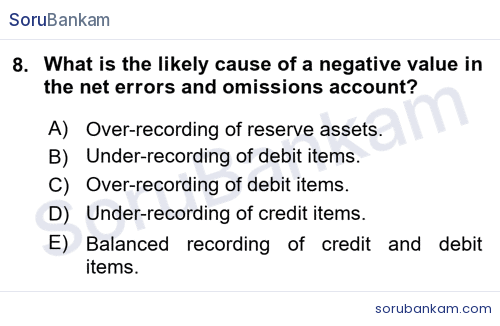
What is the likely cause of a negative value in the net errors and omissions account? A) Over-recording of reserve assets. B) Under-recording of debit items. C) Over-recording of debit items. D) Under-recording of credit items. E) Balanced recording of credit and debit items.
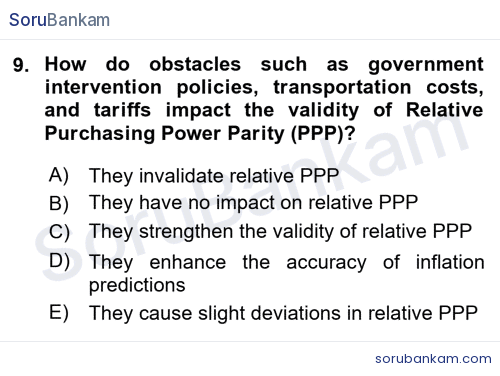
How do obstacles such as government intervention policies, transportation costs, and tariffs impact the validity of Relative Purchasing Power Parity (PPP)? A) They invalidate relative PPP B) They have no impact on relative PPP C) They strengthen the validity of relative PPP D) They enhance the accuracy of inflation predictions E) They cause slight deviations in relative PPP
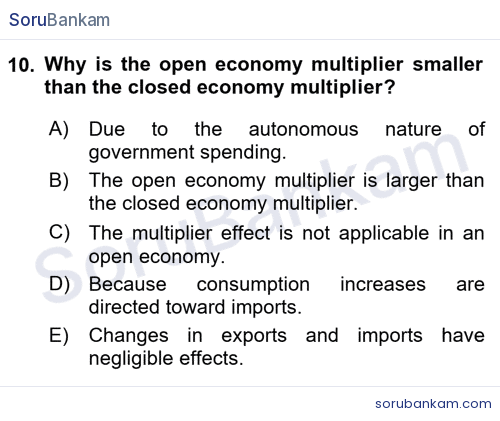
Why is the open economy multiplier smaller than the closed economy multiplier? A) Due to the autonomous nature of government spending. B) The open economy multiplier is larger than the closed economy multiplier. C) The multiplier effect is not applicable in an open economy. D) Because consumption increases are directed toward imports. E) Changes in exports and imports have negligible effects.
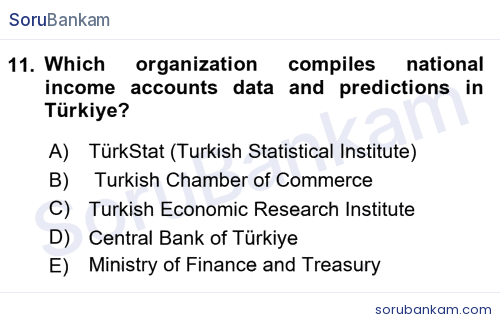
Which organization compiles national Income accounts data and predictions in Türkiye? A) TürkStat (Turkish Statistical Institute) B) Turkish Chamber of Commerce C) Turkish Economic Research Institute» D) Central Bank of Turkiye E) Ministry of Finance and Treasury
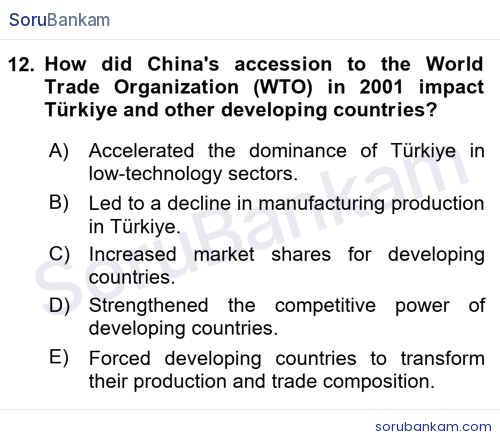
How did China's accession to the World Trade Organization (WTO) in 2001 impact Türkiye and other developing countries? A) Accelerated the dominance of Türkiye in low-technology sectors. B) Led to a decline in manufacturing production in Turkiye. C) Increased market shares for developing countries. D) Strengthened the competitive power of developing countries. E) Forced developing countries to transform their production and trade composition.
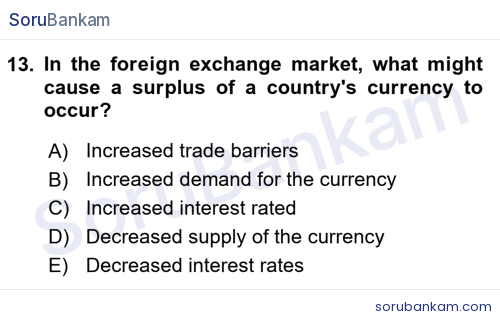
In the foreign exchange market, what might cause a surplus of a country's currency to occur? A) Increased trade barriers B) Increased demand for the currency C) Increased interest rated D) Decreased supply of the currency E) Decreased interest rates
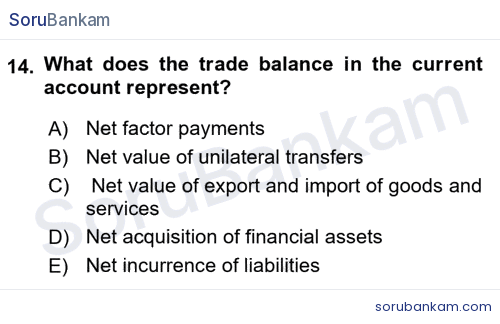
14. What does the trade balance in the current account represent? - A) Net fagor payments Net value of unilateral transfers Net value of export and import of goods and services D) Net acquisition of financiąl assets E) Net incurrence of liabilities
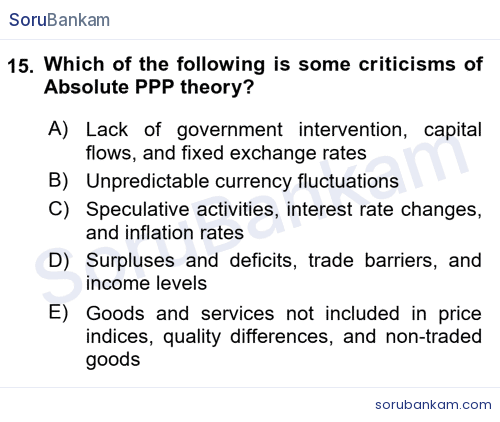
Which of the following is some criticisms of Absolute PPP theory? A) Lack of govemment intervention, capital flows, and fixed exchange rates B) 'B) Unpredictable currency fluctuations C) Speculative activities, interest rate changes, and inflation rates D) Surpluses and deficits, trade barriers, and income levels E) Goods and services not included in price indices, quality differences, and non-traded goods
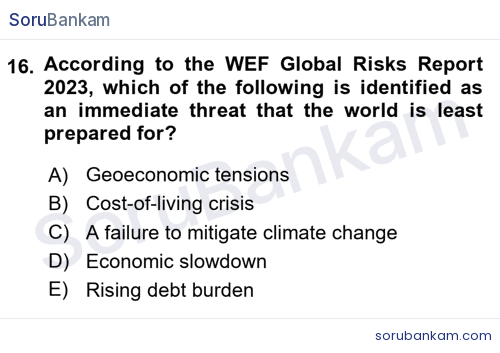
According to the WEF Global Risks Report 2023, which of the following is identified as an immediate threat that the world is least prepared for? A) Geoeconomic tensions B) Cost-of-living crisis C) A failure to mitigate climate change D) Economic slowdown E) Rising debt burden
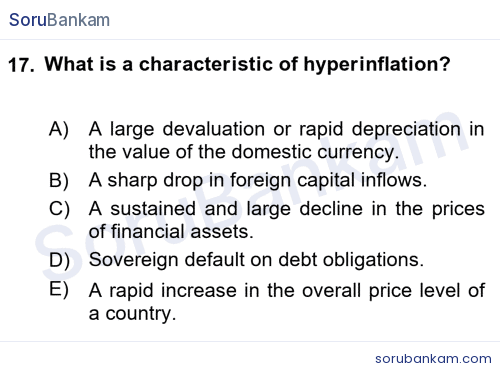
What is a characteristic of hyperinflation? A) A large devaluation or rapid depreciation in the value of the domestic currency. B) A sharp drop in foreign capital inflows. C) A sustained and large decline in the prices of financial assets. D) Sovereign default on debt obligations. E) A rapid increase in the overall price level of a country.
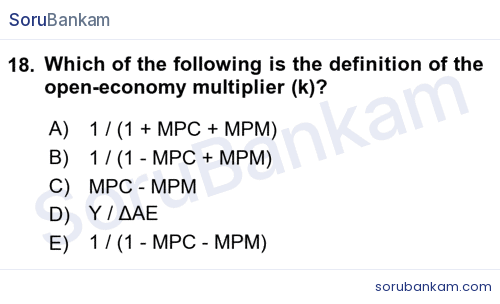
18. Which of the following is the definition of the open-economy multiplier (k)? A) 1 / (1 + MPC + MPM) B) 1 / (1 - MPC + MPM) C) MPC - MPM T. E) 1 / (1 - MPC - MPM) ..
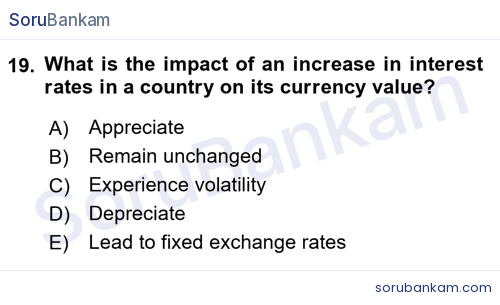
What is the impact of an increase in interest rates in a country on its currency value? A) Appreciate B) Remain unchanged C) Experience volatility D) Depreciate E) Lead to fixed exchange rates
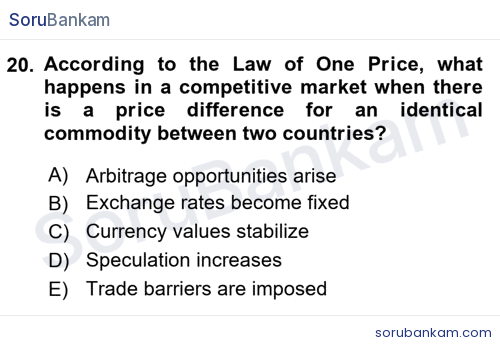
According to the Law of One Price, what happens in a competitive market when there a price difference for an identical commodity between two countries? A) Arbitrage opportunities arise B) Exchange rates become fixed • 1' C) Currency values stabilize D) Speculation increases E) Trade barriers are imposed