IKT320U International Economics 2 2024-2025 Vize Soruları
20 soru · Vize · 2024-2025
IKT320U International Economics 2 dersinin 2024-2025 vize sınavı 20 sorudan oluşur; ders AÖF İktisat (İngilizce) bölümünde okutulur. Sorular aşağıda sırasıyla yer alır. Doğru cevaplar ve sonucun, testi çözdüğünde görünür.
Önizleme · 20 soru. Cevaplamak ve sonucunu görmek için sınavı başlat.
Sorular
20 soru
Soru 1
Soru 2
Soru 3
Soru 4
Soru 5
Soru 6
Soru 7
Soru 8
Soru 9
Soru 10
Soru 11
Soru 12
Soru 13
Soru 14
Soru 15
Soru 16
Soru 17
Soru 18
Soru 19
Soru 20
Sınav modunda süre tutulur, doğru cevaplar ve sonucun sınav bitince görünür.
Dersin üniteleri
IKT320U International Economics 2 ders sayfası: bütün sınavlar ve üniteler
Soruların metni (otomatik okuma)
Görsellerden otomatik okunmuştur; hata içerebilir. Sorular, görsellerdeki hâliyle geçerlidir.
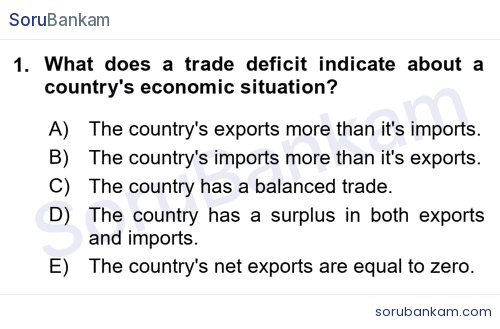
What does a trade deficit indicate about a country's economic situation? A) The country's exports more than it's imports. B) The countrys imports more than it's exports. C) The country has a balanced trade. D) The country has a surplus in both exports and imports. E) The country's net exports are equal to zero.
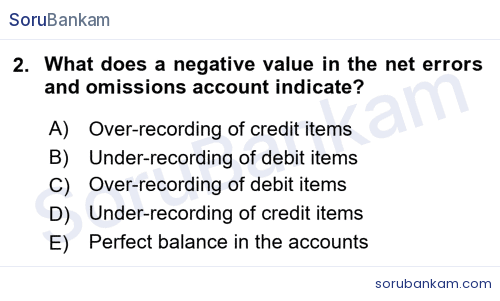
What does a negative value in the net errors and omissions account indicate? A) Over-recording of credit items B) S Under-recording of debit items C) Over-recording of debit items D) Under-recording of credit items E) Perfect balance in the accounts
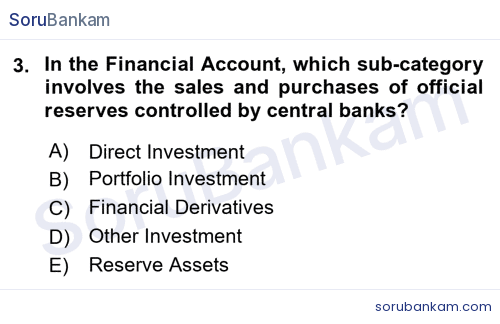
In the Financial Account, which sub-category. involves the sales and purchases of official reserves controlled by central banks? A) Direct Investment B) Portfolio Investment C) Financial Derivatives D) Other Investment E) Reserve Assets
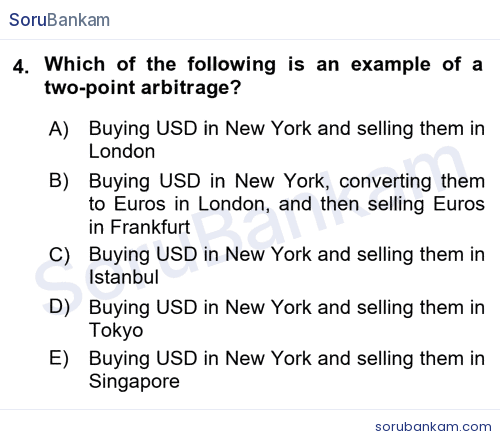
4. Which of the following is an example of a two-point arbitrage? A) Buying USD in New York and selling them in London Buying USD in New York, converting them to Euros in London, and then selling Euros in Frankfurt C) Buying USD in New York'and selling them in Istanbul D) Buying USD in New York and selling them in Tokyo E) Buying USD in New York and selling them in Singapore
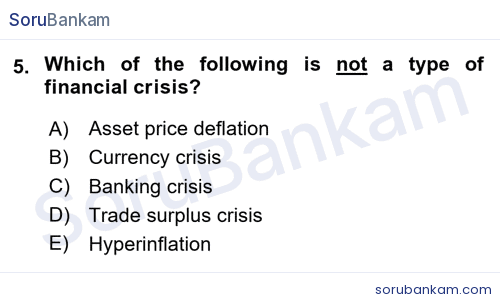
Which of the following is not a type of financial crisis? A) Asset price deflation B) Currency crisis C) Banking crisis D) Trade surplus crisis E) Hyperinflation
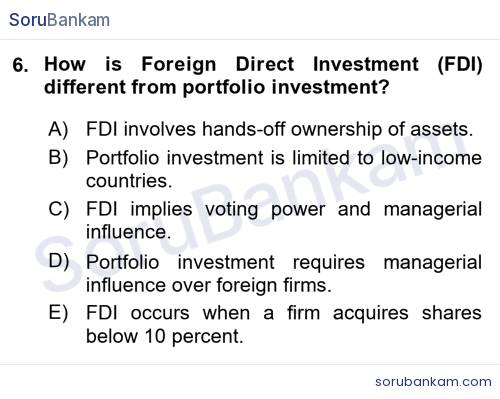
How is Foreign Direct Investment (FDI) different from portfolio investment? A) FDI involves hands-off ownership of assets. B) Portfolio investment is limited to low-income countries. C) FDI implies voting power and managerial influence, D) Portfolio investment requires managerial influence over foreign firms. E) FDI occurs when a firm acquires shares below 10 percent.
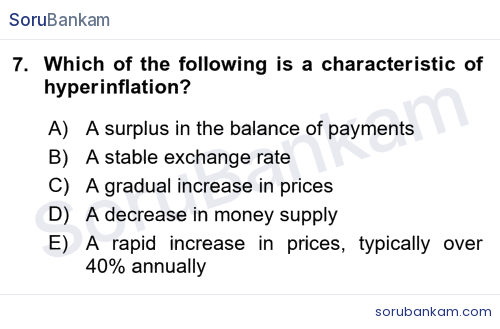
7. Which of the following is a characteristic of hyperinflation? A) A surius'in the balance of payments ¿j. Astable exchange rate A gradual increase in prices D) A decrease in money supply E) A rapid, increase in prices, typically over 40% annually
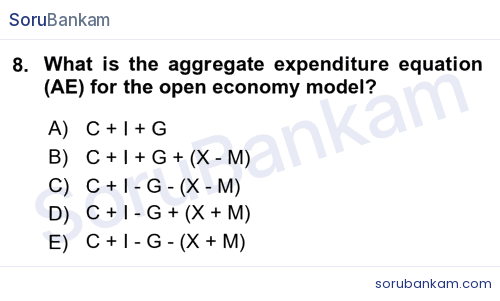
8. What is the aggregate expenditure equation (AE) for the open economy model? A) atI+G+ (X-M) C + |-G-(X-M) D) C + 1-G+ (X+M) E) C+I-G-(+M)
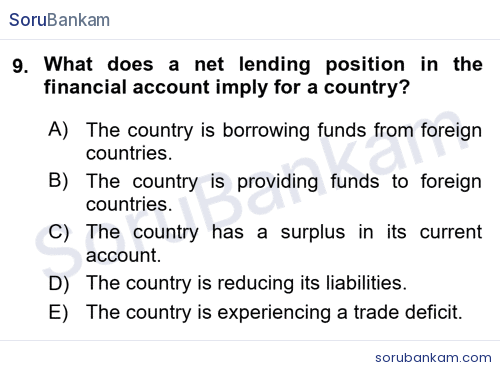
What does a net lending position in thẹ financial account imply for a country? A) The couritry is borrowing funds from foreign countries. B) The country is providing funds to foreign countries. C) The country has a surplus in its current account. D) The country is reducing its liabilities. E) The country is experiencing a trade deficit.
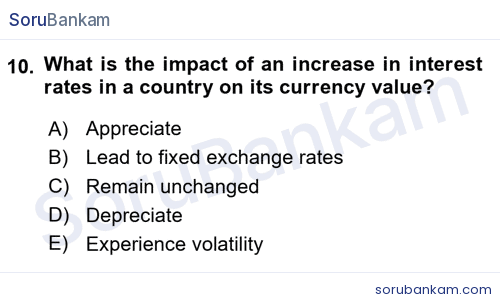
What is the impact of an increase in interest rates in a country on its currency value? A) Appreciate B) Lead to fixed exchange rates C) Remain unchanged D) Depreciate E) Experience volatility
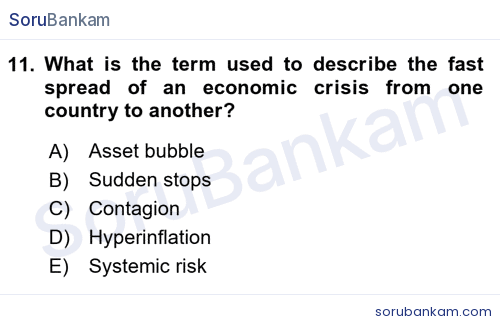
What is the term used to describe the fast spread of an economic crisis from one country to another? A) Asset bubble B) Sudden stops C) Contagion D) Hyperinflation E) Systemic risk
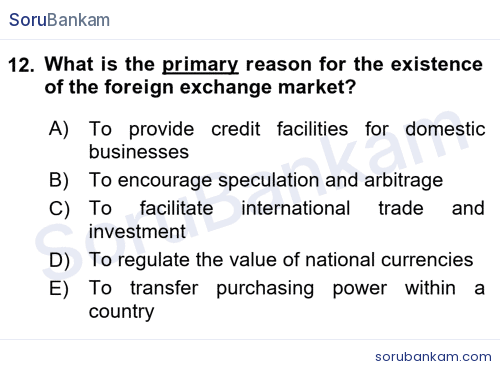
What is the primary reason for the existence of the foreign exchange market? A) To provide credit facilities for domestic businesses B) To encourage speculation and arbitrage. C) To facilitate international trade and investment D) To regulate the value of national currencies E) To transfer purchasing power within a country
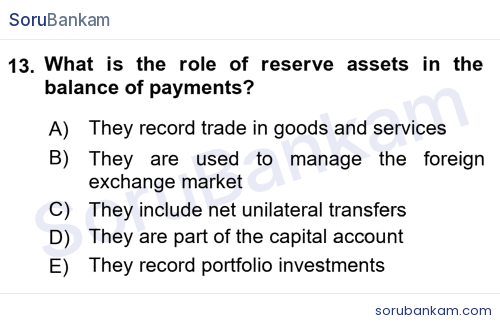
What is the role of reserve assets in the balance of payments? A) They record trade in goods and services B) They are used to manage the foreign exchange market C) They include net unilateral transfers D) They are part of the capital aocount E) They record portfolio investments
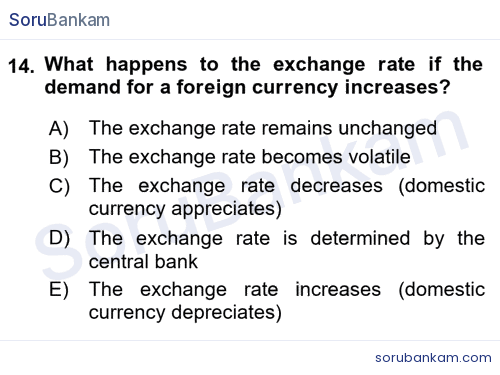
14. What happens to the exchange rate if the. demand for a foreign currency increases? A) The exshange rate remains unchanged The exchange rate decomes volatile C) The exchange rate decreases (domestic currency appreciates) D) The exchange rate is determined by the central bank The exchange rate increases (domestic currency depreciates)
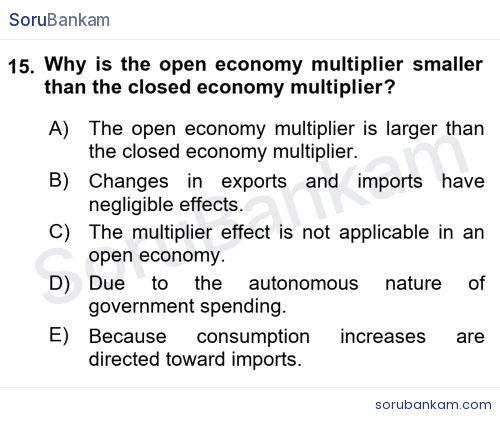
Why is the open economy multiplier smaller than the closed economy multiplier? A) The open economy multiplier is larger than the closed economy multiplier. B) Changes in exports and imports have negligible effects. C) The multiplier effect is not applicable in an open economy. D) Due to the autonomous nature of government spending. E) Because consumption increases are directed toward imports.
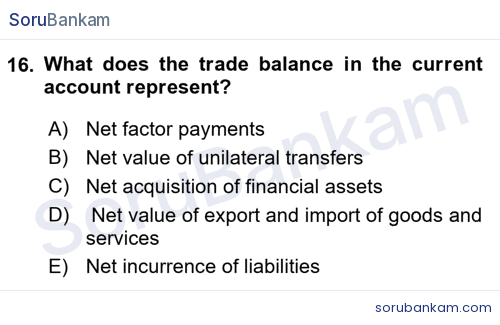
What does the trade balance in the current account represent? A) Net factor payments B) Net value of unilateral transfers C) Net acquisition of financial assets D) Net value of export and import of goods and services E) Net incurrence of liabilities
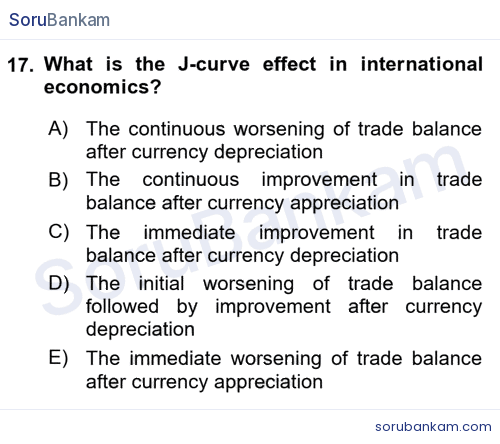
What is the -curve effect in international economics? A) The continuous worsening of trade balance after currency depreciation B) The continuous improvement in trade balance after currency appreciation C) The immediate improvement in trade balanse after currency depreciation D) The initial worsening of trade balance followed by improvement after currency depreciation E) The immediate worsening- of trade balance after currency appreciation
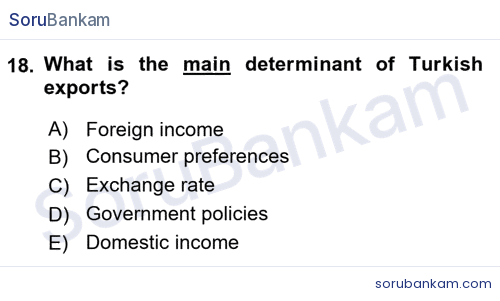
18. What is the main determinant of Turkish exports? A) Foreign income Cyr tönsumer preferences Exchange rate D) Govemment policies E) Domestic income
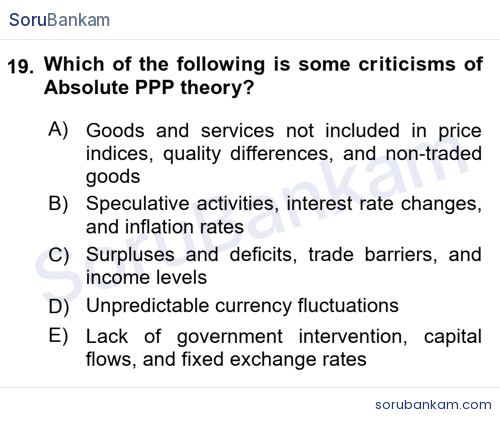
Which of the following is some criticisms of Absolute PPP theory? A) Goods and services not included in price indices, quality differences, and non-traded goods B) Speculative activities, interest rate changes, and inflation rates C) Surpluses and deficits, trade barriers, and income levels D) Unpredictable currency fluctuations E) Lack of govemment intervention, capital flows, and fixed exchange rates
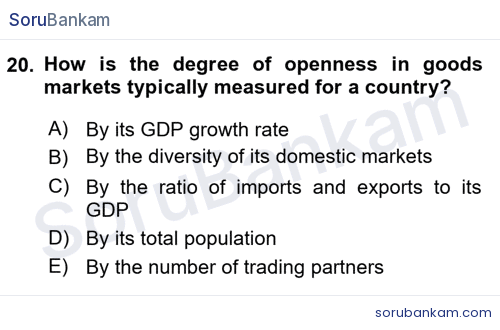
How is the degree of openness in goods markets typically measured for a country? A) By its GDP growth rate B) By the diversity of its domestic markets C) By the ratio of imports and exports to its GDP D) By its total population E) By the number of trading partners