IKT321U Behavioral Economics 2023-2024 Yaz Okulu Soruları
20 soru · Yaz okulu · 2023-2024
IKT321U Behavioral Economics dersinin 2023-2024 yaz okulu sınavı 20 sorudan oluşur; ders AÖF İktisat (İngilizce) bölümünde okutulur. Sorular aşağıda sırasıyla yer alır. Doğru cevaplar ve sonucun, testi çözdüğünde görünür.
Önizleme · 20 soru. Cevaplamak ve sonucunu görmek için sınavı başlat.
Sorular
20 soru
Soru 1
Soru 2
Soru 3
Soru 4
Soru 5
Soru 6
Soru 7
Soru 8
Soru 9
Soru 10
Soru 11
Soru 12
Soru 13
Soru 14
Soru 15
Soru 16
Soru 17
Soru 18
Soru 19
Soru 20

Sınav modunda süre tutulur, doğru cevaplar ve sonucun sınav bitince görünür.
Dersin üniteleri
IKT321U Behavioral Economics ders sayfası: bütün sınavlar ve üniteler
Soruların metni (otomatik okuma)
Görsellerden otomatik okunmuştur; hata içerebilir. Sorular, görsellerdeki hâliyle geçerlidir.
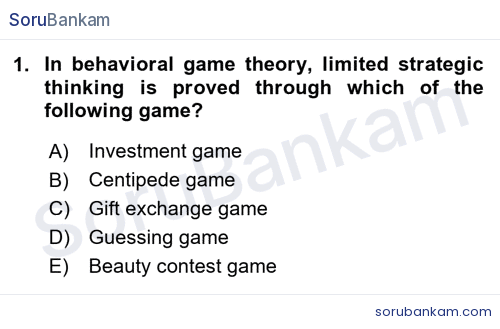
In behavioral game theory, limited strategic thinking is proved through which of the following game? A) Investment game B) Centipede game C) Gift exchange game D) Guessing game E) S Beauty contest game
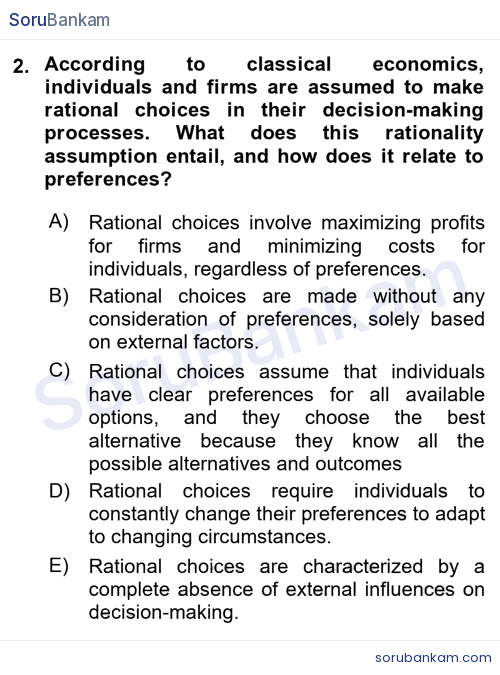
According to classical economics, individuals and firms are assumed to make rational choices in their decision-making processes. What does this rationality assumption entail, and how does it relate to preferences? A) Rational choices involve maximizing profits for firms and minimizing costs for individuals, regardless of preferences. B) Rational choices are made without any consideration of preferences, solely based on external factors. C) Rational choices assume that individuals have clear preferences for all availablen options, and they choose the best alternative because they know all the possible alternatives and outcomes D) Rational choices require individuals to constantly change their preferences to adapt to changing circumstances. E) Rational choices are charatterized by a complete absence of external influences on decision-making.
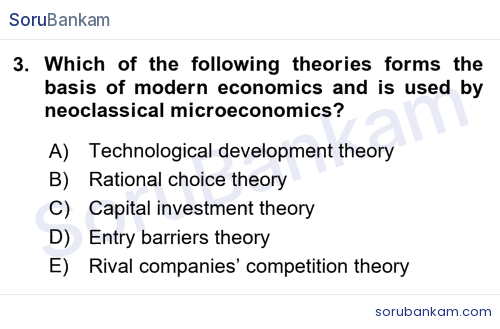
Which of the following theories forms the basis of modern economics and Is used by neoclassical mieroeconomics? A) Technological development theory B) Rational choice theory C) Capital investment theory D) Entry barriers theory E) Rival companies' competition theory
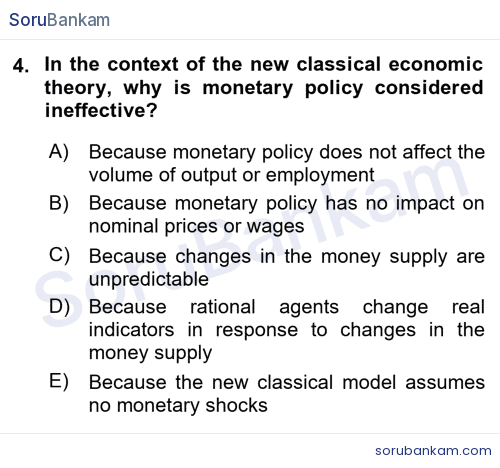
In the context of the new classical economic theory, why Is monetary policy considered ineffective? A) Because monetary policy does not affect the volume of output or employment B) Because monetary policy has no impact on nominal prices or wages C) Because changes in the money supply are unpredictable D) Because rational agents change real indicators in response to changes in the money supply E) Because the new classical model assumes no monetary shocks
The automatic enrollment plan in the Private Pension System Is an example of which choice architecture principle? A) Default options B) Incentives C) Understand mappings D) Expect error E) Structure complex choices
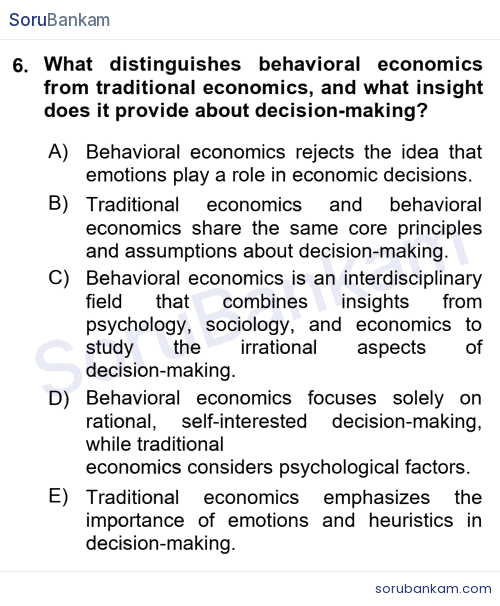
6. What distinguishes behavioral economics from traditional economics, and what insight does it provide abbut decision-making? A) Behavioral economics rejects the idea that emotions play a role in economic decisions. B) Traditional economics and behavioral economics share the same core principles and assumptions about decision-making. C) Bêhavioral economics is an interdisciplinary "'N° field that combines insights from psychology, sociology, and economics to study ..the irrationa, aspects of decision-making. " y. 0). Behavioral economics focuses solely on rational, self-interested decision-making, while traditional economics considers psychological factors. E) Traditional economics emphasizes the • importance of emotions and heuristics in decision-making.
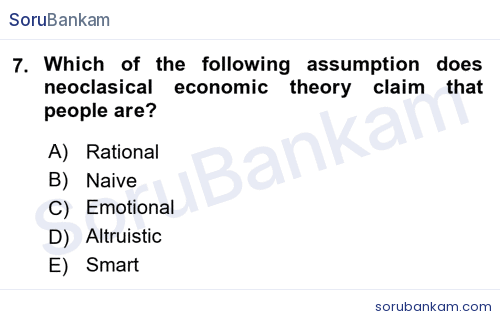
Which of the following assumption does neoclasical economic theory claim that people are? A) Rational B) Naive C) Emotional D) Altruistic E) Smart
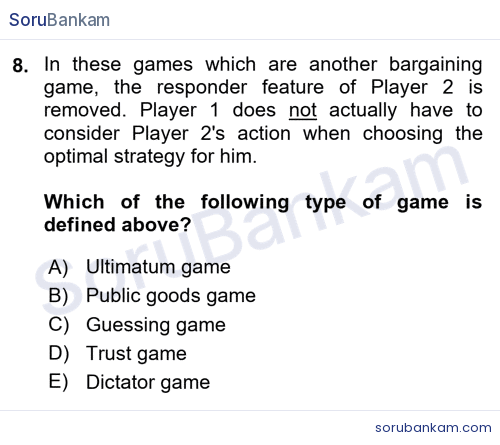
In these games which are another bargaining game, the responder feature of Player 2 is removed. Player 1 does not actually have to consider Player 2's action when choosing the optimal strategy for him: Which of the following type of game is defined above? A) Ultimatum game B) Public goods game C) Guessing game D) Trust game E) Dictator game
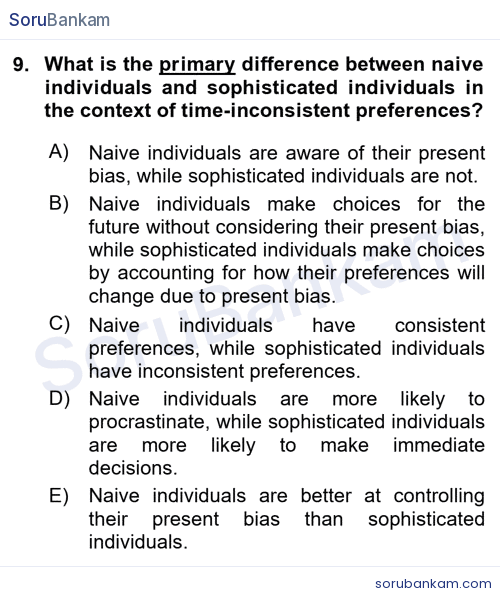
What is the primary difference between naive Individuals and sophisticated individuals in the context of time-inconsistent preferences? A) Naive individuals are aware of their present bias, while sophisticated individuals are not: B) Naive individuals make choices for the future without considering their present bias, while sophisticated individuals make choices by accounting for how their preferences will change due to present bias. C) Naive individuals have consistent preferences, while sophisticated individuals have inconsistent preferences. D) Naive individuals are more likely to procrastinate, while sophisticated individuals are more likely to make immediate decisions: E) Naive individuals are better at controlling their present bias than sophisticated individuals.
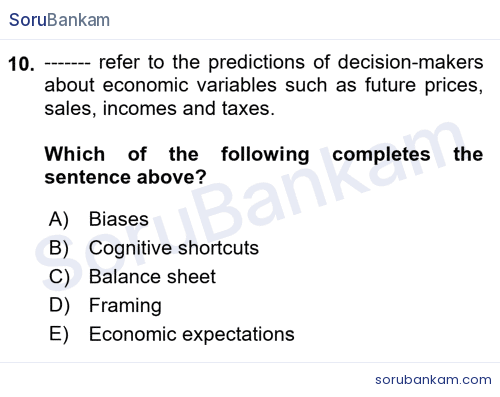
- refer to the predictions of decision-makers about economic variables such as future prices, sales, incomes and taxes. Which of the following completes the sentence above? A) Biases B) Cognitive shortcuts C) Balance sheet D) Framing E) Economic expectations
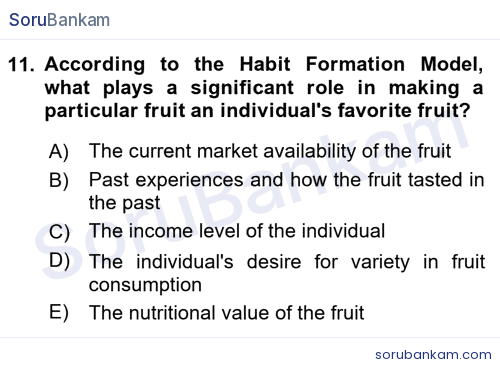
11. According to the Habit Formation Model, what plays a significant role in making a particular fruit art individual's favortte fruit? A) The current market availability of the fruit B) Past experiences and how the fruit tasteg in the past C) The income level of the individual D) The individual's desire for variety in fruit consumption The nutritional value of the fruit
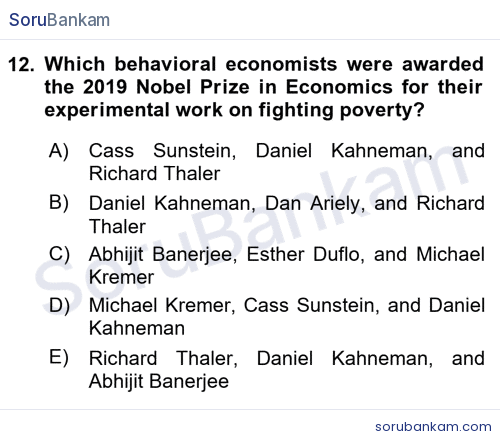
Which behavioral economists were awarded the 2019 Nobel Prize in Economics for their experimental work on fighting poverty? A) Cass Sunstein, Daniel Kahneman, and Richard Thaler B) Daniel Kahneman, Dan Ariely, and Richard Thaler C) Abhijit Banerjee, Esther Duflo, and Michael Kremer D) Michael Kremer, Cass Sunstein, and Daniel Kahneman E) Richard Thaler, Daniel Kahneman, and Abhijit Banerjee
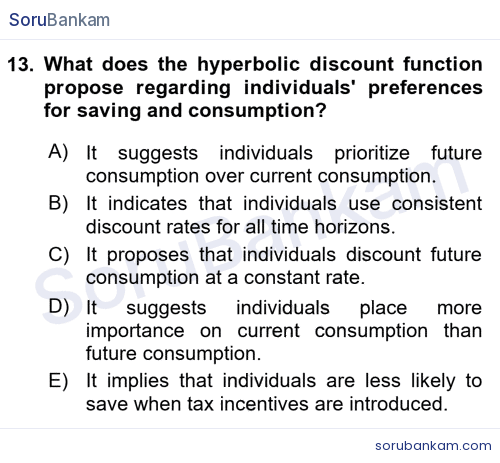
What does the hyperbolic discount function propose regarding Individuals preferences for saving and consumption? A) It suggests individuals prioritize future consumption over current consumption. (" B) It indicates that individuals use consistent discount rates for all time horizons. C) It proposes that individuals discount future consumption at a constant rate. D) It suggests individuals place more importance on current consumption than future consumption. E) It implies that individuals are less likely to save when tax incentives are introduced.
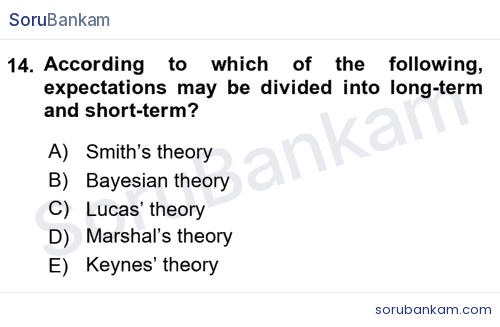
According to which of the following, expectatlons may be divided Into long-term and short-term?? A) Smith's theory B) " B) Bayesian theory C) Lucas' theory D) Marshal's thooly E) Keynes' theory
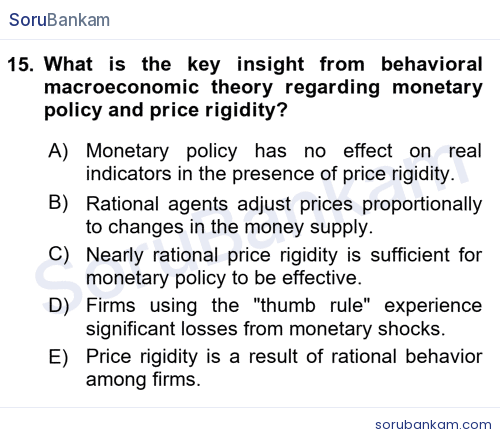
What is the key insight from behavioral. macroeconomic theory regarding monetary policy and price rigidity? A) Monetary policy has no effect on real indicators in the presence of price rigidity. B) Rational agents adjust prices proportionally to changes in the money supply. C) Nearly rational price rigidity is sufficient for monetary policy to be effective. D) Firms using the "thumb rule" experience significant losses from monetary shocks. E) Price rigidity is a result of rational behavior among firms.
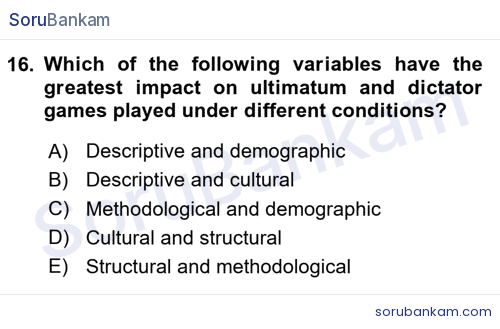
Which of the following variables have the greatest Impact on ultimatum and dictator games played under different conditions? A) Descriptive and demographic B) Descriptive and cultural C) Methodological and demographic D) Cultural and structural E) Structural and methodological
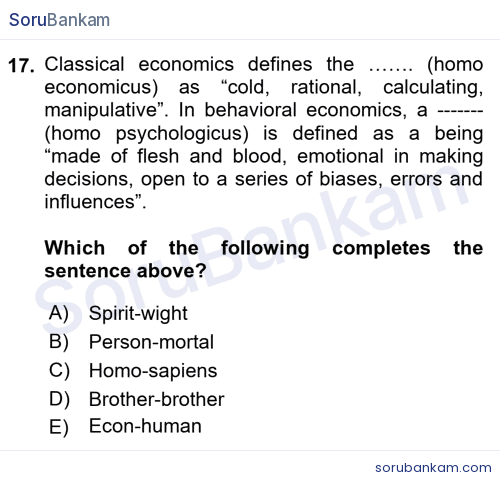
Classical economics defines the ..... (homo economicus) as "cold, rational, calculating, manipulative". In behavioral economics, a — (homo psychologicus) is defined as a being "made: of flesh and blood, emotional in making declsions, open to a series of biases, errors and influences". Which of the following completes the sentence above? A) Spirit-wight B) Person-mortal C) Homo-sapiens D) Brother-brother E) Econ-human
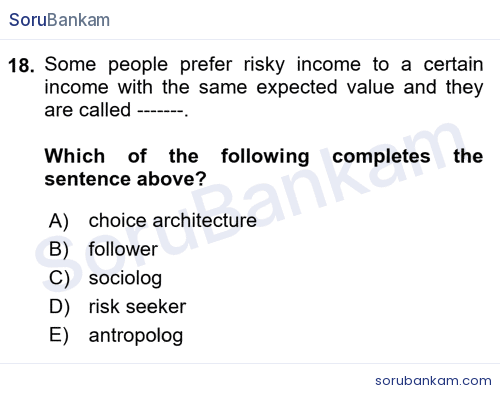
Some people prefer risky income to a certain. income with the same expected value and they are called — Which of the following completes the sentence above? A) choice architecture B) follower • 1% C) sociolog D) risk seeker E) antropolog
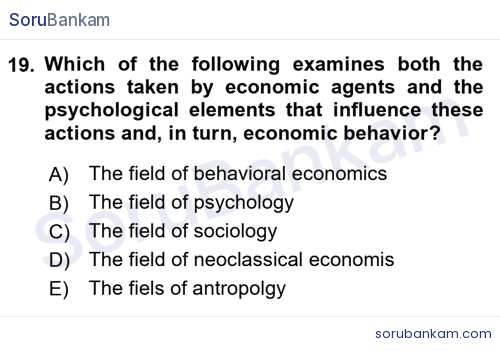
Which of the following examines both the actions taken by economic agents and the psychologicai elements that influence these actions and, in turn, economic behavior? A) The field of behavioral economics B) The field of psychology C) The field of sociology D) The field of neoclassical economis E) The fiels of antropolgy
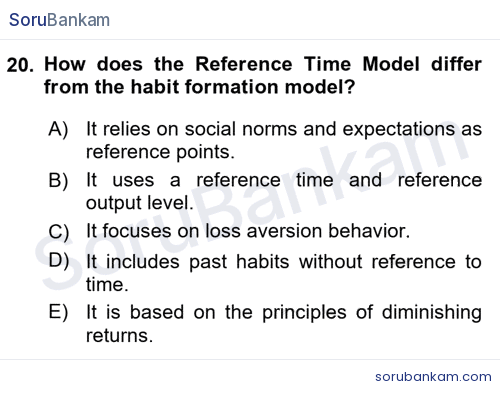
How does the Reference Time Model differ from the habit formation model? A) It relies on social norms and expectations as reference points. B) It uses a reference time and reference output level. C) It focuses on loss aversion behavior. D) It includes past habits without reference to time. E) It is based on the principles of diminishing returns.