IKT321U Behavioral Economics 2024-2025 Final Soruları
20 soru · Final · 2024-2025
IKT321U Behavioral Economics dersinin 2024-2025 final sınavı 20 sorudan oluşur; ders AÖF İktisat (İngilizce) bölümünde okutulur. Sorular aşağıda sırasıyla yer alır. Doğru cevaplar ve sonucun, testi çözdüğünde görünür.
Önizleme · 20 soru. Cevaplamak ve sonucunu görmek için sınavı başlat.
Sorular
20 soru
Soru 1
Soru 2
Soru 3
Soru 4
Soru 5
Soru 6
Soru 7
Soru 8
Soru 9
Soru 10
Soru 11
Soru 12
Soru 13
Soru 14
Soru 15
Soru 16
Soru 17
Soru 18
Soru 19
Soru 20
Sınav modunda süre tutulur, doğru cevaplar ve sonucun sınav bitince görünür.
Dersin üniteleri
IKT321U Behavioral Economics ders sayfası: bütün sınavlar ve üniteler
Soruların metni (otomatik okuma)
Görsellerden otomatik okunmuştur; hata içerebilir. Sorular, görsellerdeki hâliyle geçerlidir.
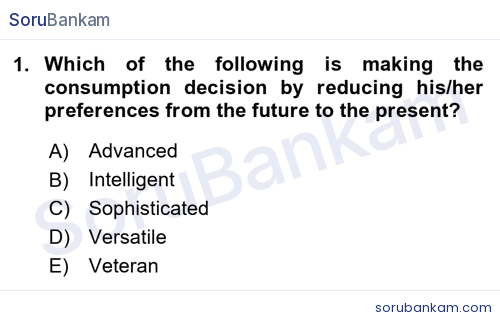
Which of the following is making the consumption decison by reducing his/her preferences from the future to the present? A) Advanced B) Intelligent C) Sophisticated D) Versatile E) Veteran
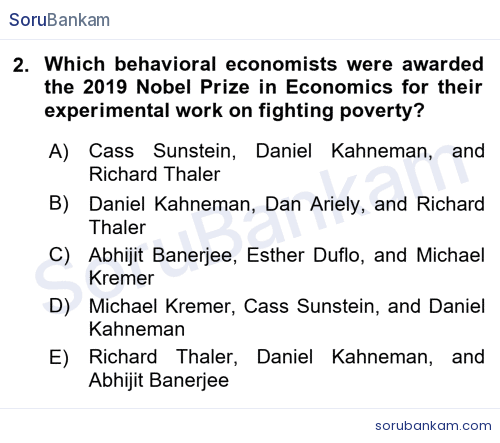
2. Which behavioral economists were awarded the 2019 Nobel Prize in Economics for their experimental work on fighting poverty? A) Cass Sunstein, Daniel Kahneman, and Richard Thaler B) Daniel Kahneman, Dan Ariely, and Richard Thaler C) Abhijit Banerjee, Esther Duflo, and Michael Kremer D) Michael Kremer, Cass Sunstein, and Daniel Kahneman Richard Thaler, Daniel Kahneman, and Abhijit Banerjee
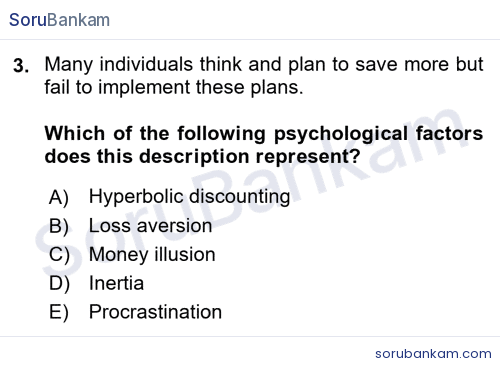
Many individuals think and plan to save more put fail to implement these plans. Which of the following psychological factors does this description represent? A) Hyperbolic discounting B) Loss aversion C) Money illusion / V' D) Inertia E) Procrastination
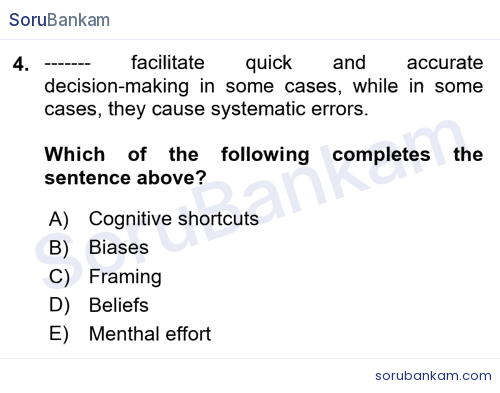
facilitate quick and accurate, decision-making in some cases, while in some cases, they cause systematic errors. Whicht" of the following completes the ¡sentence above? A) Cognitive shortcuts B) Biases C) Framing D) Beliefs E) Menthal effort
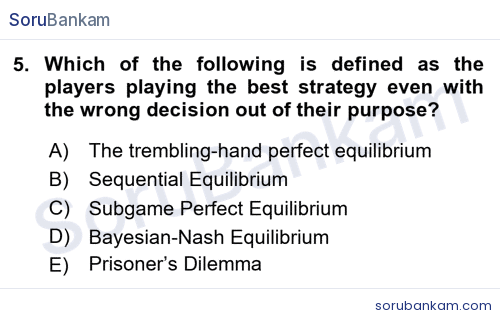
Which of the following is defined as the players playing the best strategy even with the wrong decision out of their purpose? A) The trembling-hand perfect equilibrium B) Sequential Equilibrium C) Subgame Perfect Equilibrium D) Bayesian-Nash Equilibrium E) Prisoners Dilemma
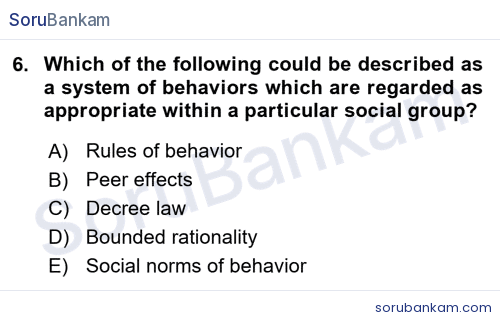
Which of the following could be described as a system of behavlors which are regarded as appropriate within a particular social group? A) Rules of behavior B) Peer effects C) Decree law D) Bounded rationality E) Social norms of behavior
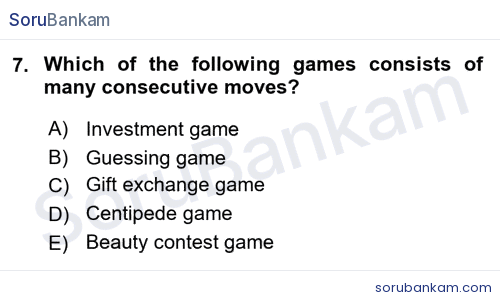
Which of the following games consists of many consecutive moves? A) Investment game B) Guessing game C) Gift exchange game D) Centipede game. E) Beauty contest game
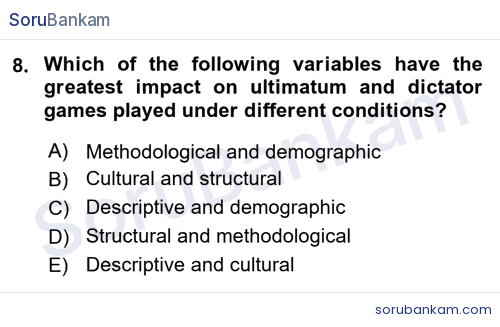
Which of the following variables have the greatest impact on ultimatum and dictator games played under different conditions? A) Methodological and demographic B) INBy Cultural and structural C) Descriptive and demographic D) Structural and methodological E) Descriptive and cultural
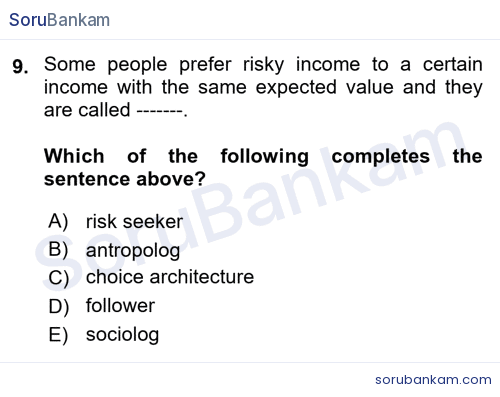
Some people prefer risky income to a certain income with the same expected value and they are called - Which of the following completes the sentence above? A) risk seeker B) antropolog C) cholce architecture D) follower E) sociolog
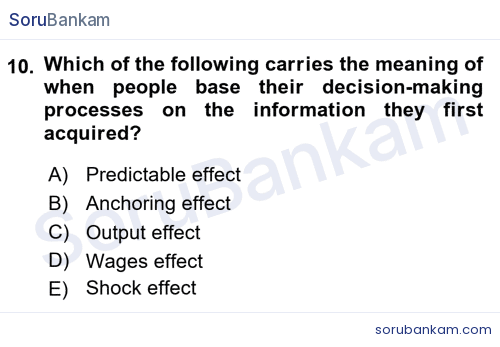
Which of the following carries the meaning of when people base their decision-making processes on the information they first acquired? A) Predictable effect B) Anchoring effect C) Output effect D) Wages effect E) Shock effect
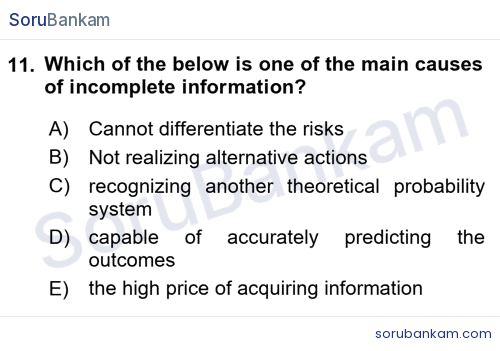
Which of the below is one of the main causes of incomplete information? A) Cannot differentiate the risks B) Not realizing alternative actions C) recognizing another theoretical probability system D) capable of accurately predicting the outcomes E) the high price of acquiring information
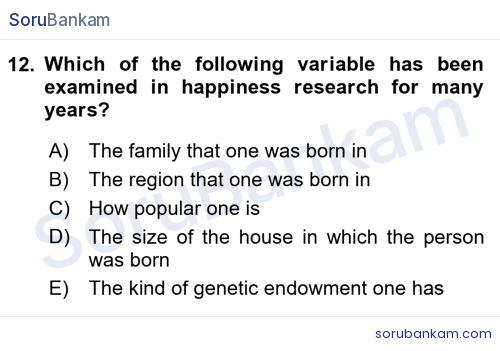
Which of the following variable has been examined in happiness research for many years? A) The family that one was born B) The region that one was born C) How popular one D) The size of the house in which the person was born E) The kind of genetic endowment one has
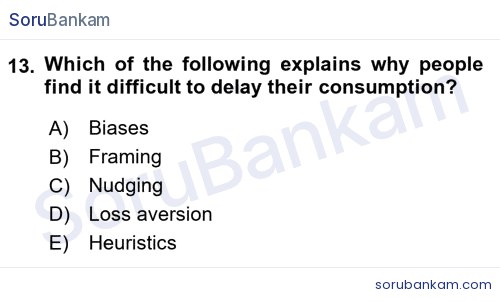
Which of the following explains why people find it difficult to delay their consumption? A) Biases B) Framing C) Nudging D) Loss aversion E) Heuristics
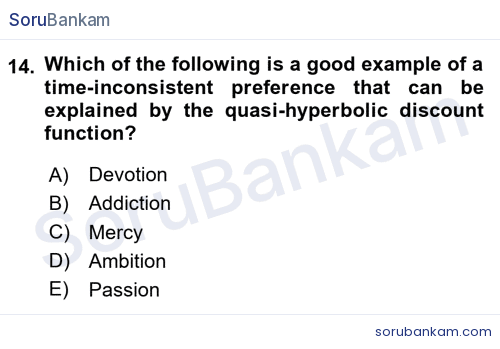
Which of the following is a good example of a time-inconsistent preference that can be explained by the quasi-hyperbolic discount function? A) Devotion B) Addiction C) Mercy D) Ambition E) Passion
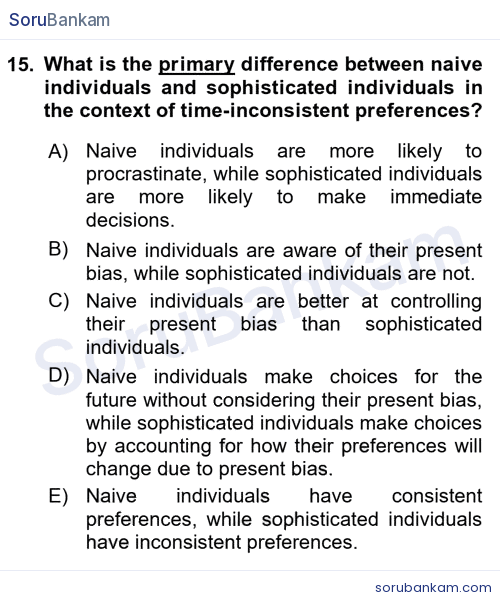
What is the primary difference between naive individuals and sophisticated individuals In the context of time-inconsistent preferences? A) Naive individuals are more likely to procrastinate, while sophisticated individuals. are more likely to make immediate decisions. B) Naive individuals are aware of their present bias, while sophisticated individuals are not. C) Naive individuals are better at controlling their present bias than sophisticated individuals. D) Naive individuals wake choices for the future without considering their present bias, while sophisticated individuals make choices by accounting for how their, Preferences will change due to present pids. E) Naive individuals have consistent •preferences, while sophisticated individuals have inconsistent preferences.
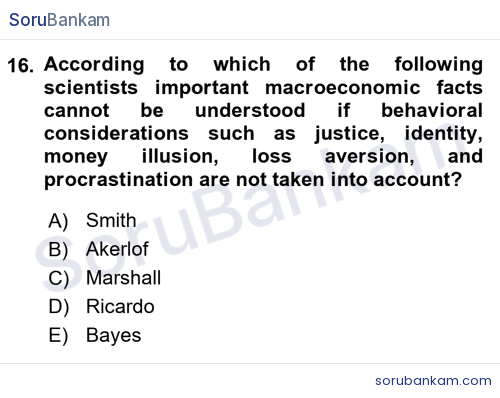
According to which of the following scientists important macroeconomic facts cannot be understood behavioral consideratións such as justice, identity, money " illusion, loss aversion, and ex procrastination are not taken into account? A) Smith B) Akerlot C) Marshall D) Ricardo E) Bayes
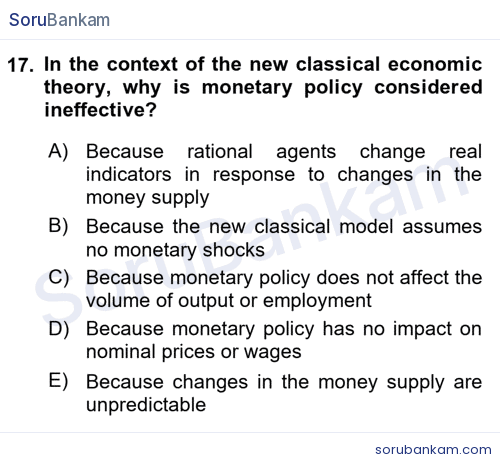
In the context of the new classical economic theory, why is monetary policy considered ineffective? A) Because rational agents change real indicators in response to changes in the money supply B) Because the new classical model assumes no monetary shocks C) Because monetary policy does not affect the volume of output or employment D) Because monetary policy has no impact on nominal prices or wages E) Because changes in the money supply are unpredictable
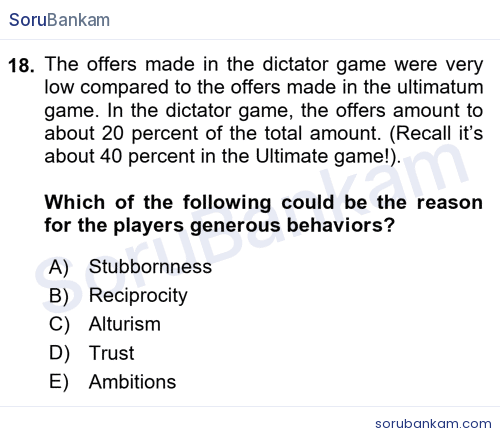
The offers made in the dictator game were very low compared to the offers made in the ultimatum game. In the dictator game, the offers amount to about 20 percent of the total amount. (Recall it's about 40 percent in the Ultimate game!). Which of the following could be the reason for the players generous behaviors? A) Stubbornness B) Reciprocity C) Alturism D) Trust E) Ambitions
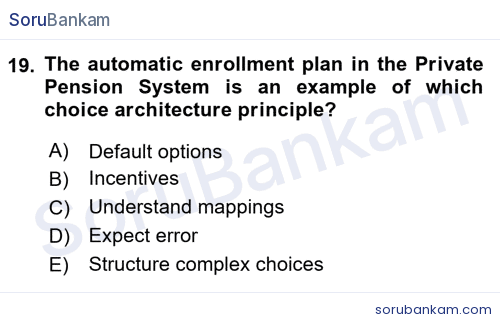
The automatic enrollment plan in the Private Pension System is an example of which choice architecture principle? A) Default options B) Incentives C) Understand mappings D) Expect error E) Structure complex choices
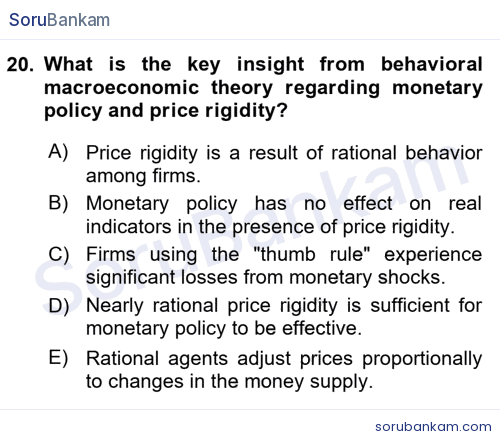
What is the key insight from behavioral. macroeconomic theory regarding monetary policy and price rigidity? A) Price rigidity is a result of rational behavior among firms. B) Monetary policy has no effect oh • real indicators in the presence of price rigidity. C) Firms using the "thumb rule" experience significant losses from monetary shocks. D) Nearly rational price rigidity is sufficient for monetary policy to be effective. E) Rational agents adjust prices proportionally to changes in the money supply.