IKT321U Behavioral Economics 2024-2025 Vize Soruları
20 soru · Vize · 2024-2025
IKT321U Behavioral Economics dersinin 2024-2025 vize sınavı 20 sorudan oluşur; ders AÖF İktisat (İngilizce) bölümünde okutulur. Sorular aşağıda sırasıyla yer alır. Doğru cevaplar ve sonucun, testi çözdüğünde görünür.
Önizleme · 20 soru. Cevaplamak ve sonucunu görmek için sınavı başlat.
Sorular
20 soru
Soru 1
Soru 2
Soru 3
Soru 4
Soru 5
Soru 6
Soru 7
Soru 8
Soru 9
Soru 10
Soru 11
Soru 12
Soru 13
Soru 14
Soru 15
Soru 16
Soru 17
Soru 18
Soru 19
Soru 20
Sınav modunda süre tutulur, doğru cevaplar ve sonucun sınav bitince görünür.
Dersin üniteleri
IKT321U Behavioral Economics ders sayfası: bütün sınavlar ve üniteler
Soruların metni (otomatik okuma)
Görsellerden otomatik okunmuştur; hata içerebilir. Sorular, görsellerdeki hâliyle geçerlidir.
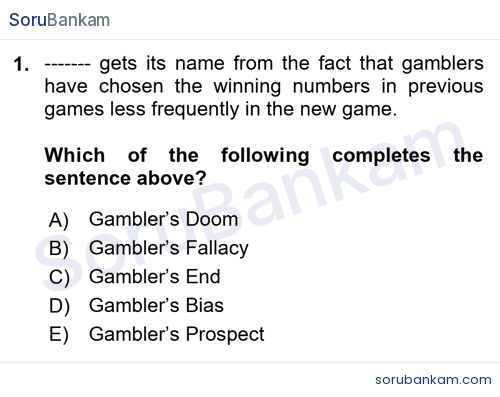
.. gets its name from the fact that gamblers have chosen the winning numbers in previous games less frequently In the new game. Which of the following completes the sentence above? A) Gambler's Doom B) Gambler's Fallacy C) Gambler's End D) Gambler's Bias E) Gambler's Prospect
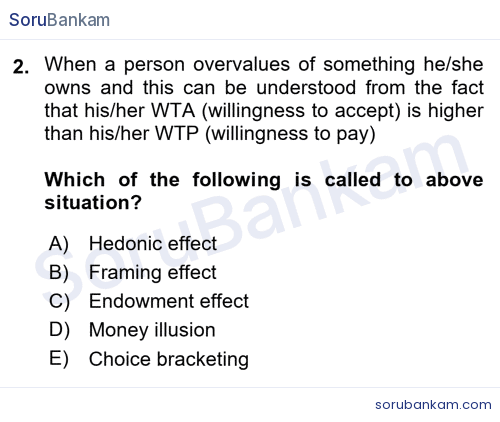
When a person overvalues of something he/she owns and this can be understood from the fact that his/her WTA (willingness to accept) is higher than his/her WTP (Willingness to pay) Which of the following is called to above situation? A) Hedonic effect B) Framing effect C) Endowment effect D) Money illusion E) Choice bracketing
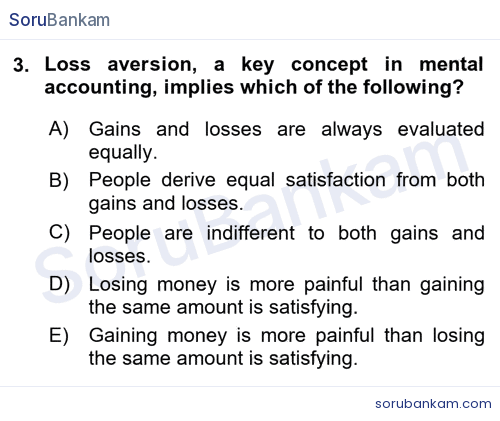
Loss aversion, a key concept in menta accounting, implies which of the following! A) Gains and losses are always evaluated equally. B) People derive equal satisfaction from bott gains and losses. C) People are indifferent to both gains and losses. D) Losing money is more painful than gaining; the same amount is satisfying. E) Gaining mopey is more painful than losing the same amount is satisfying.
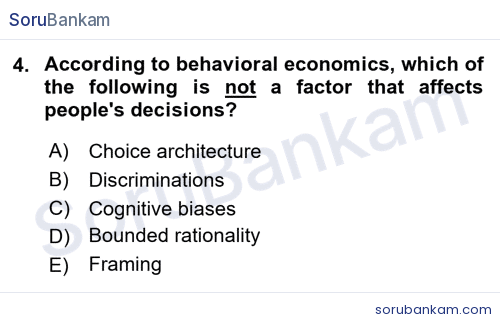
According to behavioral economics, which of the following is not a factor that affects people's decisions? A) Choice architecture B) Discriminations C) Cognitive biases D) Bounded rationality E) Framing
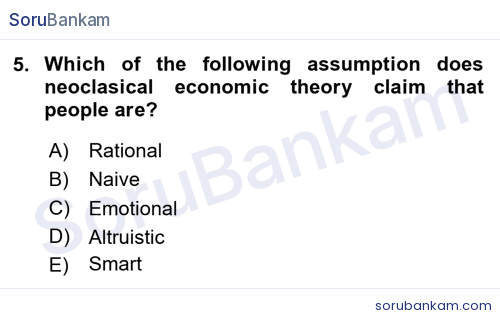
Which of the following assumption does neoclasical economic theory claim that people are? A) Rational B) Naive C) Emotional D) Altruistic E) Smart
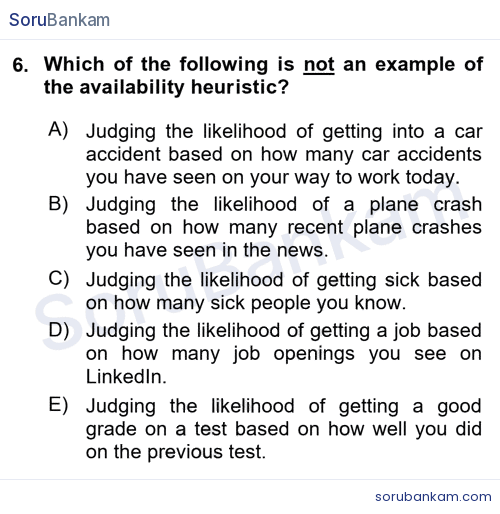
Which of the following is not an example of the availability heuristic? A) Judging the likelihood of getting into a car accident based on how many car accidents you have seen on your way to work todaye! B) Judging the likelihood of a plane crash based on how many recent plane crashes you have seen in the news. C) Judging the likelihood of getting sick based on how many sick people you know. D) Judging the likelihood of getting a job based on how many job opgoings you see on Linkedin. E) Judging the likelihood of getting a good grade on a test based on how well you did on the previoys test.
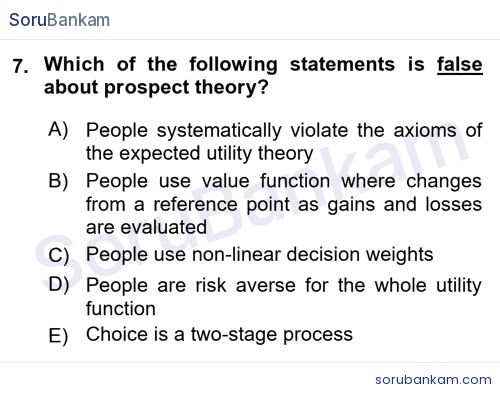
7. Which of the following statements is false about prospect theory? People systematically violate the axioms of the expected utility theory People use value function where changes from a reference point as gains and losses are evaluated C) Pepple use non-linear decision weights Di Péople are risk averse for the whole utility function E) Choice is a two-stage process
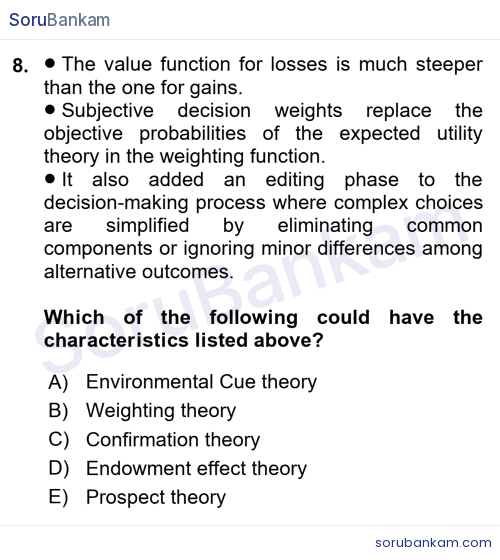
• The value function for losses is much steeper than the one for gains. • Subjective decision weights replace the objective probabilities of the expected utility theory in the weighting function. • It also added an editing phase to the decision-making process where complex choices are simplified by eliminating common components or ignoring minor differences among alternative outcomes. Which of the following could have the characteristics listed above? A) Environmental Cue theory B) Weighting theory C) Confirmation theory D) Endowment effect theory E) Prospect theory
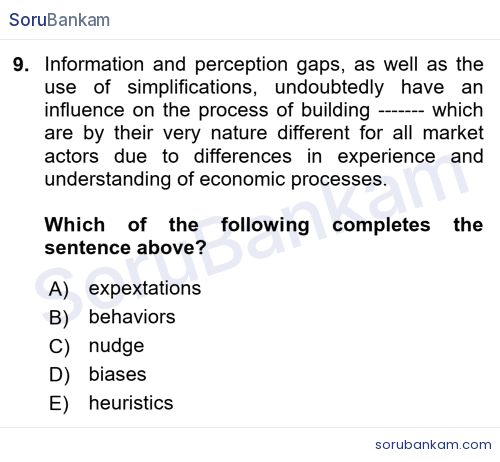
Information and perception gaps, as well as the use of simplifications, undoubtedly have an influence on the process of building -- which are by their very nature different for all market actors due to differences in experience and understanding of economic processes. Which of the following completes the sentence above? A) expextations B) behaviors C) nudge D) biases E) heuristics
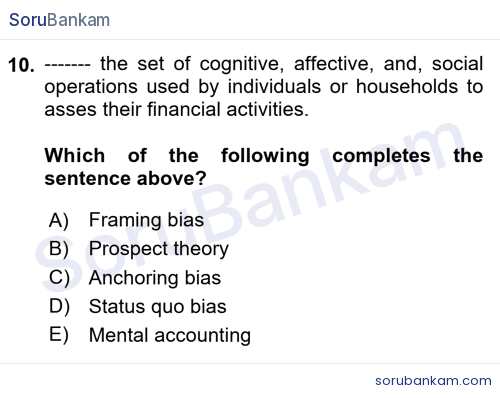
— the set of cognitive, affective, and, social operations used by individuals or households to asses their financial activities. Which of the following completes the sentence above? A) Framing bias B) Prospect theory C) Anchoring bias D) Status quo bias E) Mental accounting
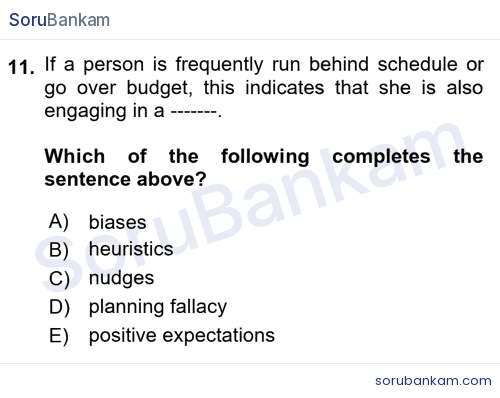
11. If a person is frequently run behind schedule on go over budget, this indicates that shę is also engaging in a — Which of the following completes the sentence above? A) biases C), nudges • D) planning fallacy E) positive expectations
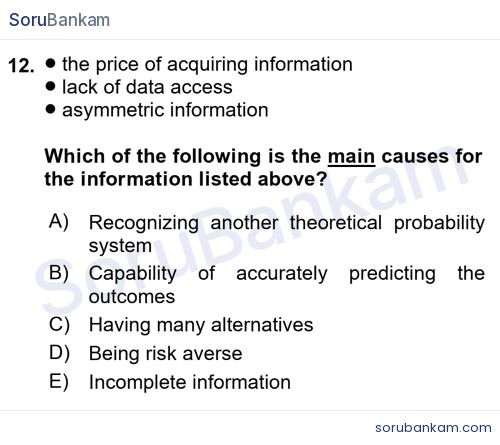
12. • the price of acquiring information • lack of data access • asymmetric information Which of the following is the main causes for the information listed above? A) Recognizing another theoretical probability system Capability of accurately predicting the outcomes C) Having many alternatives D) Being risk averse E) Incomplete information
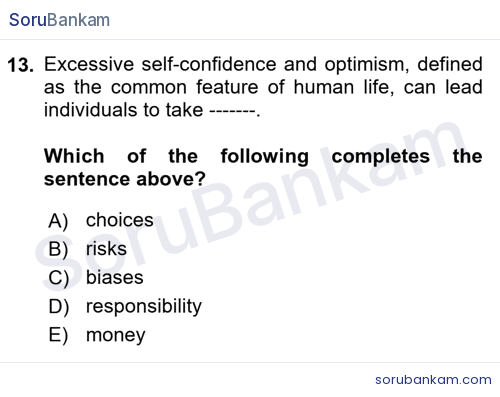
Excessive self-confidence and optimism, defined as the common feature of human life, can lead individuals to take -__. Which of the following completes the sentence above? A) choices B) risks C) biases D) responsibility E) money
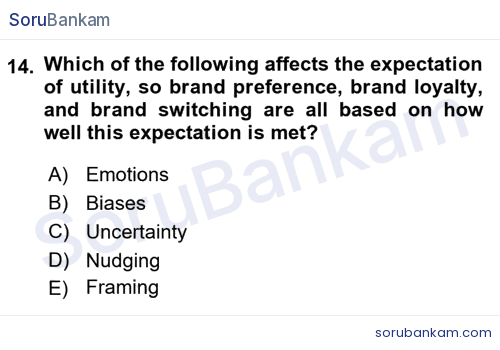
Which of the following affects the expectation of utility, so brand preference, brand loyalty, and brand switching are all based on how well this expectation is met? A) Emotions B) Biases C) Uncertainty D) Nudging E) Framing
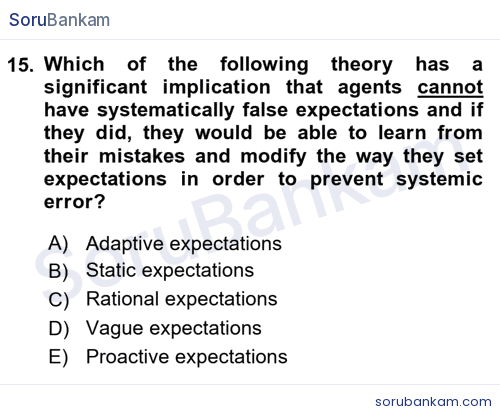
Which of the following theory has significant implication that agents cannot have systematically false expectations and if they did, they would be able to learn from their mistakes and modify the way they set expectations in order to prevent systemic error? A) Adaptive expectations B) Static expectations C) •+ VC) Rational expectations D) Vague expectations E) Proactive expectations
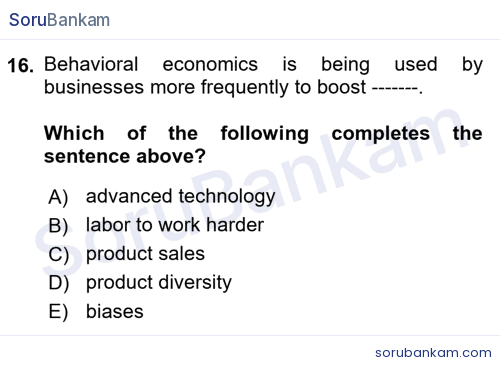
Behavioral economics is being used by businesses more frequently to boost-.... Which of the following completes the senterice above? A) advanced technology B) labor to work harder C) product sales D) product diversity E) biases
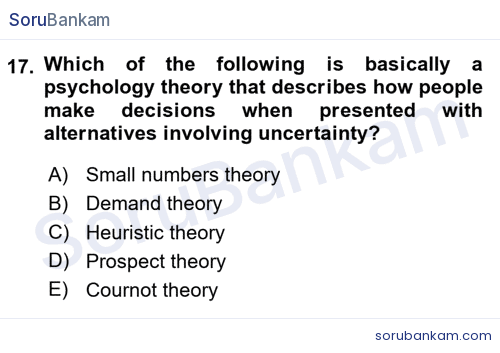
Which of the following is basically a psychology theory that describes how people make decisions when presented with alternatives involving uncertainty? A) Small numbers theory B) Demand theory C) Heuristic theory D) Prospect theory E) Cournot theory
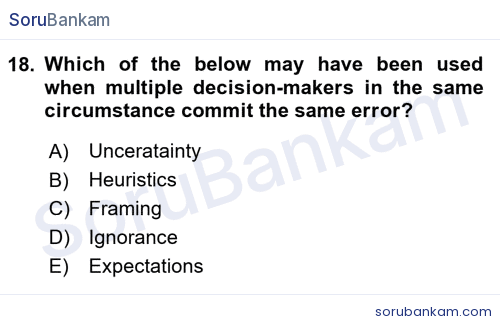
Which of the below may have been used when multiple decislon-makers in the same circumstance commit the same error? A) Unceratainty B) Heuristics C) Framing D) Ignorance E) Expectations
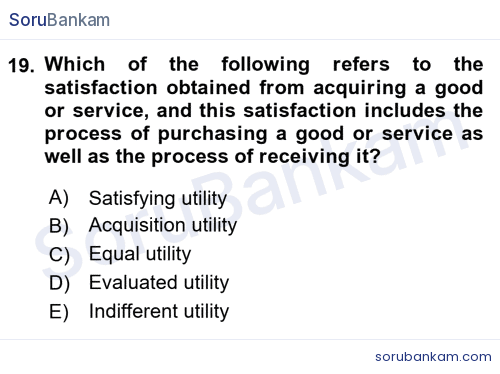
Which of the following refers to the satisfaction obtained from acquiring a good or service, and this satisfaction includes the process of purchasing a good or service as well as the process of receiving it? A) Satisfying utility B) Acquisition utility C) Equal utility D) Evaluated utility E) Indifferent utility
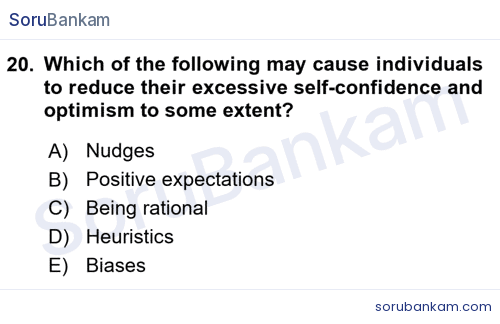
Which of the following may cause individuals to reduce their excessive self-confidence and optimism to some extent? A) Nudges B) Positive expectations C) Being rational D) Heuristics E) Biases