IKT321U Behavioral Economics 2023-2024 Vize Soruları
20 soru · Vize · 2023-2024
IKT321U Behavioral Economics dersinin 2023-2024 vize sınavı 20 sorudan oluşur; ders AÖF İktisat (İngilizce) bölümünde okutulur. Sorular aşağıda sırasıyla yer alır. Doğru cevaplar ve sonucun, testi çözdüğünde görünür.
Önizleme · 20 soru. Cevaplamak ve sonucunu görmek için sınavı başlat.
Sorular
20 soru
Soru 1
Soru 2
Soru 3
Soru 4
Soru 5
Soru 6
Soru 7
Soru 8
Soru 9
Soru 10
Soru 11
Soru 12
Soru 13
Soru 14
Soru 15
Soru 16
Soru 17
Soru 18
Soru 19
Soru 20
Sınav modunda süre tutulur, doğru cevaplar ve sonucun sınav bitince görünür.
Dersin üniteleri
IKT321U Behavioral Economics ders sayfası: bütün sınavlar ve üniteler
Soruların metni (otomatik okuma)
Görsellerden otomatik okunmuştur; hata içerebilir. Sorular, görsellerdeki hâliyle geçerlidir.
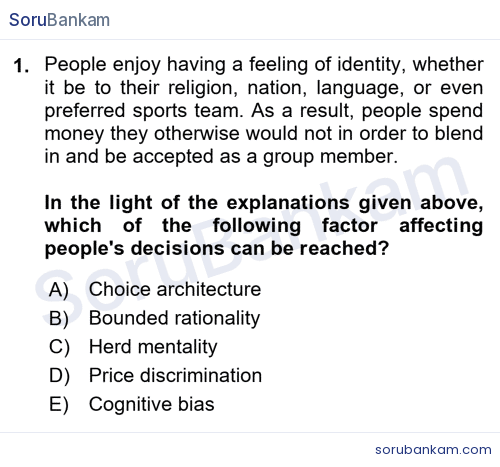
People enjoy having a feeling of identity, whether it be to their religion, nation, language, or even preferred sports team. As a result, people spend money they otherwise would not in order to blend in and be accepted as a group member. In the light of the explanations given above, which of the following factor affecting people's decisions can be reached? A) Choice architecture B) Bounded rationality C) Herd mentality D) Price discrimination E) Cognitive bias
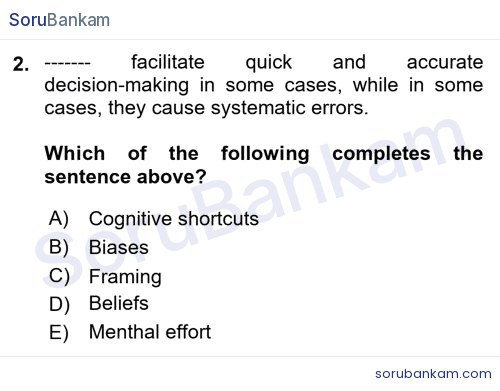
facilitate quick and accurate decision-making in some cases, while in some cases, they cause systematic errors. Which of the following completes the sentence above? A) Cognitive shortcuts B) Biases C) Freming D) Beliefs E) Menthal effort
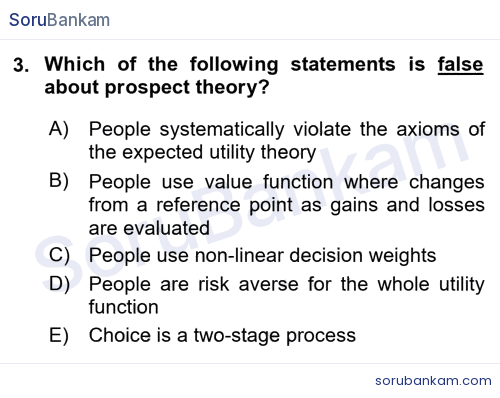
Which of the following statements is false about prospect theory? A) People systematically kjolate the axioms of the expected utility theory B) People use value function where changes from a reference point as gains and losses are evaluated C) People use non-linear, decision weights D) People are risk averse for the whole utility function E) Choice is a two-stage process
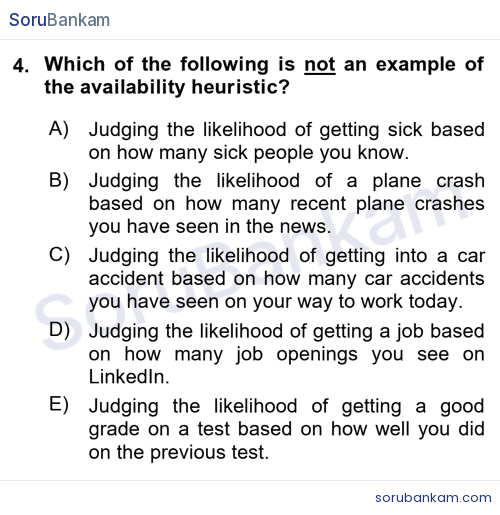
4. Which of the following is not an example of the availability heuristic? A) Judging the likelihood of getting sick based on how many sick people you know. Judging the likelihood of a plane crash based on how many recent plane crashes you have seen in the news. C) Judging the likelihood of getting into a car accident based on how many car accidents you have seen on your way to work today. D) Judging the likellhood of getting a job based on how many job openings you see on Linkedin. E) Judging the likelihood of getting a good grade on a test based on how well you did on the previous test.
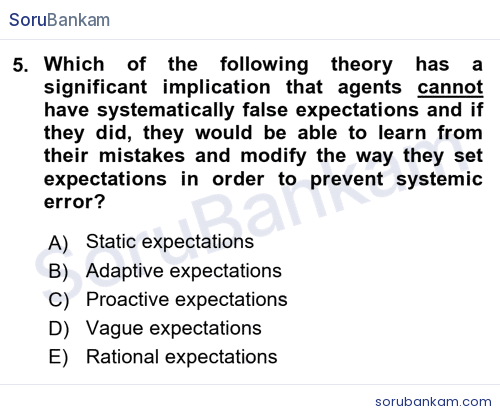
Which of the following theory has significant implication that agents cannot have systematically false expectations and if they did, they would be able to learn from their mistakes and modify the way they set expectations in order to prevent systemić error? A) Static expectations B) Adaptive expectations C) Proactive expectations D) Vague expectations E) Rational expectations
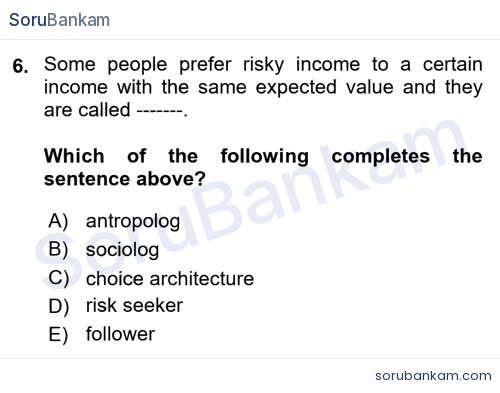
6. Some people prefer risky income to a certain income with the same expected value and they are called - Whick the following completes the , sentence above? A) antropolog B) sociolog" c) aholce architecture . *D) risk seeker E) follower
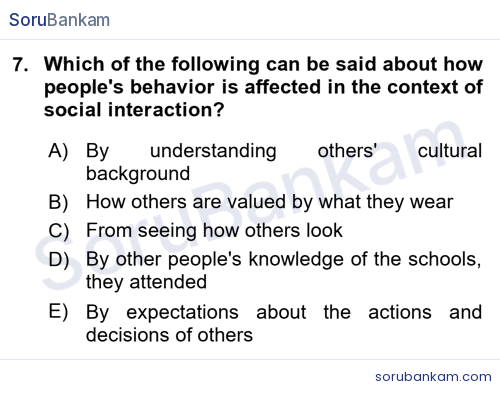
Which of the following can be said about how people's behavior is affected in the context of soclal interaction? A) By understanding others' cultural background B) How others are valued by what they wear C) From seeing how others look D) By other people's knowledge of the schools, they attended E) By expectations about the actions and decisions of others
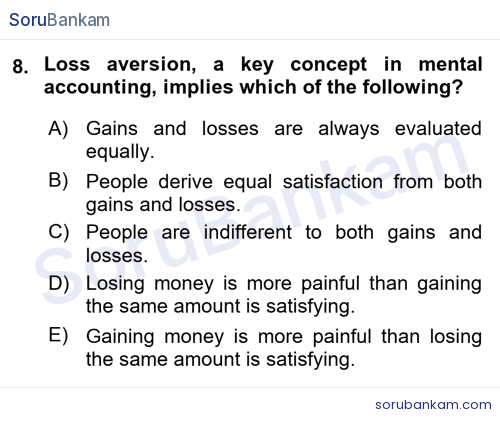
Loss aversion, a key concept in mental. accounting, implies which of the following? A) Gains and losses are always evaluated equally. B) People derive equal satisfaction from both gains and losses. C) People are indifferent to both gains and losses. D) Losing money is more painful than gaining the same amount is satisfying. E) Gaining money is more painful than losing the same amount is satisfying.
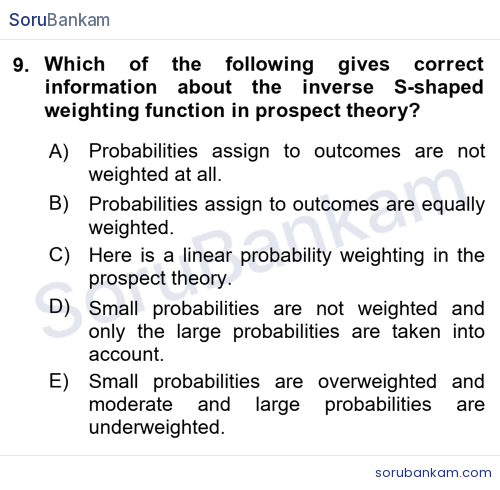
Which of the following gives correct information about the inverse S-shaped weighting function in prospect theory? A) Probabilities assign to outcomes are not weighted at all. B) Probabilities assign to outcomes are equally weighted. C) Here is a linear probability weighting in the prospect theory. D) Small probabilities are not weighted and only the large probabilities are taken into account. E) Small probabilities are overweighted and moderate and large probabilities are underweighted.
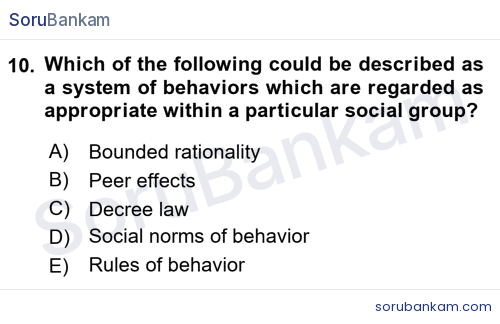
Which of the following could be described as a system of behaviors which are regarded as appropriate within a particular social group? A) Bounded rationality B) Peer effects C) Decree law D) Social norms of behavior E) Rules of behavior
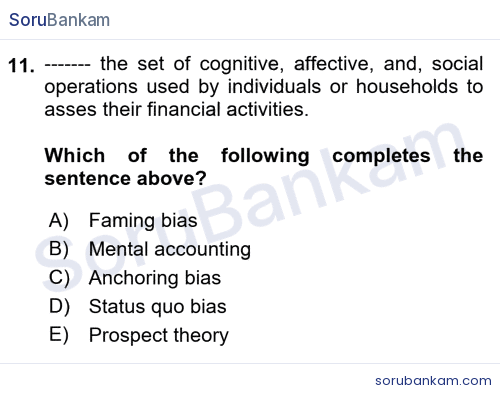
11. — the set of cognitive, aftective, and, social operations used by individuals or households to asses their financiar activities. 3 Which the following completes the sentence above? A) Faming bias j" B) Mental accounting: Anchoring bias ~ D) Status quo bias E) Prospect theory
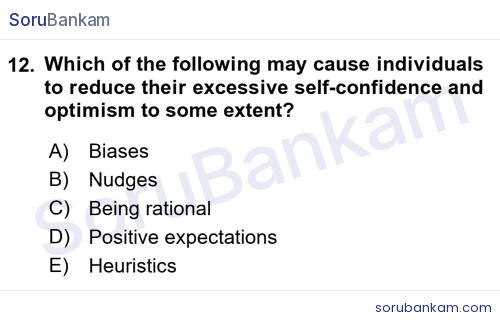
Which of the following may cause individuals to reduce their excessive self-confidence and optimism to some extent? A) Biases B) Nudges C) Being rational D) Positive expectations E) Heuristics
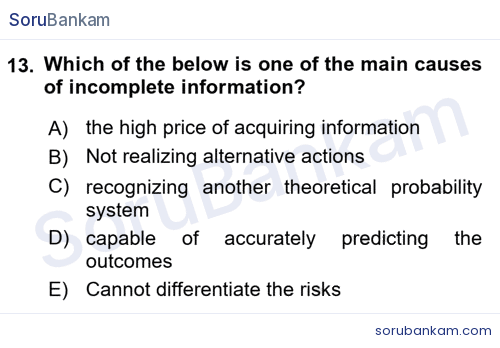
Which of the below is one of the main causes of incomplete information? A) the high price of acquiring information B) Not realizing alternative actions C) recognizing another theoretical probability system D) capable of accurately predicting the outcomes E) Cannot differentiate the risks
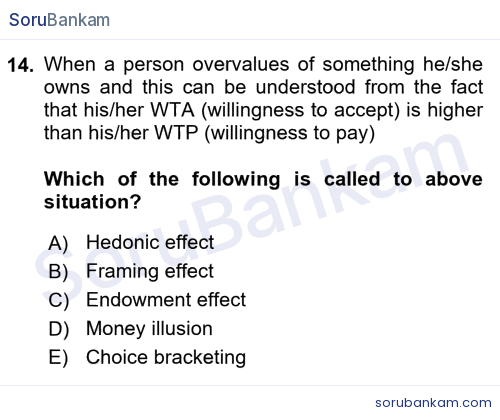
When a person overvalues of something he/she owns and this can be understood from the fact that his/her WTA (Willingness to accept) is higher than his/her TP (willingngsaxo"pay) Which of the following is called to above situation? A) Hedonic effect B) Framing effect C) * C) Endowment effect D) Money illusion E) Choice bracketing
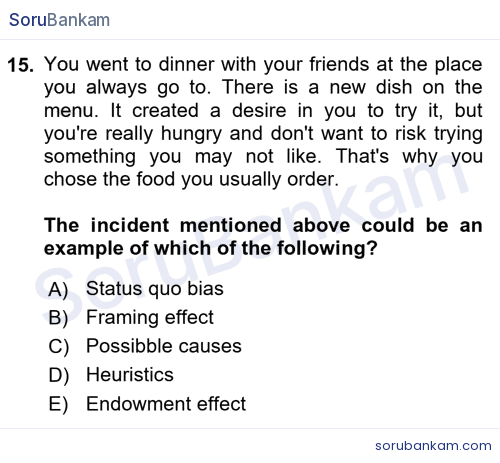
You went to dinner with your friends at the place you always go to. There is a new dish on the menu. It created a desire in you to try it, but you're really hungry and don't want to risk trying something you may not like. That's why you chose the food you usually order. The incident mentioned above could be an example of which of the following? A) Status quo bias B) Framing effect C) Possibble causes D) Heuristics E) Endowment effect
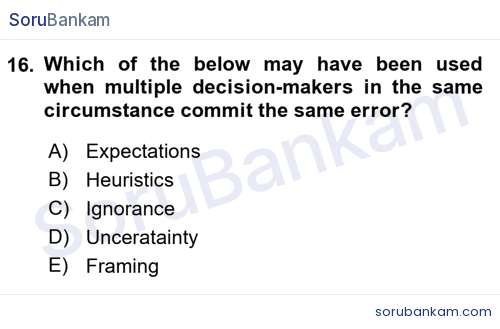
Which of the below may have been used when multiple decision-makers in the same circumstance commit the same error? A) Expectations B) Heuristics C) Ignorance D) Unceratainty E) Framing
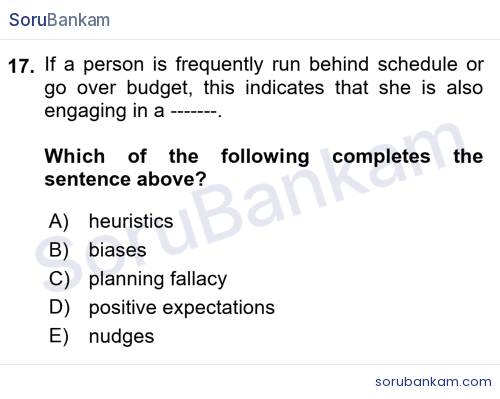
If a person is frequentiy run behind schedule or go over budget, this indicates that she is also engaging in a — Which of the following completes the sentence above? A) heuristics B) biases- C) planning fallacy D) positive expectations E) nudges
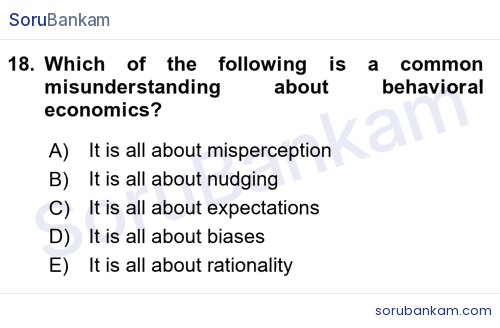
Which of the following is common misunderstanding about behavioral economics? A) It is all about misperception B) It is all about nudging C) It is all about expectations D) It is all about biases E) It is all about rationality
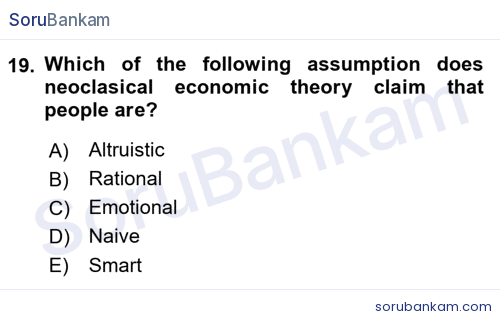
Which of the following assumption does neoclasical economic theory claim that people are? A) Altrulstic B) Rational C) Emotional D) Naive E) Smart
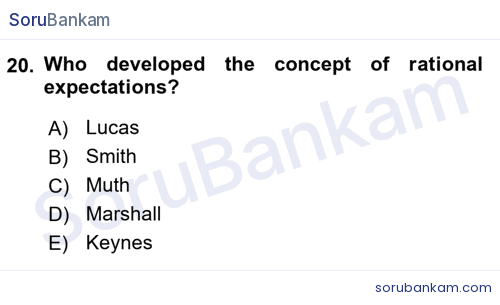
Who developed the concept of rational. expectations? A) Lucas B) Smith C) Muth D) Marshall .. E) Keynes