PSI106U Psychology 2024-2025 Final Soruları
20 soru · Final · 2024-2025
PSI106U Psychology dersinin 2024-2025 final sınavı 20 sorudan oluşur; ders AÖF İşletme (İngilizce) bölümünde okutulur. Sorular aşağıda sırasıyla yer alır. Doğru cevaplar ve sonucun, testi çözdüğünde görünür.
Önizleme · 20 soru. Cevaplamak ve sonucunu görmek için sınavı başlat.
Sorular
20 soru
Soru 1
Soru 2
Soru 3
Soru 4
Soru 5
Soru 6
Soru 7
Soru 8
Soru 9
Soru 10
Soru 11
Soru 12
Soru 13
Soru 14
Soru 15
Soru 16
Soru 17
Soru 18
Soru 19
Soru 20
Sınav modunda süre tutulur, doğru cevaplar ve sonucun sınav bitince görünür.
Dersin üniteleri
Ünite özetleri ve konu anlatımları
Soruların metni (otomatik okuma)
Görsellerden otomatik okunmuştur; hata içerebilir. Sorular, görsellerdeki hâliyle geçerlidir.
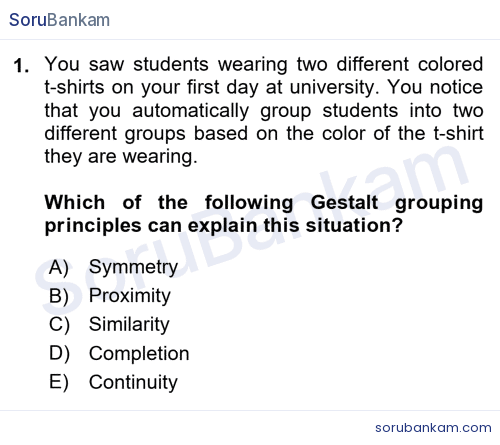
You saw students wearing two different colored t-shirts on your first day at university. You notice that you automatically group students into two different groups based on the color of the t-shirt they are wearing. Which of the following Gestalt grouping principles can explain this situation? A) Symmetry B) Proximity C) Similarity D) Completion E) Continuity
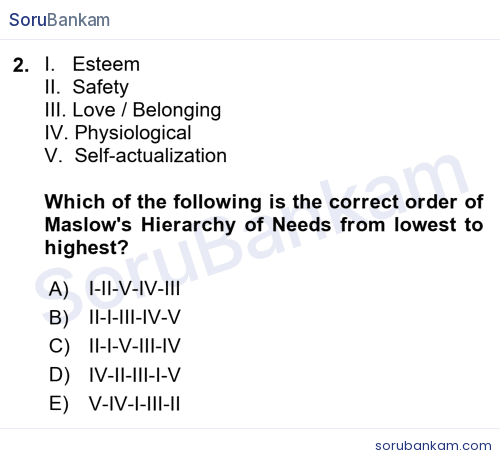
I. Esteem II. Satety lil. Love / Belonging IV. Physiological V. Self-actualization Which of the following is the correct order of Maslow's Hierarchy of Needs from lowest to highest? A) I-II-V-IV-III B) II-I-III-IV-V C) I-I-V-III-IV D) IV-I-III-I-V E) e) V-IV--||-|l
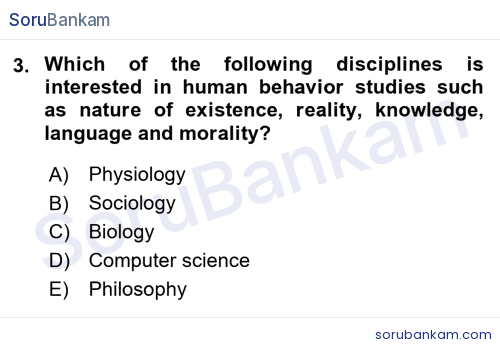
Which of the following disciplines, is interested in human behavior studieg such as nature of existence, reality, knowledge, language and morality? A) Physiology B) Sociology C) Biology 1.~ D) Computer science » E) 'Philosophy
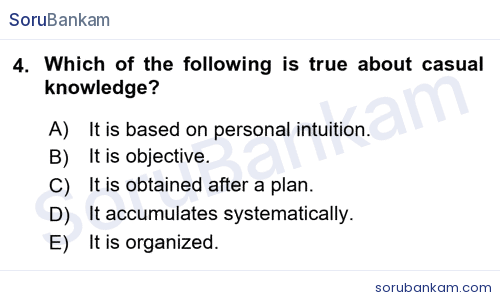
Which of the following is true about casual knowledge? A) It is based on personal intuition. B) It is objective. C) It is obtained after a plan. D) It accumulates systematically. • E) It is organized.
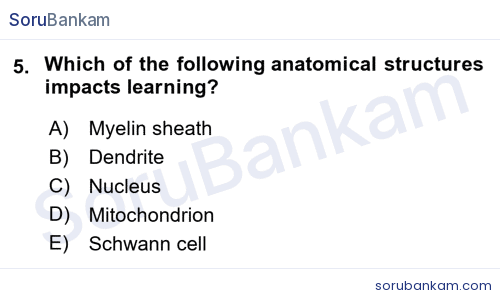
Which of the following anatomical structures impacts learning? A) Myelin sheath B) Dendrite C) Nucleus D) Mitochondrion E) Schwann cell
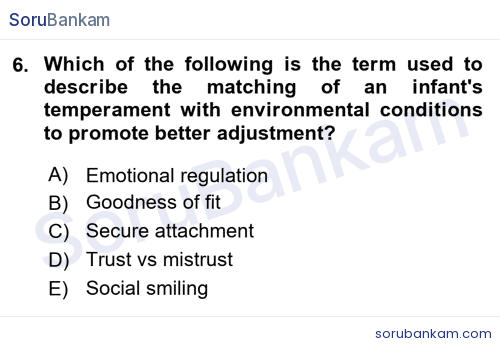
Which of the following is the term used to describe the matching of an infant's temperament with environmental conditions to promote better adjustment? A) Emotional regulation B) Goodness of fit C) Secure attachment D) Trust vs mistrust E) Social smiling
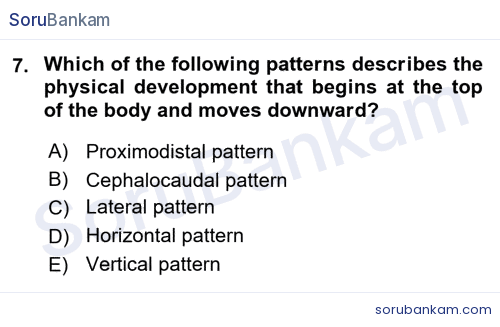
Which of the following patterns describes the physical development that begins at the top of the body and moves downward? A) Proximodistal pattern B) Cephalocaudal pattern C) Lateral pattern D) Horizontal pattern E) Vertieal pattern
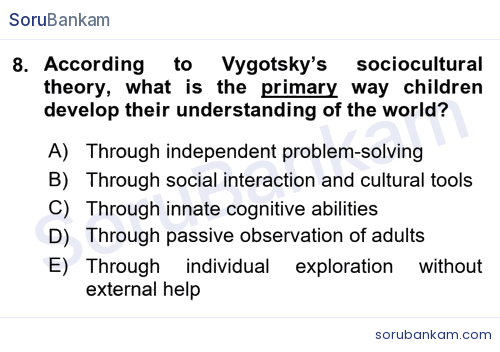
According to Vygotsky's sociocultural theory, what is the primary way children develop their understanding of the world? A) Through independent problem-solving B) , "') Through social interaction and cuitural tools C) Through innate cognitive abilities D) Through passive observation of adults E) Through individual exploration without external help
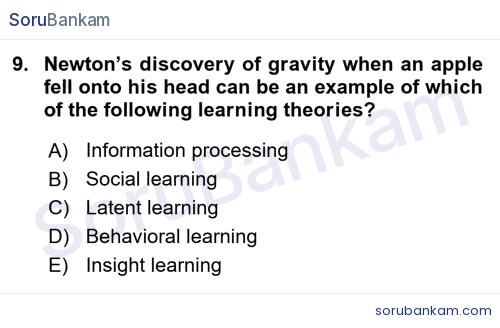
Newton's discovery of gravity when an apple fell onto his head can be an example of which of the following learning theories? A) Information processing B) Social leaming C) Latent learning D) Behavioral learning E) Insight learning
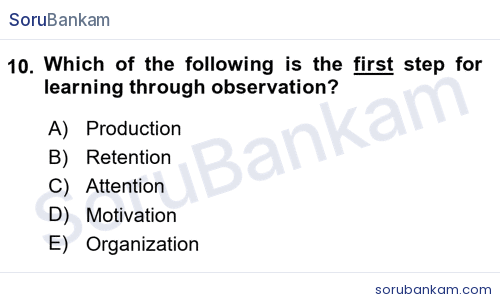
Which of the following is the first step for learning through observation? A) Production B) Retention C) Attention D) Motivation E) Organization
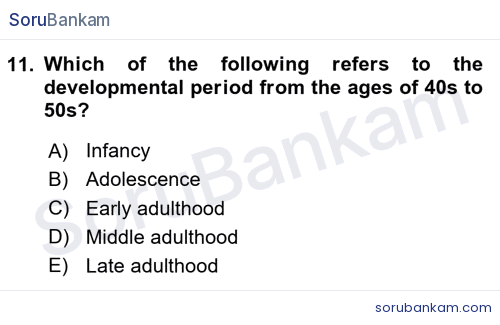
Which of the following refers to the developmental period from the ages of 40s to 50s? A) Infancy B) Adolescence C) Early adulthood D) Middle adulthood E) Late adulthood
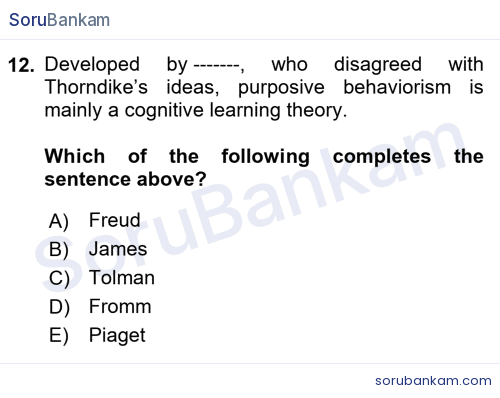
Developed by who disagreed with Thorndike's ideas, purposive behaviorism is mainly a cognitive learning theory. Which of the following completes the sentence above? A) Freud B) James C) Tolman D) Fromm E) Piaget
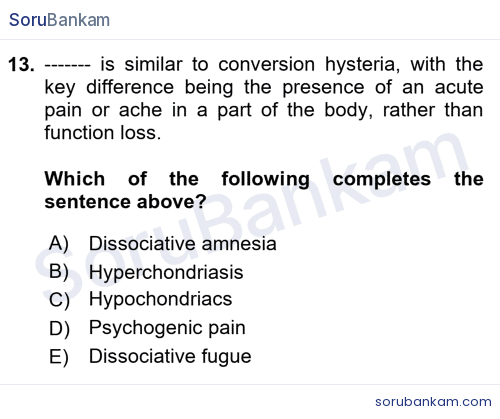
- is similar to conversion hysteria, with the key difference being the presence of an acute pain or ache in a part of the body, rather than function loss. Which of the following completes the sentence above? A) Dissociative amnesia B) Hyperchondriasis C) Hypochondriacs D) Psychogenic pain E) Dissociative fugue
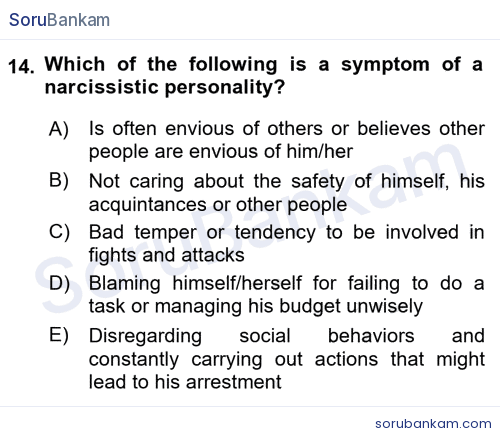
Which of the following is a symptom narcissistic personality? A) Is often envious of others or believes other people are envious of him/her B) Not caring about the safety of himself, bie! acquintances or other people C) 4) Bad temper or tendency to be involved in fights and attacks D) . Blaming himself/herself for failing to do a task or managing his budget unwisely E) Disregarding social behaviors and constantly carrying qut actions that might lead to his arrestment
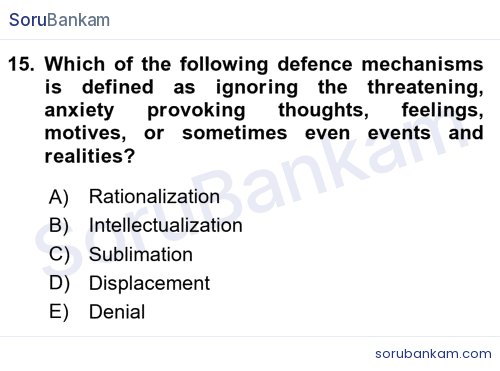
Which of the following defence mechanisms is defined as ignoring the threatening, anxiety provoking thoughts, feelings, motives, or sometimes even events and realities? A) Rationalization B) Intellectualization C) Sublimation D) Displacement E) Denial
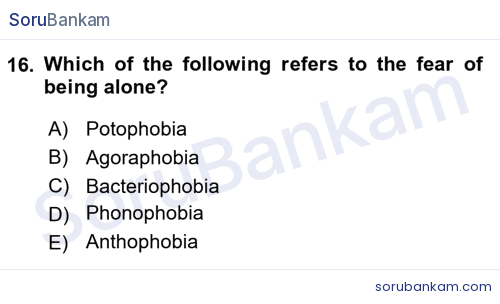
Which of the following refers to the fear of being alone? A) Potophobia B) Agoraphobia C) Bacteriophobia D) Phonophobia E) Anthophobia
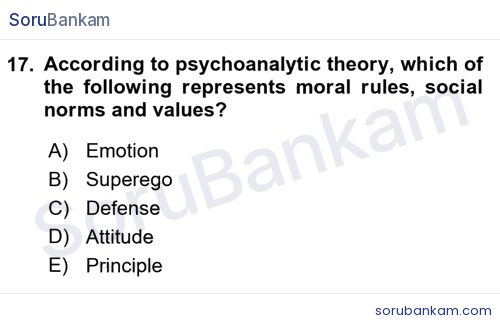
According to psychoanalytic theory, which of the following represents moral rules, social norms and values? • A) Emotion B) Superego C) Defense D) Attitude, E) Principle
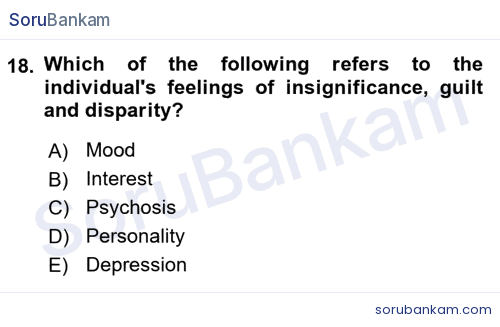
Which of the following refers to the individual's feelings of Insignificance, guilt and disparity? A) Mood B) NB) Interest C) Psychosis D) Personality E) Depression
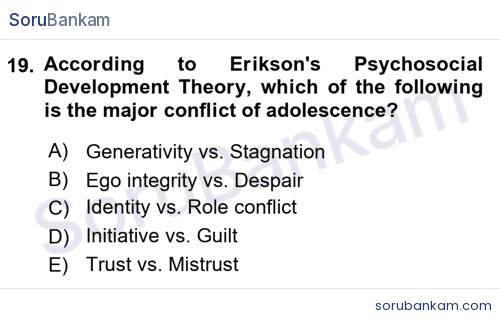
According to Erikson's Psychosocial Development Theory, which of the following is the major conflict of adolescence? A) Generativity vs. Stagnation B) Ego integrity vs. Despair C) Identity vs. Role conflict D) Initiative vs. Guilt E) Trust vs. Mistrust
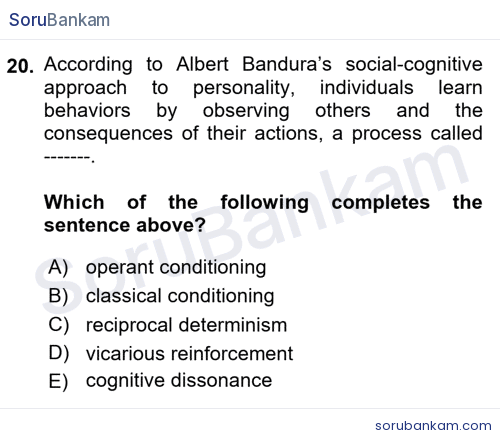
According to Albert Bandura's social-cognitive approach to personality, individuals learn behaviors by observing others and the consequences of their actions, a process called -----. Which of the following completes the sentence above? A) operant conditioning B) classical conditioning C) reciprocal determinism D) vicarious reinforcement E) cognitive dissonance