PSI106U Psychology 2021-2022 Vize Soruları
20 soru · Vize · 2021-2022
PSI106U Psychology dersinin 2021-2022 vize sınavı 20 sorudan oluşur; ders AÖF İşletme (İngilizce) bölümünde okutulur. Sorular aşağıda sırasıyla yer alır. Doğru cevaplar ve sonucun, testi çözdüğünde görünür.
Önizleme · 20 soru. Cevaplamak ve sonucunu görmek için sınavı başlat.
Sorular
20 soru
Soru 1
Soru 2
Soru 3
Soru 4
Soru 5
Soru 6
Soru 7
Soru 8
Soru 9
Soru 10
Soru 11
Soru 12
Soru 13
Soru 14
Soru 15
Soru 16
Soru 17
Soru 18
Soru 19
Soru 20
Sınav modunda süre tutulur, doğru cevaplar ve sonucun sınav bitince görünür.
Dersin üniteleri
Ünite özetleri ve konu anlatımları
Soruların metni (otomatik okuma)
Görsellerden otomatik okunmuştur; hata içerebilir. Sorular, görsellerdeki hâliyle geçerlidir.
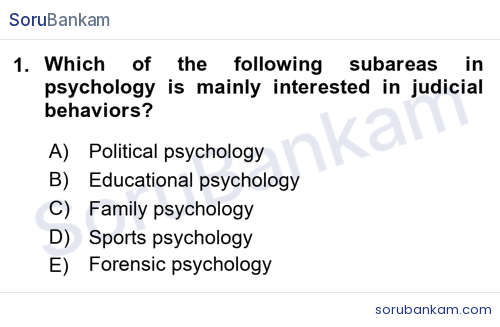
Which of the following subareas in psychology is mainly interested in judicial behaviors? A) Political psychology B) Educational psychology C) Family psychology D) Sports psychology E) Forensic psychology
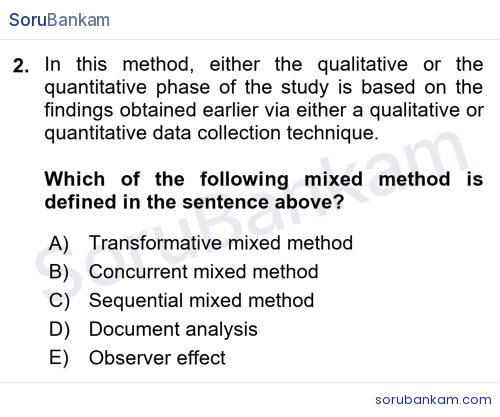
In this method, either the qualitative or the quantitative phase of the study is based on the findings obtained earlier via either a qualitative or quantitative data collection technique. Which of the following mixed method is defined in the sentence above? A) Transformative mixed method B) Concurrent mixed method C) Sequential mixed method D) Document analysis E) Observer effect
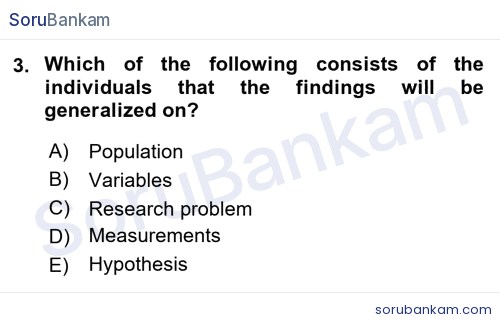
Which of the following consists of the individuals that the findings will - be generalized on? A) Population B) Variables C) Research problem D) Measurements E) Hypothesis
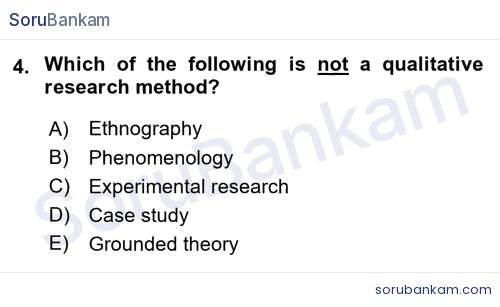
Which of the following is not a qualitative research method? A) Ethnography B) Phenomenology C) n" C) Experimental research D) Case study E) Grounded theory
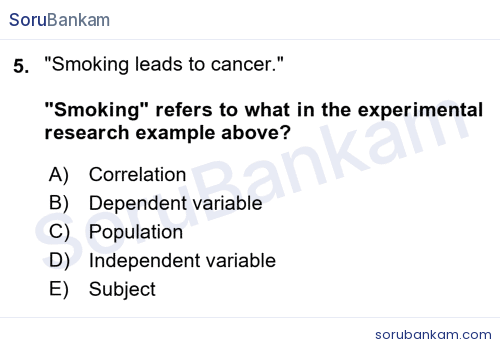
"Smoking leads to cancer." "Smoking" refers to what in the experimental research example above? A) Correlation B) Dependent variable C) Population D) Independent variable E) Subject
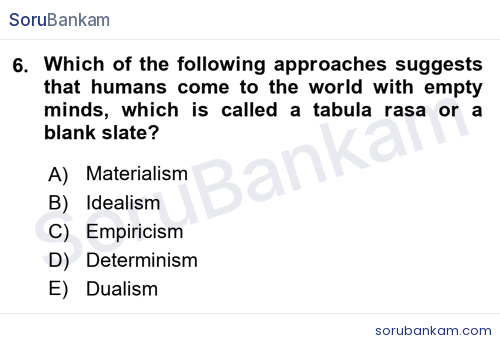
Which of the following approaches suggests that humans come to the world with empty minds, which is called a tabula rasa or a blank slate? A) Materialism r. B) Idealism C) Empiricism D) Determinism E) Dualism
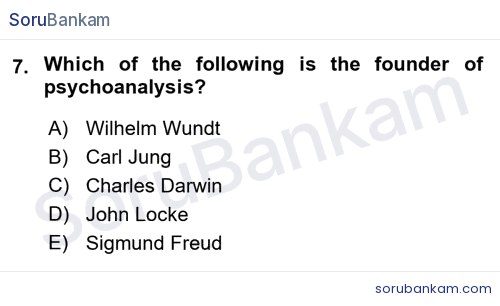
Which of the following is the founder of psychoanalysis? A) Wilhelm, Wundt B) Carl Jung C) Charles Darwin D) John Locke *.Ci E) Sigmund Freúd
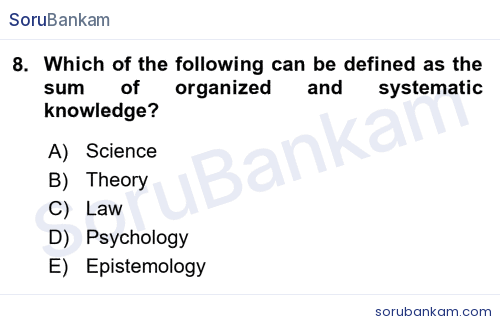
Which of the following can be defined as the sum of organized and systematic knowledge? A) Science B) 'B) Theory C) Law D) Psychology E) Epistemology
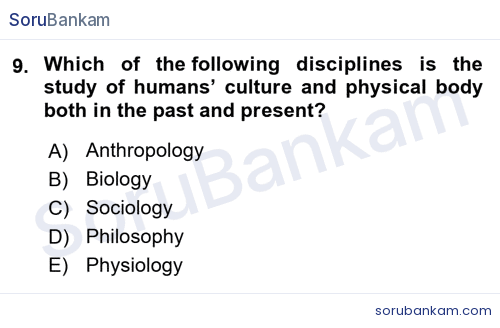
Which of the following disciplines is the study of humans' culture and physical body both in the past and present? A) Anthropology B) Biology C) Sociology D) Philosophy E) Physiology
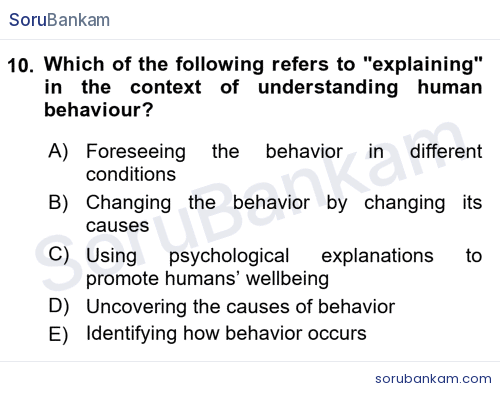
Which of the following refers to "explaining" in the context of understanding human behaviour? A) Foreseeing the behavior in different conditions B) Changing the behavior by changing its causes C) Using psychological explanations to promote humans' wellbeing D) Uncovering the causes of behavior E) Identifying how behavior occurs
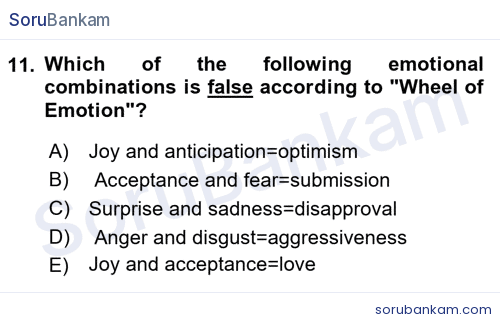
Which the following emotional combinations is false according to "Wheel of Emotion"? A) Joy and anticipation=optimism B) Acceptance and fear=submission C) Surprise and sadness=disapproval D) Anger and disgust-aggressiveness E) Joy and acceptanca=love
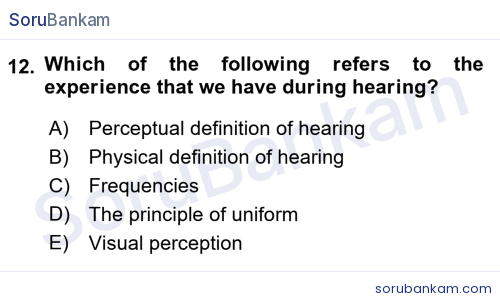
Which of the following refers the experience that we have during hearing? A) Perceptual definition of hearing B) Physical definition of hearing C) Frequencies D) The principle of uniform E) Visual perception
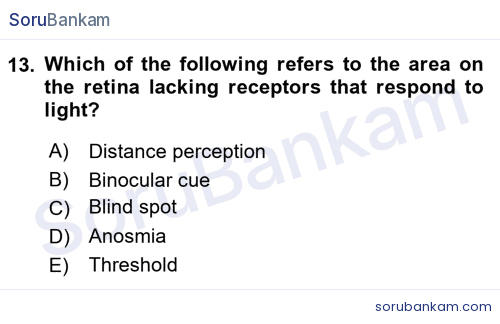
Which of the following refers to the area on! the retina lacking receptors that respord to light? A) Distance perception B) Binocular cue C) Blind spot D) Anosmia E) Threshold
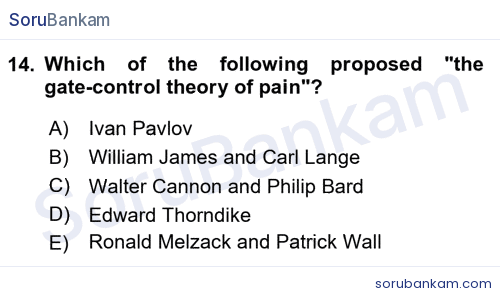
14. Which of the following proposed the gate-control theory of pain"? A) Ivan Pavlov furliam James and Carl Lange "C) Walter Cannon and Philip Bard D) Edward Thordike E) Ronald Melzack and Patrick Wall
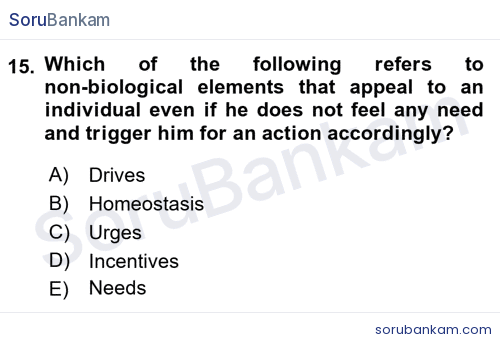
Which the following refers non-biological elements that appeal to an individual even if he does not feel any need and trigger him for an action accordingly? A) Drives B) Homeostasis C) Urges D) Incentives E) Needs
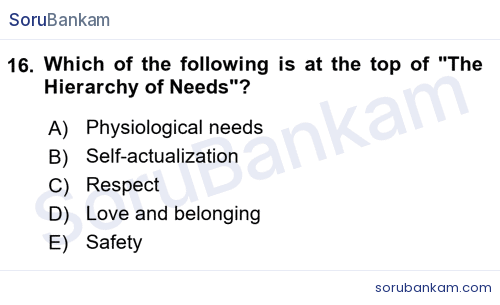
Which of the following is at the top of "The Hierarchy of Needs"? A) Physiological needs B) Self-actualization r. C) Respect D) Love and belonging 211. E) Safety
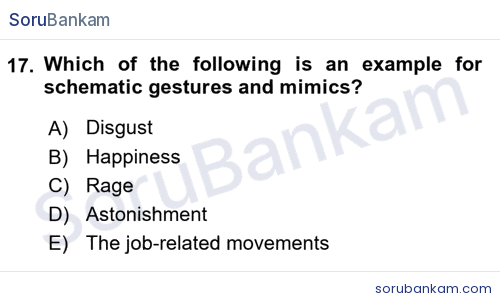
Which of the following is an example for schematic gestures and mimics? A) Disgust 1.6? B) Happiness C) Rage D) Astonishment E) The job-related movements
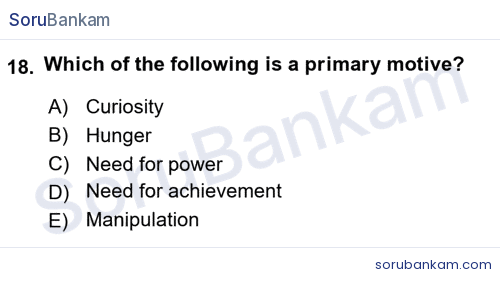
Which of the following is a primary motive? A) Curiosity B) Hunger C) Need for power D) Need for achievement E) Manipulation
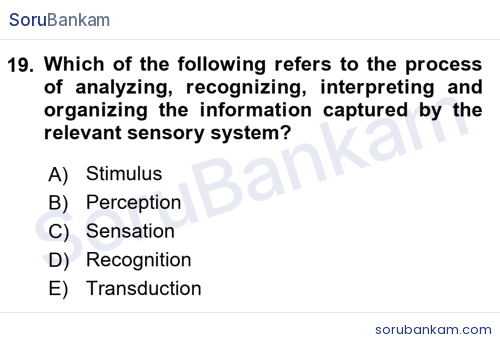
Which of the following refers to the process of analyzing, recognizing, interpreting and organizing the information captured by the relevant sensory system? A) Stimulus B) Perception C) Sensation D) Recognition E) Transduction
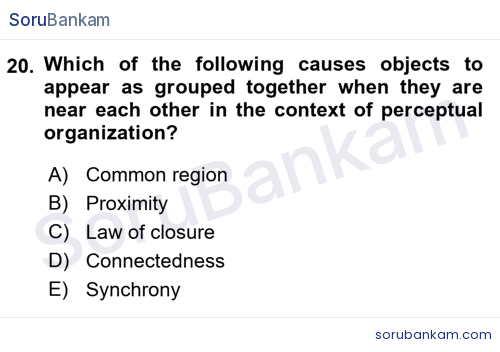
Which of the foliowing causes objects to appear as grouped together when they are near each other in the context of perceptual organization? A) Common region B) Proximity C) Law of closure D) Connectedness E) Synchrony