INO307U Okuma ve Dinleme Öğretimi 2013-2014 Tek Ders Soruları
20 soru · Tek ders · 2013-2014
INO307U Okuma ve Dinleme Öğretimi dersinin 2013-2014 tek ders sınavı 20 sorudan oluşur; ders AÖF İngilizce Öğretmenliği bölümünde okutulur. Sorular aşağıda sırasıyla yer alır. Doğru cevaplar ve sonucun, testi çözdüğünde görünür.
Önizleme · 20 soru. Cevaplamak ve sonucunu görmek için sınavı başlat.
Sorular
20 soru
Soru 1
Soru 2
Soru 3
Soru 4
Soru 5
Soru 6
Soru 7
Soru 8
Soru 9
Soru 10
Soru 11
Soru 12
Soru 13
Soru 14
Soru 15
Soru 16
Soru 17
Soru 18
Soru 19
Soru 20
Sınav modunda süre tutulur, doğru cevaplar ve sonucun sınav bitince görünür.
Dersin üniteleri
INO307U Okuma ve Dinleme Öğretimi ders sayfası: bütün sınavlar ve üniteler
Soruların metni (otomatik okuma)
Görsellerden otomatik okunmuştur; hata içerebilir. Sorular, görsellerdeki hâliyle geçerlidir.
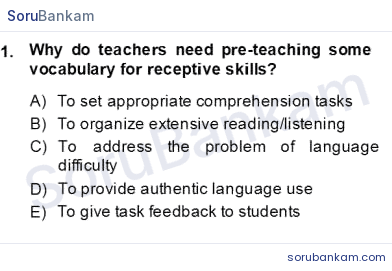
Why do teachers need pre-teaching some vocabulary for receptive skills? A) To set appropriate comprehension tasks B) To organize extensive reading/listening C) To address the problem of language difficulty D) To provide authentic language üse E) To give task feedback to students
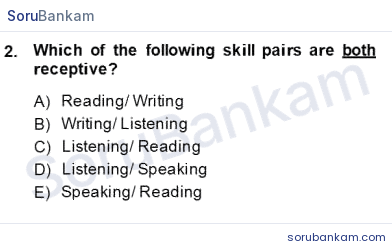
Which of the following skill pairs are both receptive? A) Reading/ Writing B) Writing/Listening C) Listening/ Reading D) Listening/ Speaking E) Speakingy Reading
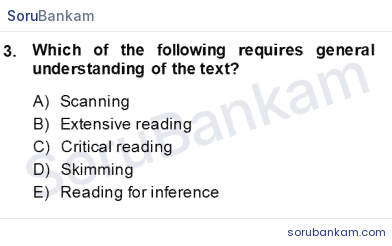
Which of the following requires generat understanding of the text? A) Scanning B) Extensive reading C) Critical reading D) Skimming E) Reading forinference
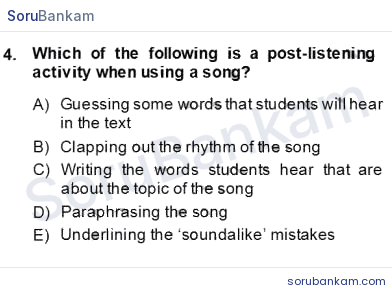
Which of the following is @post-listenine. activity when using a song A) Guessing some y mayor thet stuckens withear in the text, B) Clapping out thi • rhythm C) Writing the bids stutents hear that are about thatopic of the songh D) traising thees *ng E) rining the soupdalike' mistakes
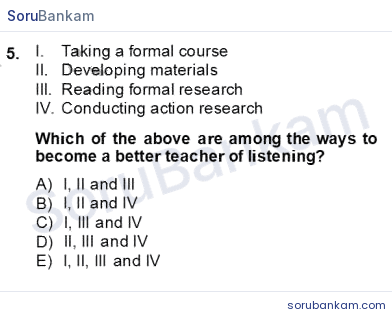
65. Taking a formal course Il Devaloping materials w. Bondinging at on escarch Which of the above are among the ways. ta. become a better teacher of listening? A) 1, ll and lt. !' Ill and N D) Il,ill and IV E) 1, II, Ill and IV
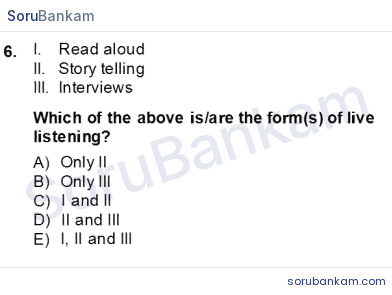
6. Read aloud II. Story telling III. Interviews Which of the above isfare the forms) of live listening? A) Only B) i Only i!! a. frand ill 1, ll and lil
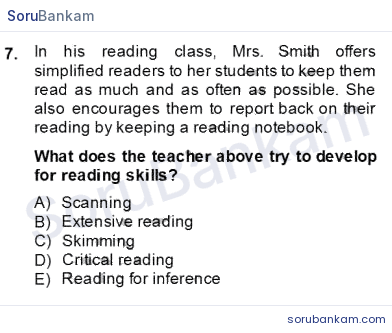
7. reading class, Mrs. Voters reading by keeping a repaing notebook. top Nor redes the ear love trie for reading skifk? Al Shaming edine C) Skinning D) Gaicaleading E), Reading for mfere
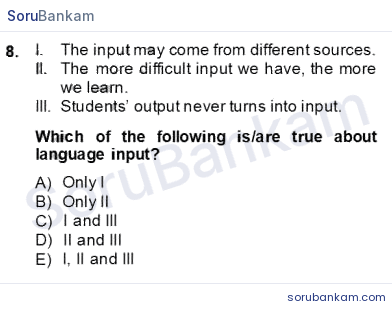
The inpurmy come from different sources. The mate lificult input we have, the more il. stufeat output never tums into input. ah the following stare true pour. inguage input? A) Only l B) ' Hand Ill • I' D) Il and til E) I, Il and til
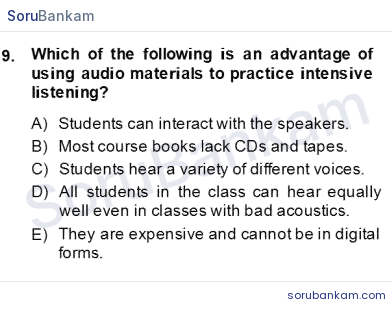
Which of the following is an advantage of using audio materials to practice intensive listening? A) , Students can interact with the speakers. B) Most course books lack CDs and tapes: C) Students hear, a variety of differen voices. D) All studehts in the class, can hear equally wall even in classes with bad acoustics. E) ¡ "É) They are expensive and cannot be in digital forms.
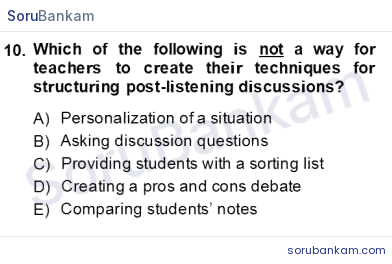
Which of the following is not a way for teachers to create their techniques for structuring post-listening discussions? A) Peršonalization of a situation B) Asking discussion questions C) Providing students with a sorting list - D) Creating a plos and cons debate E) Gomparing students' notes
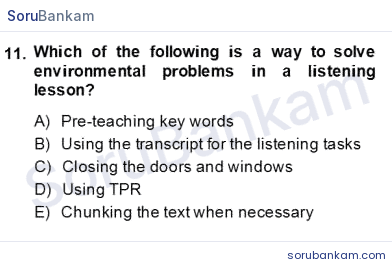
11. Which of the following is a way to solve environmental problems in * listening lesson? A) Pre-teaching key words B) Using the transcript for the listening tasks. C) Closing the doors and windows, - * 5) Chinking the text when necessary
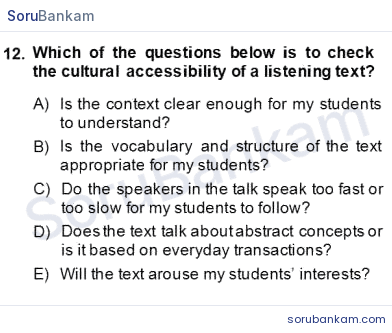
12. Which of the questions below is to check the cultural accessibility of a listening text? • Is the context clear enough for my students to Ünderstand? •B) Is the vocabulary and structure of the text appropriate for my students? C) Do the,speakers in the talk speak too fast or tge stow for my students to follow? Does the text talk aboutabstract concepts or is it based on everyday transactons? E) Will the text arouse my students' interests?
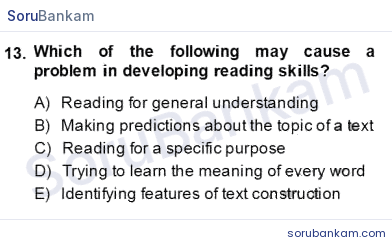
Which of the following may cause problem in developing reading skills? A) Reading for general understanding B) Making predictions about the topic of C) Reading for a specific purpose • ' D) Trying to learn the meaning of exong tord E) Identifying features of test edeshugion
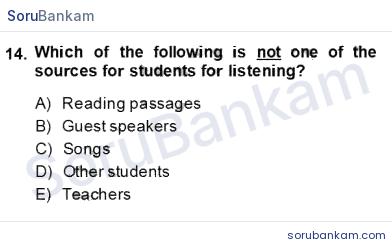
14. Which of the follow is not the of the sources for studer! listening? A) Reading passades B) Gúest speakers C) songs D) achers''
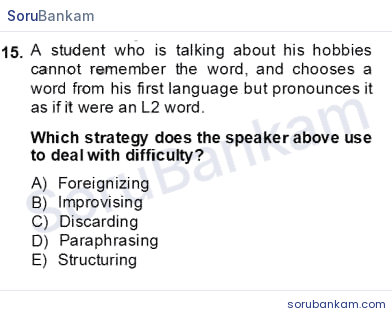
15. A student who is talking about his hobbies. atifor somember the word, and chooses a sificam his first language but pronounces it vere an L2 word. Which strategy does the speaker above use. to deal with difficulty? A) Foreignizing"* E) Structuring
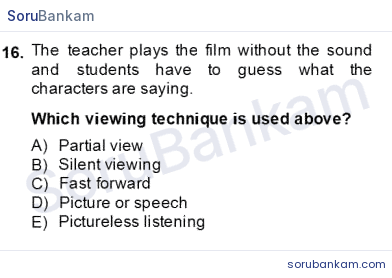
16. The teacher plays the film without the sound and students have to guess. what the characters are.saying. Which viewing technique is used above? A) Partial view B) Silent viewing C) Fast forward?! Picture or speech ..Ey Mctureless listening
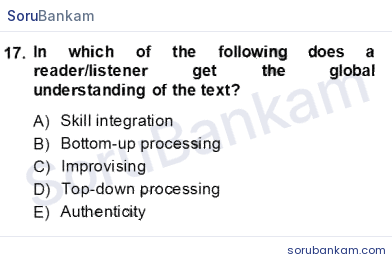
In which the following readerflistener get globa understanding of the text? A) Skil integration B) I Bottom-up prod ritapç C) Improvising D) Top-dayn E) Aubenta
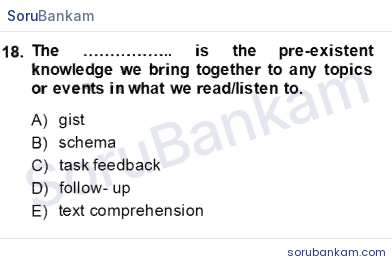
the pre-existent knowiedde bring together to any topics * events m What we readlisten to. A) gist schema Sask feedback follow-ups rE E) text: comprehension
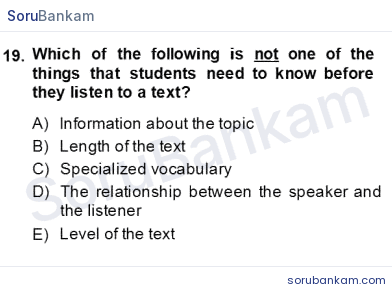
Which of the following is not one of the things that students need to know before they listen to a text? A) Information about the topic B) Length ofthe text C) Specialized yocabulary D) The relationship betweeg-the speaker and the Istener E) • "E) Level of the text
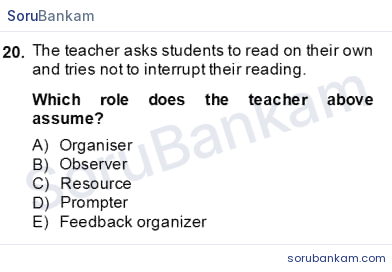
The teacher asks students to read on their own and tries notto interrupt their reading: • Which role does the teacher above assume? A) Organiser B) Observer C) Resource. D) Prpmpter E) Et Feedback organizer