INO307U Okuma ve Dinleme Öğretimi 2013-2014 Final Soruları
20 soru · Final · 2013-2014
INO307U Okuma ve Dinleme Öğretimi dersinin 2013-2014 final sınavı 20 sorudan oluşur; ders AÖF İngilizce Öğretmenliği bölümünde okutulur. Sorular aşağıda sırasıyla yer alır. Doğru cevaplar ve sonucun, testi çözdüğünde görünür.
Önizleme · 20 soru. Cevaplamak ve sonucunu görmek için sınavı başlat.
Sorular
20 soru
Soru 1
Soru 2
Soru 3
Soru 4
Soru 5
Soru 6
Soru 7
Soru 8
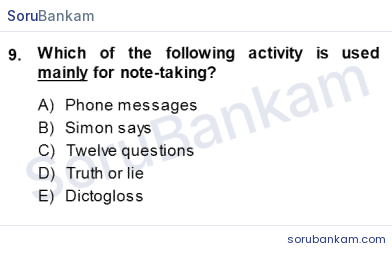
Soru 9
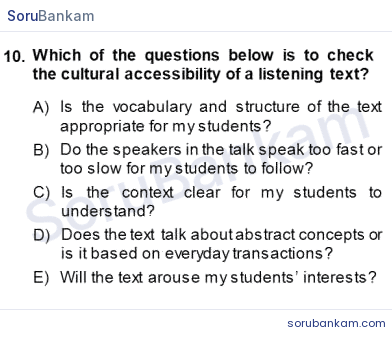
Soru 10
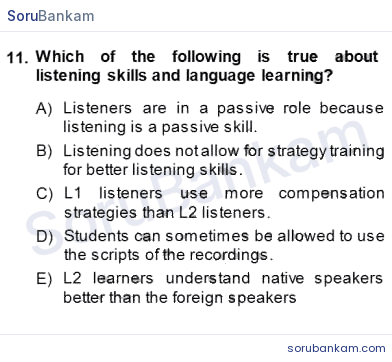
Soru 11
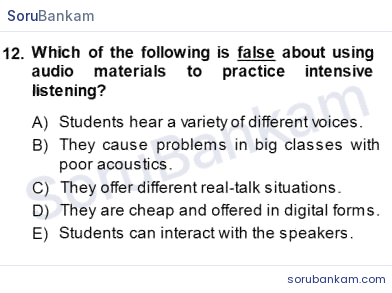
Soru 12
Soru 13
Soru 14
Soru 15
Soru 16
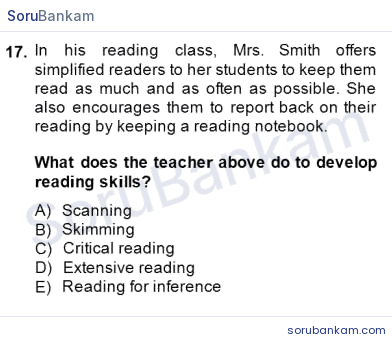
Soru 17
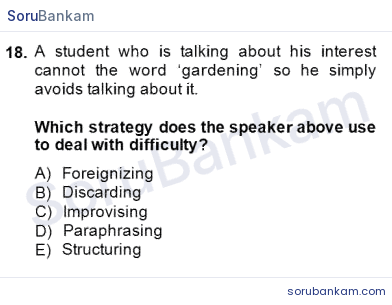
Soru 18
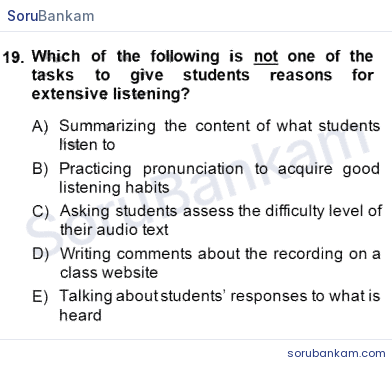
Soru 19
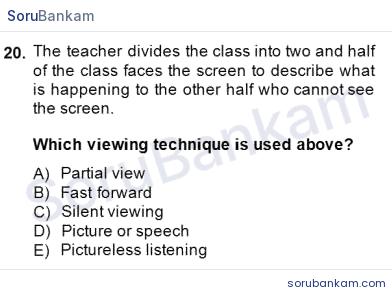
Soru 20
Sınav modunda süre tutulur, doğru cevaplar ve sonucun sınav bitince görünür.
Dersin üniteleri
INO307U Okuma ve Dinleme Öğretimi ders sayfası: bütün sınavlar ve üniteler
Soruların metni (otomatik okuma)
Görsellerden otomatik okunmuştur; hata içerebilir. Sorular, görsellerdeki hâliyle geçerlidir.
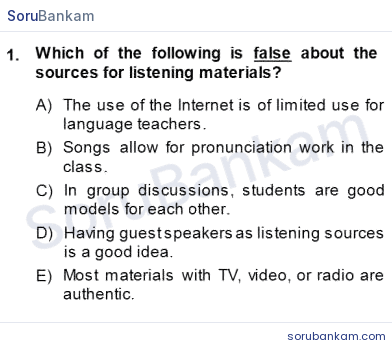
1. Which of the following is false about the sources for listening materials? A) The use of the Internet is of limited use for anguage teachers. •B) Songs allow for pronunciation work in, the class. Clin group aiscussions, sudents are good models for each other: Having guestspeakers as listening sources is a good idea. E) Most materials with TV, video, or radio are authentic.
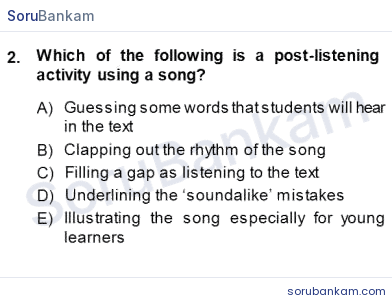
2. Which of the following is a post-listening activity using a song? A) Guessing some words thatstudents will hear in the text B) Clapping out the rhythm of the song. C) Filling a gap-as listening to the text Underlining the 'soundalike" mistakes "nE austrating the song especially for young learners
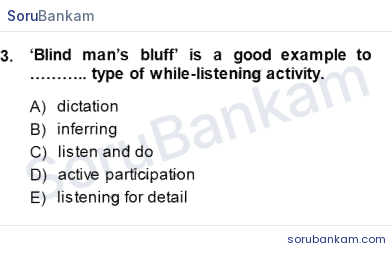
3. 'Blind man's bluff is a example, tok •... type of while-listen ictivity." A) dictation B) inferring D) active parteinaton E) listening for detail
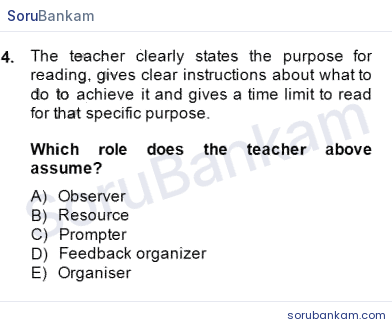
The teac clearly states the purpose for gadings sides clear instructions about what to achieve it and gives a time lirit to read for that specific purpose,. role does the teacher above assume? Al Observant: T Resource Prompter Dy Feedback organizer E) Organiser.
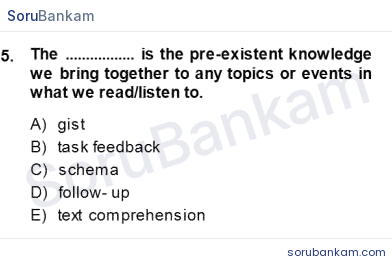
The .... Is the pre-existent knowledge we bring together to any topics or events in what we readlisten to. A) gist B) task feedback C) schema D) follow-upt. " E) tent comprehension
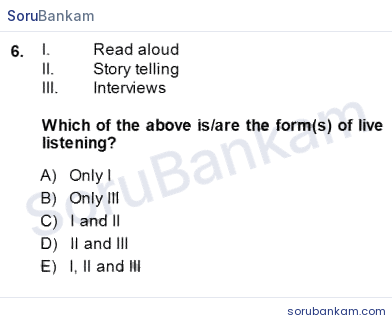
в. I. Read aloud Story telling. Interviews * Which of the sire engines of live listening? A) Qnly sinc B) JI and Ill t,Il and
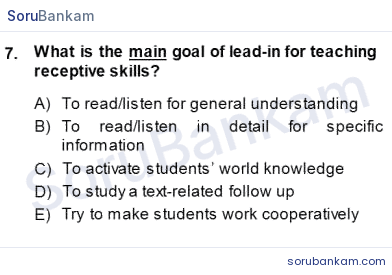
What is the main goal of lead-in for teaching receptive skills? A) To read/listen for general understanding B) To read/listen in detail for specific information C) To activate studants' world knowledge D) To studya text-related follor E) . Try to make students work cooperatively
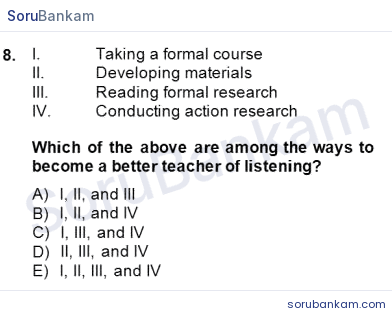
8. I. Taking a formal course II. Developing materials Reading formal research: IV. Conducting action research Which of the above are among the ways. to become a better peacher of listening? A) 1, ll, and it' B) tal, and IV D) II, Ill, and IV E) I, II, III, and IV
Which of the following activity is used mainly for note-taking? A) Phone messages B) Simon says C) • C) Twelve questions D) Truth orlie E) Dictator's
Which of the questions below Is to check the cultural accessibility of a listening text? A) Is the vocabulary and structure of the text appropriate for my students? B) Do the speakers in the talk speak too faistor too slow for my students ta follow?: C) Is the context clear for my students to uriderstand? D) ;: "D) Does the text talk about abstract concepts or is it based on everyday transactions? E) Will the text arouse my students' interests?
11. Which of the following true listeniøg skills and tanguage learhir .A) Listeners are in a passive Mo because listoning is a passive skilh •B) Listening does notallow Estrateg for better lis toping s kiles C) L1 fislehers nare: comp sation alategies than listeners. i* "'Ờ) students can sgmetimes be ali wed to. use he scripts ofte recgrdings mätive speakers =) L2 en she nder hep atais
12. Ve jar of the following is false about using materials practice Intensive ›is tehing? Students hear a variety of different voices. B) They cause problems in big classes with poor acoustics, C) They offer diferent real-talk situations. D) They are cheap and offered in digital farms. Students can interact with the speakers.
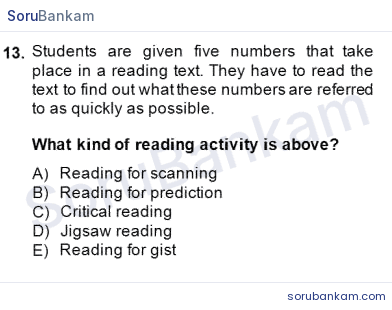
Students are given five numbers that take: place in a reading text. They have to read the text to find out what these numbers are referred to as quickly as possibie. What kind of reading activity is above? A) Reading for scanning B) Reading for prediction. C) Critical reading D) "(D) Jigsaw reading E) Reading for gist
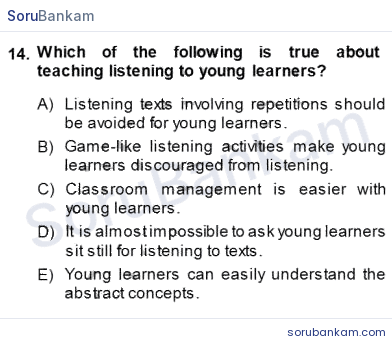
14. Which of the following is true abou teaching listening te young learners? A) Listening 1 Prolving fions should Game-ikes listening ities make yoursy iscoy aged tom listening: as room n management is easier with aung leamers. It is almostimpossible to ask young learners sit stilyst istaning to texts. E) Young Barers can easily understand the test concepts.
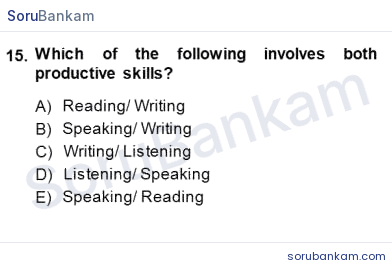
Which of the following involves both productive skills? A) Reading/ Writing B) Speaking/ Writing C) Writing/ Listening D) Listening/ Speaking E) Speakimg Reading
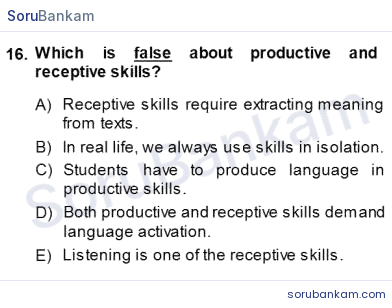
Which false about productive and receptive skills? A) Receptive skills require exträcting meaning front texts. B) In real life, we always use skills in isolation: C) Stadua skio o produce, language in Students D) . Botfi productve andreceptive skills demand i* "'"* language activation. E) Listening is one of the receptive.skills.
In his reading class, Mrs. Smith offers simplified readers to her students to keep them read as much and as often as possible. She • also encourages them to report back on their reading by keeping a reading notebook. What does the teacher above do to develop reading skills?' A) Scanning B) Skimming C) Critcal reading D) Extensive reading E) Reading for inference:
1B. A student who is talking about his interest. cannot the word 'gardening' so he simply avoids talking about it. Which strategy does the speaker above use. •to deal with difficulty? A) Foreignizing: B) Discarding C) . anprovising Site D) Paraphrasing E) Structuring
mich of she" following is not one of the tasks gve students reasons Extensive listening? Memoring the content of what sudants Practicing pronunciation to acquiné good listening hablts C) Apting students assess the difficulty level of " their audio text D) Writing comments about the recording on a class website E) Talking aboutstudents' responses to what is heard
20. The teacher divides the class into two and half of the class faces the screen to describe what is happening to the other half who cannot see the screen. Which viewing technique is used above? A) artal view pr B) Fast forward Silent viewing "Đ) Picture or speech E) Pictureless istening