INO307U Okuma ve Dinleme Öğretimi 2012-2013 Final Soruları
20 soru · Final · 2012-2013
INO307U Okuma ve Dinleme Öğretimi dersinin 2012-2013 final sınavı 20 sorudan oluşur; ders AÖF İngilizce Öğretmenliği bölümünde okutulur. Sorular aşağıda sırasıyla yer alır. Doğru cevaplar ve sonucun, testi çözdüğünde görünür.
Önizleme · 20 soru. Cevaplamak ve sonucunu görmek için sınavı başlat.
Sorular
20 soru
Soru 1
Soru 2
Soru 3
Soru 4
Soru 5
Soru 6
Soru 7
Soru 8
Soru 9
Soru 10
Soru 11
Soru 12
Soru 13
Soru 14
Soru 15
Soru 16
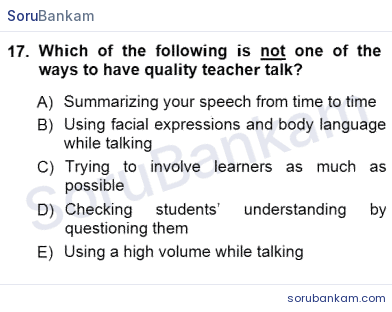
Soru 17
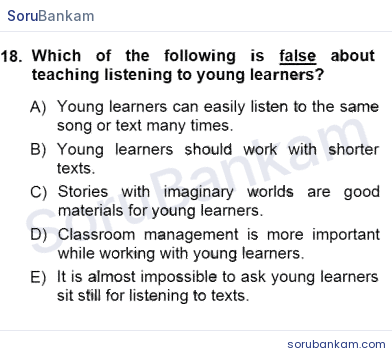
Soru 18
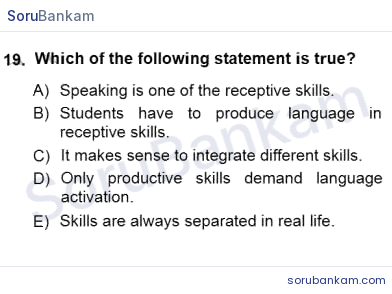
Soru 19
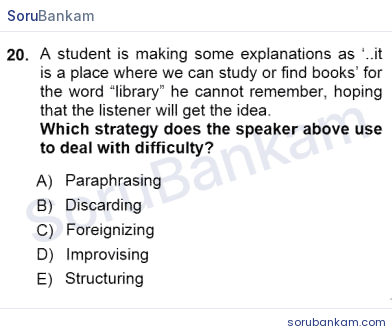
Soru 20
Sınav modunda süre tutulur, doğru cevaplar ve sonucun sınav bitince görünür.
Dersin üniteleri
INO307U Okuma ve Dinleme Öğretimi ders sayfası: bütün sınavlar ve üniteler
Soruların metni (otomatik okuma)
Görsellerden otomatik okunmuştur; hata içerebilir. Sorular, görsellerdeki hâliyle geçerlidir.
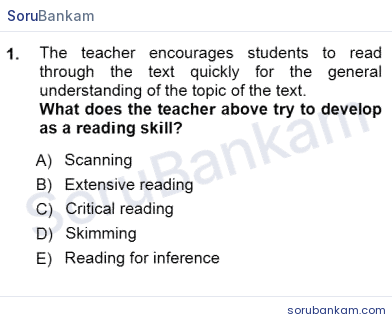
The teacher encourages students to read through the text quickly for the general understanding of the topic of the text. • What does the teacher above try to develop as a reading skill? A) Scanning B) Extensive reading C) Gridcal reading D) i D) Skimming E) Reading for inference
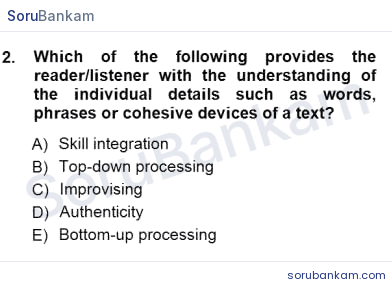
Which the following provides the reader/listener with the understanding of the individual details such as words, phrases or cohesive devices of a text? A) Skill integration B) Top-town professing C) Improvişing D) Authenticity E) * "È) Bottom-up processing
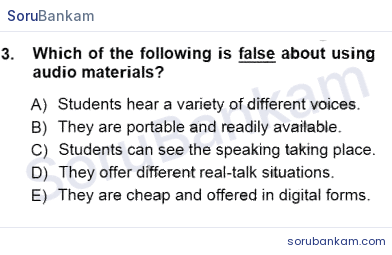
Which of the folfowing is false/sh dut usin audio materials? A) Students hear a vanety-e B) They are portable and readily avattable. C) Students can see the speaking aking place: D) They offer ditchest real-talk statiors. E) They are o Eep'and offer gun digital forms.
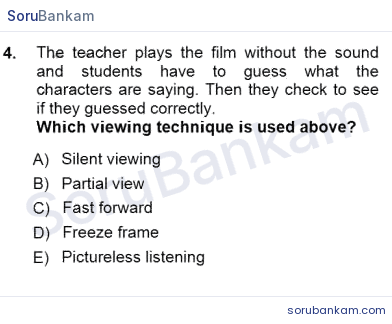
The teacher plays the film without the sound aba biters are saving. Then theys ecata see to guess if they guessed correctly. Which viewing technique is used above? A) Silent viewing B) Partial view C) Fast forward D) Freeze frame E) Pictureless listening
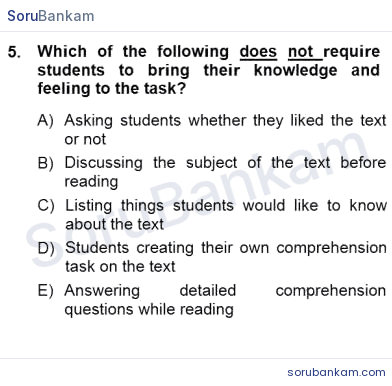
Which of the following does not require students to bring their knowledge and feeling to the task? A) Asking students whether they liked the text or not B) Discussing the subject of the text before reading r." C) Listirig things students Would like to know D) * /: about the text b) Students creating their own comprehension task on the text E) Answering detailed comprehension questions while reading
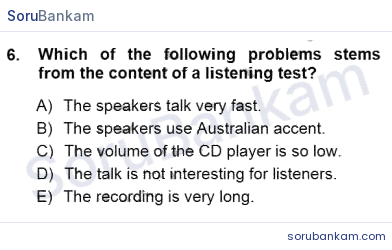
6. Which of the following problems stems from the cootert or a listening test?. B) The 6peakers use Australian accent.
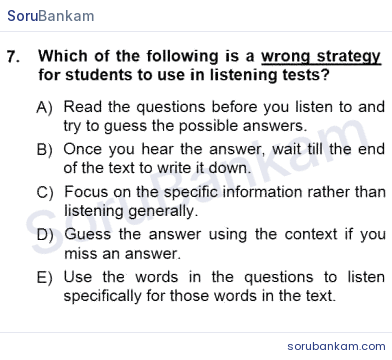
Which of the following is a wrong stratesy for students to use in listening tests? A) Read the questions before you listen to and try to guess the possible answers. •B) Once you hear the answer, wait till the end of the text to nte it down. C) Focys on the specific information rather than gatening generally. Guess the answer using the context if you miss an answer. E) Use the words in the questions to listen specifically for those words in the text.
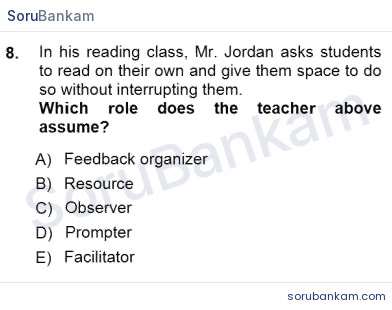
In his reading class, Mr. Jordan asks students to read on their own and give them space to do so without interrupting them: Which rote does the teacher above assume? A) Feedback organizer B) Resource. "' C) Observer D) i ! D) Prompter E) Facilitator
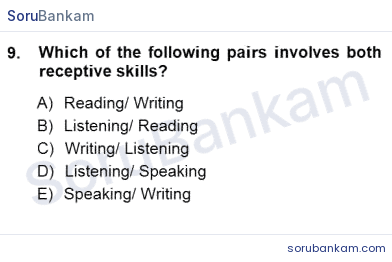
Which of the foliowing pairs involves both receptive skills? A) Reading/ Writing B) Listening/ Reading C) • C) Writing/ Listening D) Listening/ Speaking E) Speąkiag) Writing
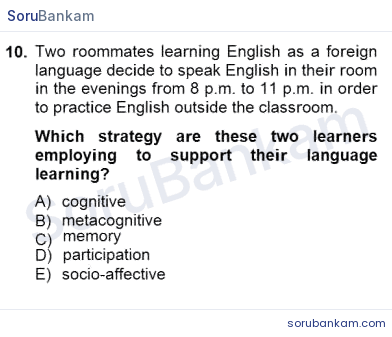
Two roommates learning English as a foreign language décide to speak English in their room in the evenings from 8 p.m. to 11 p.m. in order • to practice English outside the classroom. Which strategy are these two learners. employing support their language learning? A) cogative B) metacognitive C) memory D) participation E) socio-affecțive
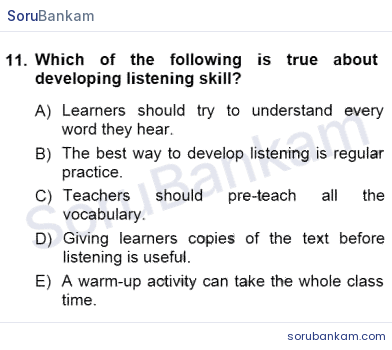
11. Which of the following is true about developing listening skill? A) Learners should try to understan so every word they hear. B) The best way to develop listent is regular practice. C) Teachers!'. should ach all? the vocabulary. Giving leamers copies of the text. befóre listening is useful E) A warm-up : can take ti é whole class time:
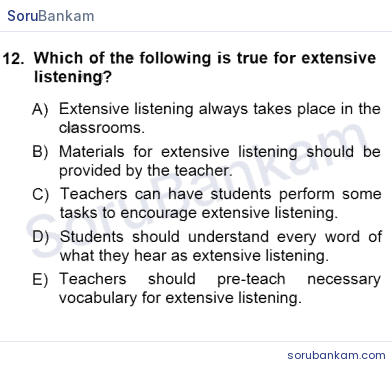
12. Which a he following is true for extensive Extensive listening always takes place in the lessrooms. Materials for extensive listening should be provided by the teacher. C) Teachers can have students perform some tasks to encourage extensive listening. i D) Students should understand every word of what they hear as extensive listening. E) Teachers should pre-tesich necessary vocabulary for extensive listening.
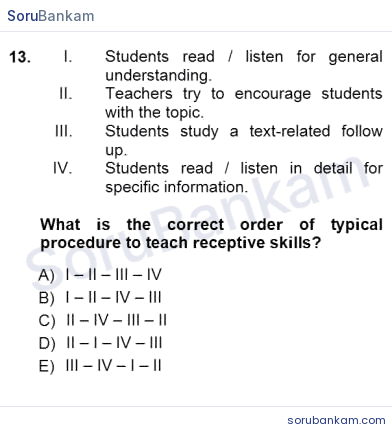
1. Students read / listen for general understanding. II. Teachers try to encourage students with the topic. lil: Students study a text-related follow up. IV. students read / listen in - detail for pecific information... What is the correct order typical procedure to teach receptive skills? A) I - II - III - B) I-N- IV - C) G) II - IV- II-II D) II - 1- IV - fIf stemi E) !) - IV- I-H
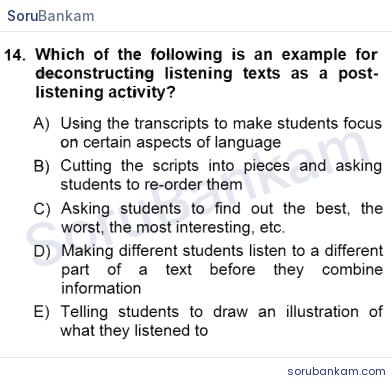
14. Which of theolowing is an example for constructing listening texts as a post- Vistening a ativity? 'A) Waigo the transcripts ta make students focus. certain aspects of language Cutting the scripts into pieces and asking students to re-order them C) Asking students to find out the best, the •!. worst, the most interesting, etc. D) Making different students listen to a different part of a text before they combine information Telling students to draw an illustration of what they listened to
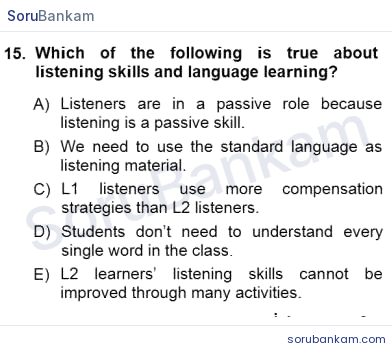
15. Which of the following is true about listening skills and language learning? A) Listeners are in a passive role because listening is a passive skill. •B) We need to use the standard language as listening material: ) L1 listeners use more: "compensation stalegies than L2 listeners. i: "D) Students don't need to understand every single word in the class. E) L2 learners'. listening skills cannot be improved through many activities.
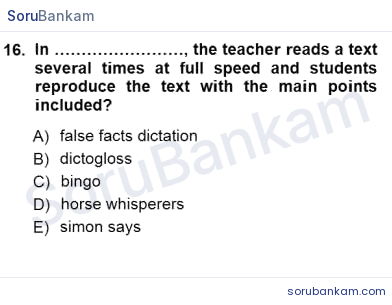
16. in... •., the teacher reads a text several times at full speed and students reproduce the text with the main points included? A). false facts dictation B) dictogloss C) bingo horset whisperers *E) simon says
Which of the following is not one of the ways to have quality teacher talk? A) Summarizing your speech from time to time B) Using facial expressions and body language while talking C) Trying to invoive leamers aş - much possible v' D) Checking students* understanding * ' questioning them E) Using a high volume while talking
18. Which of , the following is false teaching listening to young learnet Aj Young learers can easily liveled the sate, song or text many times. B) Young learners shouta work with texts. Care good C) Stones: with imaginary: materials foryoung leamers. 1) son we amore important ) It is almost imposible to ask young learners site or listening to texts.
Which of the following statement is true? Speaking is one of the receptive skills. B) Students have to produce language in receptive skills. C) It makes sense to integrate different skis. D) Only produstive skills demakd language activatibn. Skills are always separated in real life.
A student is. making some explanations as it is a place where we can study or find books' for the word "library" he cannot remember, hoping that the listener will get the idea. Which strategy does the speaker above use • to deal with difficulty? A) Paraphrasing' B) Discarding C) i: t) Foreignizing D) Improvising E) Structuring