INO307U Okuma ve Dinleme Öğretimi 2014-2015 Final Soruları
20 soru · Final · 2014-2015
INO307U Okuma ve Dinleme Öğretimi dersinin 2014-2015 final sınavı 20 sorudan oluşur; ders AÖF İngilizce Öğretmenliği bölümünde okutulur. Sorular aşağıda sırasıyla yer alır. Doğru cevaplar ve sonucun, testi çözdüğünde görünür.
Önizleme · 20 soru. Cevaplamak ve sonucunu görmek için sınavı başlat.
Sorular
20 soru
Soru 1
Soru 2
Soru 3
Soru 4
Soru 5
Soru 6
Soru 7
Soru 8
Soru 9
Soru 10
Soru 11
Soru 12
Soru 13
Soru 14
Soru 15
Soru 16
Soru 17
Soru 18
Soru 19
Soru 20
Sınav modunda süre tutulur, doğru cevaplar ve sonucun sınav bitince görünür.
Dersin üniteleri
INO307U Okuma ve Dinleme Öğretimi ders sayfası: bütün sınavlar ve üniteler
Soruların metni (otomatik okuma)
Görsellerden otomatik okunmuştur; hata içerebilir. Sorular, görsellerdeki hâliyle geçerlidir.
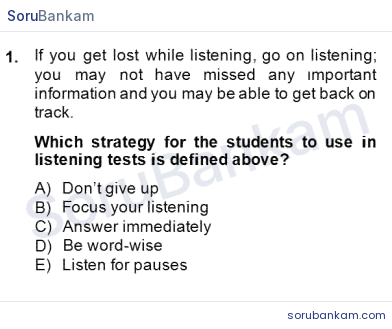
1. if you get lost while listening, go on listening; you may not have missed any important information and you may be able to get back on •track. Which strategy for the students to use in. listening tests is defined above? A) Don't give up B) Epcab your listening .. "6) Answer immediately Be word-wise E) Listen for pauses
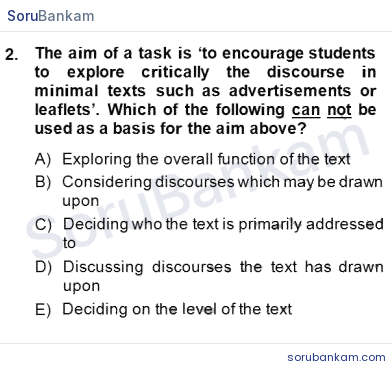
2. The aim of a task is 'to encourage students to explore critically the discourse minimal texts such as advertisements or leaflets. Which of the following can not be used as a basis for the aim above? A) Exploring the overall function of the B) Considering discourses which ekdrawn i. ®) Deciding who the text is pot ly addressi Discussing a discours a text ta ироп E) Deciding on the level of the test
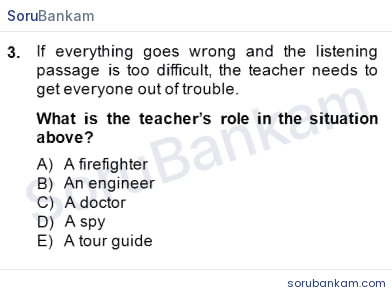
3. everything goes wrong and the listening passage is too difficult, the teacher needs to gef everyone out of trouble. What is the teacher's role in the situation above? A) A firefighter B) An engineer" C) A gottor E) A tour guide
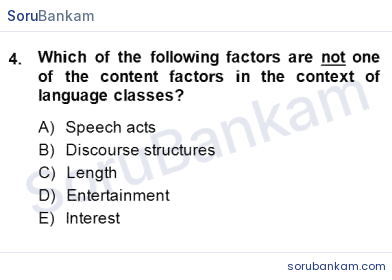
4. Which of the following factors are not one of the content factors in the context of tanguage classes? A) Speech acts B) Discourse structures C) Length D) Entertainment
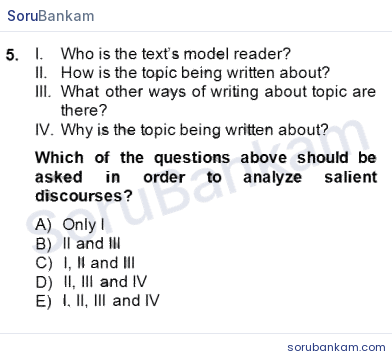
5. I. Who is the text prodel reader? How is the topto being written about? Ill What otherways of writing about topic are there? Randpic being ken aboute, Whic analyz salient only 1• ll a Kitap™ C) D) I, ll and IV
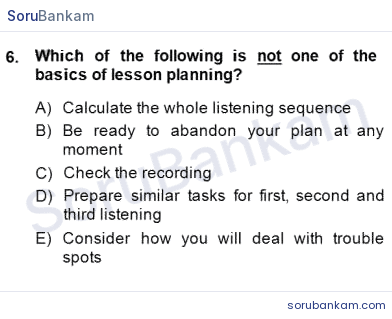
6. h of the following is not one of the basics of lesson planning? A) Calculate the whole listaning sequence B) Be ready to abandon your plan at any moment C) Check the rpoording Prepare similar tasks for first, second and unlid listening 'E Consider how you will deal with trouble spots
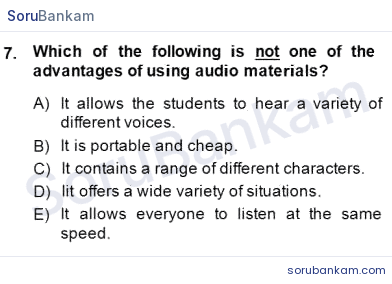
7. Which of the following is not one of the advantages of using audio materials? A) It allows the students to, hear a variety of different voices. •B) It is portable and cheap. C) it contains a range of different charadters. D) lit offere at wide variety of sitations. lo illows everyone to listen at the same • 5/174 speed.
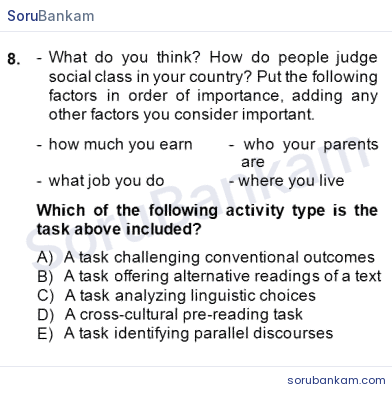
- What do you think? How do people judge social class in your country? Put the following factors in order of importance, adding any other factors you considerimportant. . - how much you earn - who your parents are - what job qu do - where you live Which of the following activity type is the ¡ task above included? A) A task challenging conventional outcomes B) A task offenng altemative readings of a text C) A task analyzing linguistic choices: D) Across-cultural pre-reading task E) A task identifying paratel discourses
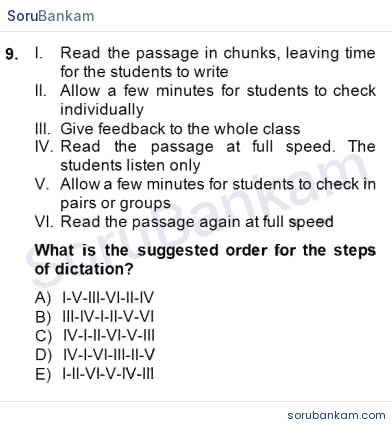
9. 1. Read the passage in chunks, leaving time for the students to write II. Allow a few minutes for students to check individually Ill Give feedback to the whole class IV. Read the passage at full speed. The students listen only V. Allow a few rhinutes for students to s pairs or groups .,Kl Read the passage again at full se what as the suggested or grate step of dictation? C) IV--I-VI-v-I/ nive D) IV-I-VI-II-ll E) -I-VPV
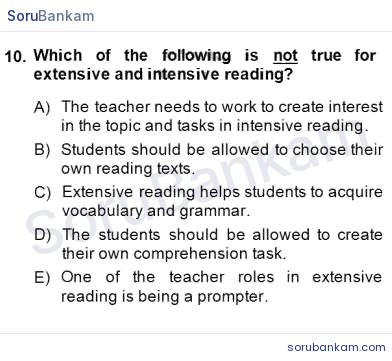
Which of the is not true for extensive and iffensiye reading? A) The teacher needs to work to create interest in the topic and tasks in intensive reading. B) Students should be allowed to choose ther own reading, texts. C) Extensive reading heips students to acquire vocabulary and grammar: D) ¡* "B) The students should be allowed to create their own comprehension task. E) One of the teacher roles in extensive reading is being a prompter.
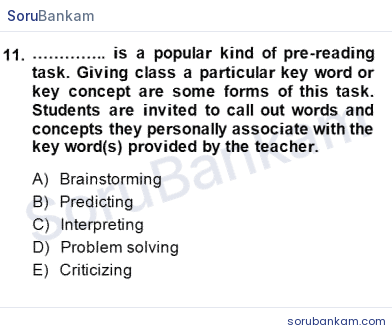
is a popular kind of pre-reading task. Giving class a particular key word or key concept are some forms of this task. Students are invited to call out words and concepts they personally associate with the •key words) provided by the teacher. A) Brainstorming' B) Predicting C) i. G) interpreting D) Prablem solving. rictemi E) Criticizing
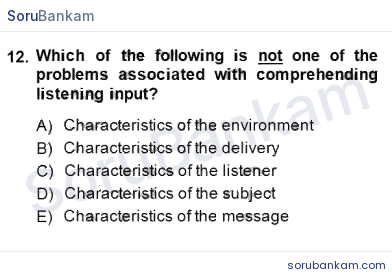
12. Which of problema sociated listani pout? Steristics environme Characteristcs the deliver Character tige of the list Ó) Chattênsios of thesaut E) chorack ristics otthe giessage
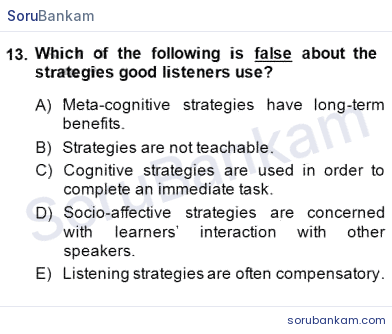
de the following is false about the 13 Greates tood steins sta A) A Meta-cognitive strategies. have long-term benefits. B) Strategies are not teachable. C) Cognitive stategies are used a order to compleje an immediate task. D) . Socio-affective strategies are concerned with learners' interaction with other speakers. E) Listening strategies are often compensatory.
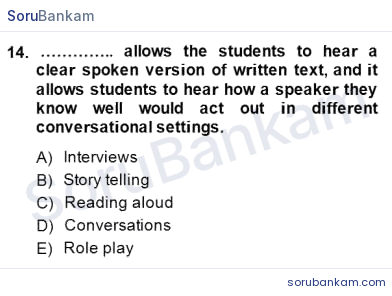
14. ... allows the students to hear a clear spoken version of written text, and it allows students to hear how a speaker they know well woul act out in different conversational settings. A) Interviews 8) Story telling * C) Rpading aloud it conversations E) Role play
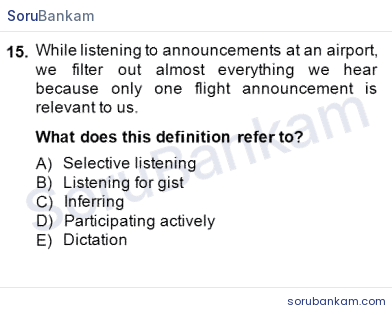
While listening to announcements at an airport; we filter out almost everything we hear because only pre flight announcement is • relevantto us. What does this definition refer to? A) Selective listening B) Listening for gist C) Intering D) D› Participating actively E) Dictation
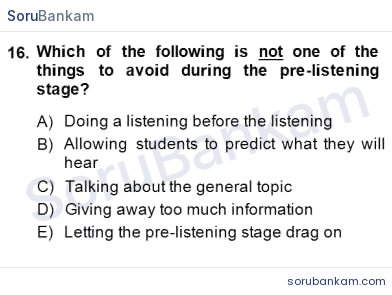
Which of the tollowing is not one of the things avoid during the pre-listening stage? A) Doing a listening before the listening B) Allowing students to predict what they Wit hear C) Talking about the general topic D) Siving away too much information E) * "'E) Letting the pre-listening stage drag
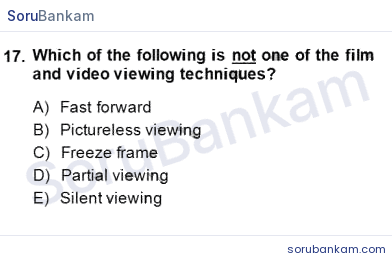
17. Which of the fellowing is nots Not the fit? and video viewing technie A) Fast forward Freeze trame D) Parbal viewie E) Silent revies
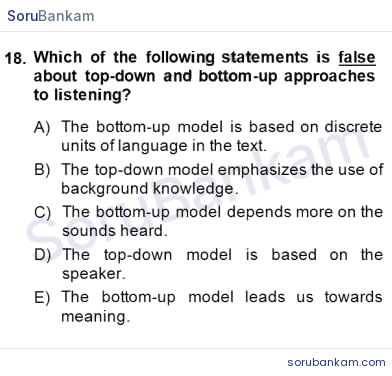
1B. Which of the following? tatements is false about top-down atom-up approaches to listening? A) The bottom-up model is based on discrete units of language in the text B) The top-down model emphasizes the use of background knowledge... C) The bottom-up model depends more on the sounds heard. D) The top-down model is based on the speaker. E) The bottom-up model leads us towards meaning.
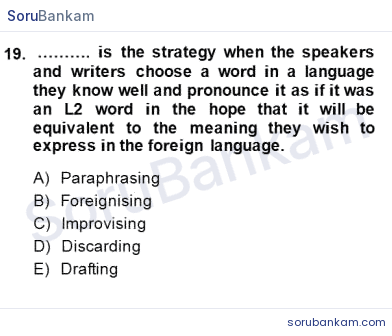
... is the strategy when the speakers and writers choose a word in å language they know well and pronounce if as if it was an L2 word in the hope that it will be equivaient to the meaning they wish to express in the foreign language. A) Paraphrasing B) Egregitsing C) improvising D) Discarding rictemi E) Drafting
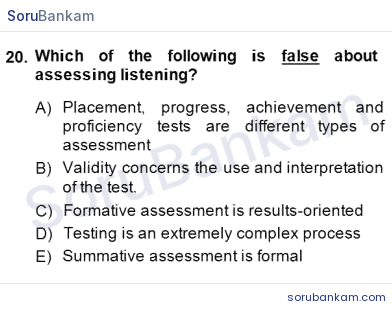
20. Which of the following is false about assessing listening? • A) Placement, progress, achievement and proficiency tests are different types of assessment B) Validity concerns the use and interpretation of the test c) Formative assessmentis results-oriented i* "b) Testing is an extremely complex process E) Summative assessment is formal •