IKT108U Introduction to Economics 2 2018-2019 Yaz Okulu Soruları
20 soru · Yaz okulu · 2018-2019
IKT108U Introduction to Economics 2 dersinin 2018-2019 yaz okulu sınavı 20 sorudan oluşur; ders AÖF İktisat (İngilizce) bölümünde okutulur. Sorular aşağıda sırasıyla yer alır. Doğru cevaplar ve sonucun, testi çözdüğünde görünür.
Önizleme · 20 soru. Cevaplamak ve sonucunu görmek için sınavı başlat.
Sorular
20 soru
Soru 1
Soru 2
Soru 3
Soru 4
Soru 5
Soru 6
Soru 7
Soru 8
Soru 9
Soru 10
Soru 11
Soru 12
Soru 13
Soru 14
Soru 15
Soru 16
Soru 17
Soru 18
Soru 19
Soru 20
Sınav modunda süre tutulur, doğru cevaplar ve sonucun sınav bitince görünür.
Dersin üniteleri
Ünite özetleri ve konu anlatımları
- 1. Ünite: Basic Concepts And National Income Accounting
- 2. Ünite: Determination Of National Income
- 3. Ünite: Equilibrium İn The Economy
- 4. Ünite: Fiscal Policy And Aggregate Expenditures
- 5. Ünite: Money And The Economy
- 6. Ünite: Aggregate Demand-Aggregate Supply Analysis And Economic Stability
- 7. Ünite: International Trade And Finance
- 8. Ünite: Economic Growth And Development
IKT108U Introduction to Economics 2 ders sayfası: bütün sınavlar ve üniteler
Soruların metni (otomatik okuma)
Görsellerden otomatik okunmuştur; hata içerebilir. Sorular, görsellerdeki hâliyle geçerlidir.
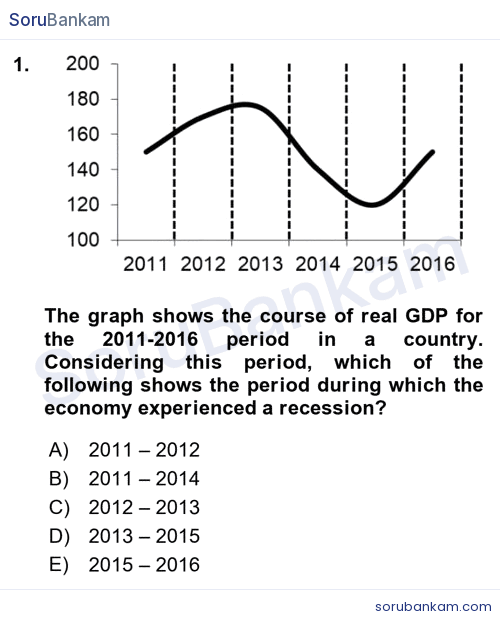
2011 2012 2013 2014 2015 2016 The graph shows the course of real GDP for the 2011-2016 period in a country. Considering this period, which of the following shows the period during which the economy experienced a recession? A) 2011 - 2012 B) 2011 - 2014 C) 2012 - 2013 D) 2013 - 2015 E) 2015 - 2016
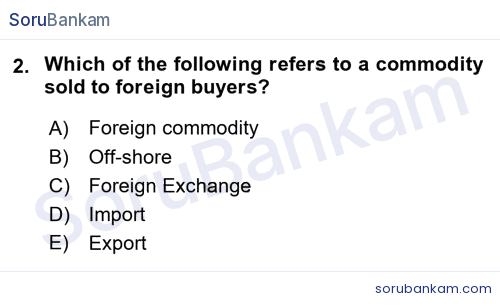
Which of the following refers to a commodity? sold to foreign buyers? A) Foreign commodity B) Off-shore C) Foreign Exchange D) Import: E) Export
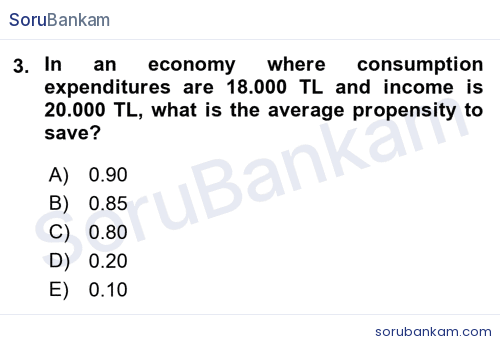
In an economy where consumption expenditures are 18.000 TL and income is 20.000 TL, what is the average propensity to save? A) 0.90 B) 0.85 C) 0.80 D) 0.20 E) 0.10
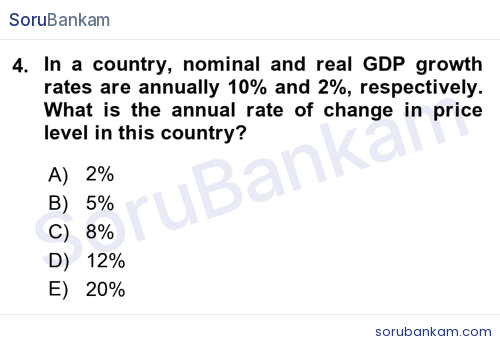
In a country, nominal and real GDP growth rates are annually 10% and 2%, respectively. What is the annual rate of change in price level in this country? A) 2% B) 5% C) 8% D) 12% E) 20%
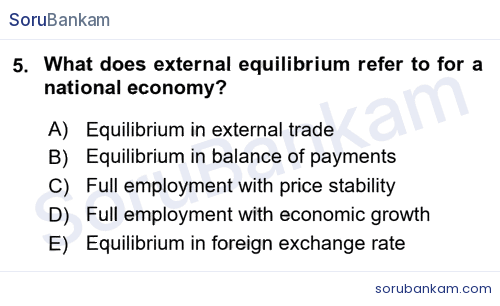
What does external equilibrium refer to for a national economy? A) Equilibrium in external trade B) Equilibrium in balance of payments C) , *C) Full employment with price stability D) Full employment with economic growth E) Equilibrium in foreign exchange rate
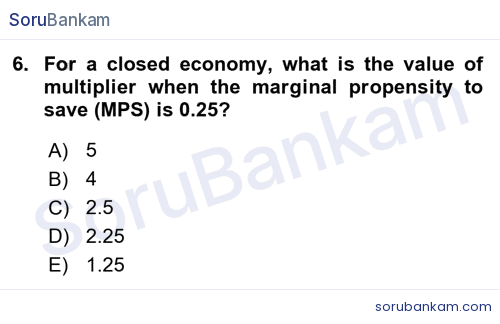
• 6. For a closed economy, what is the value of multiplier when the marginal propensity to save (MPS) is 0.25? A) 5 • B) 4 C) 2.5 D) 2.25 E) 1.25
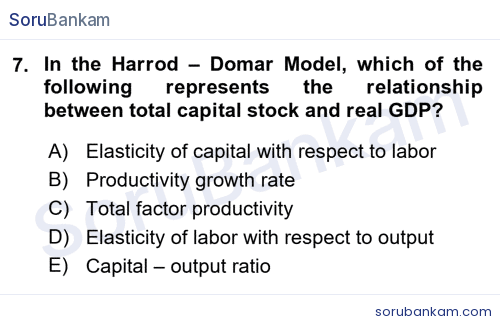
In the Harrod - Domar Model, which of the following represents the relaționship between total capital stock and real GDP? A) Elasticity of capital with respect to labor B) Productivity growth rate C) Total factor productivity D) Elasticity of labor with respect to output E) Capital - output ratio
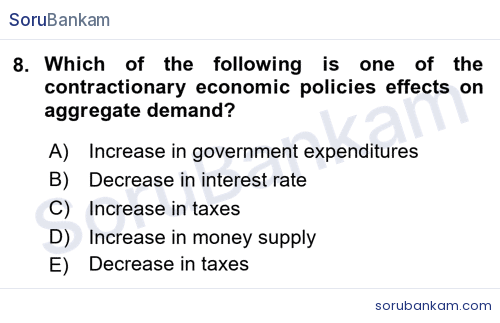
Which of the following is one of the contractionary economic policies effects on aggregate demand? A) Increase in government expenditures B) Decrease in interest rate C) Increase in taxes D) Increase in money supply E) Decrease in taxes
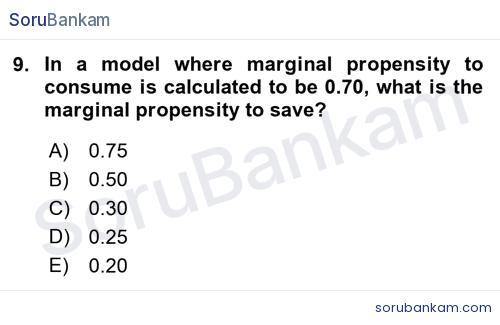
In a model where marginal propensity to consume is calculated to be 0.70, what is the marginal propensity to save? A) 0.75 B) 0.50 C) 0.30 D) 0.25 E) 0.20
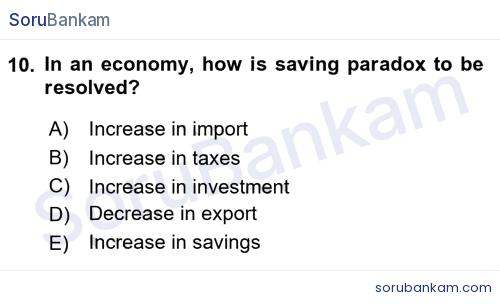
10. In an economy, how is saving paradox to be resolved? A) Increase in import Increase in taxes C) Increase in investment D) Decrease in export Increase in savings
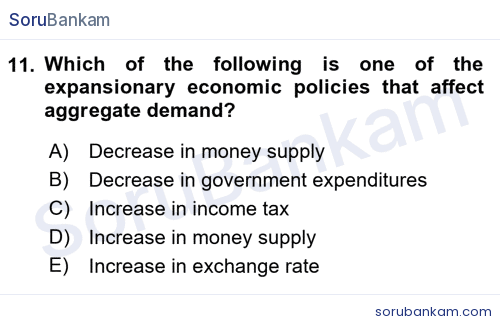
Which of the following is one of the expansionary economic policies that affect aggregate demand? A) Decrease in money supply B) Decrease in govemment expenditures C) Increase in income tax D) Increase in money supply E) Increase in exchange rate
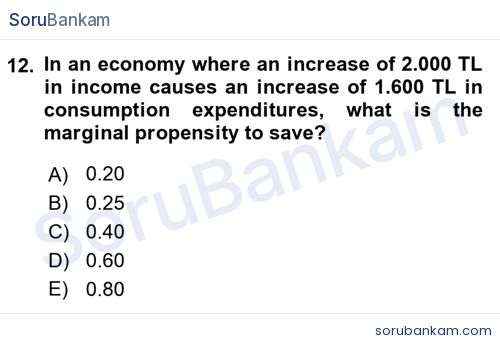
In an economy where an increase of 2.000 TL in income causes an increase of 1.600 TL in consumption expenditures, what is the marginal propensity to save? A) 0.20 B) 0.25 C) 0.40 D) 0.60 E) 0.80
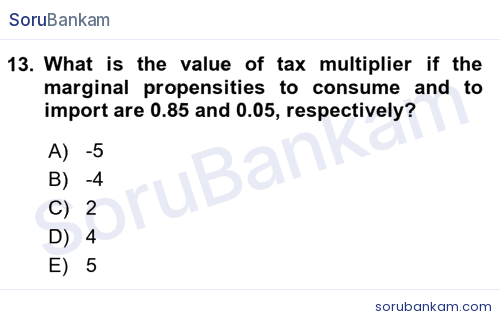
13. What is the value of tax multiplier if the marginal propensities to consume and to import are 0.85 and 0.05, respectively? A) B) -4 G) 2 D)
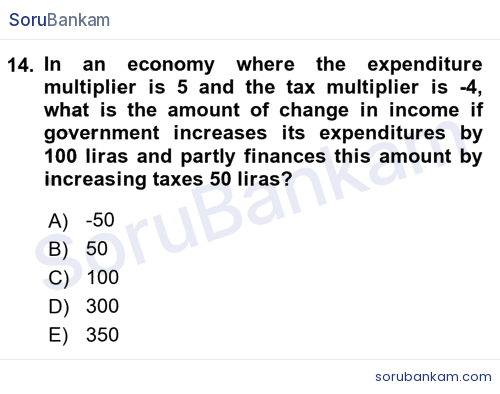
In an economy where the expenditure multiplier is 5 and the tax multiplier is -4, what is the amount of change in income if government increases its expenditures by top liras and partly finances this amount by ¡aircreasing taxes 50 liras? A) -50 B) 50 C) 100 D) 300 E) 350
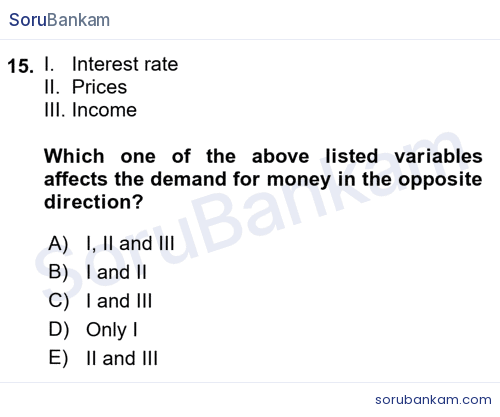
I. Interest rate II. Prices Ili. Income Which one of the above listed variables affects the demand for money in the opposite direction? A) I, Il and fil B) I and C) I and III D) Only ! E) II and III
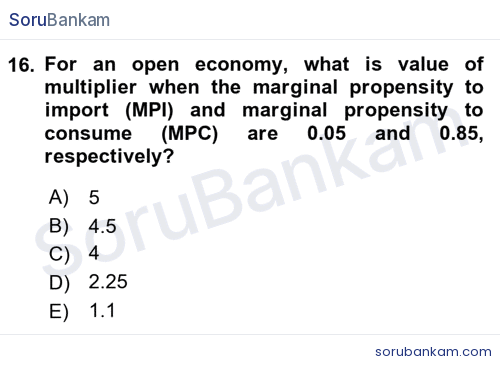
For an open economy, what is value of multiplier when the marginal propensity to import (MPI) and marginal propensity to consume (MPC) are 0.05 and 0.85, respectively? A) 5 B) 4.5 C) 4 D) 2.25 E) 1.1
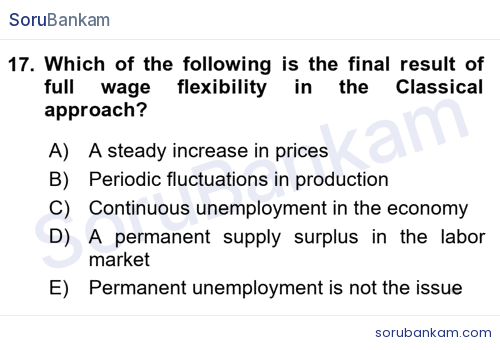
Which of the following is the final result of full wage flexibility in the Classical approach? A) A steady increase in prices B) Periodic fluctuations in production C) Continuous unemployment in the economy D) A permanent supply surplus in the labor market E) Permanent unemployment is not the issue,
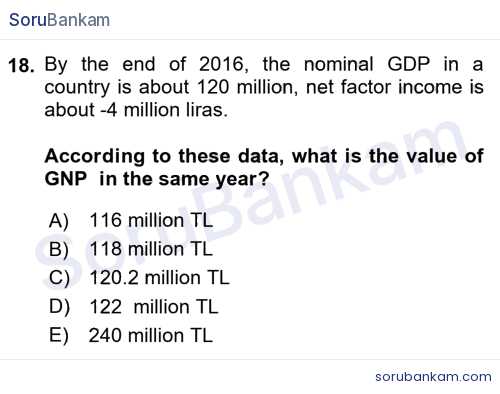
18. By the end of 2016, the nominal GDP in a country is about 120 milion, net factor inçome Is about -4 million liras. According to these data, what is the value of GNP in the same year? A) 116 million TL B) 118 million TL c) 120.2 million TL • D) 122 million TL E) 240 million TL
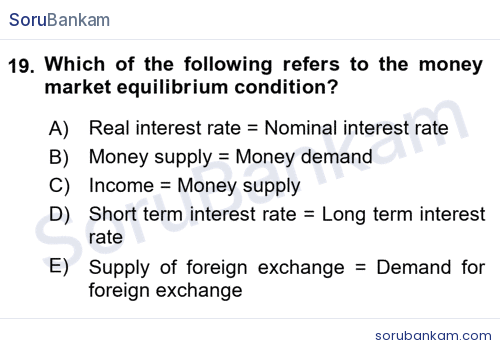
Which of the following refers to the money market equilibrium condition? A) Real interest rate = Nominal interest rate B) Money supply = Money demand C) Income = Money supply D) Short term interest rate = Long term interest rate E) Supply of foreign exchange = Demand for foreign exchange
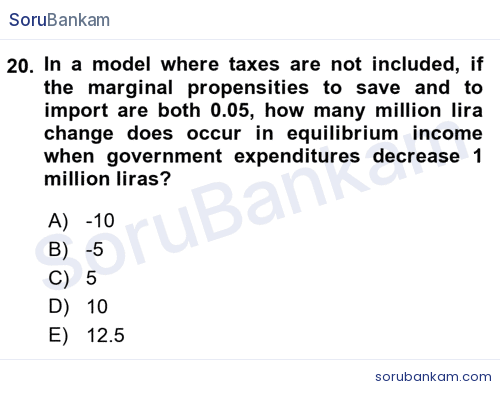
In a model where taxes are not included, if the marginal propensities to save and to import are both 0.05, how many million lira change does occur in equilibrium income when government expenditures decrease 1 million liras? A) -10 B) -5 C) 5 D) 10 E) 12.5