IKT108U Introduction to Economics 2 2023-2024 Yaz Okulu Soruları
20 soru · Yaz okulu · 2023-2024
IKT108U Introduction to Economics 2 dersinin 2023-2024 yaz okulu sınavı 20 sorudan oluşur; ders AÖF İktisat (İngilizce) bölümünde okutulur. Sorular aşağıda sırasıyla yer alır. Doğru cevaplar ve sonucun, testi çözdüğünde görünür.
Önizleme · 20 soru. Cevaplamak ve sonucunu görmek için sınavı başlat.
Sorular
20 soru
Soru 1
Soru 2
Soru 3
Soru 4
Soru 5
Soru 6
Soru 7
Soru 8
Soru 9
Soru 10
Soru 11
Soru 12
Soru 13
Soru 14
Soru 15
Soru 16
Soru 17
Soru 18
Soru 19
Soru 20
Sınav modunda süre tutulur, doğru cevaplar ve sonucun sınav bitince görünür.
Dersin üniteleri
Ünite özetleri ve konu anlatımları
- 1. Ünite: Basic Concepts And National Income Accounting
- 2. Ünite: Determination Of National Income
- 3. Ünite: Equilibrium İn The Economy
- 4. Ünite: Fiscal Policy And Aggregate Expenditures
- 5. Ünite: Money And The Economy
- 6. Ünite: Aggregate Demand-Aggregate Supply Analysis And Economic Stability
- 7. Ünite: International Trade And Finance
- 8. Ünite: Economic Growth And Development
IKT108U Introduction to Economics 2 ders sayfası: bütün sınavlar ve üniteler
Soruların metni (otomatik okuma)
Görsellerden otomatik okunmuştur; hata içerebilir. Sorular, görsellerdeki hâliyle geçerlidir.
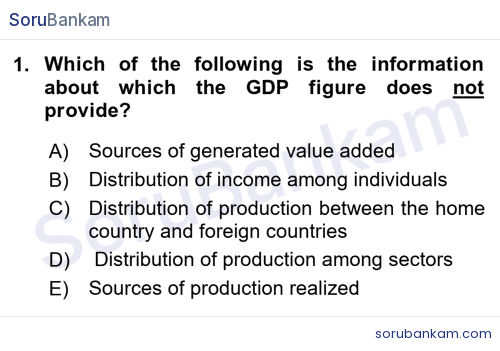
Which of the following is the information about which the GDP figure does not provide? A) Sources of generated value added B) Distribution of income among individuals C) Distribution of production between the home country and foreign countries D) Distribution of production among sectors E) Sources of production realized
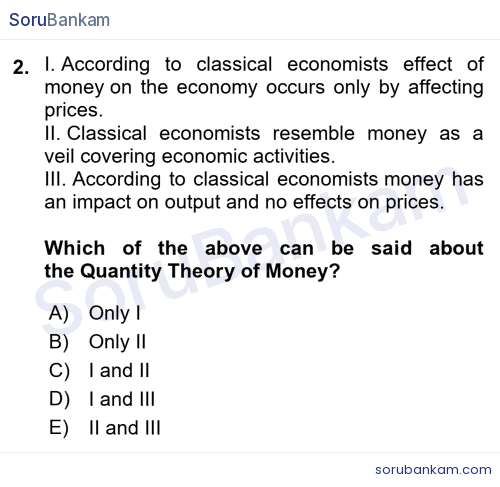
I. According to classical economists effect of money on the economy occurs only by affecting prices. li. Classical economists resemble money as a veil covering economic activities. III. According to classical economists money, has an impact on output and no effects on prices. Which of the above can be said about the Quantity Theory of Money? A) Only B) Only C) I and I/ D) I and Ill E) Il and Ill
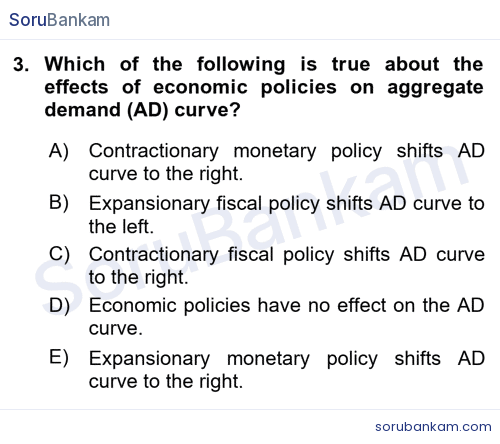
Which of the following is true about the effects of economic policies on aggregate demand (AD) curve? A) Contractionary monetary policy shifts AD curve to the right. B) Expansionary fiscal policy shifts AD curve to the left. C) Contractionary fiscal policy shifts AD curve to the right. D) Economic policies have no effect on the AD curve. E) Expansionary monetary policy shifts AD curve to the right.
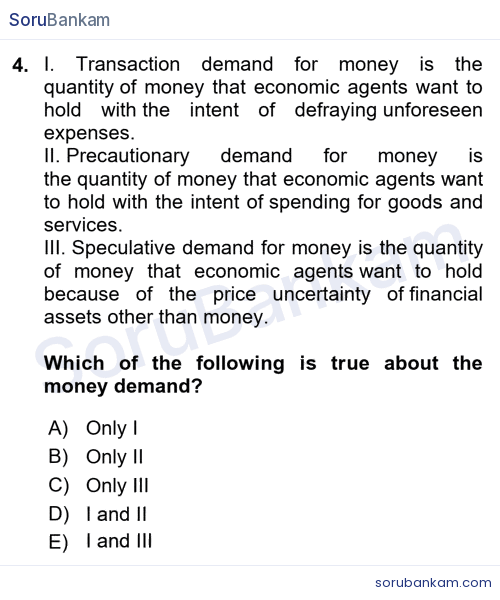
4. I. Transaction demand for money is the quantity of money that economic agents want to hold with the intent of defraying unforeseen expenses. II. Precautionary demand for money is the quantity of money that economic agents want to hold with the intent of spending for goods and services. III. Speculative demand for money is the quantity of money that economic agents want to hold because of the price uncertainty of financial assets other than money. Which of the following 'is true about the money demand? A) Only l B) Only II 1. 7 D) Tánd Il E) land ili
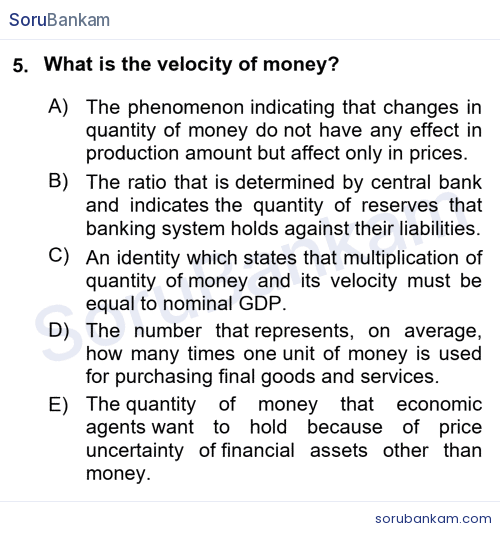
What is the velocity of money? A) The phenomenon indicating that changes in quantity of money do not have any effect in production amount but affect only in prices. B) The ratio that is determined by central bank and indicates the quantity of reserves that banking system holds against their liabilities. C) An identity which states that multiplication of quantity of money and its velocity must be equal to nominal GDP. D) The number that represents, on average, how many times one unit of money is used for purchasing final goods and services. E) The quantity of money that economic agents want to hold because of price uncertainty of financial assets other than money-
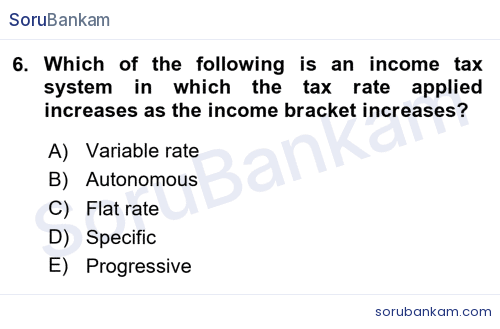
Which of the following is an income tax system in which the tax rate applied increases as the Income bracket increases? A) Variable rate B) Autonomous C) Flat rate D) Specific E) Progressive
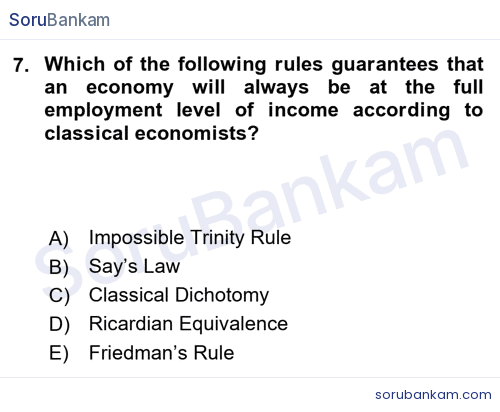
Which of the following rules guarantees that an economy will always be at the full employment level of income according to classical economists? A) Impossible Trinity Rule B) Say's Law C) Classical Dichotomy D) Ricardian Equivalence E) Friedman's Rule
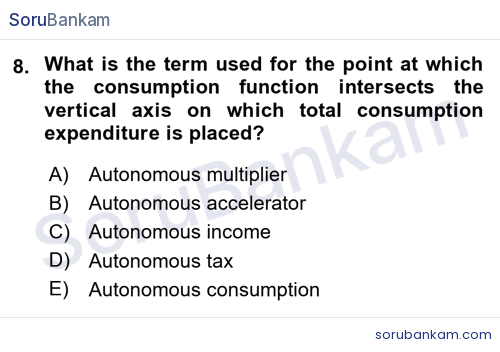
What is the term used for the point at which the consumption function intersects the vertical axis on which total consumption expenditure is placed? A) Autonomous multiplier B) Autonomous accelerator C) Autonomous income D) Autonomous tax E) Autonomous consumption
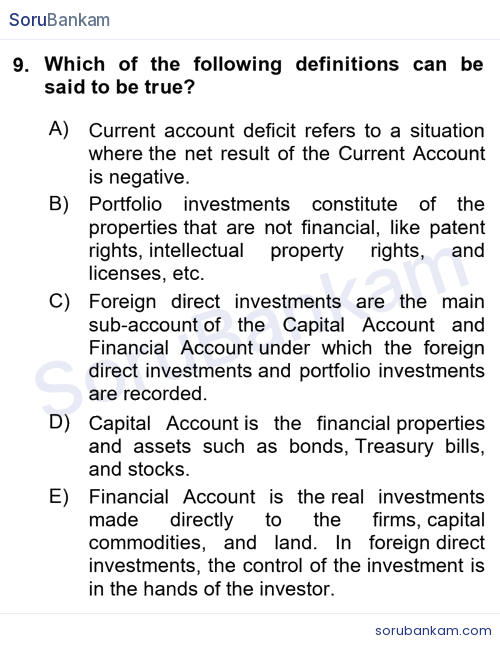
Which of the following definitions can pe said to be true? A) Current account deficit refers to a situation where the net result of the Current Account is negative. B) Portfolio investments constitute to (> properties that are not financial, like patent rights; intellectual Roperty rights, and licenses, etc. C) Foreign direct investments are the main sub-account of the Capital _ Account and Financial Account under, which the foreign directunvestments and portfolio investments are recorded. D) Capital Account is the financial properties and assets such as bonds, Treasury bills, and stocks. E) Financial Account is the real investments made directly to the firms, capital commodities, and land. In foreign direct investments, the control of the investment is in the hands of the investor.
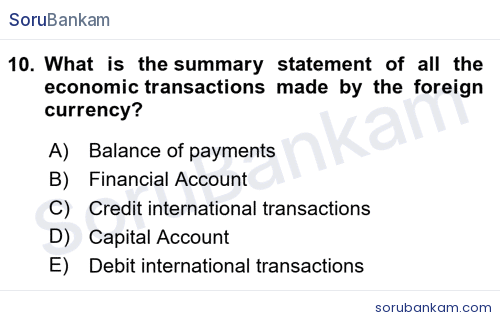
What is the summary statement of all the economic transactions made by the foreign currency? A) Balance of payments: B) Financial Account C) Credit international transactions D) Capital Account E) Debit international transactions
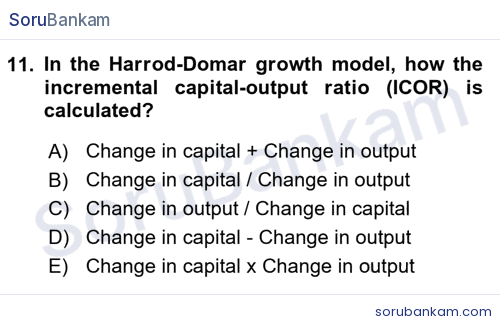
In the Harrod-Domar growth model, how the incremental capital-output ratio (ICOR) Is calculated? A) Change in capital + Change in output B) Change in capital / Change in output C) Change in output / Change in capital' • D) Change in capital - Change in output E) Change in capital x Change in output
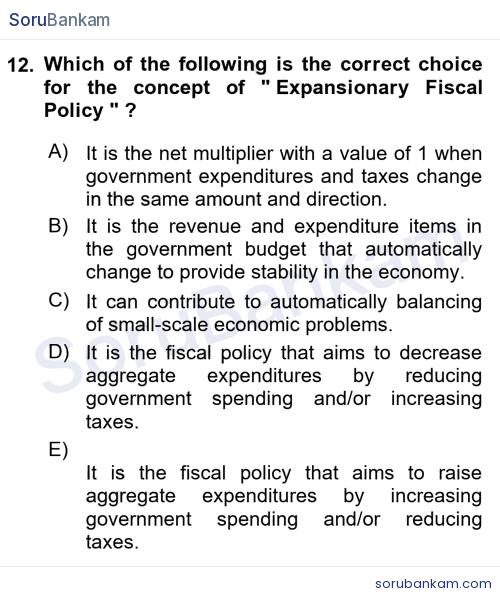
12. Which of the following is the correct choice for the concept of "Expansionary Fiscal Policy " ? • '' A) Iris the net multiplier With a value of 1 when government expenditures and taxes change in the same amount and direction. B) It is the revenue and expenditure items in the govethment budget that automatically change to provide stability in the economy. i C) It can contribute to automatically balancing of small-scale eponomic problems. D) It is the fiscal policy that aims to decrease aggregate expenditures by reducing • government spending and/or increasing taxes. It is the fiscal policy that aims to raise aggregate expenditures by increasing *• government spending and/or reducing taxes.
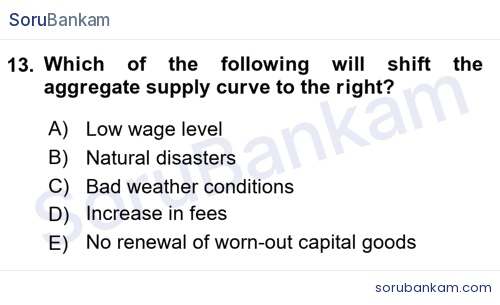
Which of the following will shift the aggregate supply curve to the right? A) Low wage level B) Natural disasters C) Bad weather conditions D) Increase in fees E) No renewal of worn-out capital goods
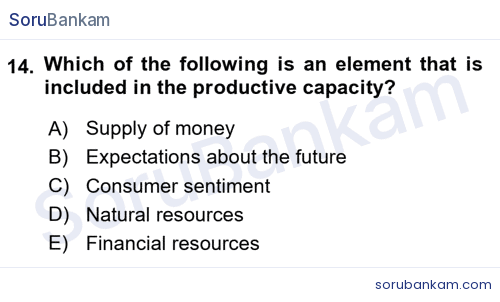
Which of the following is an element that is included in the productive capacity? A) Supply of money B) Expectations about the future C) Consumer sentiment D) Natural resources E) Financial resources
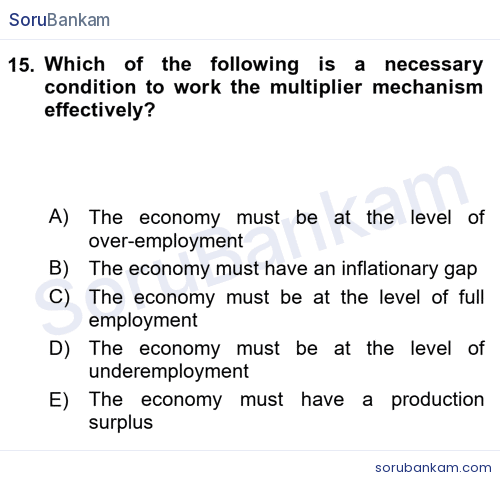
Which of the following is a necessary condition to work the multiplier mechanism effectively? A) The economy must be at the level of over-employment B) The economy must have an inflationary gap C) The economy must be at the level of full employment D) The economy must be at the level of underemployment. E) The economy must have a production surplus
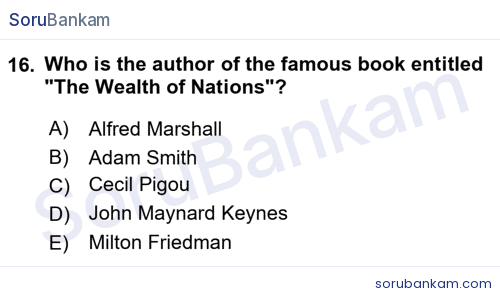
Who is the author of the famous book entitled A) "The Wealth of Nations"? Alfred Marshall B) Adam Smith C) Cecil Pigou 1=1. D) John Maynard Keynes E) Milton Friedman
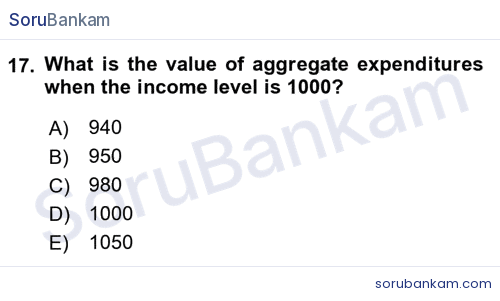
What is the value of aggregate expenditures when the income level is 1000? A) 940 N.° B) ‹950 C) 980 D) 1000 E) 1050
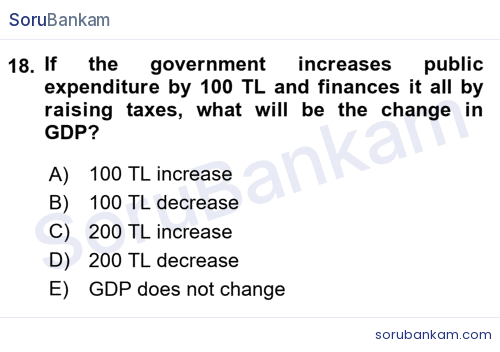
If the government increases public expenditure by 100 TL and finances it all by raising taxes, what will be the change in GDP? A) 100 TL increase B) 100 TL decrease C) 200 TL increase D) 200 TL decrease E) S GDP does not change
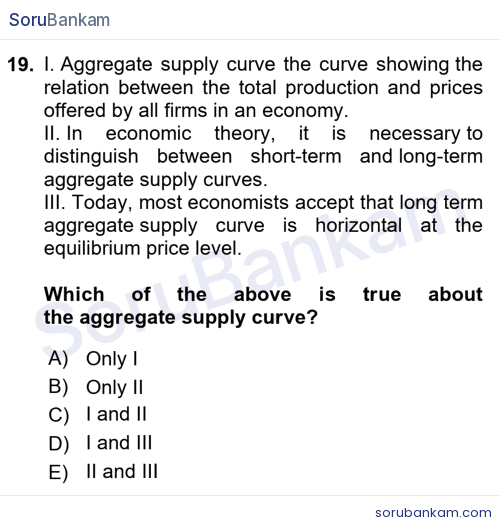
I. Aggregate supply curve the curve showing the relation between the total production and prices offered by all firms in an economy. II. In economic theory, it is necessary to distinguish between short-term and long-term aggregate supply curves. III. Today, most economists accept that lorig term aggregate supply curve is horizontal at the equilibrium price level. Which of the above is true about the aggregate supply curve? A) Only B) Only C) I and D) land ill E) Il and III.' •
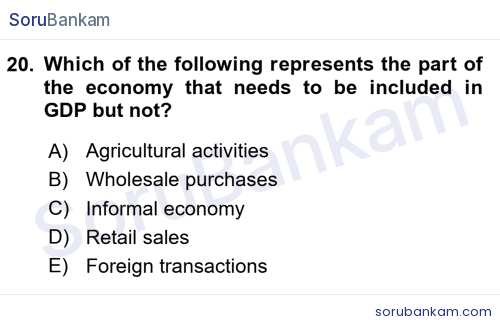
Which of the following represents the part of the economy that needs to be included in GDP but not? A) Agricultural activities B) Wholesale purchases C) Informal economy D) Retail sales E) Foreign transactions