IKT108U Introduction to Economics 2 2023-2024 Final Soruları
20 soru · Final · 2023-2024
IKT108U Introduction to Economics 2 dersinin 2023-2024 final sınavı 20 sorudan oluşur; ders AÖF İktisat (İngilizce) bölümünde okutulur. Sorular aşağıda sırasıyla yer alır. Doğru cevaplar ve sonucun, testi çözdüğünde görünür.
Önizleme · 20 soru. Cevaplamak ve sonucunu görmek için sınavı başlat.
Sorular
20 soru
Soru 1
Soru 2
Soru 3
Soru 4
Soru 5
Soru 6
Soru 7
Soru 8
Soru 9
Soru 10
Soru 11
Soru 12
Soru 13
Soru 14
Soru 15
Soru 16
Soru 17
Soru 18
Soru 19
Soru 20
Sınav modunda süre tutulur, doğru cevaplar ve sonucun sınav bitince görünür.
Dersin üniteleri
Ünite özetleri ve konu anlatımları
- 1. Ünite: Basic Concepts And National Income Accounting
- 2. Ünite: Determination Of National Income
- 3. Ünite: Equilibrium İn The Economy
- 4. Ünite: Fiscal Policy And Aggregate Expenditures
- 5. Ünite: Money And The Economy
- 6. Ünite: Aggregate Demand-Aggregate Supply Analysis And Economic Stability
- 7. Ünite: International Trade And Finance
- 8. Ünite: Economic Growth And Development
IKT108U Introduction to Economics 2 ders sayfası: bütün sınavlar ve üniteler
Soruların metni (otomatik okuma)
Görsellerden otomatik okunmuştur; hata içerebilir. Sorular, görsellerdeki hâliyle geçerlidir.
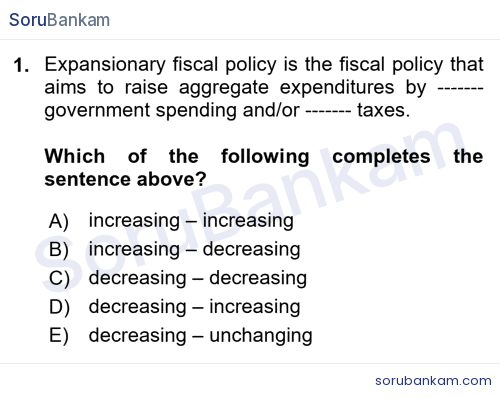
Expansionary fiscal policy is the fiscal policy that aims to raise aggregate expenditures by-.. government spending and/or --- taxes. Which of the following completes the sentence above? A) increasing - increasing B) increasing - decreasing C) decreasing - decreasing D) decreasing - increasing E) decreasing - unchanging
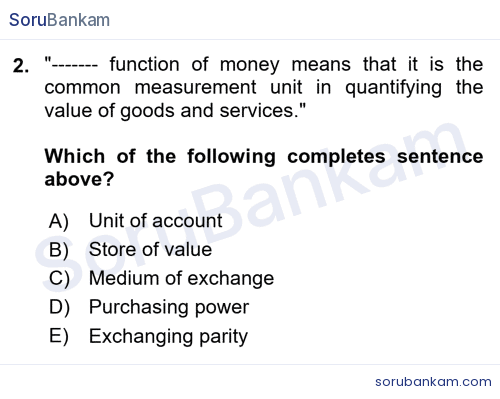
"-_ function of money means that it is the common measurement unit in quantifying the value of goods and services." Which of the following completes sentence above? A) Unit of account B) Store of value C) Medium of exchange D) Purchasing power E) Exchanging parity
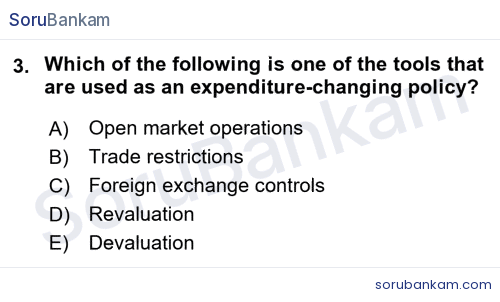
Which of the following is one of the tools that are used as an expepditure-changing policy? A) Open market operations B) Trade restrictions C) Foreign exchange controis D) Revaluation E) Devaluation
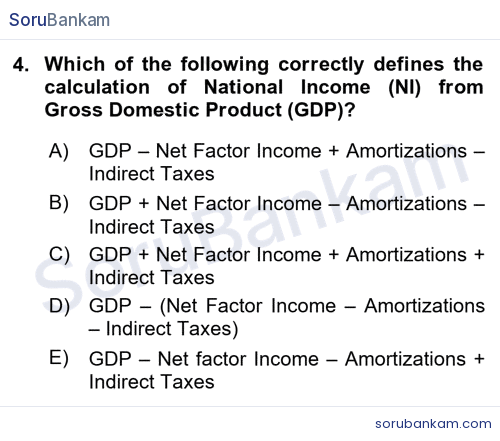
Which of the following correctly defines the calculation of National Income (NI) from Gross Domestic Product (GDP)? A) GDP > Net Factor Income + Amortizations - Indirect Taxes B) GDP + Net Factor Income - Amortizations - Indirect Taxes C) GDP + Net Factor Income + Amortizations + Indirect Taxes D) GDP - (Net Factor Income - Amortizations - Indirect Taxes) E) GDP - Net factor Income - Amortizations + Indirect Taxes
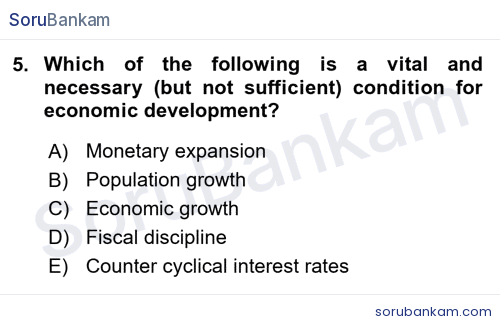
Which of the following is a vital and necessary (but not sufficient) condition for economic development? A) Monetary expansion B) Population growth C) Economic growth D) Fiscal discipline E) Counter cyclical interest rates
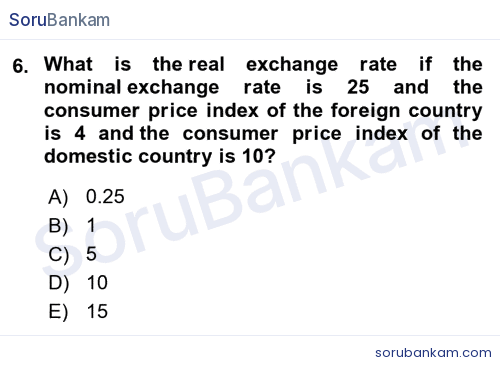
What is the real exchange rate if nominal exchange rate is 25 and the consumer price index of the foreign country is 4 and the consumer price index of the domestic country is 107 A) 0.25 B) 1 C) 5 D) 40 E) "E) 15
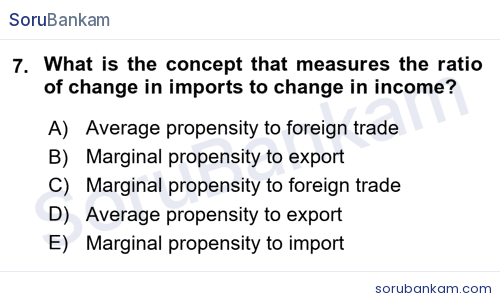
What is the concept that measures the ratio of change in imports to change in income? A) Average propensity to foreign trade B) Marginal propensity to export C) l Marginal propensity to foreign trade D) Average propensity to export E) Marginal propensity to import
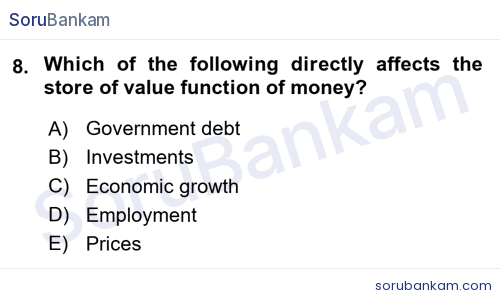
Which of the following directly affects the store of value function of money? A) Government debt B) Investments C) Economic growth D) Employment E) Prices
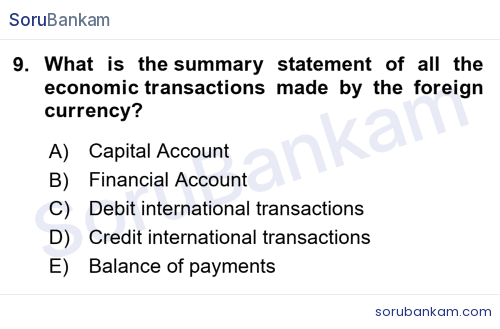
What is the summary statement of all the economle transactlons made by the foreign currency? A) Capital Account B) Financial Account C) Debit international transactions D) Credit international transactions E) Balance of payments
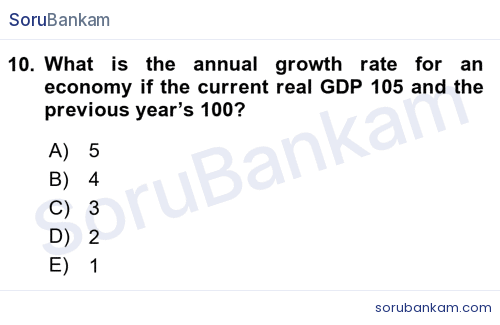
What is the annual growth rate for an economy if the current real GDP 105 and the previous year's 100? A) 5 B) 4 C) 3 D) 2 E) 1
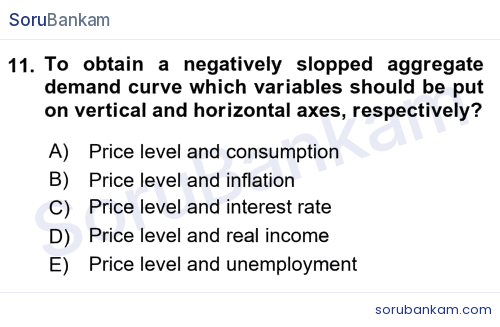
To obtain a negatively slopped aggregate demand curve which variables should be put on vertical and horizontal axes, respectively? A) Price level and consumption B) Price level and inflation C) Price level and inferest rate D) Price level and real income 4 E) Price level and unemployment
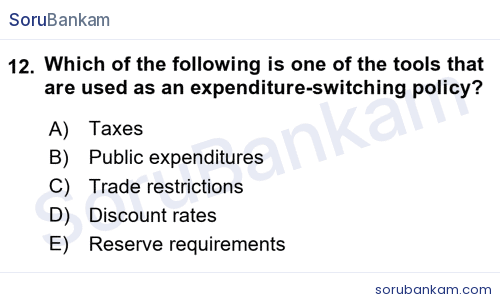
Which of the following is one of the tools that are used as an expenditure-switching policy? A) Taxes B) Public expenditures C) Trade restrictions D) Discount rateș E) Reserve requirements
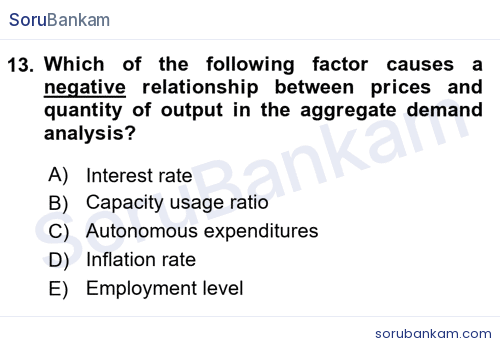
Which of the following factor causes a negative relationship between prices and quantity of output in the aggregate demand analysis? A) Interest rate B) Capacity usage ratio C) Autonomous expenditures D) Infiation rate E) Employment level
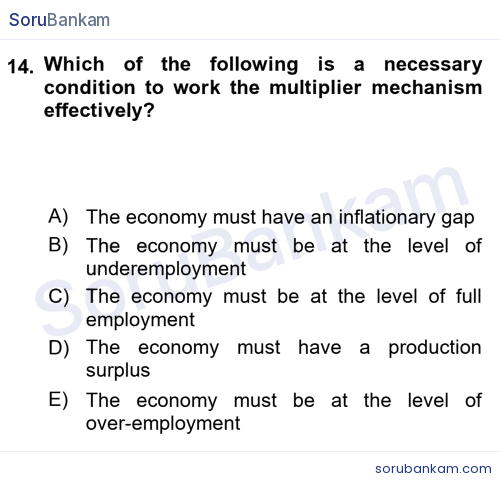
Which of the following is a necessary condition to work the multiplier mechanism effectively? A) The economy must have an inflationary gap B) Thę economy must be at the level of underemployment C) " C) The economy must be at the level of full employment D) The economy must have a production surplus E) The economy must be at the level of over-employment
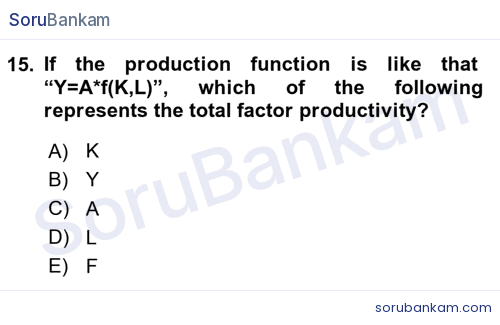
15. If the production function is like that "Y=A*(K,L)", which of the following represents the total factor productivity? A) Ki B) Y C) D) L E) F
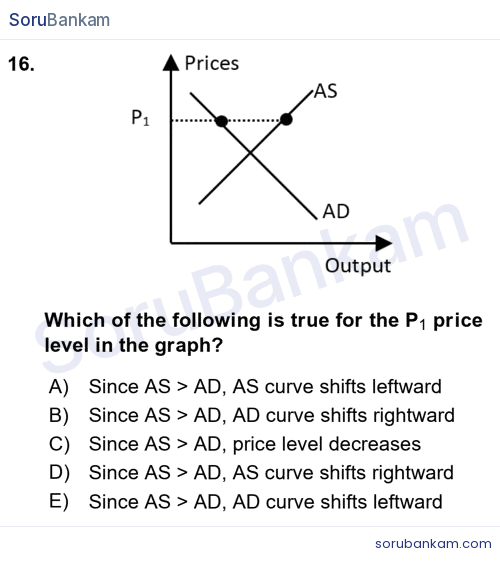
A Prices Output Which of the following is true for the Py price level in the graph? A) Since AS > AD, AS curve shifts leftward B) Since AS > AD, AD curve shifts rightward C) Since AS > AD, price level decreases D) Since AS > AD, AS curve shifts rightward E) Since AS > AD, AD curve shifts leftward
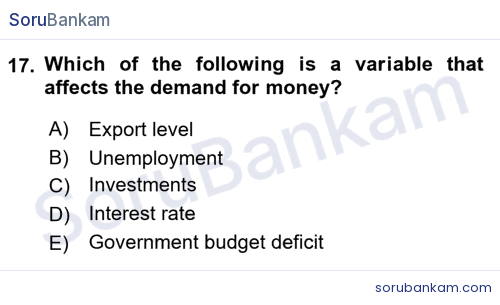
Which of the following is a variable that affects the demand for money? A) Export levet B) Unemployment C) Investments D) Interest rate E) Government budget deficit
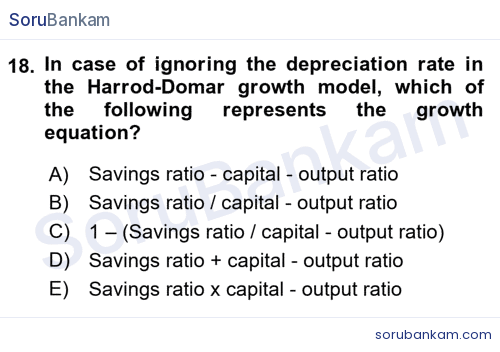
In case of ignoring the depreciation rate in the Harrod-Domar growth model, which of the following represents the growth equation? A) Savings ratio - capital - output ratio B) Savings ratio / capital - output ratio C) 1 - (Savings ratio / capital - output ratio) D) Savings ratio + capital - output ratio E) Savings ratio x capital - output ratio
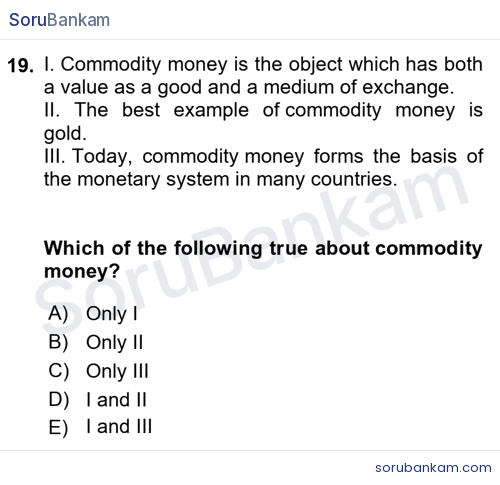
I. Commodity money is the object which has both a value as a good and a medium of exchange: II. The best example of commodity money is gold. III. Today, commodity money forms the basis of the monetary system in many countries. Which of the following true about commodity money? A) Only B) Only il • C) Only D) land! E) land Ill
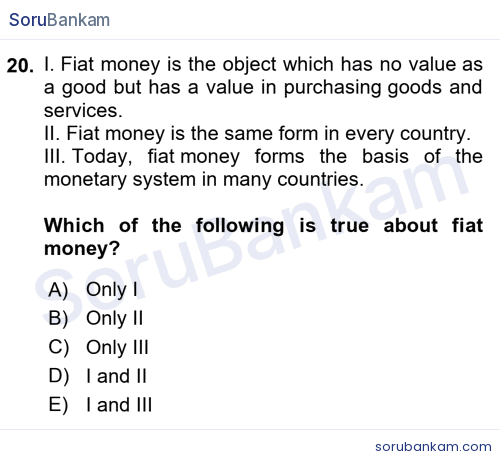
I. Flat money is the object which has no value as a good but has a value in purchasing goods and services. II. Fiat money is the same form in every country. III. Today, fiat money forms the basis of the monetary system in many countries. Which of the following is true about flat money? A) Only B) Only C) Only ill D) I and E) I and Ill