KYT102U Introduction To Public Administration 2023-2024 Yaz Okulu Soruları
20 soru · Yaz okulu · 2023-2024
KYT102U Introduction To Public Administration dersinin 2023-2024 yaz okulu sınavı 20 sorudan oluşur; ders AÖF Siyaset Bilimi ve Kamu Yönetimi (İngilizce) bölümünde okutulur. Sorular aşağıda sırasıyla yer alır. Doğru cevaplar ve sonucun, testi çözdüğünde görünür.
Önizleme · 20 soru. Cevaplamak ve sonucunu görmek için sınavı başlat.
Sorular
20 soru
Soru 1
Soru 2
Soru 3
Soru 4
Soru 5
Soru 6
Soru 7
Soru 8
Soru 9
Soru 10
Soru 11
Soru 12
Soru 13
Soru 14
Soru 15
Soru 16
Soru 17
Soru 18
Soru 19
Soru 20
Sınav modunda süre tutulur, doğru cevaplar ve sonucun sınav bitince görünür.
Dersin üniteleri
KYT102U Introduction To Public Administration ders sayfası: bütün sınavlar ve üniteler
Soruların metni (otomatik okuma)
Görsellerden otomatik okunmuştur; hata içerebilir. Sorular, görsellerdeki hâliyle geçerlidir.
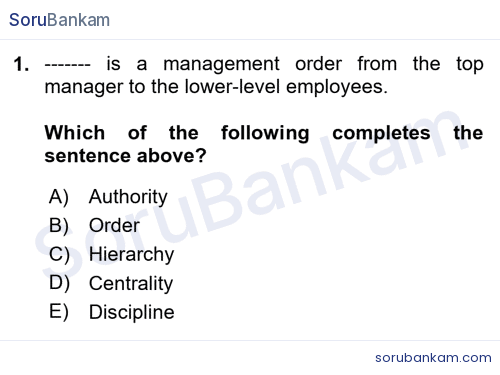
-- is a management order from the top manager to the lower-level employees. Which of the following completes the sentence above? A) Authority B) Order C) Hierarchy D) Centrality E) Discipline
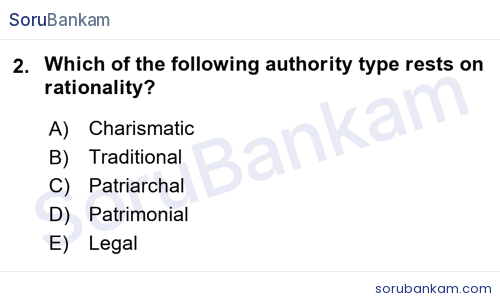
Which of the following authority type rests on rationality? A) Charismatic B) Traditional C) Patriarchal D) Patrimonial E) Legal
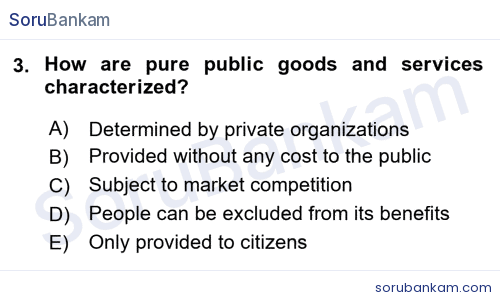
How are pure public goods and services characterized? A) Determined by private organizations B) Provided without any cost to the public C) Subject to market competition D) People can be excluded from its benefits E) Only provided to citizens •
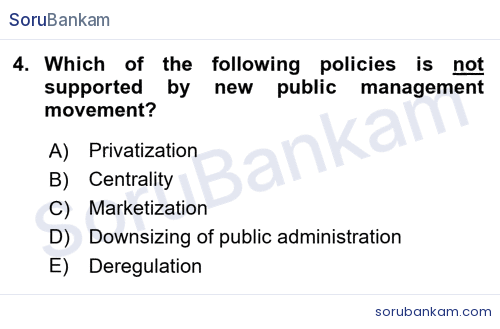
Which of the following policies is supported new public management movement? A) Privatization B) Centrality C) Marketization D) Downsizing of public administration E) Deregulation
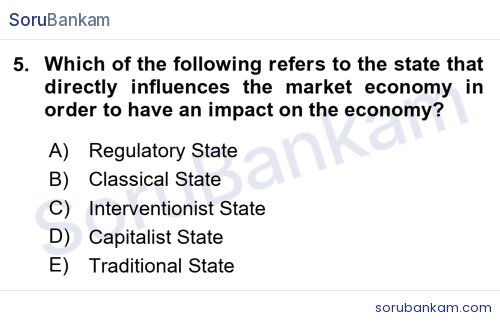
Which of the following refers to the state that directly influences the market economy in order to have an impact on the economy? A) Regulatory State B) Classical State C) Interventionist State D) Capitalist State E) Traditional State
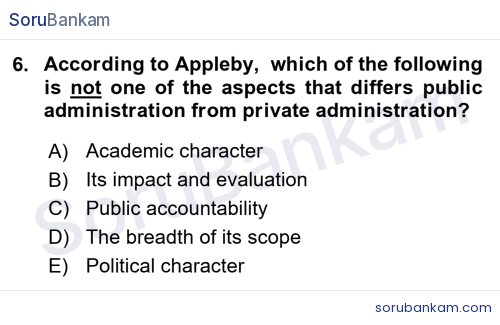
According to Appleby, which of the following is not one of the aspects that differs public administration from private administration? A) Academic character B) Belts impact and evaluation C) Public accountability D) The breadth of its scope E) Political character
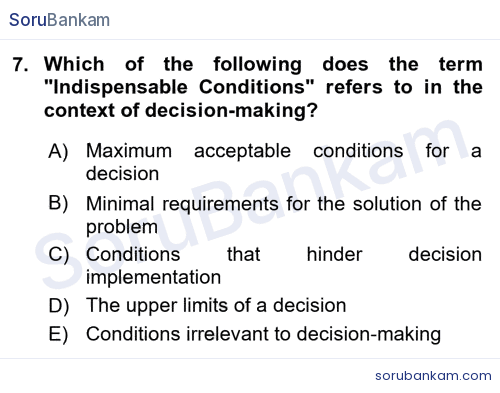
Which of the following does the term "Indispensable Conditions" refers to in the context of decision-making? A) Maximum acceptable conditions for a ' • decision B) Minimal requirements for the solution of the problem C) Condition's that at hinder decision implementation D) The upper limits of a decision E) Conditions irelavant to decision-making
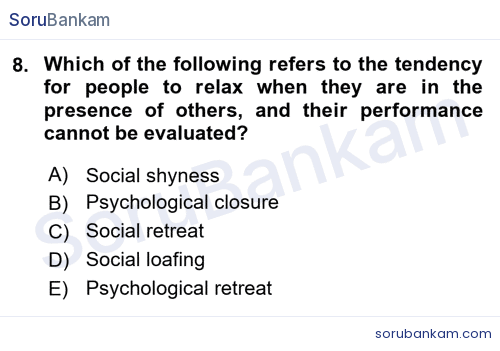
Which of the following refers to the tendency for people to relax when they are in the presence of others, and their performance cannot be evaluated? A) Social shyness B) E Psychological closure C) Social retreat : D) Social loafing E) Psychological retreat
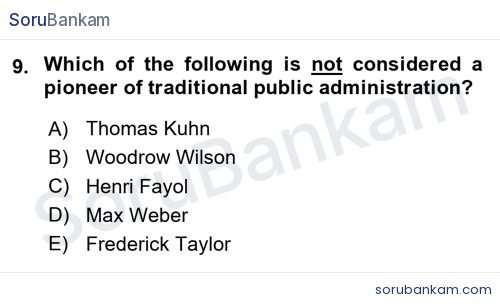
Which of the following is not considered a pioneer of traditlonal public administration? A) Thomas Kuhn B) Woodrow Wilson C) Henri Fayol D) Max Weber E) Frederick Taylor
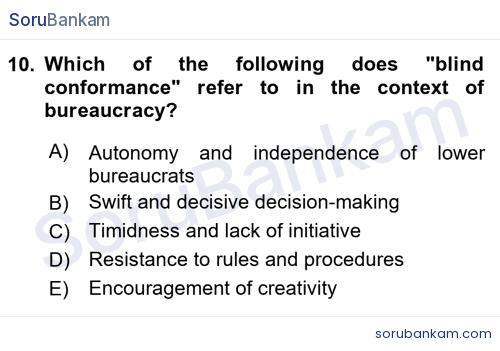
10. Which of the following does "blind conformance" refer to in the context of bureaucracy? A) Autonomy and independence of lower bureaucrats Swift and decisive decision-making C) Timidness and lack of initiative D) Resistance to rules and procedures E) Encouragement of creativity
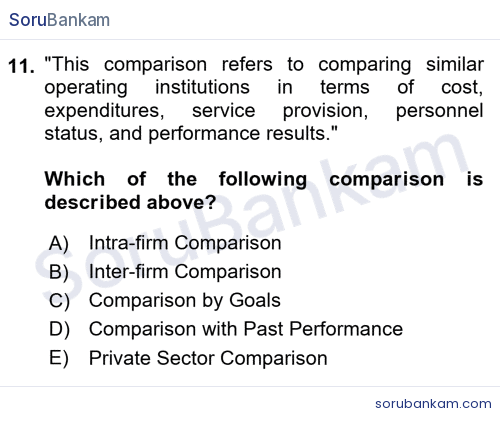
"This comparison refers to comparing similar operating institutions in terms of cost, expenditures, service provision, personnel status, and performance results." Which of the following comparison is described above? A) Intra-firm Comparison B) Inter-firm Comparison C) Comparison by Goals D) Comparison with Past Performance E) Private Sector Comparison
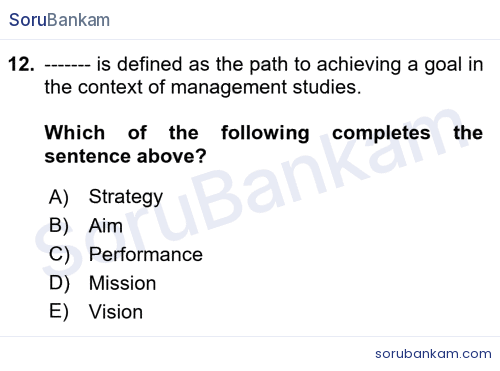
-- is defined as the path to achieving a goal in the context of management studies. Which of. the following, completes the sentence above? A) Strategy B) Aim C) Performance D) Mission E) Vision
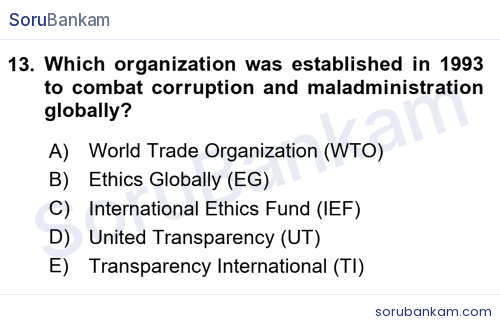
Which organization was established in 1993 to combat corruption and maladministration globally? A) World Trade Organization (WTO) B) Ethics Globally (EG) C) International Ethics Fund (IEF). D) United Transparency (UT) E) Transparency International (TI)
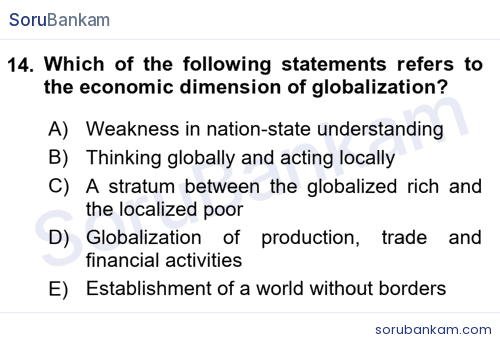
Which of the following statements refers to the economic dimension of globalization? A) Weakness in nation-state understanding B) Thinking globally and acting locally C) A stratum between the globalized rich and the localized poor D) Globalization of production, trade and financial activities E) Establishment of a world without borders
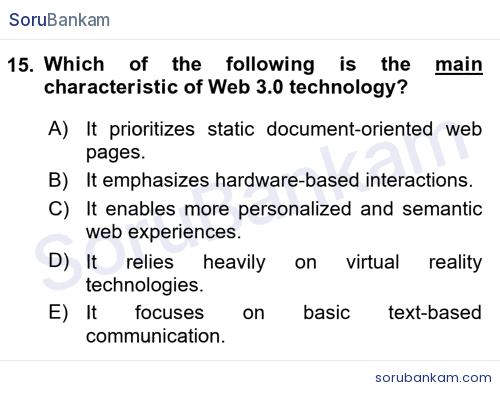
Which of the following is the main characteristic of Web 3.0 technology? A) It priortizes static document-oriented web pades. B) "VIB) It emphasizes hardware-based interactions. C) It enables more personalized and semantic web experiences. D) Ita telies heavily' son virtual reality technologies. E) It focuses basic text-based communication
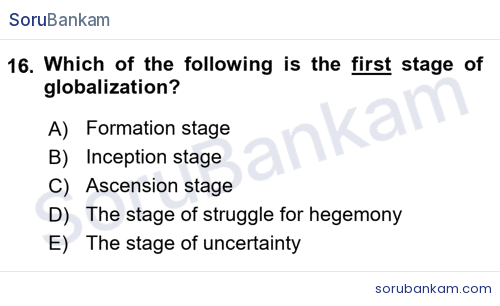
Which of the following is the first stage of globalization? A) Formation stage B) Inception stage C) Ascension stage D) The stage of struggle for hegemony E) The stage of uncertainty
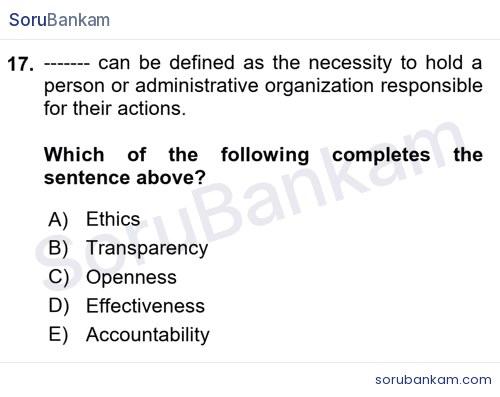
— can be defined as the necessity to hold a person or administrative organization responsible for their actions. Which of the following completes the sentence above? A) Ethics B) Transparency C) Openness D) Effectiveness E) Accountability
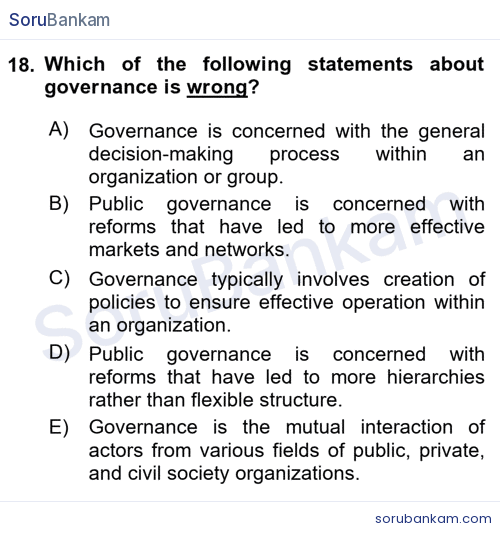
18. Which of the following statements about governance is wrong? A) Governance is concerned with the general decision-making process within an organization or group. B) Public governance is concerned with reforms that have led to more effective markets and networks. C) Governance typically involves creation of policies to ensure effective operation within an organization. D) Public governance is concerned with reforms that have led to more hierarchies rather than flexible structure. Governance is the mutual interaction of actors from various fields of public, private, and civil society organizations.
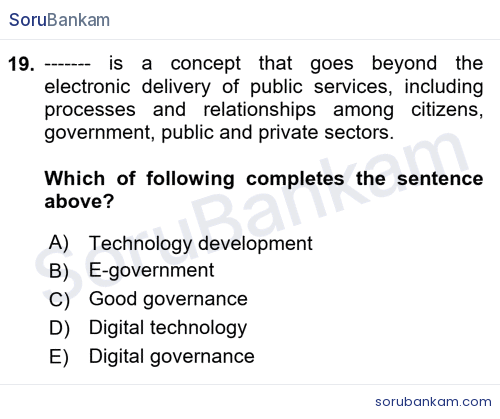
- is a concept that goes beyond the electronic delivery of public services, including processes and relationships among citizens, government, public and private sectors. Which of following completes the sentence above? A) Technology development B) E-government C) Good govemance D) Digital technology E) Digital goverance
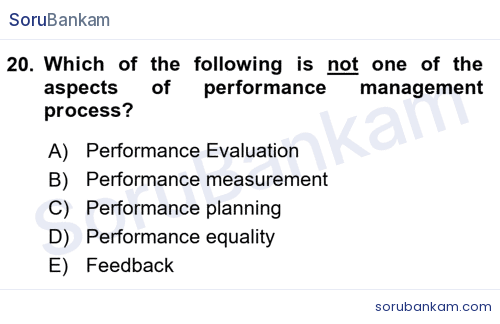
Which of the following is not one of the aspects performance management process? A) Performance Evaluation B) Performance measurement C) Performance planning • 1• D) Performance equality E) Feedback