KYT102U Introduction To Public Administration 2024-2025 Final Soruları
20 soru · Final · 2024-2025
KYT102U Introduction To Public Administration dersinin 2024-2025 final sınavı 20 sorudan oluşur; ders AÖF Siyaset Bilimi ve Kamu Yönetimi (İngilizce) bölümünde okutulur. Sorular aşağıda sırasıyla yer alır. Doğru cevaplar ve sonucun, testi çözdüğünde görünür.
Önizleme · 20 soru. Cevaplamak ve sonucunu görmek için sınavı başlat.
Sorular
20 soru
Soru 1
Soru 2
Soru 3
Soru 4
Soru 5
Soru 6
Soru 7
Soru 8
Soru 9
Soru 10
Soru 11
Soru 12
Soru 13
Soru 14
Soru 15
Soru 16
Soru 17
Soru 18
Soru 19
Soru 20
Sınav modunda süre tutulur, doğru cevaplar ve sonucun sınav bitince görünür.
Dersin üniteleri
KYT102U Introduction To Public Administration ders sayfası: bütün sınavlar ve üniteler
Soruların metni (otomatik okuma)
Görsellerden otomatik okunmuştur; hata içerebilir. Sorular, görsellerdeki hâliyle geçerlidir.
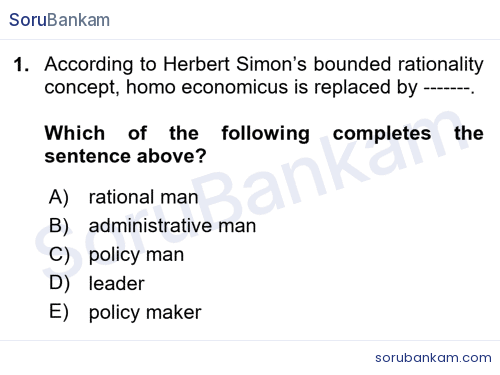
According to Herbert Simon's bounded rationality concept, homo economicus is replaced by -..-.-. Which of the following completes the sentence above? A) rational man B) administrative man C) policy man D) leader E) policy maker
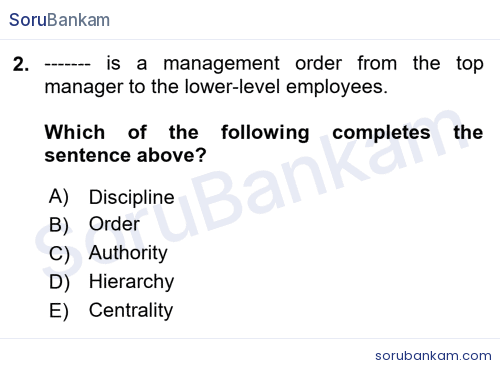
-.... IS a management order from the top manager to the lower-level employees. Which of the following completes the sentence above? A) Discipline B) Order C) Authority D) Hierarchy E) Centrality
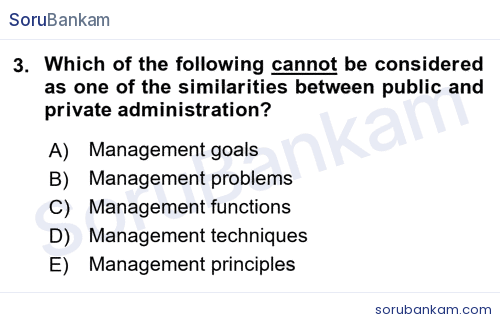
3. Which of the following cannot be considered' as one of the similarities between public and private administration? A) Management goals i Management problems C) Management functions D) Management techniques Management principles
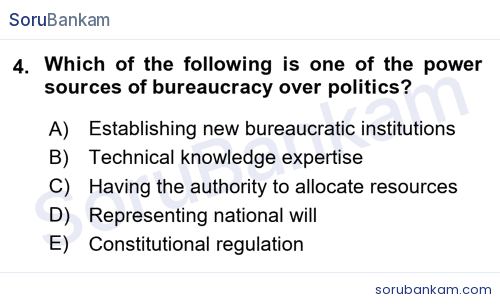
Which of the following is one of the power sources of bureaucracy over politics?. A) Establishing new bureaucratic institutions B) Technical knowledge expertise C) Having the authority to allocate resources D) Representing national will E) Constitutional regulation
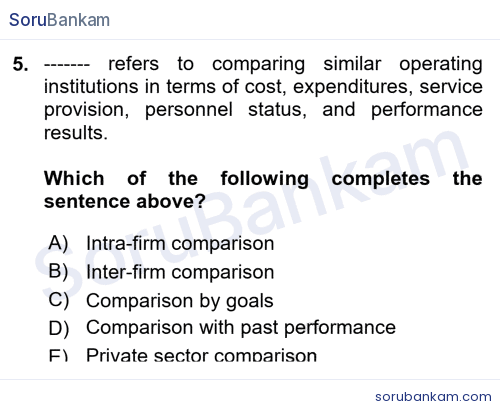
- refers to comparing similar operating institutions in terms of cost, expenditures, service provision, personnel status, and performance results. Which of the following completes the sentence above? A) Intra-firm comparison B) Inter-firm comparison C) Comparison by goals D) Comparison with past performançe E) F) Private sector comparison
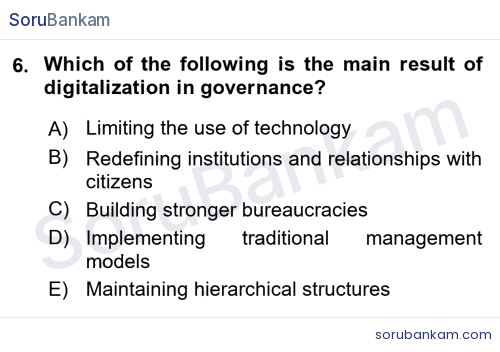
6. Which of the following is the main result of digitalization in governance? A) Limiting the use of technology Redefining institutions and relationships with 1 citizens C) Building stronger bureaucracies Implementing traditional management models vE) • Maintaining hierarchical structures
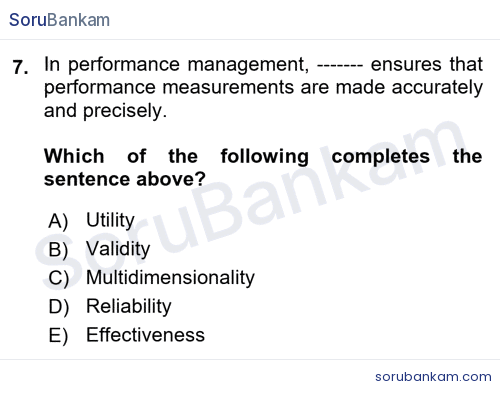
In performance management, - ensures that performance measurements are made accurately and precisely. Which of the following completes the sentence above? A) Utility B) Validity C) Multidimensionality D) Reliability E) Effectiveness
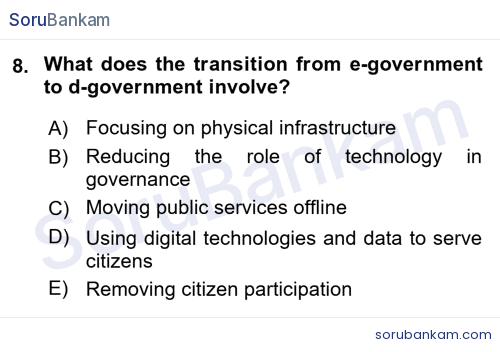
What does the transition from e-government to d-government involve? A) Focusing on physical infrastructure B) Reducing the role of technology in governance C) Moving public services offline D) Using digital technologies and data to serve citizens E) Removing citizen participation
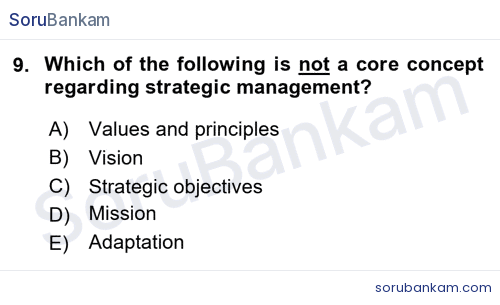
Which of the following is not a core concept regarding strategic management? A) Values and principles B) Vision C) Strategic objectives D) Mission E) Adaptation
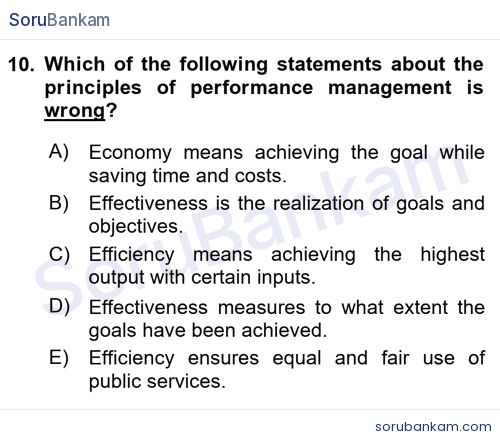
Which of the following statements about the principles of performance management is wrong? A) Economy means achieving the goal while saving time and costs. B) Effectiveness is the realization of goals and objectives. C) Efficiency means achieving the highest output with certain inputs. D) Effectiveness measures to what extent the goals have been achieved E) Efficiency ensures equal and fair use of public services.
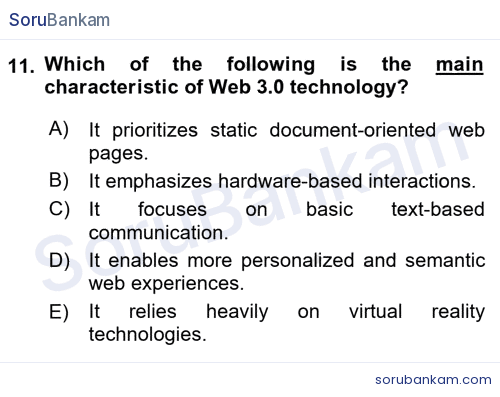
Which of the following is the main characteristic of Web 3.0 technology? A) It priogitizes static documani-oriented web pages. B) It emphasizes hardware-based interactions! C) focuses « on basic, alext-based communication. D) Iț enables more personalized and semantic i. web experiences. E) It relies heavily on virtual reality technologies.
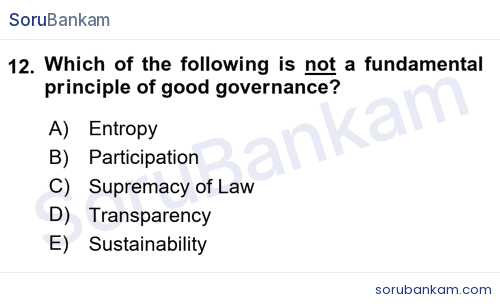
Which of the following is not a fundamental principle of good governance? A) Entropy B) Participation C) Supremacy of Law D) Transparency E) Sustainability
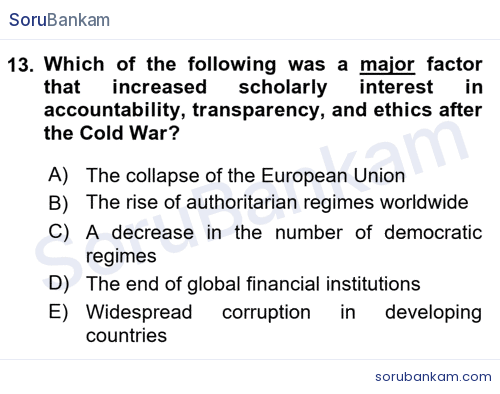
Which of the following was a major factor that increased scholarly interest in accountability, transparency, and ethics after the Cold War? A) The collapse of the European Union B) The rise of authoritarian regimes worldwide C) A decrease in the number of democratic regimes D) The end of global financial institutions E) Widespread corruption in developing countries
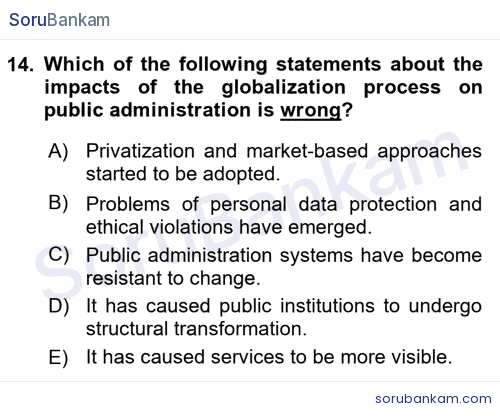
Which of the following statements about the public do strain is zain reass A) . Privatization and market-based approaches started to be adopted. B) Problems of personal data protection and ethical violations have emerged. C) Puplic administration systems have become •Posistant to change. D) " D) It has caused public institutions to undergo structural transformation. E) It has caused services to be more visible.
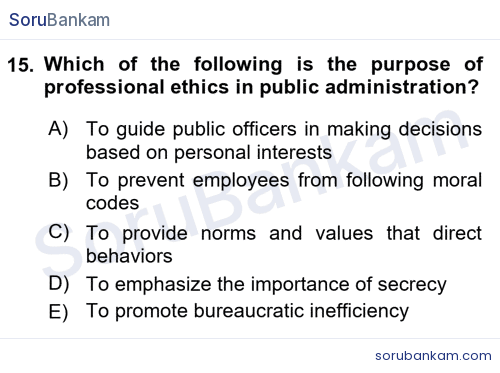
Which of the following is the purpose of professional ethics in public administration? A) To guide public officers in making decisions based on personal interests B) To prevent employees from following moral codes C) To provide norms and values that direct behaviors D) To emphasize the importance of secrecy E) To promote bureaucratic inefficiency
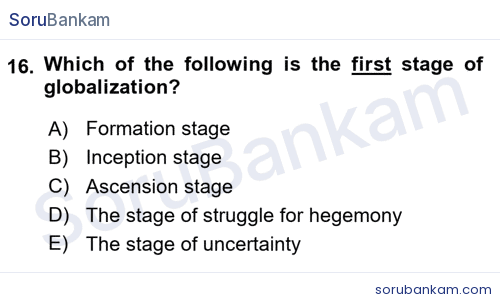
Which of the following is the first stage of globalization? A) Formation stage B) Inception stage C) Ascension stage D) The stage of struggle for hegemony E) The stage of uncertainty
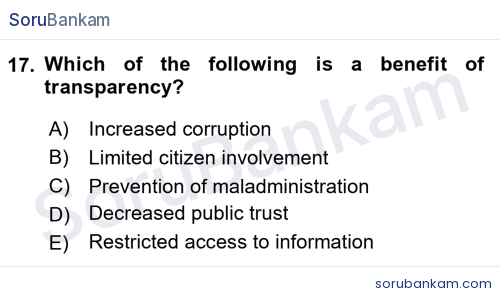
Which of the following is a benefit of transparency? A) Increased corruption B) Limited citizen involvement C) Prevention of maladministration D) Decreased public trust E) Restricted access to information
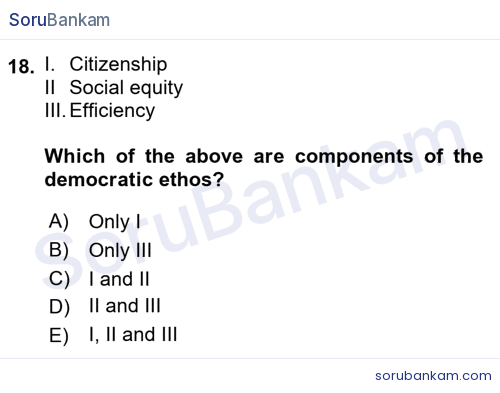
I. Citizenship Social equity III. Efficiency Which of the above are components of the democratic ethos? A) Only B) Only I!! C) I and D) I and E) EI, ll and I|l
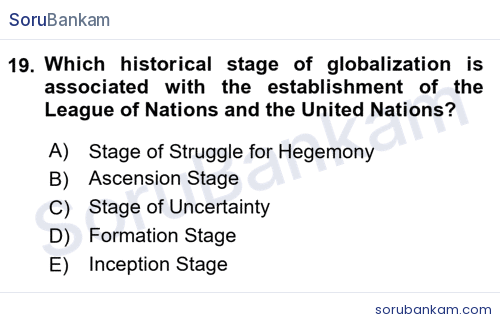
Which historical stage of globalization iş associated with the establishment of the League of Nations and the United Nations? A) Stage of Struggle for Hegemony B) Ascension Stage C) Stage of Uncertainty D) Formation Stage E) Inception Stage
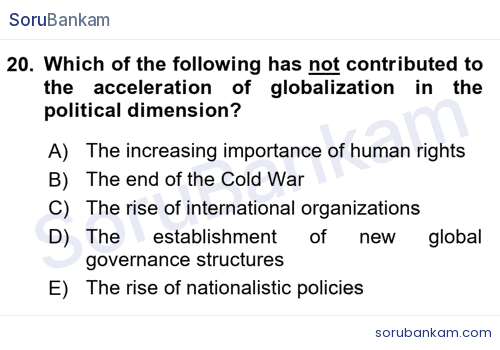
Which of the following has not contributed to the acceleration of globalization in the political dimension? A) The increasing importance of human rights B) The end of the Cold War C) The rise of international organizations D) The establishment of new global governance structures E) The rise of nationalistic policies