INO405U Dil Edinimi 2012-2013 Vize Soruları
20 soru · Vize · 2012-2013
INO405U Dil Edinimi dersinin 2012-2013 vize sınavı 20 sorudan oluşur; ders AÖF İngilizce Öğretmenliği bölümünde okutulur. Sorular aşağıda sırasıyla yer alır. Doğru cevaplar ve sonucun, testi çözdüğünde görünür.
Önizleme · 20 soru. Cevaplamak ve sonucunu görmek için sınavı başlat.
Sorular
20 soru
Soru 1
Soru 2
Soru 3
Soru 4
Soru 5
Soru 6
Soru 7
Soru 8
Soru 9
Soru 10
Soru 11
Soru 12
Soru 13
Soru 14
Soru 15
Soru 16
Soru 17
Soru 18
Soru 19
Soru 20


Sınav modunda süre tutulur, doğru cevaplar ve sonucun sınav bitince görünür.
Dersin üniteleri
INO405U Dil Edinimi ders sayfası: bütün sınavlar ve üniteler
Soruların metni (otomatik okuma)
Görsellerden otomatik okunmuştur; hata içerebilir. Sorular, görsellerdeki hâliyle geçerlidir.
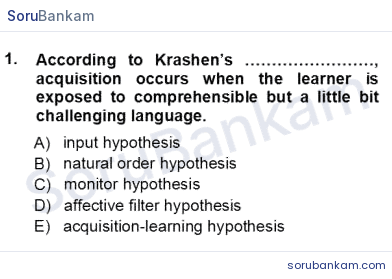
According to Krashen's ring acquisition occurs when the learner exposed to comprehensible but a little bit challenging language. A) input hypothesis B) natural order hypothesis C) monitor hypothesis D) affettive filter hypothesis" E) acquisition-learning hypothesis
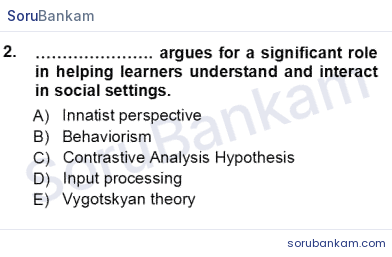
... argues for a significant role in helping learners. understand and interact in social settings. A) Innatist perspective B) Behaviorism C) Contrastive Analysis Hypothesis D) Input processing E) Virgostyan theory
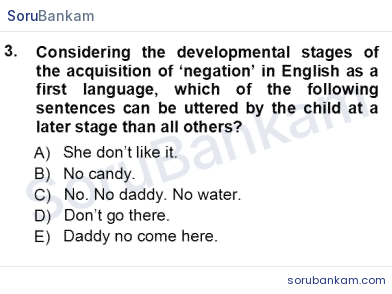
3. Considering the developmental stages of the acquisition of 'negation' in English as a first language, which of the following sentences can be uttered by the child at a later stage than all others? A) She don't like it. B) No candy. .1-- C) No. No daddy. No water. @bh't go there. Daddy no come here.
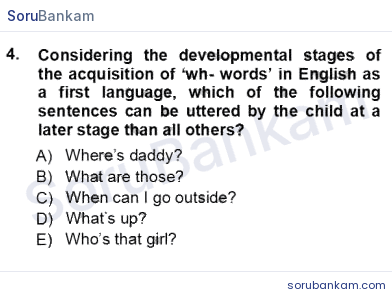
Considering the develogmental stages Ly words' in Eholen as a first lagguage child at a later stage than all others: A) Where's daddy? B) Wisero thesar man ban i go outrigh - What at ang
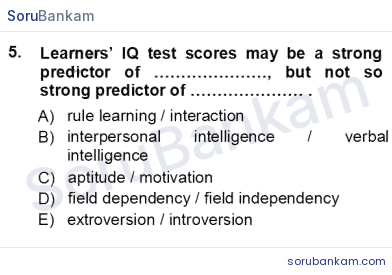
Leamers' IQ test scores may be a strong predictor of but not strong predictor of A) rule learning / interaction B) • interpersonal intelligence verbal intelligence C) aptitude (molivation D) fieldedependency / fiek independency E) extroversion / introversion
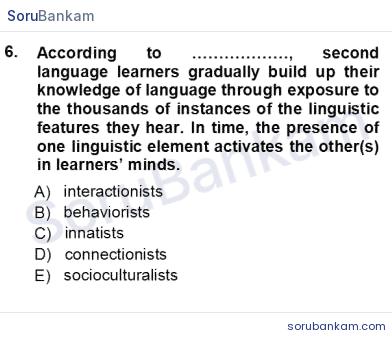
6. According second language leamers gradually build up their knowledge of language through exposure to the thousands of instances of the linguistic features they hear. In time, the presence of one linguistic element activates the other(s) in learners' minds. 4) interactiohists B) behaviorists innatists D) connectionists E) sociocutturalists
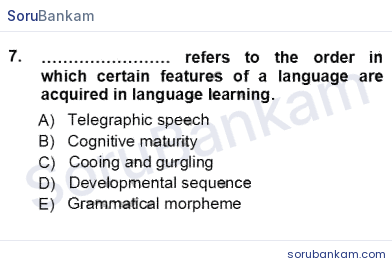
reters o to the orde which certain features or languag acquired in language e arning: A) Telegraphic B) Cognitive C) Cooing ai gling D) Dever gemital sequeg E) 1 morpheme
when a leati Gays 1 come today. She ome yesenay. They come tomorrow:, ear ris involved in.. A) cation overgeneralization avoidance contrastive ahalysis fopsilization
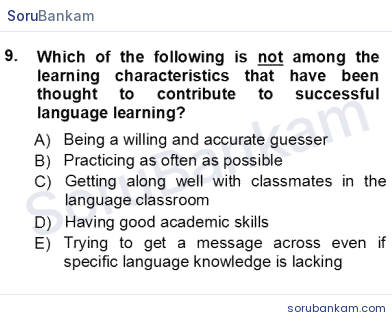
9. Which of the following is not among the learning characteristics that have been thought contribute to successful language learning? A) Being a willing and accurate guesser B) Practicing as often as possible C) Getting along well with classmates in the language classroom. Having good academic skills E) Trying to get a message across even if specific language knowledge is tacking
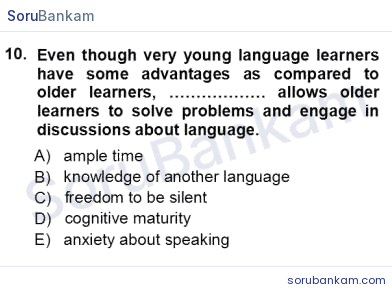
Even though very young language learners have some advantages as compared to older leamers, .... allows older leamers to solve problems and engage in discussions about tanguage. A) ample time B) knowledge of'another language C) freedom to be silent D) R) öognitive maturity E) anxiety about speaking
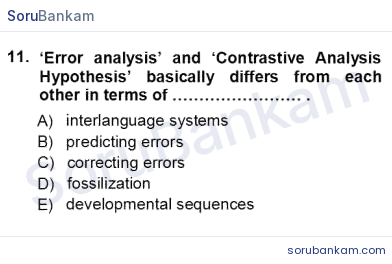
'Error analysis' and 'Contrastive Analysis Hypothesis' basically differs from each other in terms of ........... A) interlanguage systems B) 9) predicting errors C) correcting errors. D) fossilization E) devefopmental sequences
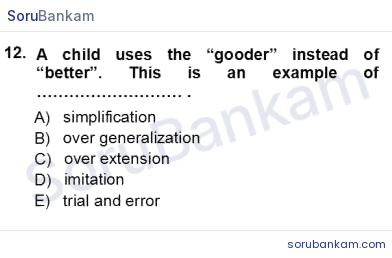
A child useS the "gooder" instead "better" This example A) simplification B) over generalization C) over extension D) imitation,, It ...- E) trial and error
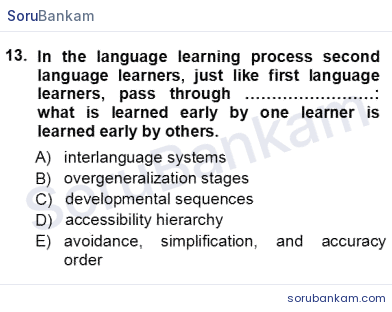
In the language learning process second language learners, just like first language learners, pass through what is learned early by one leamer is learned early by others. A) interianguage systems B) overgeneralization stages C) developmertal sequences D) accessibility hierarchy E) avoidance, simplification, and accuracy order
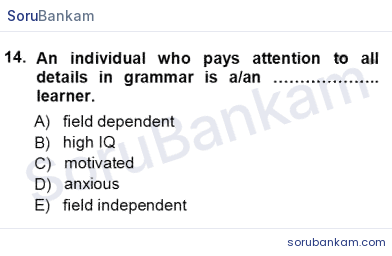
14. An individuat who pays attention learner. A) field dependent high IQ C) motivated D) anxious. " E)
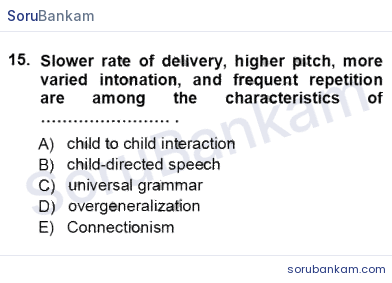
varied intonatio among child intera- tio Chives ced shad pherggperalization Coanechanism
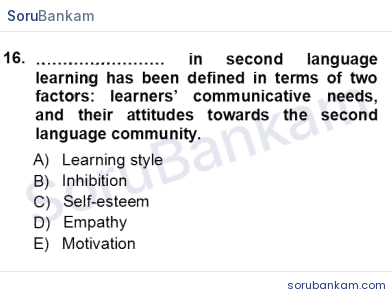
16. second language factors: hearners communicate needs s: learners' communicative needs, and their attitudes. towards the second language community. A) Learning style B) Inhibition, "' C) elf-esteem mpathy E Motivation
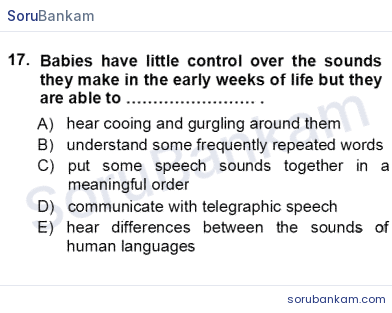
Babies have littie control over the sounds they make in the early weeks of life but they are able to.......... A) hear cooing and gurgling around them B) understand some frequently repeated wonde C) put some meaningtul orderin sounds together D) portmunicate with telegraphic speech E) "E) hear differences between the sounds human languages
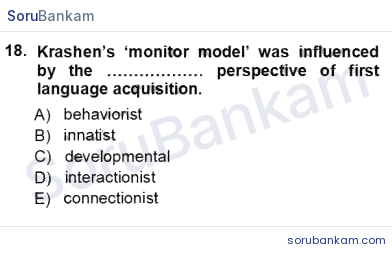
18. Krashen's 'monitor godel' was. priced by the perspyl *first language acquition. A) behra dish, B) C) developmental interactionjst sonnectionist
Cognitive and developmental psychologists criticized with placing too much emphasis on the Hirial state' and not enougti on the developmental aspects of language acquisition. A) behaviorists B) Plaget and. Wygotsky C) connectionism D) Dy. inmatists E) interactionists
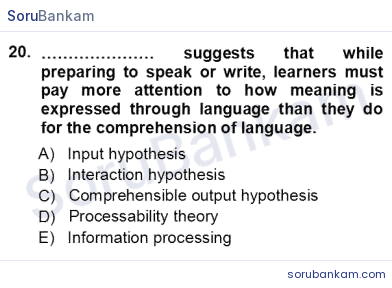
20. suggests that while preparing to speak or write, learners must pay more attention to how meaning is expressed through language than they do for the comprehension of language. A) Input hypothesis B) Interaction Rypothesis C) Comprehensible output hypothesis Ficesability theory Information processing