INO405U Dil Edinimi 2014-2015 Vize Soruları
20 soru · Vize · 2014-2015
INO405U Dil Edinimi dersinin 2014-2015 vize sınavı 20 sorudan oluşur; ders AÖF İngilizce Öğretmenliği bölümünde okutulur. Sorular aşağıda sırasıyla yer alır. Doğru cevaplar ve sonucun, testi çözdüğünde görünür.
Önizleme · 20 soru. Cevaplamak ve sonucunu görmek için sınavı başlat.
Sorular
20 soru
Soru 1
Soru 2
Soru 3
Soru 4
Soru 5
Soru 6
Soru 7
Soru 8
Soru 9
Soru 10
Soru 11
Soru 12
Soru 13
Soru 14
Soru 15
Soru 16
Soru 17
Soru 18
Soru 19
Soru 20


Sınav modunda süre tutulur, doğru cevaplar ve sonucun sınav bitince görünür.
Dersin üniteleri
INO405U Dil Edinimi ders sayfası: bütün sınavlar ve üniteler
Soruların metni (otomatik okuma)
Görsellerden otomatik okunmuştur; hata içerebilir. Sorular, görsellerdeki hâliyle geçerlidir.
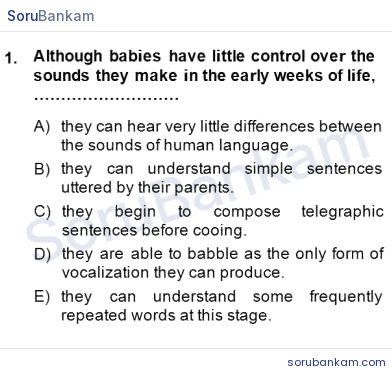
1. Although babies have little control over the sounds they make in the earty weeks of life, A) they can hear very little differences between the sounds of human language. By there dan Meand simple, eriences y begin to campose telegraphic sentences before cooing. D) they are able to babble as the only form of vocalization they can produce. E) they can understand some frequently repeated words at this stage.
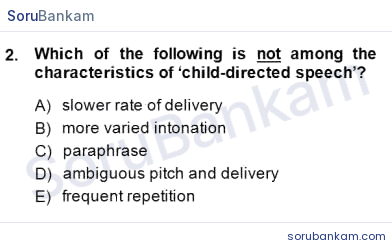
Which of the following is not among the characteristics of 'child directed speech'? A) slower rate of delivery B) more varied intonation C) paraphrase D) ambiguous pitch and delivery, E) frequent repetition
3. most babies start producing one or two words that everyone recognizes. A) Attwelve months B) At ten weeks C) Rightafter finishing the telegrat lehtence DI Before the cooing and gütry stage •! È) By the age of three
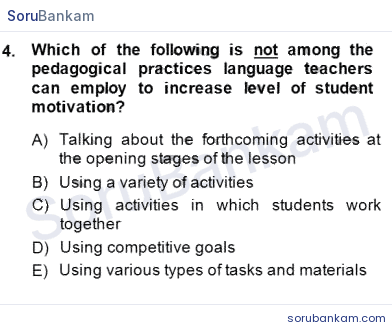
4. Which of the follging is not artong the pedagogical pres pacs language can employ rease studant motivation A) Talling about the lathcoming act re opaning sager orme lesson ang a yanety of acavites stig activities in which • students work together DI l Using competitive goals E) Using various types of tasks and materials
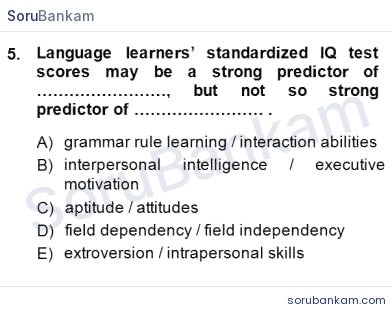
Language learners' standardized Q test scores may be a strong predictor of but not strong predictor of A) grammar rule leaming / interaction abilities: B) interpersonal intelligence -axecutive motivator C) apülade / attitudes D) i D) field dependency / field independency. E) extroversion / intrapersonal skillş
Language learners with high language learning aptitude may learn with greater ease and speed but other learners A) should bear high IQ scores B) should use different leaming styles al the same time C) needto be field dependent to be sur D) • "Di can also be successful if they studderbugh E) should focus on their motivade roblems first
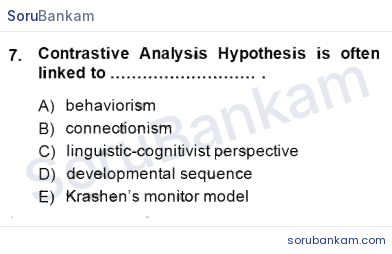
7. Contrastive Analysis Hypothesis is often linked to ..... A) behavion an B) connectionish C) linge stacognitivist ferspective opmental sequence adn's monter nadet
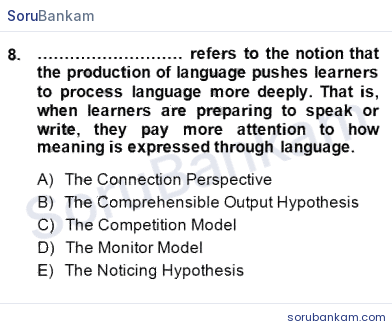
.. refers a the notion that the pr Clion of lapstage prshes learners to roars as a gore deto That is, il, they *nore attention to how rossed through language. A) THe Contation Perspective B) Breämprehensible Output Hypothesis The Competition Model "By) The Monitor Model The Noticing Hypothesis
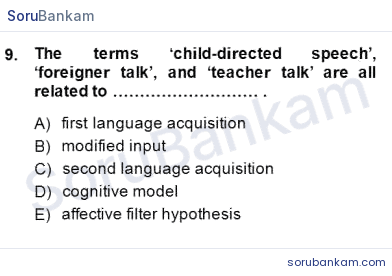
The terms 'child-directed speech, foreigner talk', and teacher talk are all related to A) first language acquisition B) modified input C) second language acquisition D) cognitive model E) . affective filter hypotfiesis ..1"
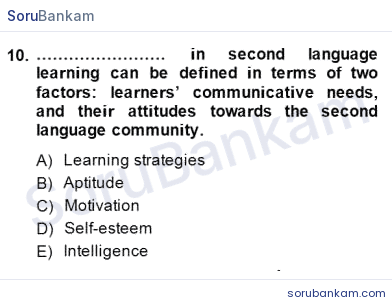
second language learning can be defined in terms of two factors: learers: communicative needs, and their attitudes , towards the second language community. A) Learning strategies B) Aptitude « 1' C) Mestivation D) i. D) Self-esteem E) Intelligence
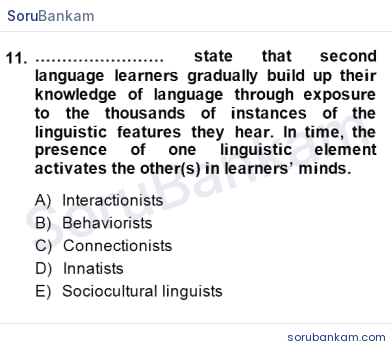
state thạt . second language learners gradually build up their knowledge of language through exposure to the thousands of instances of the linguistic features they hear. In time, the presence one linguistic element activates the offerts) in learners' minds. A) Interactionists B) i: "B) Behaviorists C) Connectionists D) Innatists E) Sociocuftural linguișts
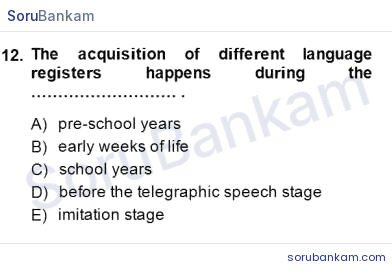
The acquisition different language registers happens during the A) pre-school years B) early weeks of life C) school years.. D) before to telegraphic speech stage E) 5 irtation stage
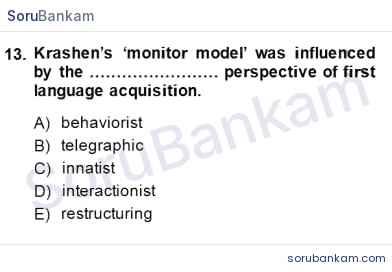
Krashen's monitor model was intluenced by the ...... perspective offirst language acquisition. A) behaviorist B) telegraphic C) innatist versite: D) interactiohis!' E) restructuring
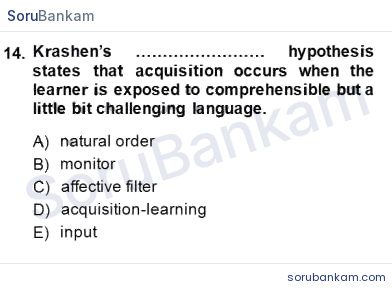
14. Krashen's *X hypothesis the bit callengi aghaige. atural order monitor affective fitef D) apquisiton-learning ¡ "!E) input
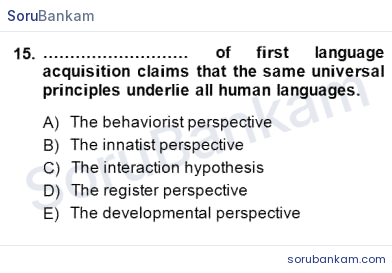
first language acquișition claims that the same universal principles underlie all human languages. A) The behaviorist perspective B) The innatist perspective C) The interac on typothesis D) The register perspective. E) ...E) Me developmental perspective
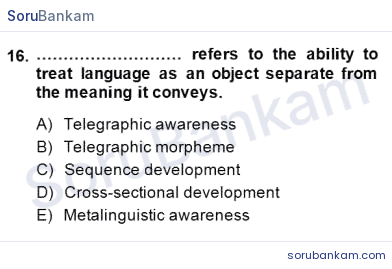
16. refers to the ability to treat tanguage as an object separate from the meaning, it conveys. Telegraphic awareness 8) Telegraphic morpheme ..i C) Sequence davalopment D) Cross-sectional development E) Metalinguistic awarèness
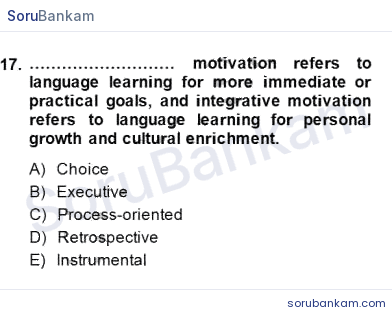
17. moriva not refers to language learning for miti immediate or practical goals; and integrative motivation great a langual anime for personal. A) Choice B) Execy aęs-oriented emi
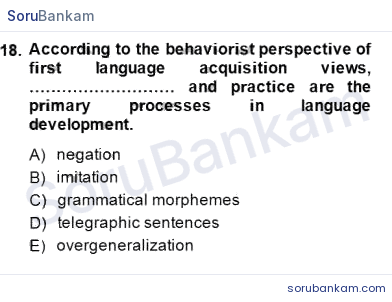
tB. According to the behavions perspective of fire inguage acquisition views, I practice are the bimary Sses •in language evelopm A) negatog B) taldn gretamatical morphemes? telegraphic sentences overgeneralization
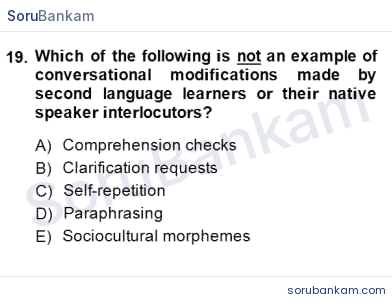
19. Which of the following is not an exampie of conversational modifications made second language learners or their native speaker interlocutors? •A) Comprehension checks B) Clarification requests C) Self-repetition D). Baraphrasing "E) Sociocultural morphemes
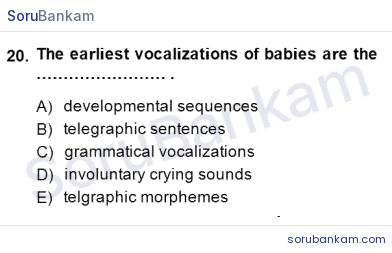
The earliest vocalizations of babies are the A) develapmental sequences B) telegraphic sentencès C) grammatical vocalizations D) involuntary prying sounds E) telgraphic morphernes: «