IKT453U Economics Of Natural Resources And Environment 2024-2025 Final Soruları
20 soru · Final · 2024-2025
IKT453U Economics Of Natural Resources And Environment dersinin 2024-2025 final sınavı 20 sorudan oluşur; ders AÖF İktisat (İngilizce) bölümünde okutulur. Sorular aşağıda sırasıyla yer alır. Doğru cevaplar ve sonucun, testi çözdüğünde görünür.
Önizleme · 20 soru. Cevaplamak ve sonucunu görmek için sınavı başlat.
Sorular
20 soru
Soru 1
Soru 2
Soru 3
Soru 4
Soru 5
Soru 6
Soru 7
Soru 8
Soru 9
Soru 10
Soru 11
Soru 12
Soru 13
Soru 14
Soru 15
Soru 16
Soru 17
Soru 18
Soru 19
Soru 20
Sınav modunda süre tutulur, doğru cevaplar ve sonucun sınav bitince görünür.
Dersin üniteleri
IKT453U Economics Of Natural Resources And Environment ders sayfası: bütün sınavlar ve üniteler
Soruların metni (otomatik okuma)
Görsellerden otomatik okunmuştur; hata içerebilir. Sorular, görsellerdeki hâliyle geçerlidir.
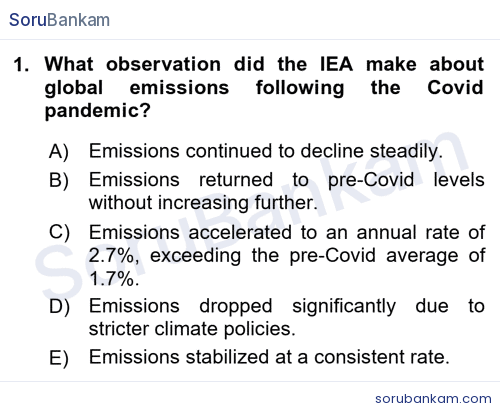
1. What observation did the IEA make about global emissions following the • Covid pandemic? A) Emissions continued to decline steadily. Emissions returned to pre-Covid levels without increasing further. C) Emissions accelerated to an annual rate of 2.7%, exceeding the pre-Covid average of 1.7%. D) Emissions dropped significantly due to stricter climate policies. E) Emissions stabilized at a consistent rate.
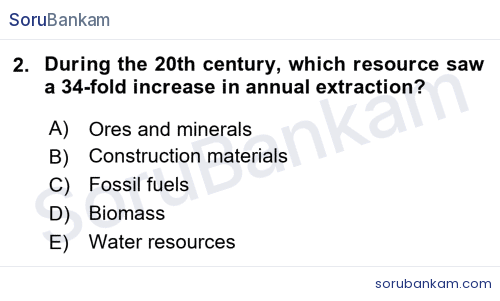
During the 20th century, which resource saw a 34-fold increase in annual extraction? A) Ores and minerals B) Construction materials C) Fossil fuels D) Biomass E) Water resources
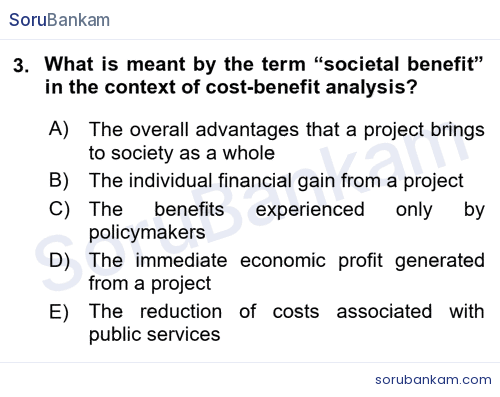
What is meant by the term "societal benefit" in the context of cost-benefit analysis? "* A) The overall advantages that a project brings to society as a whole B) The individual financial gain from a project C) The benefits y experienced only by policymakers? D) The imediate economic profit generated from a project E) The reduction of costs associated with public services
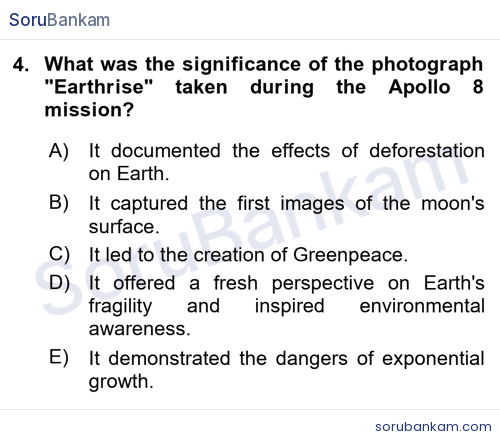
What was the significance of the photograph "Earthrise" taken during the Apollo 8 mission? A) It documented the effects of deforestation on Earth. B) It captured the first images of the moon's surface. C) It led to the creation of Greenpeace. D) It offered a fresh perspective on Earth's fragility and inspired environmental awareness. E) It demonstrated the dangers of exponential growth.
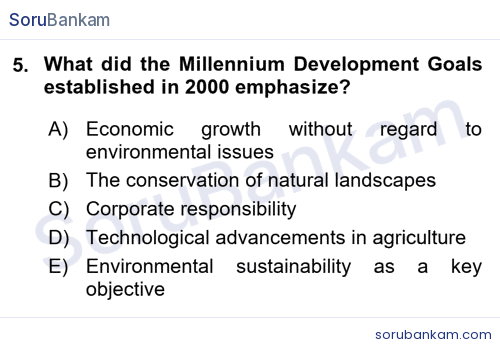
What did the Millennium Development Goals established in 2000 emphasize? A) Economic growth without regard to environmental issues B) The conservation of natural landscapes C) Corporate responsibility D) Technological advancements in agriculture E) Environmental sustainability as a key objective
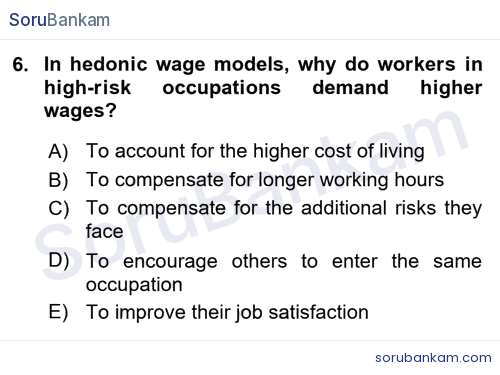
6. In hedonic wage models, why do workers in high-risk occupations demand higher wages? AL Ię,account for the higher cost ofliving B) To compensate for longer working hours. C) To compensate, for the additional risks they face D) To encourage others- to enter the same occupation *'E) To improve their job satisfaction
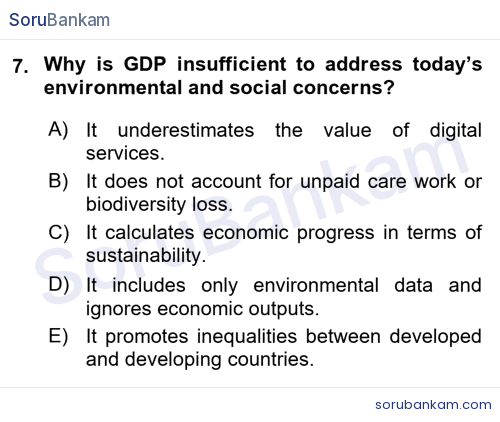
7. Why is GDP insufficient to address today's environmental and social concerns? A) It underestimates the value of digital services. It does not account for unpaid care work or biodiversity loss. C) It calculates economic progress in terms of sustainability. D) It includes only environmental data and ignores economic outputs. E) It promotes inequalities between developed and developing countries.
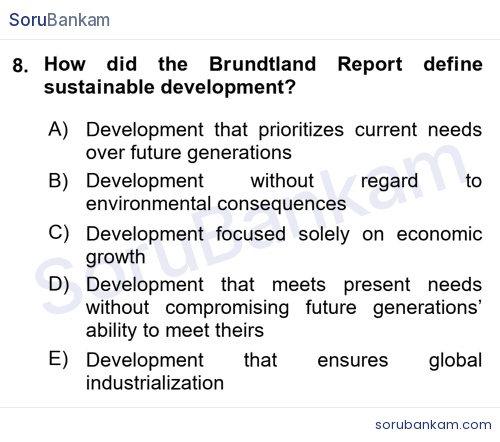
How did the Brundtland Report define sustainable development? A) Development that prioritizes current needs over future generations B) Development without regard to environmental consequences C) Development focused solely on economic growth D) Development that meets present needs without compromising future generations' ability to meet theirs E) Development that ensures global industrialization
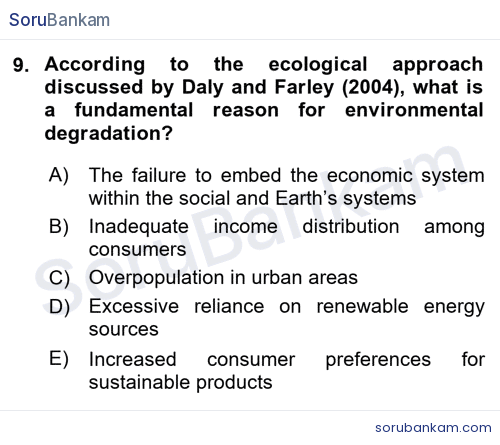
9. According to the ecological approach discussed by Daly and Farley (2004), what is a fundamental reason for environmental degradation? A) The failure to embed the economic system within the social and Earth's systems Inadequate income distribution among consumers C) Overpopulation in urban areas D) Excessive reliance on renewable energy sources E) Increased consumer preferences for sustainable products
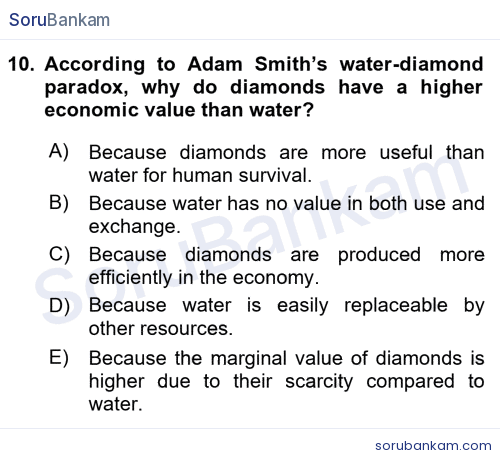
10. According to Adam Smith's water-diamond\ paradox, why do diamonds have a higher economic value than water? A) Because diamonds are more useful than water for human survival. B) Because water has no value in both use and exchange. C) Because diamonds pare produced more efficiently in the economy. D) Because water is easily replaceablé by other resourcesn Because the marginal value of diamonds is higher due to their scarcity compared water.
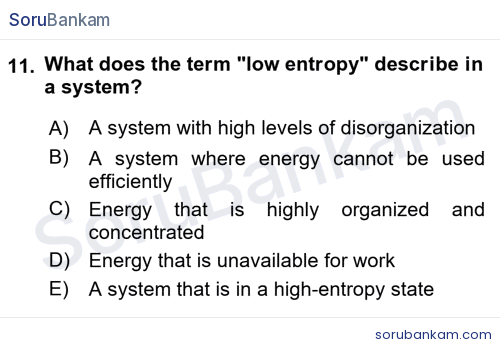
11. What does the term "low entropy" describe in a system? A) A system with high levels of disorganization A system where energy cannot be used efficiently C) Energy that is highly organized and concentrated D) Energy that is unavailable for work E) A system that is in a high-entropy state
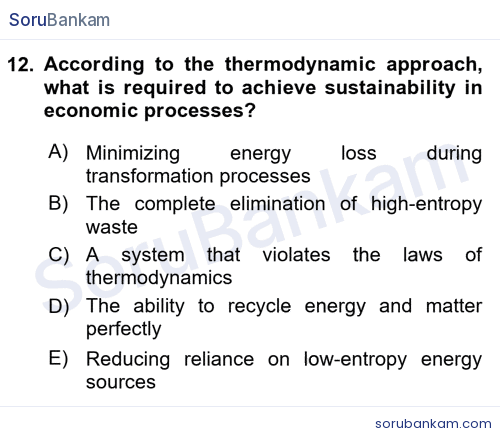
According to the thermodynamic approach, what Is required to achleve sustainabllity in economic processes? A) Minimizing energy loss during transformation processes B) The complete elimination of high-entropy waste C) A system that violates the laws of thermodynamics D) The ability to recycle energy and matter pertectly E) Reducing reliance on: wow-entropy energy sources
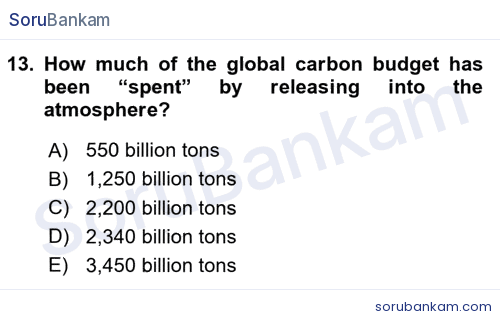
How much of the global carbon budget has been "spent" by releasing into the atmosphere? A) 55a billion tons .. ді B) 1,250 billion tons C) 2,200 billion tons D) 2,340 billian tons E) 3,450 billion tons
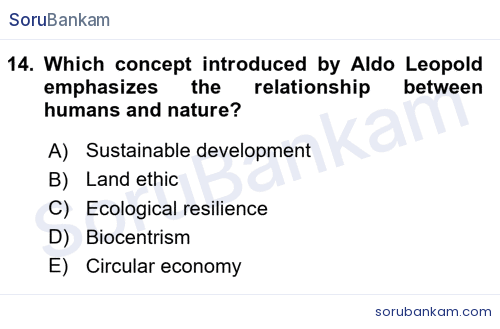
Which concept introduced by Aldo Leopold emphasizes the relationship between humans and nature? A) Sustainable development B) Land ethic C) Ecological resilience D) Biocentrism E) Circular economy
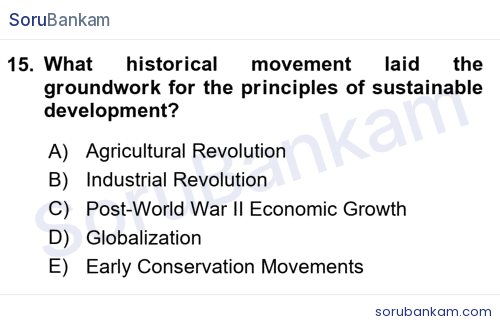
What historical movement laid the groundwork for the principles of sustainable development? A) Agricultural Revolution B) Industrial Revolution C) Post-World War I Economic Growth D) Globalization E) Early Conservation Movements
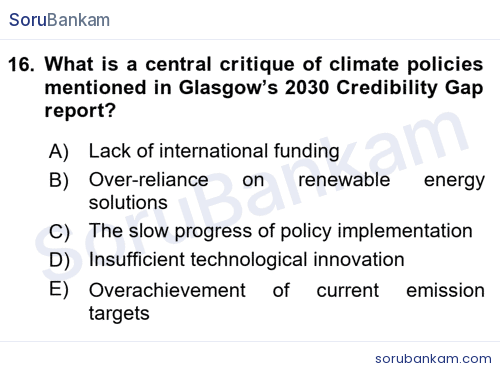
What is a central critique of climate policies mentloned In Glasgow's 2030 Credibility Gap report? A) Lack of international funding B) Over-reliance renewable energy solutions C) The slow progress of policy implementation D) Insufficient technological innovation E) Overachievement of current emission targets
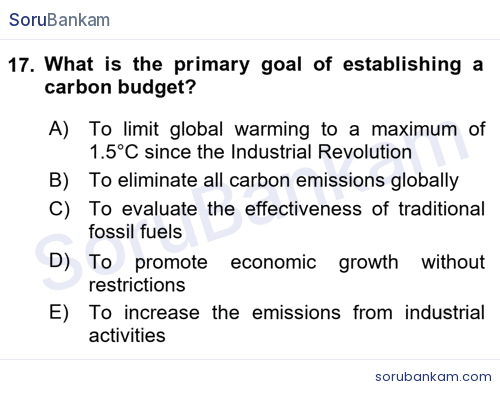
What is the primary goal of establishing a carbon budget? A) To limit global warming to a maximum of 1.5°C since the Industrial Revolution B) To eliminate all carbon emissions globally C) To evaluate the effectiveness of traditional fossil fuels D) To promote economic growth without restrictions E) To increase the emissions from industrial activities
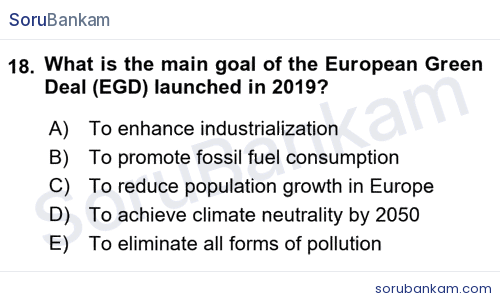
What is the main goal of the European Green Deal (EGD) launched in 2019? A) To enhance industrialization mi, B) To promote fossil fuél consumption C) To reduce population growth in Europe D) To achieve climate neutrality by 2050 E) To eliminate all forms of pollution
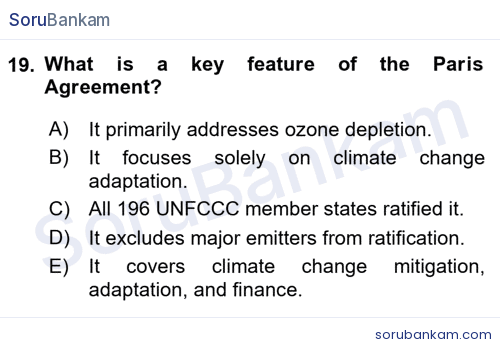
What is a key feature of the Paris Agreement? A) It primarily addresses ozone depletion. B) It focuses solely on climate change adaptation. C) All 196 UNFCCC member states ratified it. D) It excludes major emitters from ratification. E) It covers climate change mitigation, adaptation, and finance.
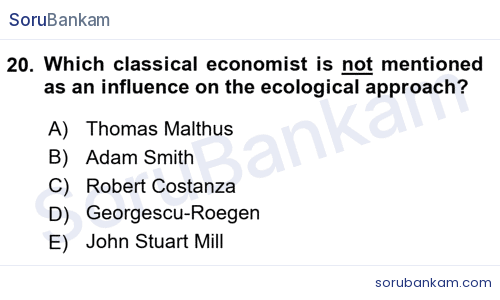
Which classical economist is not mentioned as an influence on the ecological approach? A) Thomas Malthus B) Adam Smith C) Robert Costanza D) Georgescu-Roegen E) John Stuart Mill